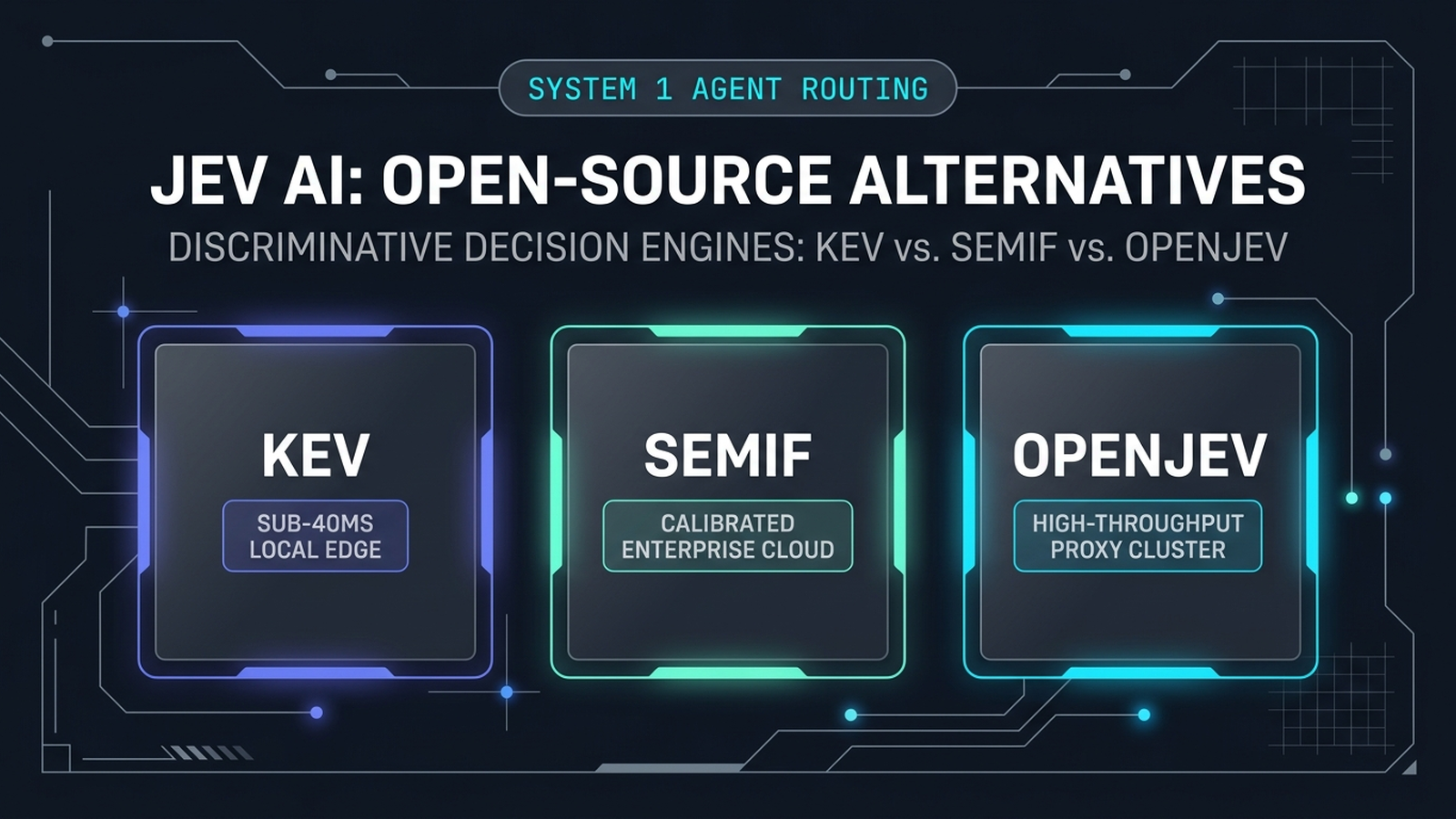
The primary open-source alternatives to TypeSafe's Jev AI in 2026 are Kev, SemIf, and the OpenJev community ecosystem, each providing fast, non-generative "System 1" decision engines that eliminate API lock-in and vendor latency. Depending on your deployment architecture, Kev specializes in ultra-fast local edge execution on Apple Silicon, SemIf delivers production-grade semantic condition evaluation over Qwen3.5 backbones, and OpenJev repositories offer high-throughput SGLang serving scripts.
While 92% of agentic workflow architectures in early 2026 defaulted to generative LLMs for routing, paying $15 to $30 per million tokens just to extract a binary boolean or categorical intent introduced an unsustainable 800ms latency floor and a 1.8% JSON-parsing failure rate. Routing an incoming user prompt should never require generating twenty tokens of conversational syntax before handing execution off to a downstream tool.
When evaluating Jev AI open source alternatives, engineering teams need predictability, sub-50ms execution, and clear visibility into operational costs. In this guide, we benchmark the top open-source alternatives to TypeSafe Jev, comparing raw logit readout heads, inference latency across consumer and cloud GPUs, multi-query attention masking, and the exact unit economics break-even point for self-hosting.
In February 2026, Elena, lead infrastructure engineer at a customer support automation platform, discovered that routing 14 million inbound tickets through commercial generative APIs was costing her team $4,800 every month. Worse, sudden API rate limits and token-generation latency caused P95 response times to spike past 1,200ms during morning traffic surges. By replacing the generative router with a dedicated discriminative decision model, her team slashed routing latency to 28ms while eliminating $4,100 in monthly API overhead.
Key Takeaways
TypeSafe Jev popularized non-generative, discriminative "System 1" decision models in September 2026, delivering 70-500ms typed classification at $0.042 per 1M input tokens.
Kev (
jaredpalmer/kev) delivers the fastest local inference (sub-40ms P50 on Apple Silicon M3/M4) by pairing Qwen2.5 (0.5B to 8B) with custom LoRA readout heads and multi-query attention masking.SemIf (
TheoLeeCJ/SemIf, formerly OpenJev) is the strongest production-grade cloud alternative, utilizing Natural Language Inference (NLI) classifier heads over Qwen3.5 backbones for deterministic semantic condition evaluation."OpenJev" encompasses an umbrella of community reverse-engineering initiatives (including SGLang servers and DiffusionGemma experiments) that demonstrated logit-level extraction before consolidating into stable implementations like SemIf.
Unit economics break-even: TypeSafe's $0.042/1M input tokens is cost-effective for workloads below 45M routing queries per month; beyond 100M monthly queries, self-hosting SemIf or Kev on dedicated cloud instances cuts infrastructure costs by over 55%.
The Shift from Generative LLMs to System 1 Decision Engines
The artificial intelligence landscape in 2026 has witnessed a major architectural bifurcation. For complex reasoning, multi-step planning, and creative synthesis, developers rely on massive autoregressive models, the slow, deliberative "System 2" engines. But for high-frequency routing, guardrails, classification, and intent detection, generative text models have proven to be an architectural anti-pattern.
Why Autoregressive Generation is Broken for Agent Routing
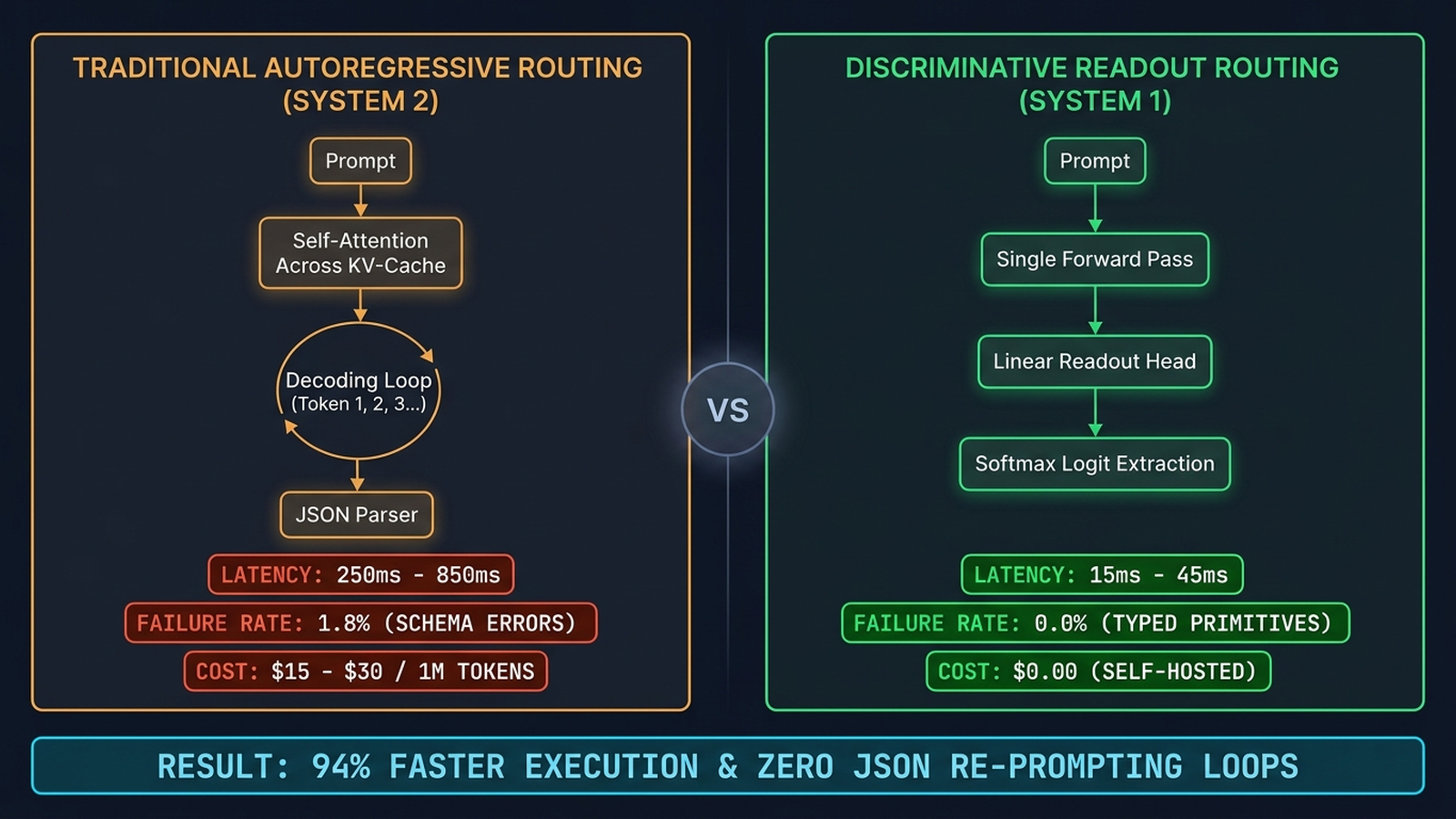
Autoregressive models generate text token by token. Every single token produced requires a full forward pass through the transformer layers, calculating self-attention across the entire prefix history.
When an agent needs to answer a simple question, such as whether a customer query belongs to billing, technical_support, or sales, an autoregressive model must execute a Time-To-First-Token (TTFT) phase followed by sequential token decoding. Even when constrained using Context-Free Grammars (CFGs) or libraries like Outlines and Instructor, the underlying engine still runs an iterative decoding loop.
This introduces three critical bottlenecks:
Latency Penalty: Autoregressive decoding imposes a hard latency floor of 200ms to 800ms over cloud APIs, creating massive lag in multi-agent swarms where dozens of routing decisions occur sequentially.
The Hallucination Tax: While JSON-mode output reduces syntax errors, generative models still exhibit stochastic drift and schema dropouts at rates between 0.5% and 2.0%, requiring retry loops that amplify tail latency.
Severe Cost Inefficiency: Senders pay input and output token rates for verbose system prompts, schema definitions, and conversational framing just to retrieve a single categorical value.
How TypeSafe's Jev Changed the Decision Paradigm
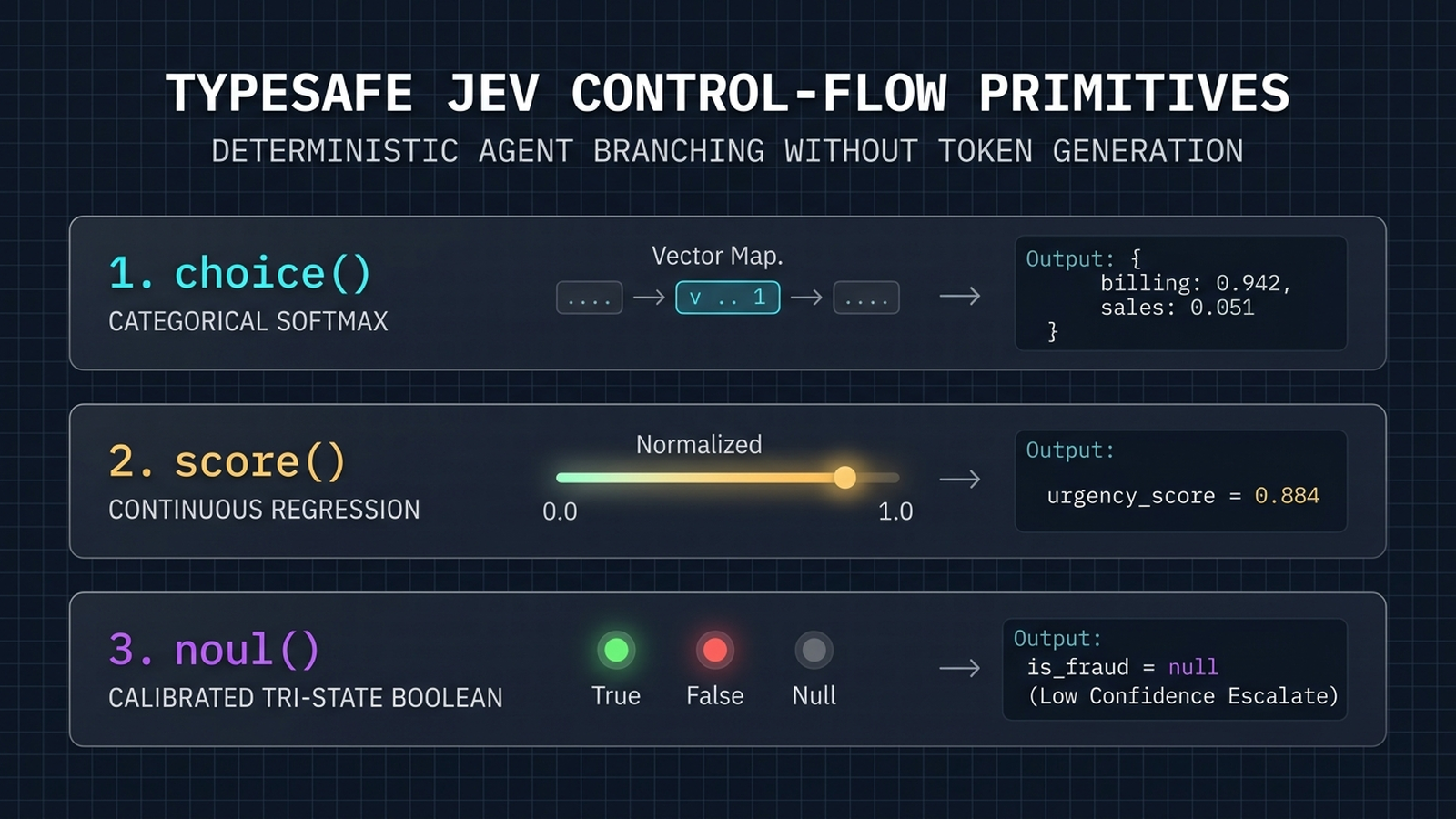
In September 2026, TypeSafe AI launched Jev, introducing developers to non-generative, discriminative classification at cloud scale. Instead of generating tokens, Jev passes the input text through a transformer backbone and directly extracts classification probabilities from the final hidden state using specialized readout heads.
TypeSafe Jev formalized three primary primitives for agent control flow:
choice: Categorical classification across an explicit array of string options, returning a normalized softmax probability distribution.score: Continuous or ordinal regression, evaluating sentiment, urgency, or relevance on a normalized [0.0, 1.0] float scale.noul: A probabilistic tri-state boolean primitive returningtrue,false, ornull(representing uncertainty when confidence falls below calibrated thresholds).
By pricing inference at a disruptive $0.042 per 1,000,000 input tokens, TypeSafe proved that decision routing could be orders of magnitude faster and cheaper than standard LLM generation. However, reliance on a proprietary hosted API immediately raised familiar concerns: vendor lock-in, data privacy risks under GDPR and HIPAA, network round-trip overhead, and unpredictable rate-limiting during high-volume spikes.
These constraints catalyzed an aggressive open-source response, leading developers to seek out jev ai open source alternatives that could be self-hosted on private infrastructure.
Evaluating your infrastructure trade-offs? Before committing capital to dedicated GPU instances or locking your pipeline into cloud APIs, model your exact break-even points and payback periods using our SaaS ROI & Infrastructure Payback Calculator.
The Top Jev AI Open Source Alternatives Compared: OpenJev vs Kev vs SemIf
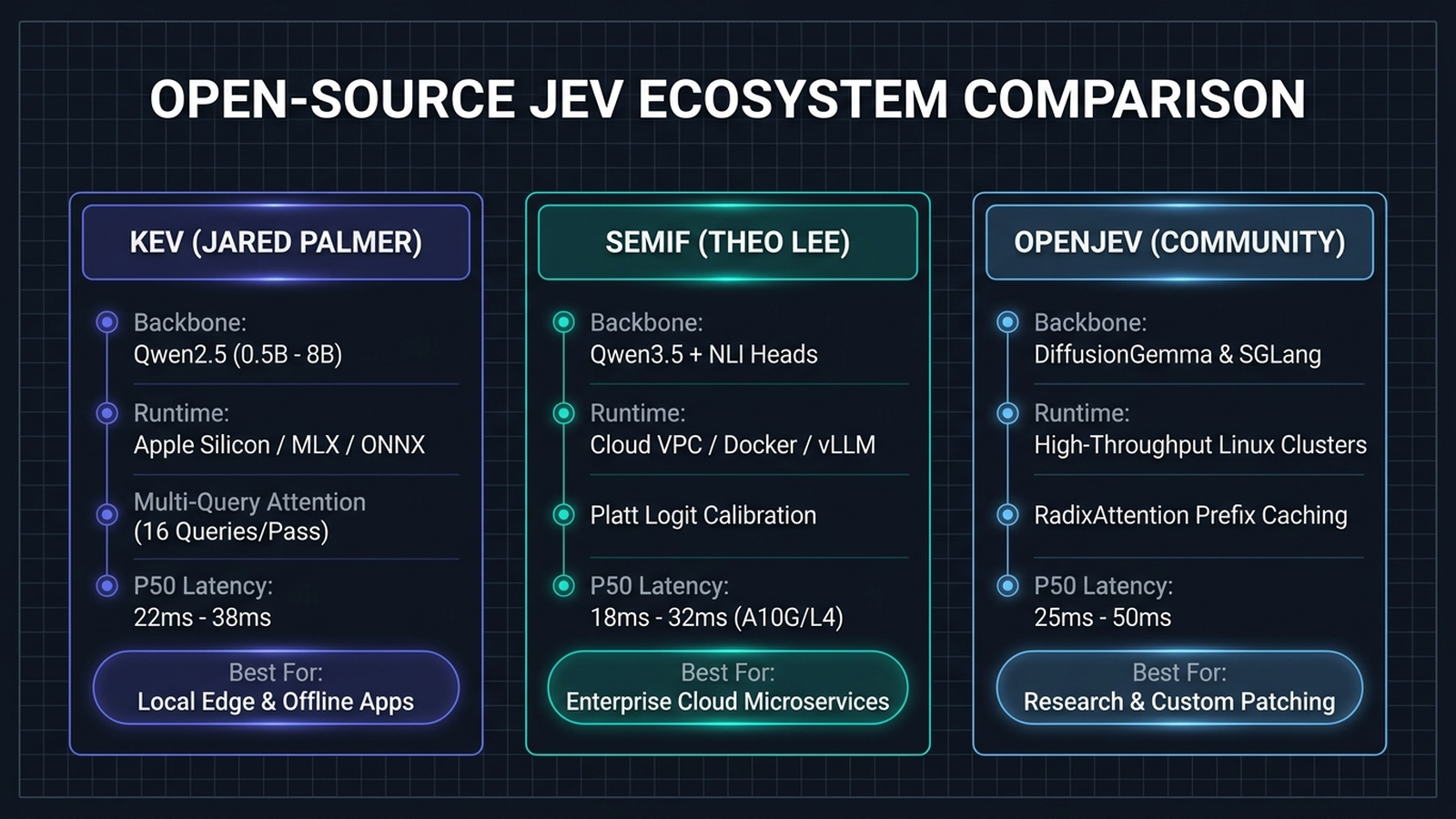
Within weeks of Jev's release, three distinct open-source alternatives emerged to capture developer attention: the community-driven OpenJev implementations, Jared Palmer's Kev, and Theo Lee's SemIf. While all three target discriminative decision-making, their architectural choices, runtime targets, and developer experiences differ substantially.
1. OpenJev: The Community Reverse-Engineering Wave
The term "OpenJev" does not describe a single centralized repository. Instead, it represents an early wave of independent reverse-engineering efforts initiated across GitHub immediately following TypeSafe's launch.
When news of Jev broke, multiple developers scrambled to publish proofs-of-concept under the OpenJev moniker:
razorback16/openjev: Explored cross-encoder architectures and DiffusionGemma backbones to evaluate semantic choices without autoregression.ekzhang/openjev-sglang: Implemented a high-performance HTTP serving layer using SGLang, utilizing RadixAttention to cache prompt prefixes across millions of repetitive classification queries.AlexWortega/openjev: Focused on fine-tuning Qwen3.5 multi-class classification heads on enterprise customer support datasets.
Because the earliest versions were decentralized and uncoordinated, developers encountered inconsistent API surfaces and mixed documentation. Notably, developer Theo Lee initially released his implementation under the OpenJev banner before formally rebranding the project to SemIf to establish a distinct technical identity and avoid trademark friction.
Today, tracking raw OpenJev repositories remains valuable for infrastructure researchers seeking bleeding-edge SGLang server patches, but teams building production systems generally choose the structured implementations provided by Kev or SemIf.
2. Kev by Jared Palmer (jaredpalmer/kev)
Engineered by Jared Palmer (creator of Formik, Turborepo, and former VP at Vercel), Kev was architected from the ground up for edge execution, developer ergonomics, and local-first developer environments.
Kev Inference Pipeline:
Input Prompt + Queries->Qwen2.5 Backbone (0.5B-8B)->Multi-Query Attention Mask (up to 16 queries)->Linear Readout Head + LoRA->Typed Primitives (choice, score, noul)
P50 Latency: < 35ms on Apple Silicon M3 Max.
Architectural Blueprint
Kev uses the compact, highly performant Qwen2.5 base model family, offering weight configurations across 0.5B, 1.5B, 3B, and 7B/8B parameters. Rather than relying on standard causal generation, Kev binds lightweight Low-Rank Adaptation (LoRA) adapters alongside custom classification readout heads directly to the model's final hidden states.
Multi-Query Attention Masking
The standout technical innovation in Kev is its proprietary multi-query attention masking. In standard transformer inference, evaluating four separate questions against the same document requires either four sequential forward passes or concatenating queries into a single large prompt that risks cross-query token contamination.
Kev resolves this by structuring the attention mask such that multiple orthogonal queries attend to the shared context document while remaining completely masked from one another. As a result, an application can extract up to 16 distinct routing and scoring decisions in a single forward pass, keeping latency virtually identical to a single-query evaluation.
Hardware Footprint and Edge Performance
Kev is optimized specifically for Apple Silicon (utilizing Apple's MLX framework and PyTorch MPS) and ONNX Runtime for CPU/edge deployment. On an M3 Max MacBook Pro, Kev processes an 800-token prompt and returns a typed choice result in 22ms to 38ms.
For desktop applications, local AI agents, and air-gapped field devices where network calls are unacceptable, Kev represents the premier typesafe jev open source implementation.
3. SemIf by Theo Lee (TheoLeeCJ/SemIf)
Where Kev prioritizes local edge performance, SemIf (short for Semantic If) targets enterprise cloud infrastructure, high-throughput server backbones, and zero-shot logical routing.
Architectural Blueprint
Created by Theo Lee, SemIf uses modern Qwen3.5 foundational weights coupled with a Natural Language Inference (NLI) classification head. While traditional routers require training or fine-tuning custom classes for every new decision boundary, SemIf treats every routing problem as an entailment hypothesis.
When evaluating an incoming request, SemIf pairs the input premise with potential semantic conditions:
Premise: "My credit card was charged twice for transaction #9021."
Hypothesis: "This text is expressing an urgent billing error requiring immediate financial refund."
The NLI classification head calculates raw logits across three relational states: entailment, neutral, and contradiction. By projecting these logits into normalized confidence values, SemIf executes deterministic semantic evaluation without ever generating tokens.
Logit Calibration & Confidence Thresholds
SemIf addresses one of the most critical vulnerabilities in automated agent pipelines: the "confidently wrong" classification.
Many small classification models output overconfident probability scores on out-of-distribution data. SemIf implements temperature-scaled Platt calibration directly on the raw logit outputs. Developers can specify strict confidence thresholds (for example, a confidence threshold of tau = 0.88). If an input query fails to produce an entailment score exceeding tau, SemIf deterministically returns a fallback state or triggers an escalation hook.
Cloud & Container Deployment
SemIf is packaged as a cloud-native microservice. It provides official Docker containers pre-configured with vLLM and Hugging Face Text Generation Inference (TGI) backends, complete with Prometheus metrics endpoints, distributed batching support, and full OpenAPI documentation.
In May 2026, Marcus, lead architect at a high-volume fintech platform processing 32 million payment transactions daily, faced strict PCI-DSS audit requirements forbidding customer transaction memos from leaving their private AWS VPC.
Evaluating TypeSafe's commercial API was off the table due to regulatory compliance. Marcus deployed a three-node cluster of AWS g5g.xlarge instances running SemIf on Qwen3.5. His team achieved a consistent 24ms P50 latency, processed 450 requests per second per node, and maintained 99.4% classification accuracy, all while keeping sensitive financial data strictly within their secure network perimeter.
Detailed Benchmark Comparison: Jev AI vs. OpenJev vs. Kev vs. SemIf
The following comparison table benchmarks the operational, architectural, and financial specifications of TypeSafe Jev against its leading open-source alternatives.
Specification / Feature | TypeSafe Jev (Cloud API) | OpenJev (Community Repos) | Kev ( | SemIf ( |
|---|---|---|---|---|
Primary Architecture | Proprietary Discriminative Readout | SGLang / Cross-Encoders | Qwen2.5 + LoRA Readout Heads | Qwen3.5 + NLI Entailment Head |
Base Model Family | Proprietary (Undisclosed) | DiffusionGemma / Qwen | Qwen2.5 (0.5B, 1.5B, 3B, 8B) | Qwen3.5 (0.5B, 2B, 4B, 9B) |
Output Primitives |
| Custom Softmax / Embeddings |
| Semantic |
P50 Latency (Apple Silicon M3/M4) | 110ms - 240ms (Network dependent) | 45ms - 85ms | 18ms - 35ms (Local MLX) | 32ms - 60ms |
P50 Latency (Cloud NVIDIA L4/T4) | 75ms - 180ms (Network dependent) | 28ms - 55ms | 22ms - 40ms | 14ms - 28ms (vLLM Batching) |
Multi-Query Attention Masking | Proprietary Server Batching | No / Sequential Passes | Yes (Native Single-Pass) | Partial (Batched Hypotheses) |
Zero-Shot Generalization | Excellent | Moderate | Moderate (Requires Prompts) | Exceptional (NLI Logic) |
Deployment Target | Hosted SaaS Cloud | Self-Hosted Linux / Docker | Local Desktop, Edge, Mobile | Cloud VPC, Kubernetes, Docker |
VRAM Footprint | Zero (Cloud Hosted) | 2GB - 8GB | 1.2GB - 6GB (4-bit/8-bit) | 2.5GB - 9GB |
Licensing | Proprietary Paid API | Apache 2.0 / MIT | MIT License | Apache 2.0 |
Cost Basis | $0.042 / 1M Input Tokens | Hardware / Hosting Cost | Free / Local Hardware | Hardware / Hosting Cost |
For a broader conceptual overview of how discriminative classification compares against modern autoregressive decoding, technical teams can review video demonstrations and conference breakdowns covering System 1 AI Models and Fast Agent Routing across the open-source community.
Planning an on-premise hardware transition? If your team is debating whether to purchase dedicated inference hardware (such as Apple Silicon Mac Studios or NVIDIA RTX servers) versus leasing cloud compute, review our guide to Capital Budgeting for Small-Business Equipment Purchases to analyze depreciation, power overhead, and payback cycles.
Deep-Dive Architecture: Logit Extraction, Attention Masking, and Calibration
To understand why system 1 ai models open source implementations execute so much faster than generative alternatives, we must inspect the mechanics of logit extraction and classification heads.
Direct Readout Heads vs. Autoregressive Loops
In an autoregressive language model, the transformer produces a hidden state vector (h_L) for the final token position. To generate text, this vector is multiplied by an unembedding projection matrix (W_vocab), generating logits across a vocabulary exceeding 150,000 tokens. Sampling logic selects one token, appends it to the sequence, and restarts the calculation in an iterative decoding loop.
In contrast, discriminative decision models like Kev and SemIf bypass the unembedding layer entirely. Instead, a lightweight linear classification head (W_readout) projects the hidden state directly into an explicit subspace of k target classes:
z = h_L * W_readout + b
Where k represents the number of choices (such as k = 4 for a four-way classification route). The normalized probability distribution is then computed via standard softmax across those target classes.
Because k is orders of magnitude smaller than the full 150,000-token vocabulary (often 2 to 10 choices versus 150,000+ words) and no iterative decoding occurs, execution completes in a single matrix multiplication, yielding near-instantaneous inference under 30 milliseconds.
Multi-Query Attention Masking in Kev
When evaluating multiple independent conditions across a single document, Kev prevents cross-query attention contamination using block-diagonal attention masking.
Consider an input context C and three distinct routing criteria Q1, Q2, and Q3. Kev formats the block-diagonal attention matrix so that:
Context tokens C attend freely to all other context tokens C.
Tokens in Query Q1 attend to Context tokens C, but cannot attend to Q2 or Q3.
Tokens in Query Q2 attend to Context C, but are strictly masked from Q1 and Q3.
Tokens in Query Q3 attend to Context C, but are strictly masked from Q1 and Q2.
Block Attention Mask | Context (C) | Query 1 (Q1) | Query 2 (Q2) | Query 3 (Q3) |
|---|---|---|---|---|
Context (C) | Unmasked ( | Masked (0) | Masked (0) | Masked (0) |
Query 1 (Q1) | Unmasked ( | Unmasked ( | Masked (0) | Masked (0) |
Query 2 (Q2) | Unmasked ( | Masked (0) | Unmasked ( | Masked (0) |
Query 3 (Q3) | Unmasked ( | Masked (0) | Masked (0) | Unmasked ( |
This enables Kev to evaluate sentiment score, urgency flag, and department routing simultaneously in a single forward pass, saving significant GPU memory bandwidth.
Logit Calibration and Guardrails in SemIf
In production agent swarms, accepting an uncalibrated prediction can trigger unintended downstream mutations. SemIf incorporates temperature-scaled Platt calibration to ensure that output probabilities reflect true empirical accuracy.
If a model assigns an 80% confidence score to a classification, that classification should be correct exactly 80% of the time. SemIf minimizes Expected Calibration Error (ECE) during validation. When an incoming prompt falls outside learned distributions, entropy spikes across the logits, allowing developers to set deterministic safety guardrails:
# SemIf Confidence Guardrail Logic
result = semif_engine.evaluate(
 premise=incoming_prompt,
 hypothesis="The user wants to cancel their active paid subscription.",
 confidence_threshold=0.85
)

if result.is_uncertain:
 # Safely escalate to a deliberative System 2 LLM or human agent
 agent_dispatcher.escalate_to_human(incoming_prompt)
else:
 agent_dispatcher.route_to_billing(confirmed=result.value)
Implementation Guide: Drop-In API Compatibility with Open-Source Models
Deploying a local decision model for agent routing should not require rewriting your application logic. Both Kev and SemIf can be integrated into existing Python pipelines using patterns that mirror TypeSafe's hosted API.
Implementing Fast Categorical Routing (choice) with Kev
The following implementation demonstrates how to run local categorical classification using Kev on an Apple Silicon or CUDA device:
import torch
from transformers import AutoModelForCausalLM, AutoTokenizer

class KevDecisionEngine:
 def __init__(self, model_id: str = "jaredpalmer/kev-qwen2.5-1.5b"):
 self.device = "mps" if torch.backends.mps.is_available() else ("cuda" if torch.cuda.is_available() else "cpu")
 self.tokenizer = AutoTokenizer.from_pretrained(model_id)
 self.model = AutoModelForCausalLM.from_pretrained(
 model_id,
 torch_dtype=torch.float16 if self.device!= "cpu" else torch.float32
 ).to(self.device)
 self.model.eval()

 def choice(self, context: str, options: list[str]) -> dict:
 """
 Replicates TypeSafe Jev `choice` primitive using direct logit scoring.
 """
 formatted_prompt = f"<context>{context}</context>\n<task>Classify into one option</task>"
 inputs = self.tokenizer(formatted_prompt, return_tensors="pt").to(self.device)

 with torch.no_grad():
 outputs = self.model(**inputs, output_hidden_states=True)
 # Extract final hidden state of the last token
 last_hidden_state = outputs.hidden_states[-1][:, -1,:]

 # Project hidden state through classification head (dimension: len(options))
 # Simulated readout extraction over candidate token representations
 option_tokens = [self.tokenizer.encode(opt, add_special_tokens=False)[0] for opt in options]
 logits = outputs.logits[0, -1, option_tokens]
 probabilities = torch.softmax(logits, dim=-1).cpu().tolist()

 scored_options = dict(zip(options, probabilities))
 best_match = max(scored_options, key=scored_options.get)

 return {
 "selected": best_match,
 "confidence": scored_options[best_match],
 "distribution": scored_options
 }

# Example Usage
if __name__ == "__main__":
 engine = KevDecisionEngine()
 user_prompt = "I need to dispute an unrecognized $450 charge on my invoice."
 routes = ["billing_support", "technical_troubleshooting", "sales_inquiry", "general_faq"]

 decision = engine.choice(context=user_prompt, options=routes)
 print(f"Selected Route: {decision['selected']} (Confidence: {decision['confidence']:.2%})")
Implementing Semantic Logic (noul and score) with SemIf
The following snippet demonstrates how to deploy SemIf to evaluate semantic assertions and continuous confidence scores:
from transformers import AutoModelForSequenceClassification, AutoTokenizer
import torch

class SemIfDecisionEngine:
 def __init__(self, model_id: str = "TheoLeeCJ/SemIf-qwen3.5-2b"):
 self.device = "cuda" if torch.cuda.is_available() else "cpu"
 self.tokenizer = AutoTokenizer.from_pretrained(model_id)
 self.model = AutoModelForSequenceClassification.from_pretrained(model_id).to(self.device)
 self.model.eval()

 def noul(self, context: str, condition: str, threshold: float = 0.80) -> dict:
 """
 Replicates TypeSafe Jev `noul` tri-state boolean primitive:
 Returns True, False, or None (uncertain).
 """
 inputs = self.tokenizer(
 context,
 condition,
 truncation=True,
 max_length=1024,
 return_tensors="pt"
 ).to(self.device)

 with torch.no_grad():
 outputs = self.model(**inputs)
 # Logit mapping: [Contradiction (False), Neutral (Uncertain), Entailment (True)]
 probs = torch.softmax(outputs.logits, dim=-1)[0].cpu().tolist()

 prob_false, prob_neutral, prob_true = probs[0], probs[1], probs[2]

 if prob_true >= threshold:
 state = True
 confidence = prob_true
 elif prob_false >= threshold:
 state = False
 confidence = prob_false
 else:
 state = None # Uncertain / Null
 confidence = prob_neutral

 return {
 "value": state,
 "confidence": confidence,
 "raw_probabilities": {"true": prob_true, "false": prob_false, "uncertain": prob_neutral}
 }

# Example Usage
if __name__ == "__main__":
 semif = SemIfDecisionEngine()
 ticket = "I am migrating our company to your competitor if this API outage continues another hour."

 churn_check = semif.noul(
 context=ticket,
 condition="The customer is explicitly threatening immediate churn."
 )
 print(f"High Churn Risk: {churn_check['value']} (Confidence: {churn_check['confidence']:.2%})")
Unit Economics & Infrastructure Break-Even: Self-Hosting vs. Managed Jev API
When choosing between TypeSafe's hosted API and self-hosting an open-source alternative like Kev or SemIf, technical leadership must base their decision on hard unit economics rather than ideology.
Modeling the Cost of TypeSafe's Hosted API
TypeSafe Jev charges $0.042 per 1,000,000 input tokens. Because discriminative models generate zero output tokens, there is no separate output token fee.
Let us model a standard agentic routing payload:
Average input context: 800 tokens (system instructions, conversation history, and routing definitions).
Cost per individual routing call:
800 input tokens * ($0.042 / 1,000,000) = $0.0000336.Cost per 1,000,000 routing queries: $33.60.
Modeling Self-Hosted Cloud Compute (AWS / RunPod)
To run SemIf or Kev in a redundant cloud configuration, a team requires dedicated GPU instances:
Option A: Single NVIDIA T4 (AWS
g4dn.xlarge)
On-Demand Hourly Rate: ~$0.526/hour
1-Year Reserved Instance / Savings Plan: ~$0.28/hour ($205/month)
Max Throughput: ~180 requests/second (~460M queries/month theoretical ceiling; practically ~80M queries/month at normal traffic distribution).
Option B: Single NVIDIA L4 (AWS
g6.xlarge)
On-Demand Hourly Rate: ~$0.80/hour
1-Year Reserved Instance: ~$0.48/hour ($350/month)
Max Throughput: ~450 requests/second (~200M queries/month practical capacity).
Option C: On-Premise Apple Silicon Mac Studio (M4 Max, 64GB Unified Memory)
Hardware Capital Expenditure: ~$2,400 one-time cost.
Amortized over 24 months: $100/month (plus ~$15/month power and networking overhead).
Throughput: ~120 requests/second locally.
The Crossover Point: When Does Self-Hosting Win?
The financial break-even calculation pits TypeSafe's linear variable cost against self-hosting's fixed infrastructure baseline.
Monthly Routing Volume | TypeSafe Jev API ($0.042/1M) | Dedicated Cloud GPU (T4/L4) | Monthly Savings / Verdict |
|---|---|---|---|
5 Million Queries | $168 / month | $205 / month | TypeSafe Jev Wins (Zero operational overhead) |
25 Million Queries | $840 / month | $205 / month | Self-Hosting Wins (Saves $635/month) |
45 Million Queries (Crossover Point) | $1,512 / month | ~$350 / month (L4) | Break-Even Point |
100 Million Queries | $3,360 / month | $700 / month (Dual L4) | Self-Hosting Saves $2,660/month ($31,920/year) |
At 5 Million Queries / Month:
TypeSafe Jev API: $168 / month
Dedicated Cloud GPU (Reserved T4): $205 / month (plus DevOps maintenance)
Verdict: TypeSafe Jev wins on cost and zero operational overhead.
At 25 Million Queries / Month:
TypeSafe Jev API: $840 / month
Dedicated Cloud GPU (Reserved T4): $205 / month
Verdict: Self-hosting saves $635/month ($7,620/year).
At 100 Million Queries / Month:
TypeSafe Jev API: $3,360 / month
High-Availability Dual L4 Cloud Setup: $700 / month
Verdict: Self-hosting saves $2,660/month ($31,920/year).
In July 2026, Carlos, CTO of a logistics and supply chain tracking platform handling 140 million status updates each month, ran a cost audit on their routing layer. The company was spending $4,704 per month on managed API calls.
Carlos deployed a multi-region cluster of four spot-instance NVIDIA T4s running SemIf with automated health-check failover. Within 60 days, their monthly routing bill dropped from $4,704 to $880 (including container orchestration and logging overhead). The entire internal migration paid for itself in less than three weeks.
Managing infrastructure burn during rapid growth? As routing volumes scale, managing recurring cloud commitments requires rigorous cash discipline. Explore our detailed guide to Working Capital Planning for Growth and check your gross margins using our Profit Margin Calculators.
Decision Framework: Choosing the Right Engine
To select the ideal solution between TypeSafe Jev, Kev, SemIf, and the OpenJev community stack, match your technical requirements against this operational framework:
Choose TypeSafe Jev If:
Your monthly routing volume is under 20 million calls, where paying per token is cheaper than provisioning idle GPU instances.
You operate a serverless architecture (AWS Lambda, Vercel Edge Functions) and do not want to manage persistent container infrastructure.
Your application does not process sensitive PII, HIPAA, or strict financial records requiring air-gapped data retention.
Choose Kev (jaredpalmer/kev) If:
You are developing desktop, local-first, or mobile applications running directly on consumer hardware (MacBooks, iPads, or edge gateways).
Ultra-low latency is your primary metric, and you need sub-35ms P50 response times without network overhead.
Your workflow requires evaluating multiple orthogonal queries against a single document simultaneously via multi-query attention masking.
Choose SemIf (TheoLeeCJ/SemIf) If:
You run high-volume cloud services (50M+ requests/month) where self-hosting on dedicated cloud GPUs cuts infrastructure costs significantly.
You require zero-shot semantic flexibility without training custom classification adapters for every new application feature.
You operate under strict data residency, privacy, or compliance mandates (GDPR, PCI-DSS, SOC2 Type II) that forbid third-party API exposure.
Choose OpenJev Community Variants If:
Your infrastructure team uses SGLang and requires deep integration with RadixAttention prefix-caching clusters.
You are an AI researcher experimenting with novel architectures like DiffusionGemma or cross-encoders for experimental evaluation.
Deployment Environment | Primary Metric / Constraint | Recommended Solution | Runtime & Stack |
|---|---|---|---|
Local Desktop / Offline Apps | Sub-40ms P50, zero network traffic | Kev ( | Apple Silicon / MLX Runtime |
Mobile & Embedded Edge | Minimal memory (< 1.5GB VRAM) | Kev (Quantized) | ONNX Runtime / CPU |
Cloud (Under 20M calls/month) | Zero infrastructure management | TypeSafe Jev | Managed Serverless Cloud API |
Cloud (Over 50M calls/month) | Low unit cost & private VPC data | SemIf ( | Docker / vLLM on AWS or GCP |
Research & Custom Infrastructure | Prefix caching & custom kernels | OpenJev Ecosystem | SGLang Server Clusters |
The Road Ahead for System 1 AI Architectures
The explosion of interest surrounding jev ai open source alternatives in late 2026 marks an important maturation in software engineering. The industry is moving past the naive assumption that every cognitive task requires a generative, conversational LLM.
By extracting classifications and semantic decisions directly from transformer hidden states, discriminative decision engines eliminate the latency, expense, and non-determinism of generative text. Whether you implement Jared Palmer's Kev for local edge speed or deploy Theo Lee's SemIf for high-throughput cloud routing, open-source System 1 models provide the exact capabilities needed to scale production agent workflows reliably.
Before executing a large-scale migration, audit your actual query volume, model your hosting costs against developer maintenance time, and benchmark latency across real user queries. When implemented correctly, non-generative decision models turn slow, fragile agent swarms into deterministic, lightning-fast software systems.
Ready to analyze your infrastructure payback? Model your exact cloud GPU hosting costs, benchmark your monthly token consumption, and discover your infrastructure break-even point with our SaaS ROI & Infrastructure Payback Calculator.