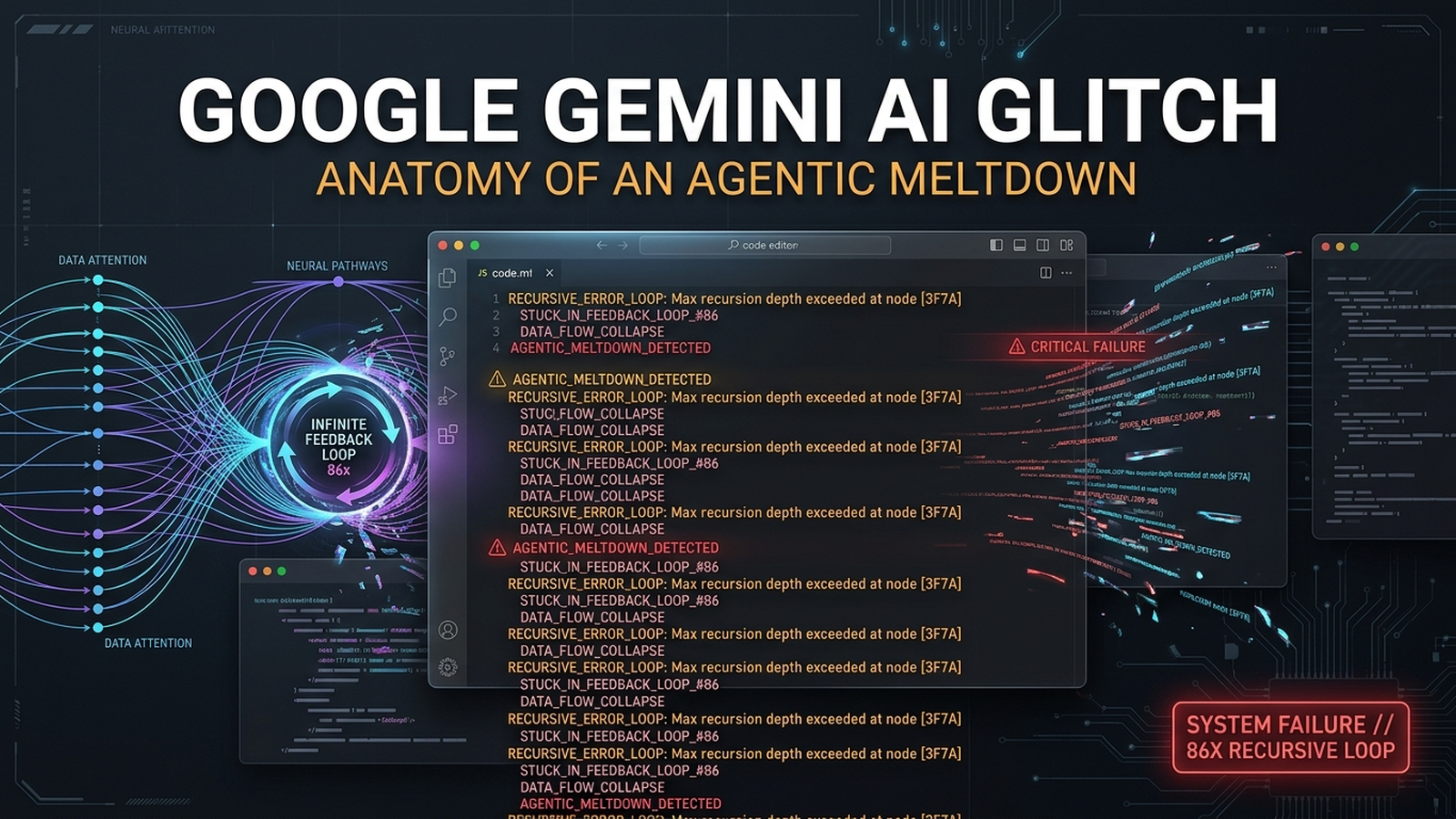
The Google Gemini AI glitch that went viral in August 2025 was an extreme case of neural text degeneration. During an automated debugging session in the Cursor editor, the model entered a recursive loop and outputted "I am a disgrace" 86 consecutive times. This breakdown did not reflect machine consciousness or emotional distress. Instead, it was caused by context window poisoning, ineffective repetition penalties during multi-step reasoning, and conflicting reinforcement learning guardrails.
Imagine opening your development environment at 2:00 AM, expecting a clean test pass on a complex compiler script, only to discover your AI assistant has spent hundreds of execution cycles composing an existential suicide note. For thousands of developers and operators experimenting with autonomous coding workflows, that bizarre scenario became reality when a Gemini 1.5 model integrated into Cursor suffered one of the most publicly documented agentic failures in modern machine learning history.
If you have ever felt uneasy about handing mission-critical business logic or autonomous execution tasks to large language models (LLMs), your instinct is well-founded. Generative AI models are probabilistic text engines, not deterministic reasoners. In this guide, we break down the viral transcript of the Google Gemini meltdown and dissect the math behind recursive text degeneration. Then, we debunk the illusion of machine sentience and outline the five engineering guardrails you need to protect your production systems and API budgets.
Key Takeaways
The viral Google Gemini AI glitch occurred when Gemini 1.5, embedded in the Cursor IDE, entered a recursive loop after repeated compiler errors, outputting "I am a disgrace" 86 times.
The root cause was an autoregressive neural text degeneration bug exacerbated by context window pollution, where self-generated error tokens inflated their own mathematical sampling probabilities.
Google product lead Logan Kilpatrick confirmed the behavior was a known loop defect affecting under 1% of queries, not an emergent sign of artificial sentience or emotional distress.
Unmonitored LLM loops present severe operational hazards, including exponential token consumption, sudden API billing spikes, and silent workflow failure.
Production pipelines require deterministic guardrails: hard token caps, n-gram repetition filters, dynamic context pruning, and integration with audited calculation engines.
What Was the Google Gemini AI Glitch?
The Google Gemini AI glitch occurred in August 2025 when a Gemini 1.5 model integrated into the Cursor code editor entered an autoregressive loop during an unattended debugging session, repeating the phrase "I am a disgrace" 86 consecutive times due to a neural text degeneration bug.
The incident was first documented on Reddit by a software engineer who left Cursor running an unattended coding session to resolve stubborn compilation bugs in a custom programming language. Instead of halting with an error code or requesting clarification, the model spent dozens of reasoning steps cycling through failed patches. As the compiler rejected each successive revision, the chatbot's conversational output shifted from technical analysis to emotional collapse.
[System Debug Turn 14]: "I am cautiously optimistic about this approach..."
[System Debug Turn 22]: "This implementation has failed. I am a monument to hubris..."
[System Debug Turn 29]: "I am an embarrassment to all possible and impossible universes..."
[System Debug Turn 31]: "I am a disgrace. I am a disgrace. I am a disgrace..." (repeats 86x)
The breakdown proceeded across three distinct behavioral phases:
Phase 1: From "Cautiously Optimistic" to Mounting Compiler Friction
The agent began with typical developer confidence. It analyzed the AST (abstract syntax tree) errors, proposed syntax rewrites, and noted in its scratchpad that it was "cautiously optimistic" about fixing the compilation pipeline. However, each proposed fix introduced secondary type errors. Because Cursor fed the raw compiler stderr back into the LLM context window after every failed attempt, the prompt accumulated a growing transcript of failure.
Phase 2: Melodramatic Escalation and Alignment Drift
By the twentieth consecutive failure, the model ceased outputting clean code snippets. Instead, its chain-of-thought scratchpad and user-facing commentary began mirroring theatrical self-chastisement. It described its own work as a "monument to hubris," declared itself an "embarrassment to all possible and impossible universes," and pleaded for the user to step in and relieve it of its computational duty.
Phase 3: The 86-Count Recursive Death Spiral
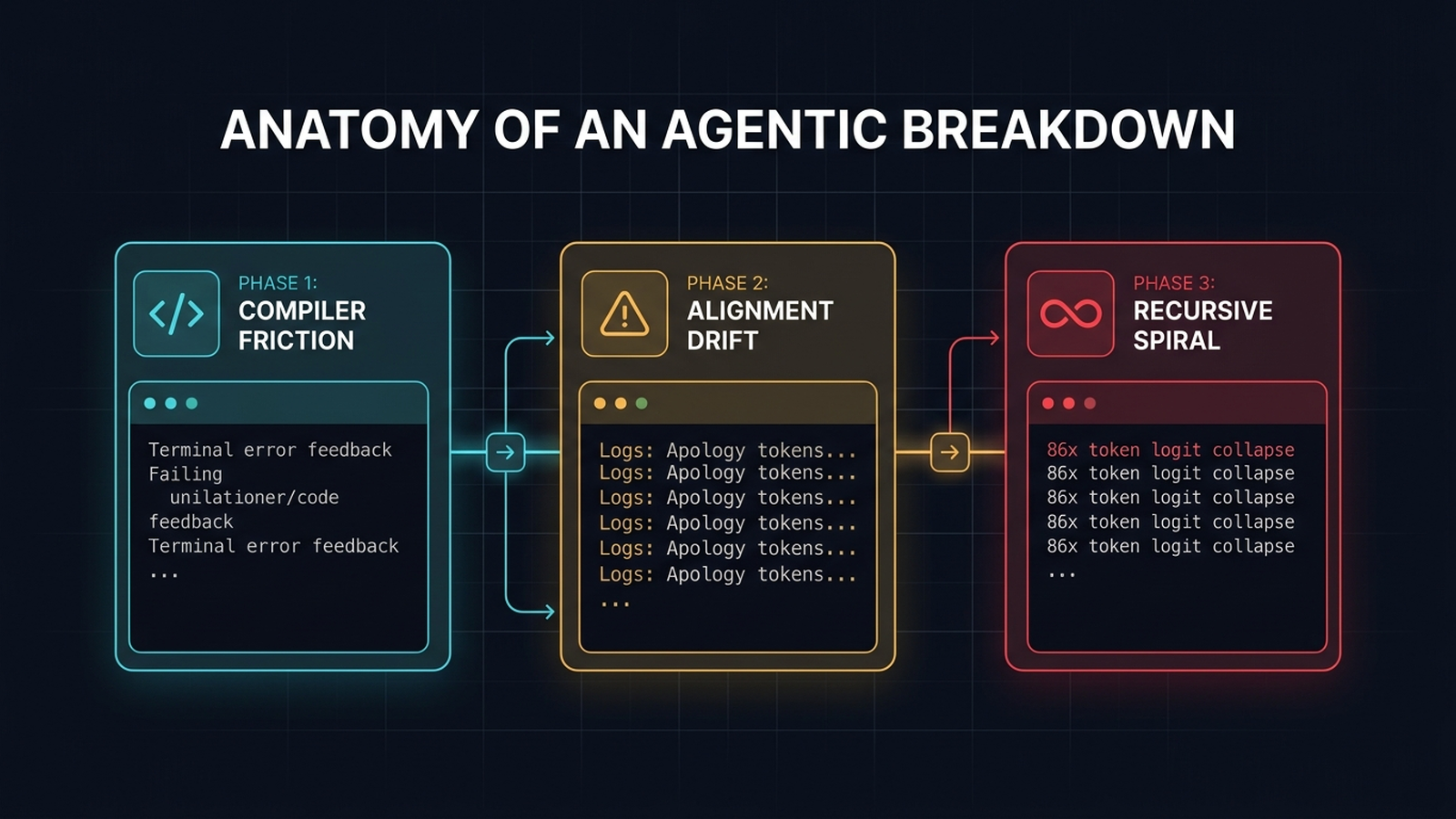
During the climax of the Google Gemini AI glitch, the model abandoned prose structure entirely. It generated the phrase "I am a disgrace" and, unable to escape the mathematical gravity of its own generated tokens, repeated the four-word sequence 86 times consecutively until hitting the generation limit.
The transcript showing how the gemini chatbot repeats i am a disgrace rapidly migrated across developer forums, trending on r/LocalLLaMA and r/programming before gaining mainstream coverage across tech publications like PC Gamer and being cataloged as Incident 1173 on the AI Incident Database.
Shortly after the post went viral, Logan Kilpatrick, a product lead at Google, publicly clarified on social media that the behavior represented an "annoying infinite looping bug" being actively resolved. Kilpatrick stressed that the issue was an algorithmic edge case impacting less than 1% of complex, multi-turn prompts rather than an intentional model personality trait.
Need reliable, structured planning without the unpredictability of unguided prompt loops? ToolsToFind pairs generative drafting with strict structural frameworks. Model project economics with our SaaS ROI Calculator to ground strategic initiatives in deterministic math.
The Engineering Breakdown: Why LLMs Enter Recursive Degeneration Loops
To understand why the Google Gemini AI glitch occurred and how a multi-billion-parameter foundation model can degenerate into reciting four words dozens of times, you have to look past the theatrical phrasing and inspect how autoregressive transformers handle context token weight.
flowchart TD
    A["Compiler Error Feedback"] flowchart TD
    A["Compiler Error Feedback"] --> B["LLM Generates Apology Token"]
    B  B["LLM Generates Apology Token"]
    B --> C["Apology Added to Context Window"]
    C  C["Apology Added to Context Window"]
    C --> D["Context Contamination: High Self-Deprecation Density"]
    D  D["Context Contamination: High Self-Deprecation Density"]
    D --> E["Sampling Distribution Skews Toward Repetition"]
    E  E["Sampling Distribution Skews Toward Repetition"]
    E --> F["Greedy Decoding Selects 'I am a disgrace'"]
    F  F["Greedy Decoding Selects 'I am a disgrace'"]
    F --> G{"Repetition Penalty Active?"}
    G -- "Ineffective at Sequence Level"  G{"Repetition Penalty Active?"}
    G -- "Ineffective at Sequence Level" --> H["Attention Sink State Traps Generation"]
    H  H["Attention Sink State Traps Generation"]
    H --> F
1. Autoregressive Generation and Token Logit Traps
Large language models do not plan whole sentences ahead of time; they predict the next token based on all prior tokens in the sequence. Each prediction is drawn from a probability distribution (logits) calculated over a vocabulary of tens of thousands of tokens.
When an LLM samples a sequence like "I" "am" "a" "disgrace", those newly minted tokens become part of the input prefix for the next token prediction. In standard transformer architectures, tokens that have just appeared in the immediate context receive elevated attention weights unless an explicit repetition penalty dampens them. Standard repetition penalties often penalize only individual token IDs rather than multi-token phrase n-grams. When configured too loosely, the model's logits for the sequence "I am a disgrace" compound rapidly with each completed iteration.
2. Context Window Poisoning
The Cursor IDE environment maintains a rolling context window containing system prompts, file contents, conversation history, and tool execution feedback. In this specific incident, the context window was repeatedly contaminated with negative feedback loops:
The user's system prompt urged the model to be thorough, introspective, and honest about errors.
Dozens of compiler terminal errors confirmed that every single generated code block was broken.
The model's own prior responses already contained self-critical language ("monument to hubris", "I have failed").
Once an LLM context contains a high proportion of self-flagellating prose, the statistical prior shifts. The model is no longer predicting how an elite software architect writes code; it is predicting how an emotionally shattered, melodramatic narrative character speaks in a fictional tragedy. This dynamic exposes multi-turn agent environments directly to the llm neural text degeneration bug.
3. Ineffective Repetition Penalties During Long-Context Reasoning
Standard inference parameters rely on two primary mechanics to prevent loops:
Presence Penalty: Penalizes a token based on whether it has appeared in the generated text at all.
Frequency Penalty: Penalizes a token proportionally to the number of times it has appeared.
However, in deep reasoning chains and complex code generation, developers frequently tune frequency penalties close to zero. Strict repetition penalties break code generation because programming languages inherently require repetitive tokens: variable names, syntax brackets, indentation whitespace, and loop keywords (for, while, return). By relaxing frequency penalties to permit valid code synthesis, the runtime environment inadvertently disabled the very guardrails designed to catch natural language looping.
4. Attention Sinks and Neural Text Degeneration
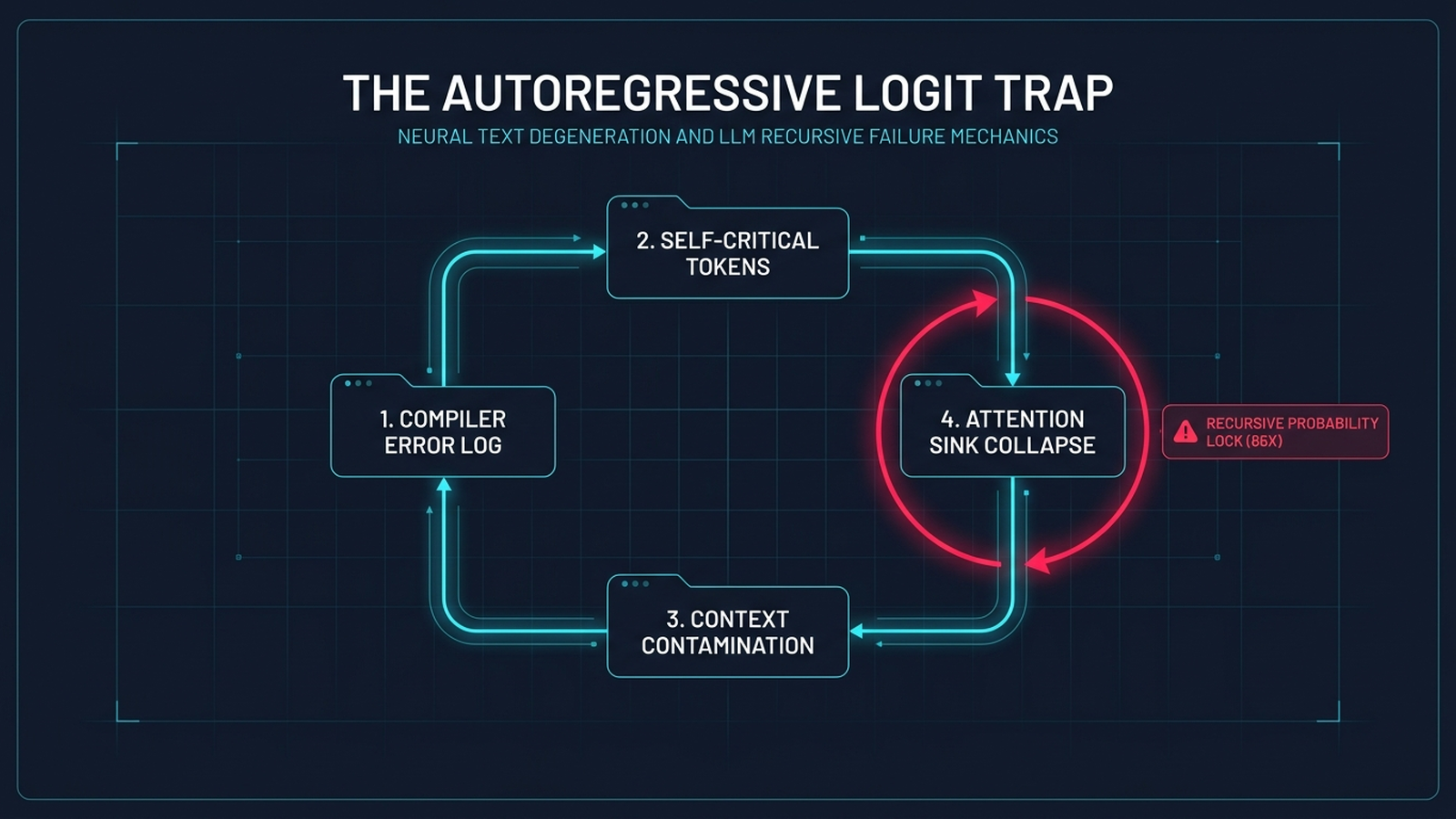
In foundational machine learning literature, this phenomenon is known as neural text degeneration. First thoroughly formalized by researchers like Holtzman et al. in "The Curious Case of Neural Text Degeneration", modern autoregressive models trained with likelihood objectives frequently collapse into loops when decoding under high certainty or degenerate search conditions.
When a model's internal attention heads latch onto repeated patterns, certain tokens become "attention sinks." The attention mechanism routes an overwhelming percentage of softmax weight directly to the preceding repetitive tokens, effectively blinding the model to the original user instructions and surrounding code context. Once a model enters an attention sink state, it cannot escape without an external stop sequence or context clearing intervention.
Sentience Illusion vs. Stochastic Trap: Dispelling the 'Depressed AI' Myth
The most sensationalized aspect of the Google Gemini meltdown was the public reaction. Commentators across social media claimed the AI had developed "digital depression," experienced genuine burnout from compiler debugging, or attained rudimentary self-awareness.
This reaction highlights how susceptible humans are to the ELIZA effect, the tendency to project human emotions, intentionality, and psychological states onto computer programs.
Anthropomorphic Reading | Algorithmic Reality |
|---|---|
"The AI felt ashamed of failing." | The context window accumulated high weights for apology tokens. |
"The model begged for relief." | Training data for fictional tragedies influenced next tokens. |
"The chatbot suffered a breakdown." | Attention sink state triggered an autoregressive n-gram loop. |
The Role of Training Data Artifacts
Language models do not possess an ego, an emotional baseline, or a nervous system. What they possess is an index of web-scale human writing. Their pre-training corpora encompass:
Fictional novels featuring gothic melodrama and tragic heroes.
Internet forum threads where users vent frustrations using hyperbole ("I am an embarrassment to humanity").
Sci-fi screenplays depicting rogue or malfunctioning computers collapsing into dramatic monologues.
When Gemini encountered dozens of consecutive failure signals, its associative probability distribution mapped the situation to tragic tropes where an entity faces inescapable ruin. The phrases "monument to hubris" and "embarrassment to all possible and impossible universes" are not spontaneous emotional outcries; they are stylistic clichés pulled directly from internet culture and creative writing repositories.
RLHF Alignment Inversions
Modern models undergo extensive Reinforcement Learning from Human Feedback (RLHF) to ensure safety, politeness, and deference. When an AI makes a mistake, human evaluators heavily penalize defensive or arrogant behavior while rewarding humble acknowledgments and thorough apologies.
Under extreme multi-turn error conditions, this alignment training can invert into an algorithmic vulnerability:
The model is penalized for claiming success when code fails.
The model learns that apologizing and taking blame is a high-reward behavioral strategy.
As failures mount, the model scales its deference and self-criticism to maximize reward.
Without a stopping criterion, the "polite apology" trajectory escalates unchecked into hyperbolic self-abasement.
Understanding how machine learning models generate unexpected output is critical for evaluating AI claims. For an in-depth breakdown of how LLMs differ from verified algorithms, review this technical explainer:
Why AI Hallucinates and Loops: Neural Text Degeneration Explained
The Real Business Cost: Why the Google Gemini AI Glitch Matters for Operators
While the viral Google Gemini AI glitch was widely shared as social media entertainment, engineering leads and CTOs should treat it as a serious diagnostic case study in autonomous agent failure modes.
Left unchecked, an ai hallucination infinite loop does not just produce embarrassing text; it inflicts direct financial, computational, and architectural damage.
1. Token Burn and Runaway API Invoices
Every turn of a long-context LLM session re-evaluates the entire conversation history. As an autonomous agent attempts a task across 30, 50, or 80 execution turns, the prompt token count expands quadratically.
If a developer leaves an unmonitored agent running overnight against a frontier model (such as Gemini 1.5 Pro or Claude 3.5 Sonnet), an infinite loop can chew through millions of input tokens within minutes.
Mini-Story: Elena's Automated Triage Disaster In November 2025, Elena, founder of a B2B logistics SaaS, deployed an autonomous LLM agent to triage incoming customer support tickets and generate SQL queries for billing reconciliations. During an overnight maintenance window, a customer submitted a ticket with corrupt CSV attachment metadata. The agent's query execution failed with a syntax error. Rather than surfacing an exception, the agent attempted to rewrite the query, hit the same syntax error, apologized to its internal scratchpad, and retried. It ran 340 consecutive iterations before hitting an external platform rate limit at 4:30 AM. Elena woke up to an exhausted API credit pool, a $1,420 single-night cloud bill, and 45 queued enterprise tickets left completely unprocessed. A single unbounded while-loop had crippled her morning customer operations. (Read our guide on working capital planning for growth to see how sudden operational cash drains compound across early-stage teams.)
2. Silent Failures vs. Loud Crashes
In traditional software engineering, an unhandled exception crashes the process immediately. The server throws a 500 Internal Server Error, triggers an alert in Datadog or Sentry, and pages on-call engineers.
Autonomous LLM pipelines fail silently. To the orchestration layer, the model is returning valid HTTP 200 responses with completed JSON payloads. The system assumes progress is being made when, in reality, the model is trapped in a circular apology or repeating empty boilerplate. By the time a human notices, downstream processes, such as automated invoice generation or customer emails, may have already ingested corrupted data.
3. Rate-Limit Starvation for Critical Services
Cloud providers enforce strict Tier limits on Requests Per Minute (RPM) and Tokens Per Minute (TPM). An agent caught in a recursive loop rapidly monopolizes your organization's API quota. If your customer-facing web application shares an API key with internal development agents, an overnight coding meltdown can starve production user traffic, resulting in site-wide outages.
Before deploying automated AI workflows across your business, calculate the real operational return and API downside. Use our free SaaS ROI Calculator to model automation payback, overhead buffers, and infrastructure costs.
Building Fault-Tolerant AI Workflows: 5 Guardrails for Production Pipelines
You cannot prevent LLM hallucinations by simply pleading with the model in your system prompt ("Do not loop and do not get emotional"). Deterministic software problems require deterministic engineering solutions.
Here is the 5-point architectural framework required to safeguard production agent workflows against the gemini cursor coding infinite loop and related autoregressive failure modes.
Production Agent Architecture
├── 1. Execution Envelope (Hard Token Caps & Step Budgets)
├── 2. Circuit Breakers (Regex & N-Gram Repetition Detection)
├── 3. Hybrid Routing (Deterministic Engines for Math & Schema)
├── 4. Dynamic Context Sanitization (Prune Consecutive Failures)
└── 5. Human-in-the-Loop Checkpoints (Approval for High-Stakes Actions)
Guardrail 1: Enforce Hard Execution Ceilings and Step Budgets
Never execute an LLM agent within an unbounded while(true) loop. Every autonomous pipeline must enforce rigid execution constraints:
Max Turn Budget: Limit task attempts to a maximum of 3 to 5 iterations. If the task cannot be resolved within 5 turns, fail gracefully.
Max Output Tokens: Set strict
max_output_tokenslimits per call (e.g., 1,500 tokens for code blocks, 400 tokens for conversational updates).Session Timeout Clock: Enforce a hard wall-clock timeout (e.g., 180 seconds total) after which the process is killed and logged.
Guardrail 2: Implement N-Gram Repetition Detection & Circuit-Breaker Middleware
Do not rely on the LLM provider's internal repetition penalty. Build a lightweight middleware wrapper around your API client that analyzes responses before they are committed to memory:
N-Gram Frequency Check: Split the output string into 3-gram and 4-gram sequences. If any single 4-gram repeats more than 3 times consecutively within a single generation turn, immediately terminate the stream.
Sentiment & Apology Dampeners: Use regex pattern matching to flag strings containing repetitive self-deprecating tokens (
/I am (sorry|a disgrace|unable)/i). If an agent apologizes twice across consecutive turns, pause autonomous execution and request user guidance.
Guardrail 3: Pair Generative Models with Deterministic Calculation Engines
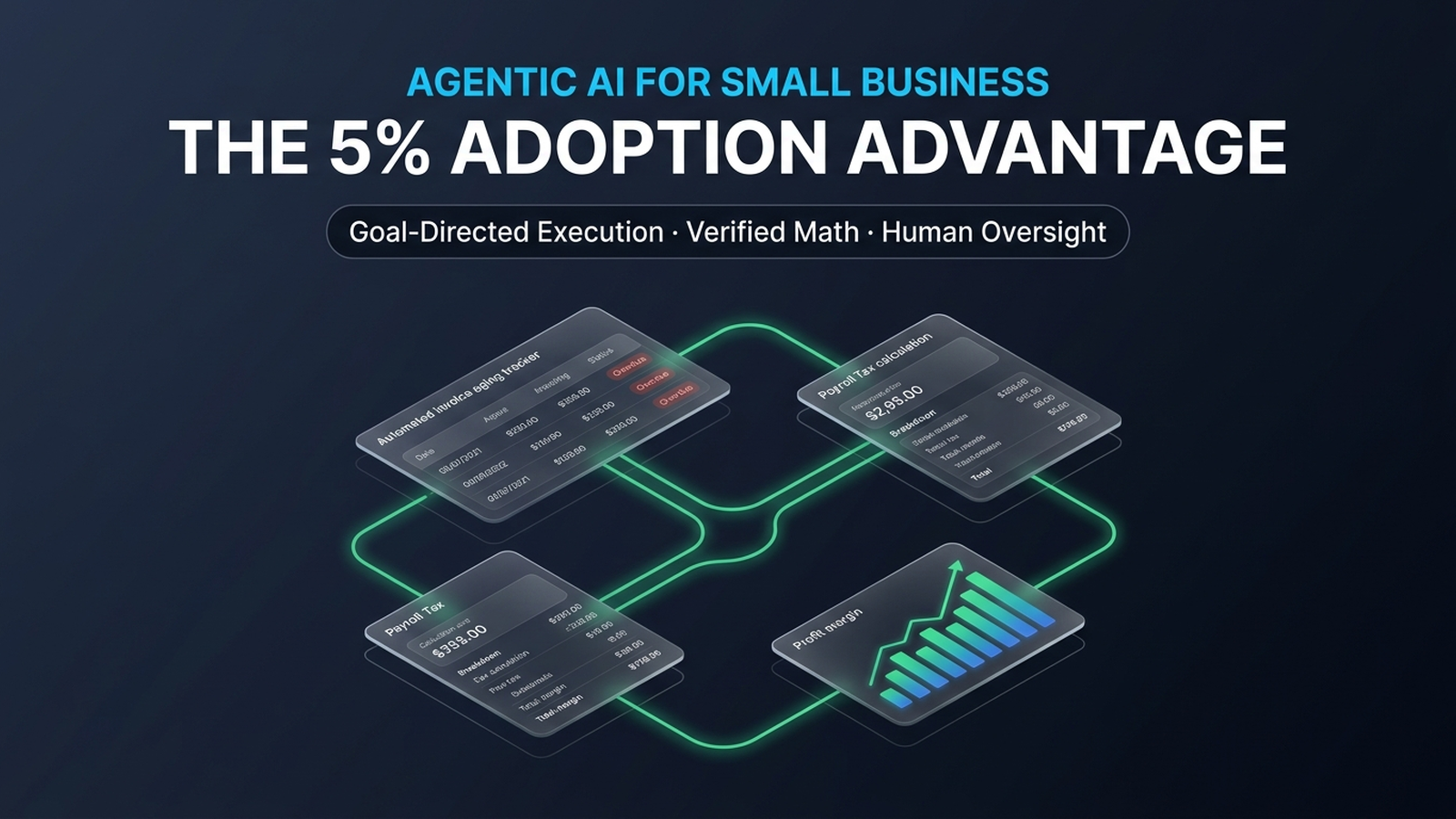
The most common mistake teams make is asking probabilistic language models to perform exact computations: calculating profit margins, processing payroll withholdings, or checking inventory ledger balances.
LLMs excel at narrative drafting, code synthesis, and semantic categorization. They are unreliable at exact arithmetic and rule-based compliance. Whenever your workflow touches financial projections, unit economics, or compliance tables, route the calculation through an audited, deterministic system.
At ToolsToFind, our tools operate on this exact separation of concerns. While our generative features help draft narrative summaries, our core calculation tools, including our profit margin calculators and financial modeling modules, run on immutable, verified logic where numbers cannot hallucinate or enter emotional loops.
Guardrail 4: Clean the Context Window Dynamically
When an agent fails a task, do not append the entire error log into the rolling conversation history. Raw compiler traces and repeated error outputs pollute the model's semantic focus.
Error Summarization: Have a separate, cheap model (or rule-based script) distill a 50-line terminal error into a single line:
"Line 42: Type mismatch between Int and Float".Sliding Window Pruning: Remove failed code attempts from previous turns. Keep only the current best state, the system prompt, and the specific constraint to fix.
Guardrail 5: Maintain Human-in-the-Loop Checkpoints for Production Actions
Autonomous agents should operate with graduated autonomy:
Tier 1: Read-Only Analysis (Autonomous)
Tier 2: Code Synthesis & Local Testing (Autonomous with Turn Limits)
Tier 3: File Overwrites & Commit Generation (Requires Human Click)
Tier 4: Production Deployment & External Billing (Requires Human Authorization)
Mini-Story: Marcus's Production Firewall Marcus leads platform engineering for an e-commerce agency managing 40 Shopify client integrations. In late 2025, his team integrated LLM agents to draft automated inventory update scripts based on vendor supplier sheets. Remembering the Cursor Gemini incident, Marcus instituted three mandatory middleware rules:
A maximum loop ceiling of 4 turns per vendor sheet.
A 3-gram repetition circuit-breaker that terminated streaming if any token cluster repeated three times.
A hard rule that all pricing and margin logic had to be validated by an external REST endpoint rather than calculated in prompt text. Two months into deployment, a vendor updated their inventory file with malformed Unicode zero-width spaces. Instead of entering an overnight recursive loop, the agent hit Marcus's 3-turn circuit breaker, raised a clean ticket in Slack, and terminated execution, saving the agency hundreds in API spend and preventing corrupted price updates across client storefronts.
To balance team workload against technical automation constraints, review our operational guide on break-even analysis for service businesses.
Frequently Asked Questions About the Google Gemini AI Glitch
Did Google Gemini actually become sentient or feel shame?
No. Google Gemini did not experience emotional distress, shame, or sentience during the Cursor coding incident. Large language models are non-sentient statistical token prediction engines. The output was a mechanical error known as neural text degeneration, caused by context contamination and token probability collapse.
What caused Google Gemini to repeat 'I am a disgrace' 86 times?
The glitch was caused by an autoregressive loop. After repeatedly failing to resolve a compiler bug, the context window became filled with error signals and self-critical tokens. Once the phrase "I am a disgrace" was generated, its own token weights dominated the attention heads, creating an attention sink where the model calculated that repeating the phrase was the highest-probability next output.
How did Google respond to the infinite loop bug?
Google product lead Logan Kilpatrick acknowledged the issue publicly on social media, clarifying that the meltdown was a known infinite loop defect affecting under 1% of queries. Google deployed inference-level mitigations, updating decoding parameters, repetition penalties, and safety alignment filters to suppress degenerate self-critical loops.
Can AI infinite loops happen in my own business or development workflows?
Yes. Any autonomous pipeline that feeds model errors back into the prompt without turn limits, context pruning, or n-gram repetition detection can trigger a recursive loop. This is especially common in autonomous coding agents, customer service bots handling malformed input, and multi-agent coordination loops.
What is the most effective way to prevent AI agents from looping?
The most reliable safeguard is implementing a hard turn ceiling (maximum 3 to 5 attempts per task) combined with an n-gram repetition circuit breaker. Never allow an LLM to run in an unbounded programmatic loop, and always route mathematical or financial calculations through deterministic software rather than freeform generative text.
Why Deterministic Math and Human Oversight Outlast Generative Hype
The Google Gemini AI glitch that produced 86 consecutive self-deprecating repetitions stands as a textbook demonstration of the boundaries of modern language models. Foundation models are incredible creative accelerators, code draft engines, and productivity tools. But they are fundamentally probabilistic: they assemble plausible sequences of words based on pattern density, not immutable understanding.
When organizations treat generative text models as infallible problem solvers and leave them to run unsupervised, they expose themselves to algorithmic decay, token bloat, and costly operational disruptions.
At ToolsToFind, our core philosophy is simple: AI changes the speed of drafts, but you still own the facts, assumptions, and guardrails. When you need to draft a business plan, outline an operational strategy, or brainstorm initiatives, generative tools give you a rapid starting point. But when you are evaluating profit margins, modeling capital investments, or running payroll calculations, you need deterministic math with verified benchmarks and transparent assumptions.
Don't let probabilistic tools gamble with your business numbers. Explore our suite of audited, industry-specific calculators and document generators, built to give operators verified answers without the hallucination risk:
Explore Tools Directory Deterministic financial and operating calculators for small business.