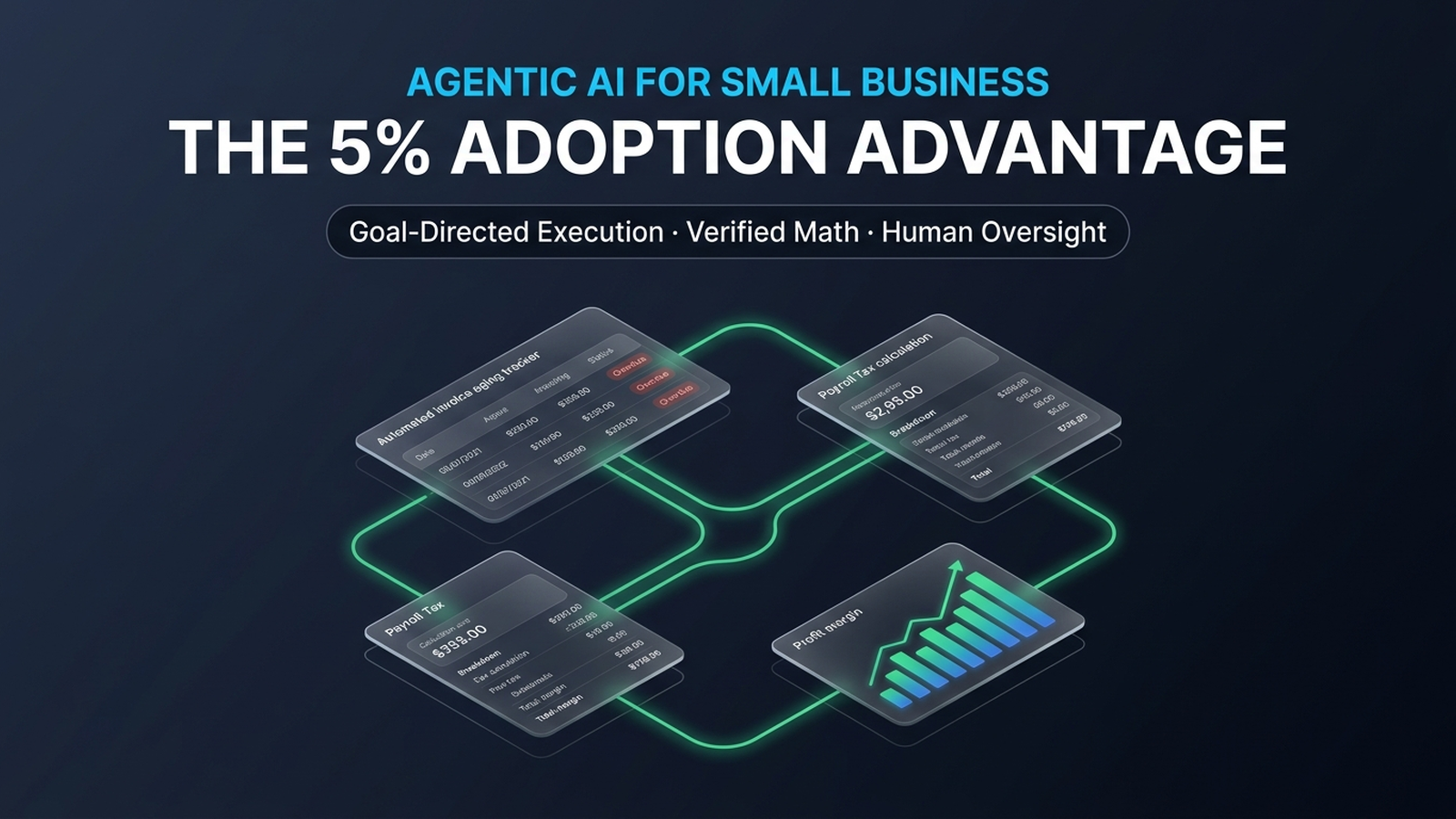
Agentic AI for small business refers to autonomous software systems that can plan, execute multi-step workflows, call specialized software tools, and solve complex operational problems without requiring constant human prompting. While roughly 55% of small business owners now use basic generative AI tools for writing emails or generating social copy, research indicates that only 5% have deployed true agentic workflows in their day-to-day operations. This massive adoption gap represents an unprecedented competitive window for lean operators to scale output, protect profit margins, and streamline back-office tasks without adding costly overhead.
What if the hours you spend typing prompts into ChatGPT every week are actually costing your business thousands of dollars in lost operational momentum?
You likely already recognize the fatigue of modern AI tools: copy-pasting numbers into a chat window, arguing with a chatbot about basic arithmetic, and reformatting responses into spreadsheets. You do not need another conversational toy that writes polite paragraphs. You need systems that actually execute tasks across your accounts receivable, pricing models, payroll verification, and business planning.
In this guide, you will discover the concrete difference between reactive generative AI and goal-directed agentic systems, why the 5% adoption divide exists, and how to deploy reliable, human-in-the-loop workflows that give a three-person team the operational horsepower of a 20-person enterprise.
Key Takeaways
The 5% Adoption Divide: More than 50% of small businesses use basic conversational AI, but fewer than 5% deploy autonomous agentic workflows that execute multi-step business operations.
Generative vs. Agentic: Generative AI produces raw text from isolated prompts; agentic AI accepts an operational objective, orchestrates software tools and calculators, handles edge cases, and produces finished business deliverables.
Eliminating Prompt Fatigue: Operators lose valuable hours babysitting chatbots. Agentic systems run background workflows like invoice aging audits and margin alerts without continuous human input.
The Math Guardrail: Autonomous agents must never guess financial calculations. Safe implementations anchor AI reasoning to verified, deterministic business calculators for payroll, pricing, and cash flow.
Zero Coding Required: Small businesses do not need dedicated software engineers to use agentic workflows. Structured workspaces with verified business tools deliver instant operational use on day one.
What Is Agentic AI for Small Business (and Why Chatbots Fail)?
To understand why agentic AI for small business is transforming operating economics, owners must first recognize why standard prompt-based chat tools have hit a productivity ceiling.
+-----------------------------------------------------------------------------------+
| THE THREE ERAS OF SMB AUTOMATION |
+-----------------------------------------------------------------------------------+
| Era 1: Rule-Based (Zapier/Spreadsheets) +-----------------------------------------------------------------------------------+
| THE THREE ERAS OF SMB AUTOMATION |
+-----------------------------------------------------------------------------------+
| Era 1: Rule-Based (Zapier/Spreadsheets) --> "If Invoice unpaid, send email" |
| Era 2: Generative AI (ChatGPT/Claude)  "If Invoice unpaid, send email" |
| Era 2: Generative AI (ChatGPT/Claude) --> "Draft a polite email to John" |
| Era 3: Agentic AI (Autonomous Agents)  "Draft a polite email to John" |
| Era 3: Agentic AI (Autonomous Agents) --> "Resolve overdue invoices while |
| preserving client relationships" |
+-----------------------------------------------------------------------------------+
Definition: What Is Agentic AI for Small Business?
Agentic AI for small business is an autonomous software framework where an AI system is given a business objective, formulates a sequential action plan, uses external tools (such as calculators, APIs, and databases), evaluates intermediate results, and completes multi-step tasks with minimal human intervention. Unlike reactive chatbots, agentic systems possess agency: they independently decide how to achieve a defined outcome.
From If-Then Automation to Autonomous Goals
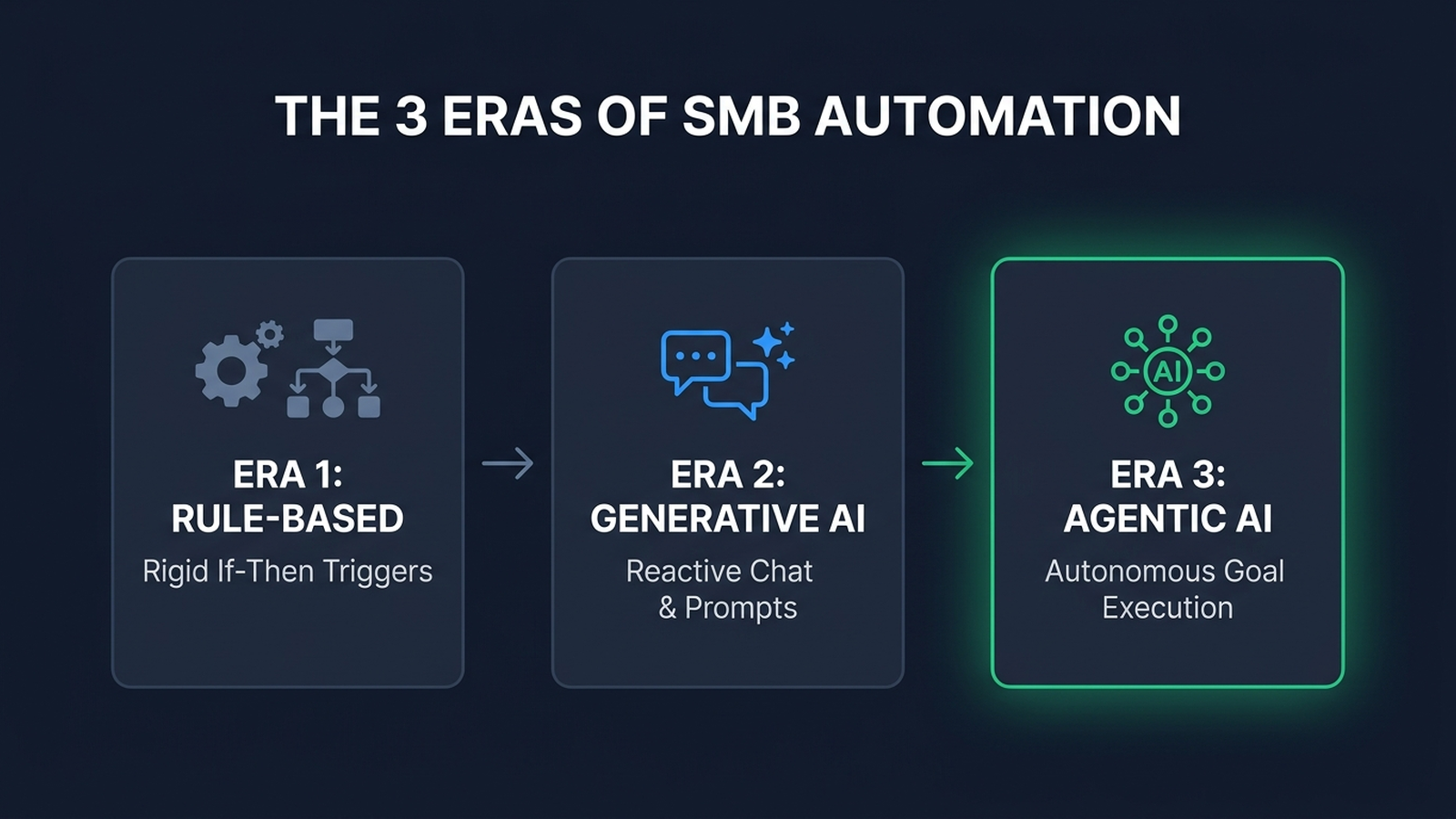
Small business automation has evolved across three distinct eras:
Rule-Based Automation (If-Then): Tools like Zapier or spreadsheet macros execute predetermined steps. If a trigger occurs, an action fires. While reliable, these systems are fragile. If an invoice reference changes format or a customer replies with an unexpected question, the automation breaks.
Generative AI (Reactive Chat): Tools like ChatGPT and Claude brought natural language fluency. However, they are fundamentally reactive. They sit idle until a human crafts a prompt, and their outputs are isolated blocks of text that still require manual verification, copying, and pasting.
Agentic AI (Goal-Directed Execution): Autonomous systems accept high-level business goals, such as "Audit last quarter's job costing against our target 35% gross margin", and self-direct. The agent breaks the goal into sub-tasks, queries verified financial tools, identifies anomalies, and prepares actionable management reports for owner review.
The "Prompt Fatigue" Trap Facing Small Business Owners
Consider Marcus, who runs a seven-person digital marketing agency in Austin. In early 2024, Marcus subscribed to multiple AI chat assistants to help with client proposals and retainer scoping. Within four months, Marcus found himself spending two hours every evening crafting elaborate prompts, feeding spreadsheet rows into chat boxes, and manually checking whether the AI's math was accurate.
Marcus was suffering from prompt fatigue: the administrative drag of having to think for the AI at every step of the workflow. Instead of delegating work, he had merely hired a digital intern that required constant, sentence-by-sentence supervision.
True autonomous AI agents for business eliminate this bottleneck. Instead of requiring step-by-step instructions, an agent understands the destination, checks its own work against deterministic business calculators, and presents the finished draft.
If you want to move past manual copy-pasting and start modeling real business numbers in seconds, you can browse tools on ToolsToFind to run verified financial scenarios for your industry right now.
Agentic AI vs Generative AI: The Core Differences
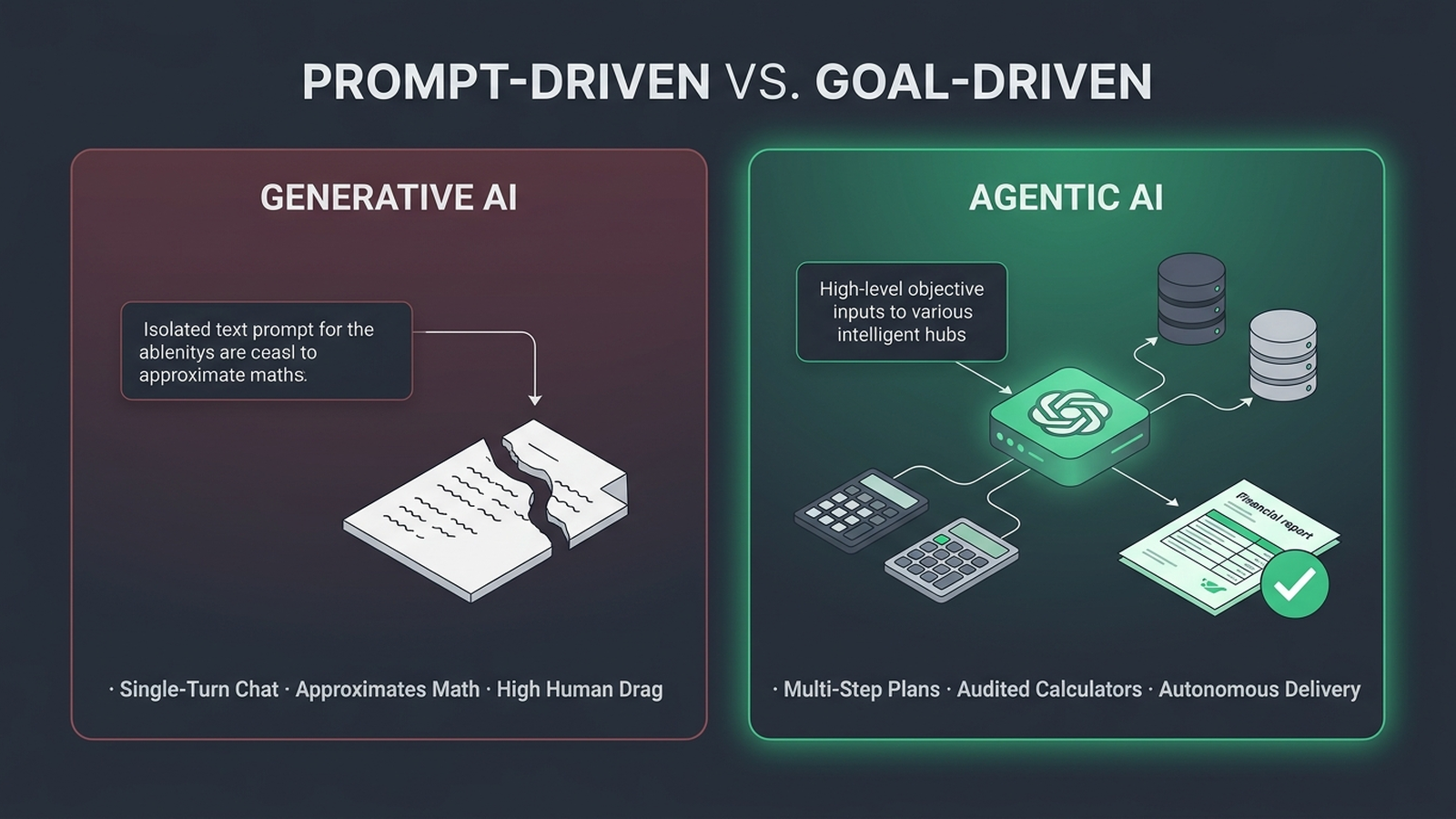
Understanding the operational boundary in the debate over agentic AI vs generative AI is essential for any owner looking to invest time and capital wisely. While both technologies rely on large language models, their business utility diverges completely at the execution stage. The table below breaks down how these technologies perform across routine small business tasks.
Operational Dimension | Generative AI (Prompt-Driven) | Agentic AI (Goal-Driven) | Small Business Impact |
|---|---|---|---|
Primary Input | Specific, detailed prompts | High-level operational objectives | Saves 5-10 hours per week in prompt drafting |
Execution Model | Single turn (input $\rightarrow$ output) | Multi-turn planning, execution, and iteration | Eliminates manual back-and-forth iteration |
Tool Usage | Confined to internal model weights | Connects to external calculators, APIs, and databases | Prevents financial calculation errors |
Error Correction | Relies on human to spot and reprompt errors | Self-evaluates output against objective constraints | Dramatically reduces administrative rework |
Data Context | Lost when the browser tab is closed | Persists in unified dashboards and workspaces | Builds institutional memory over time |
Typical Deliverable | Text snippet, email draft, raw idea | Complete business plan, reconciled invoice, margin audit | Moves from "brainstorming" to real business output |
Why Conversational AI Cannot Run Financial Operations
Generative models predict the next most probable word in a sentence. They do not calculate; they approximate. When an owner asks a general-purpose chat tool to calculate payroll taxes or multi-tier gross margins, the model produces numbers that look mathematically plausible but frequently contain silent, disastrous errors.
In contrast, an agentic framework pairs language reasoning with deterministic execution. When an agent needs to evaluate a hiring plan, it does not invent tax rates; it routes the input into a verified payroll calculator using current state and federal tables. The language model acts as the orchestrator, while audited calculation engines handle the mathematics.
Watch: How AI Agents Execute Multi-Step Workflows — Video guide explaining how goal-directed agentic workflows plan, iterate, and use specialized software tools to solve multi-step problems.
Why Only 5% of Small Businesses Have Scaled Agentic Workflows
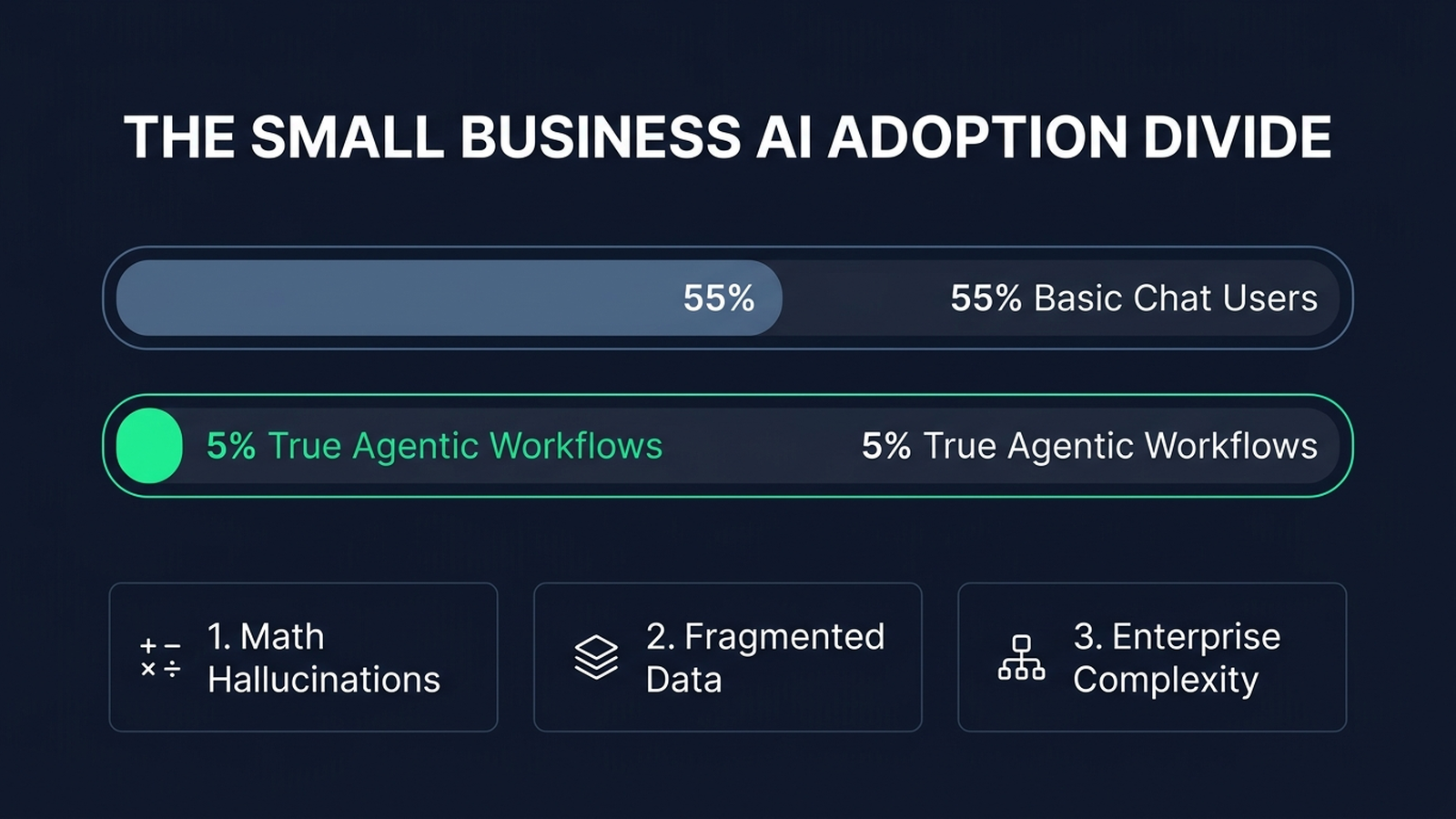
Despite the massive media attention surrounding artificial intelligence, the AI adoption gap small business operators experience daily remains remarkably wide. While enterprise tech giants deploy multi-agent systems, Main Street companies face three distinct hurdles.
+-----------------------------------------------------------------------------------+
| THE SMALL BUSINESS AI ADOPTION GAP |
+-----------------------------------------------------------------------------------+
| [==================================================] 55% Generative AI Users |
| [====] 5% True Agentic AI Workflows |
| |
| The Gap: Accuracy concerns, fragmented software, and enterprise complexity. |
+-----------------------------------------------------------------------------------+
1. The Accuracy and Hallucination Barrier in Financial Math
Small business owners operate on thin cash buffers. According to research published by McKinsey & Company on scaling AI, while over 60% of companies experiment with generative models, fewer than 5% trust them with mission-critical autonomous execution.
A retail store owner cannot afford an AI that hallucinates inventory reorder points. An electrical contractor cannot submit an estimate based on guessed labor burdens. Because standard LLMs hallucinate math, cautious owners understandably pull back from autonomous deployment. The solution is not avoiding AI, but ensuring agents rely on fixed, audited calculation engines.
2. Fragmented Data Across Disconnected Apps
Most sub-20-employee businesses run on an ad-hoc tech stack: emails in Gmail, customer notes in text messages, estimates in Excel, and receipts scattered across accounting folders. Enterprise agentic frameworks assume clean, unified SQL databases and structured APIs. When a small business attempts to implement high-end autonomous agents, the tools choke on fragmented, unstructured inputs.
Without a centralized dashboard where calculations, notes, and outputs persist, agents have no stable foundation from which to operate.
3. The Enterprise Narrative Problem
Nearly all marketing around agentic workflows is directed at Fortune 500 chief information officers. Enterprise vendors push multi-agent swarms requiring Python developers, vector databases, and six-figure software contracts.
According to small business technology surveys from the U. S. Chamber of Commerce, the number one barrier to adoption is not cost; it is complexity. Solo founders and busy operators conclude that autonomous agents are out of reach, leaving the field wide open for the few who recognize that lightweight, accessible agentic workflows already exist.
The Competitive Opportunity: Why the 5% Win on Operating Margins
When 95% of your competitors are either ignoring AI or wasting time on basic chat prompts, implementing agentic AI for small business transforms your unit economics through goal-driven automation. You do not need to replace your team; you need to multiply their billable and revenue-generating capacity.
Operating Like a 10-Person Team Without the Loaded Payroll Burden
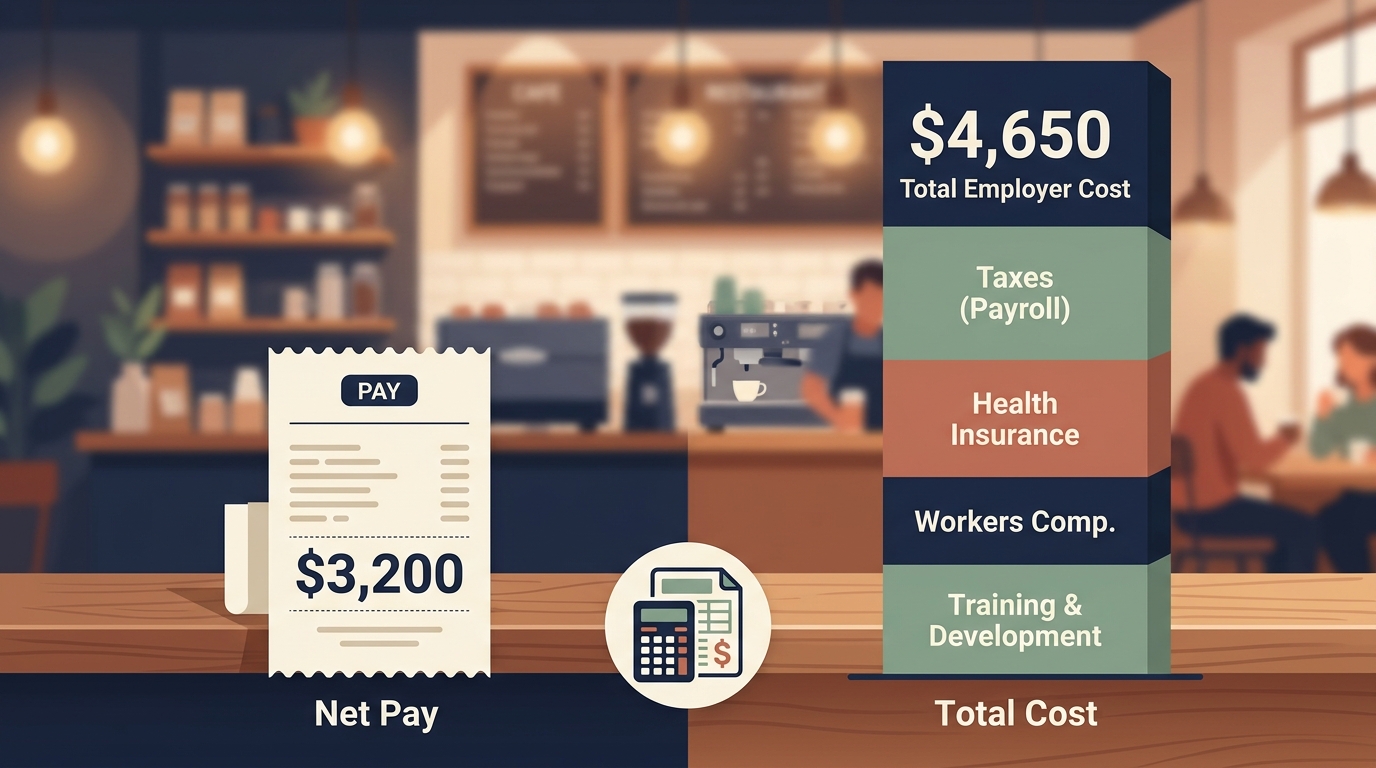
The most significant expense for any growing service, trade, or professional practice is payroll. Adding an administrative coordinator or junior financial analyst costs far more than their base wage. Once you calculate employer FICA, state unemployment taxes, workers' compensation insurance, software licenses, and onboarding drag, an employee with a $52,000 salary costs closer to $68,000 annually.
By utilizing autonomous workflows to handle repetitive data consolidation, invoice follow-up, and scenario modeling, a two- or three-person firm can handle the transaction volume of a firm twice its size before taking on fixed wage commitments.
Compressing the Cash Conversion Cycle
Cash flow is the lifeblood of small business. A company can show healthy paper profits and still become insolvent if receivables stretch from 30 days to 60 days. In typical small businesses, invoice follow-up is erratic: an owner notices an overdue balance only when checking the bank balance before a payroll run.
Agentic systems continuously monitor accounts receivable status, draft personalized reminders before due dates pass, and flag delinquent accounts for human intervention. Compressing your average Days Sales Outstanding (DSO) by even nine days dramatically frees up operating cash.
Real-Time Scenario Planning Instead of Annual Guesswork
Most small business owners review their financial health once a year when their CPA delivers tax returns. By then, unprofitable client contracts or runaway material costs have already inflicted their damage.
Early adopters of agentic AI run weekly or monthly margin checks. If subcontractor rates jump 12%, an agent recalculates contribution margins across all active jobs and alerts the owner to adjust pricing immediately.
Ready to see where your margins stand against competitors in your sector? Use our free profit margin calculator to benchmark your gross and net margins with industry-specific data.
4 High-Impact Agentic Workflows Small Businesses Can Deploy Today
You do not need to overhaul your entire business to capture the benefits of agentic systems. Start with these four high-impact small business ai workflows that directly protect cash flow, operating margins, and owner time.
+-----------------------------------------------------------------------------------+
| 4 CORE AGENTIC SMB WORKFLOWS |
+-----------------------------------------------------------------------------------+
| 1. AR & Collections +-----------------------------------------------------------------------------------+
| 4 CORE AGENTIC SMB WORKFLOWS |
+-----------------------------------------------------------------------------------+
| 1. AR & Collections --> Audits aging, categorizes delay, drafts notices |
| 2. Margin & Quoting  Audits aging, categorizes delay, drafts notices |
| 2. Margin & Quoting --> Reconciles markup vs margin, protects contribution |
| 3. Loaded Labor Modeling  Reconciles markup vs margin, protects contribution |
| 3. Loaded Labor Modeling --> Calculates full employer burden before hiring |
| 4. Plan & Strategy Draft  Calculates full employer burden before hiring |
| 4. Plan & Strategy Draft --> Translates operational goals into lender drafts |
+-----------------------------------------------------------------------------------+
1. Context-Aware Accounts Receivable & Invoice Escalation
Chasing overdue payments is emotionally draining and administratively tedious. When collections are handled haphazardly, owners either alienate good clients with overly aggressive demands or let unpaid balances slide into bad debt.
An agentic invoice workflow operates with nuance:
Phase 1 (Verification): When a billing milestone is reached, the system generates a professional invoice using an invoice generator with clear terms and line items.
Phase 2 (Monitoring): The agent tracks the invoice timeline. Three days before the due date, it drafts a friendly courtesy reminder with payment links.
Phase 3 (Root-Cause Triage): If payment does not arrive by Day 15 overdue, the agent analyzes past customer communication. Is the delay due to a missing purchase order (PO) number, or has the client gone dark?
Phase 4 (Action): If it is a paperwork issue, the agent prepares a corrected invoice package for one-click owner approval. If it is an evasion pattern, it drafts a formal escalation letter.
This systematic approach mirrors the principles in our breakdown of the invoice follow-up system, ensuring cash flows into your bank account without damaging client goodwill.
2. Margin-Preserving Quoting and Discount Analysis
Frontline salespeople and project managers love offering quick discounts to close deals. Unfortunately, a modest discount at the top line can wipe out the majority of your net profit at the bottom line.
Consider an HVAC contractor, Elena, who quotes commercial maintenance contracts. Her field estimators frequently used a standard 30% markup on subcontractor labor, assuming it provided plenty of profit. However, Elena discovered that after factoring in truck maintenance, dispatch software, and insurance, a 30% markup yielded a slim 23% gross margin, well below her 35% break-even requirement.
Elena implemented an agentic quoting workflow:
The estimator enters project hours, equipment, and material costs.
The agent passes these numbers through a calculation engine to test the difference between markup and margin, referencing our guide to gross margin versus markup.
If an estimator attempts to apply a 10% discount that pushes net margin below the company's baseline, the agent automatically flags the quote, calculates the exact extra volume needed to make up the dollar difference, and alerts Elena for review before the quote can be sent.
3. Pre-Hire Loaded Labor Modeling
When demand spikes, the instinctive reaction is to post a job opening. But hiring in haste during a temporary peak is one of the most common causes of small business cash squeezes.
An agentic hiring workflow evaluates the true operational impact of a new role:
Step 1 (Loaded Cost Calculation): The agent takes a proposed salary, say, $60,000, and applies state-specific tax rates, workers' comp, health benefits, and equipment allowances to determine the true monthly cash requirement (typically $6,500 to $7,200).
Step 2 (Capacity Check): It checks billable capacity. An employee never bills 100% of their time; the agent models the hire at a realistic 70% billable utilization.
Step 3 (Break-Even Modeling): The agent connects the loaded cost to your current revenue mix using break-even analysis. It presents the owner with an explicit threshold: "To break even on this hire, you must secure 2.4 additional retainers or $11,500 in recurring monthly project work."
+-----------------------------------------------------------------------------------+
| LOADED LABOR COST: SALARY VS REALITY |
+-----------------------------------------------------------------------------------+
| Stated Salary: $5,000 / month ($60,000/yr) |
| Employer Taxes: + $485 / month (FICA, FUTA, SUTA) |
| Health & Benefits: + $650 / month |
| Software & Gear: + $350 / month (Laptops, licenses, seats) |
| Administrative Drag:+ $250 / month (Management overhead) |
| ---------------------------------------------------------------- |
| TRUE LOADED BURDEN: $6,735 / month (+34.7% above nominal salary) |
+-----------------------------------------------------------------------------------+
4. Dynamic Business Planning & Expansion Scenarios
Small business planning is often treated as a one-time chore required by a bank loan officer, only to be archived in a drawer. Yet business models must evolve continuously as supplier costs, interest rates, and customer demands shift.
Rather than paying thousands of dollars to an outside consultant, an owner can use an agentic workflow to model expansion scenarios:
The owner outlines new expansion goals, target markets, and estimated capital expenditure.
The agent organizes the proposal into standard SBA-ready chapters: Executive Summary, Market Analysis, Operating Structure, and Marketing Strategy.
Simultaneously, the agent models cash requirements, showing how inventory build-up and receivables timing will affect liquidity, using principles from working-capital planning.
The resulting document is an edit-ready first draft that can be verified and exported for lenders, investors, or internal alignment.
How to Use Agentic AI in Small Business Without Writing Code
You do not need to hire software engineers, learn Python, or configure complex developer frameworks to implement how to use agentic ai in small business. The modern landscape allows non-technical operators to build robust agentic systems using structured tools and clear rules:
Consolidate workspaces: Replace fragmented browser tabs with a persistent dashboard.
Separate reasoning from math: Direct language tasks to LLMs and financial calculations to deterministic tools.
Deploy Draft-and-Gate protocols: Retain human approval gates for all client-facing and financial outputs.
Step 1: Replace Scattered Tabs with a Persistent Workspace
The greatest enemy of autonomous efficiency is the lost browser tab. When your financial modeling lives in one spreadsheet, your client proposals in Word documents, and your tax estimates in another window, no AI can connect the dots.
Adopt a unified workspace where calculator results, customer notes, and document drafts persist. When your inputs are saved in a structured dashboard, an AI agent can reference past calculations to detect trends, such as noting that your Q3 job margins dropped 4% compared to Q2.
Step 2: Separate Language Reasoning from Mathematical Execution
Never permit an AI language model to perform freehand financial math. When designing your operational workflows, enforce a strict architecture:
Language Models (The Brain): Use AI to interpret client emails, draft correspondence, summarize business plans, and outline strategy.
Deterministic Tools (The Calculator): Route all financial calculations, payroll withholdings, gross margins, payback periods, and net present value, through audited, client-side tools like deterministic calculators and payroll engines.
This separation ensures that your business communication remains natural and fluid while your financial balance sheets remain mathematically precise.
 +---------------------------------------+
 | OPERATIONAL OBJECTIVE |
 | "Prepare Q3 Agency Margin Review" |
 +-------------------+-------------------+
 |
 v
 +---------------------------------------+
 | AI ORCHESTRATOR |
 | Plans workflow & coordinates tools |
 +---------+-------------------+---------+
 | |
 +------------------+ +------------------+
 v v
+-----------------------+ +-----------------------+
| DETERMINISTIC TOOLS | | LANGUAGE REASONING |
| - Margin Calculator | | - Tone formatting |
| - Payroll Engine | | - Executive summary |
| - Benchmark Tables | | - Context synthesis |
+-----------+-----------+ +-----------+-----------+
 | |
 +------------------+ +------------------+
 v v
 +---------------------------------------+
 | VERIFIED FIRST DRAFT |
 | Ready for Owner Review/Signoff |
 +-------------------+-------------------+
 |
 v
 +---------------------------------------+
 | HUMAN-IN-THE-LOOP |
 | Owner verifies & exports to PDF/bank |
 +---------------------------------------+
Step 3: Implement the "Draft and Gate" Protocol
Full, unmonitored autonomy is dangerous for small businesses. A rogue agent that sends an incorrect price quote or fires off a collections notice to a VIP client can cause lasting reputational damage.
The gold standard for small business deployment is the Draft and Gate Protocol:
The agent gathers data and completes the multi-step workflow in the background.
The agent generates a complete, polished draft (an invoice, a price quote, or a job offer).
The workflow stops at an explicit human gate. The owner or manager receives an alert, reviews the numbers in their dashboard, makes any necessary judgment adjustments, and clicks approve.
This structure delivers 90% of the time savings of full automation while retaining 100% of human oversight and accountability.
The Human-in-the-Loop Guardrail: Where Autonomy Must Stop
Knowing where not to use autonomous agents is just as important as knowing where to deploy them. Trust grows when technology boundaries are respected.
The Limits of Automation
Autonomous agents excel at synthesis, pattern detection, scheduled monitoring, and first-draft generation. However, they should never be granted final authority over:
Final Pricing and Margin Sign-Off: An agent can calculate that a contract needs an 8% increase to meet margin targets, but the owner must decide whether market conditions and customer relationships support that increase.
Credit and Dispute Adjudication: When a major client disputes an invoice, the resolution requires commercial empathy, compromise, and long-term negotiation that no algorithm can replicate.
Regulatory Filings and Tax Remittance: While payroll calculators break down state and federal withholdings accurately, the actual filing and legal compliance remain the explicit responsibility of the business owner and their licensed tax professional.
Contractual and Legal Commitments: Terms of service, vendor agreements, and non-disclosure clauses require human legal judgment.
As David, who operates a boutique lighting manufacturing firm in Ohio, discovered: "Using AI to run our bill-of-materials margin checks saved our shop 14 hours every week. But every quote over $10,000 still requires my personal signature. The AI does the heavy analytical lifting; I make the commercial bet."
Conclusion: Closing the Gap in Your Business
The divide between the 5% deploying agentic AI for small business and the 95% stuck in manual prompt iterations will not remain open indefinitely. As autonomous systems become easier to access, the businesses that mastered goal-directed execution early will enjoy an unassailable advantage in speed, overhead efficiency, and profit margins.
Closing the gap in your business does not require an enterprise software budget or an engineering degree. It requires three practical commitments:
Stop settling for prompt fatigue: Move beyond chat windows that generate words without solving problems.
Anchor AI to verified business math: Combine the reasoning power of language models with the bulletproof accuracy of purpose-built calculators.
Deploy the Draft-and-Gate approach: Automate the preparation of invoices, capacity plans, and margin reviews, while keeping human judgment firmly in control of the final decision.
The competitive edge belongs to operators who treat AI not as a gimmick, but as an operating engine. When you deploy agentic AI for small business to handle repetitive financial modeling, you stop working for your administrative tools and start putting them to work for your bottom line.
Ready to upgrade your operational workspace? Explore our pricing and plan limits to unlock unlimited saved calculations, watermark-free professional PDF exports, and structured business planning tools designed specifically for your industry.
Frequently Asked Questions
What is the difference between agentic AI vs generative AI for small business?
Generative AI produces text, images, or code in direct response to a specific user prompt in a single turn. Agentic AI is goal-directed: given an objective, it independently devises a plan, calls external software tools and calculators, evaluates intermediate results, corrects errors, and executes multi-step workflows with minimal human intervention.
Is agentic AI safe to use with small business financial data?
Agentic AI is safe when deployed with proper architectural guardrails. Businesses should avoid inputting sensitive, unredacted banking credentials into public models. Safe implementation involves using client-side, deterministic calculation engines for payroll, invoicing, and margins, using AI agents to synthesize and format the results under human supervision.
How much does it cost to implement agentic AI for a small business?
You do not need six-figure enterprise software to use agentic workflows. Lightweight implementations rely on accessible tools, unified workspaces, and free or low-cost industry calculators. Platforms like ToolsToFind offer free tiers for core calculators, with affordable Pro plans ($19/month) providing unlimited saves and watermark-free client exports.
Can agentic AI replace our small business bookkeeper or CPA?
No. Agentic AI is an accelerator, not a certified fiduciary. It eliminates administrative friction, such as drafting invoices, auditing overdue receivables, and preparing margin models, allowing your bookkeeper or CPA to focus on high-value tax strategy, regulatory filings, and complex financial advisory work.
What industries benefit most from small business agentic workflows?
Service businesses (marketing agencies, consulting practices, bookkeeping firms), specialty trade contractors (HVAC, plumbing, electrical), manufacturing shops, and boutique e-commerce retailers see the fastest return on investment. These sectors feature high transaction volume, fluctuating labor costs, and tight margin tolerances where automated tracking yields immediate profit protection.