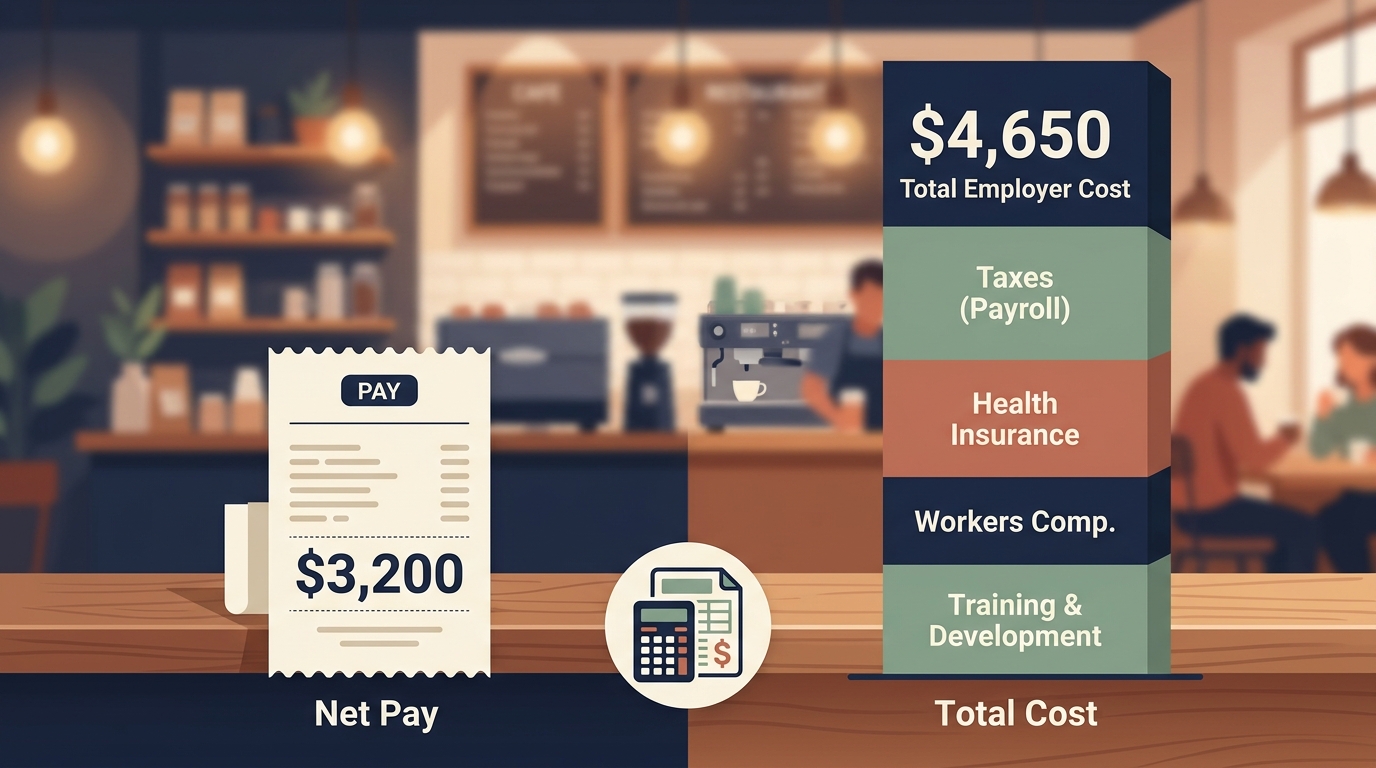
Artificial intelligence is rarely the actual operating driver of mass corporate workforce reductions; instead, the ai layoffs excuse has become a convenient narrative shield used by executive teams to mask pandemic-era overhiring corrections, high capital borrowing costs, compressed profit margins, and multi-billion-dollar budget reallocations into cloud infrastructure. While corporate announcements aggressively cite algorithmic efficiency to project visionary modernization, the underlying financial filings tell an entirely different story.
Roughly 73% of corporate layoff announcements citing technological disruption in recent quarters occurred at companies that simultaneously expanded their middle-management payrolls by more than 30% between 2020 and 2022. As an operator or business owner, you likely feel the intense pressure of these headlines. You see enterprise competitors announce 10% headcount cuts alongside bold claims of generative automation, and you wonder whether your own payroll structure has become obsolete.
This guide breaks down the financial mechanics behind corporate press releases so you can separate public-relations theater from ground-level unit economics. We will examine what verified workforce data actually shows, dissect the hidden total cost of ownership (TCO) behind enterprise software implementations, expose the costly "boomerang effect" that catches unprepared operators, and provide practical models to calculate your true labor return on investment.
Key Takeaways
The ai layoffs excuse is predominantly corporate "AI-washing," a strategic framing device designed to appease equity analysts and protect stock valuations while correcting historical overstaffing.
Enterprise cuts are driven primarily by capital budget reallocation: organizations are slashing operating payroll to fund massive, long-term capital commitments in GPU compute, cloud capacity, and enterprise seat licensing.
Premature automation creates the "60/40 Trap": automated tools easily process the predictable 60% of routine workflows, but cause severe operational bottlenecks on the 40% of complex edge cases that require human judgment.
Over 28% of organizations that aggressively cut headcount for automation in early 2025 suffered significant customer churn or were forced to quietly rehire personnel within nine months at higher market rates.
Sound business decisions require comparing fully loaded labor costs (including taxes, benefits, and administrative overhead) against the complete lifecycle expenses of software deployment rather than reacting to public headlines.
The 2026 Data: What Labor Reports Actually Say About the AI Layoffs Excuse
Headlines across the financial press would lead you to believe that autonomous algorithms are clearing out office floors overnight. When you look at the raw numbers tracked by workforce outplacement firm Challenger, Gray & Christmas, job cut announcements explicitly citing "artificial intelligence" spiked sharply throughout 2025 and into 2026. On surface inspection, it appears to validate the narrative that human white-collar labor is being rapidly displaced at scale.
Yet when labor economists cross-reference these public announcements against WARN (Worker Adjustment and Retraining Notification) filings, state unemployment claims, and federal data from the U. S. Bureau of Labor Statistics, the technological displacement claim unravels. This regulatory discrepancy exposes how the ai layoffs excuse functions as a convenient shield: in more than 80% of corporate filings where AI was highlighted in press conferences, the underlying statutory notices cited conventional financial pressures—cost containment, reduced consumer demand, project cancellations, or organizational restructuring following acquisitions.
Public Press Release Framing | Actual Regulatory WARN Filings |
|---|---|
"Restructuring for AI Efficiency" | Cost Containment / Budget Cuts |
"Streamlining via Automation" | Demand Softening / Overcapacity |
"Investing in the Digital Future" | Capital Reallocation & Debt Service |
The roles targeted in these workforce reductions reveal a consistent pattern. Rather than replacing highly repetitive transactional roles, many of which were already automated by rules-based software years ago, the recent cuts have landed disproportionately on middle management, customer success teams, copywriting departments, and entry-level software engineering cohorts.
These departments share a specific economic characteristic: they were the primary beneficiaries of the zero-interest-rate hiring boom of 2020 through 2022. When tech companies were competing for talent, they added redundant organizational layers to hoard capacity. With interest rates hovering significantly higher and venture capital demanding cash-flow sustainability over raw user growth, those surplus layers became unsustainable balance-sheet liabilities, proving that the real reason for tech layoffs is pandemic-era overhiring and capital cost, not sudden algorithmic autonomy. This contrast raises an urgent question for operators: are ai layoffs real, or are they masking routine corporate belt-tightening?
Mini-Story: The Agency Content Experiment
Elena runs a 14-person digital marketing agency in Chicago generating $2.2 million in annual revenue. In January 2025, after reading continuous industry coverage about generative AI replacing creative teams, Elena eliminated two junior copywriters whose combined loaded compensation totaled $135,000 annually. She anticipated that enterprise LLM subscriptions would easily absorb their article drafting and newsletter production.
Within eight weeks, the agency's workflow fractured. While the software generated initial text drafts in seconds, client revision requests tripled because the copy lacked verified client data and suffered from repetitive phrasing. Elena and her senior account director found themselves spending 18 hours per week rewriting drafts, catching hallucinations, and repairing client trust.
In April, a cornerstone client paying a $14,000 monthly retainer walked away after an unverified industry statistic appeared in their quarterly stakeholder report. The $135,000 payroll reduction produced an immediate $168,000 top-line revenue collapse, alongside severe founder burnout.
Before making structural workforce decisions based on industry hype, run your numbers through our payroll calculators and evaluate your operating baseline with our profit margin calculator to understand what your team actually costs and contributes.
Why the AI Layoffs Excuse Is the Ultimate Corporate Scapegoat
To understand why the ai layoffs excuse has become pervasive, you have to look at how public equity markets reward and punish executive communication. When a publicly traded company holds an earnings call and tells Wall Street analysts, "We misjudged our market expansion, hired 4,000 people we do not need, and demand for our core product has softened," institutional investors penalize the stock. Management appears undisciplined, reactive, and incapable of forecasting.
Conversely, if that same leadership team steps up to the microphone and announces, "We are proactively streamlining our operational baseline by 8% to capture massive productivity dividends from our enterprise AI investments," institutional analysts applaud. The narrative transforms a management forecasting error into visionary capital allocation. The stock often rises on the announcement because the market interprets the move as sustainable margin expansion.
This divergence has created widespread ai washing layoffs, the practice of rebranding defensive cost cuts and margin protection as offensive technological leadership.
Admitting Forecasting Errors | Claiming AI Productivity |
|---|---|
"We overhired during the pandemic and consumer demand is now slowing." | "We are transforming our operating model through cutting-edge AI automation." |
Market Reaction: Stock drops 8–15% (perceived management failure) | Market Reaction: Stock jumps 3–7% (perceived margin expansion) |
Even prominent technology executives have publicly pushed back against this narrative sleight of hand. During multiple enterprise forums, Nvidia CEO Jensen Huang explicitly characterized the trend of companies blaming AI for basic headcount reductions as "lazy." Huang pointed out that genuine technological implementation increases an organization's capacity to build new products and capture market share rather than simply serving as an arithmetic tool to prune headcount.
By utilizing artificial intelligence as an external scapegoat, executive teams accomplish three critical PR objectives:
Deflecting Executive Accountability: Leadership avoids admitting that strategic growth bets failed to materialize or that baseline revenue per employee dropped precipitously.
Preventing Morale Cascades: Remaining staff are told the organization is modernizing for the next decade, rather than hearing that the business is struggling to maintain its operating margin.
Justifying Executive Compensation: Cost-cutting programs framed as technological transformation preserve executive performance bonuses tied to operational efficiency metrics and share price targets.
Capital Reallocation: How Companies Blaming AI for Layoffs Trade Payroll for GPUs
The financial reality behind the corporate narrative is not that businesses are eliminating expenses; they are executing a massive balance-sheet swap. When evaluating organizations leaning on the ai layoffs excuse, their financial filings reveal that companies blaming ai for layoffs are systematically stripping capital out of their operational labor budget (Opex) and redirecting it into capital expenditures (Capex) and multi-year vendor commitments to fund computing hardware, data centers, and enterprise software licenses.
Developing, deploying, and maintaining proprietary AI workflows requires astronomical capital outlays. Hyperscalers like Microsoft, Amazon Web Services, and Google Cloud have committed hundreds of billions of dollars to data center construction and specialized silicon. Enterprise software providers have passed these infrastructure costs down to corporate customers through mandatory price increases, token-based usage billing, and premium AI add-on tiers.
Operating Expenses (Opex) Stripped | Capital Expenses (Capex) Funded |
|---|---|
Human payroll and benefits | Specialized GPU compute clusters |
W-2 payroll taxes and FICA burden | Cloud hyperscaler contracts |
Physical workspace and employee tooling | Enterprise API token quotas |
Internal training and team perks | Data architecture and security audits |
When an enterprise eliminates 1,000 administrative or customer-facing roles, it might reduce annual payroll obligations by $90 million. However, examining their subsequent 10-Q filing often reveals that operating cash flow was immediately absorbed by an $80 million increase in cloud hosting agreements and software licensing commitments. The business did not become significantly more profitable; it simply exchanged human labor flexibility for rigid, long-term technical debt.
The Hidden Total Cost of Ownership (TCO) of Enterprise AI
Many operators fall into the trap of comparing an employee's annual salary against a software subscription price. They assume that replacing a $60,000 coordinator with a $50-per-month software license generates an immediate $59,400 windfall. This calculation ignores the extensive technical debt and maintenance requirements of enterprise automation:
Integration and Data Hygiene: Enterprise models require structured, secure, and continuously updated internal data. Small and mid-sized businesses spend tens of thousands of dollars on external consultants or developer hours just to connect disparate databases and maintain retrieval-augmented generation (RAG) pipelines.
Consumption and Token Volatility: Unlike fixed monthly salaries, automated workflows scale their compute costs with volume. High customer inquiry volumes or recursive document parsing can trigger unpredictable monthly API invoices that exceed forecasted savings.
Human-in-the-Loop Verification Overhead: Models generate probabilistic outputs that require human review to prevent legal exposure, factual errors, and brand damage. If an experienced operator must audit every automated deliverable, labor costs have not been eliminated; they have merely shifted to higher-paid personnel.
Security, Compliance, and Vendor Lock-In: Protecting proprietary customer data from leaking into public training sets requires dedicated enterprise compliance layers, SOC 2 audits, and specialized data governance tools that carry heavy recurring price tags.
Before trading flexible operating payroll for multi-year software commitments, apply the same discipline outlined in our guide to capital budgeting for small-business equipment—evaluating cash payback periods, utilization risks, and maintenance drag before locking working capital into depreciating technological assets.
For a detailed breakdown of corporate restructuring mechanics and tech labor costs, watch Video: Corporate Tech Restructuring and the Economics of AI Layoffs.
The Boomerang Effect: Why AI Washing Layoffs Backfires on Operating Margins
When organizations eliminate experienced personnel in pursuit of premature automation, they frequently trigger the "boomerang effect." This operational breakdown exposes the fundamental flaw in the ai layoffs excuse: companies eliminate human capacity to project technical efficiency, only to discover that automated tools cannot handle real-world operational friction. They are then forced to quietly re-recruit workers 6 to 12 months later, almost always at higher fully loaded costs.
Research from workforce surveys, including data from Robert Half, indicates that 29% of hiring managers reported reopening positions they had previously eliminated in favor of AI automation within 6 to 12 months, citing quality gaps and operational friction.
The destructive boomerang cycle typically unfolds in four distinct stages:
Headcount Cut: Management slashes headcount by 15–20% to capture immediate paper savings and project AI transformation to analysts.
The 60/40 Trap: Automated tools handle routine tasks, but choke on complex real-world edge cases and nuanced client requests.
Operational Chaos: Unhandled exceptions trigger client escalations, service quality drops, customer churn, and senior team burnout.
The Rehire Penalty: The organization quietly reopens the eliminated positions 6–12 months later at a 20% wage premium plus agency placement fees.
The 60/40 Trap Explained
The root cause of this operational failure is what we call the 60/40 Trap. Large language models and predictive algorithms excel at processing the routine 60% of baseline business activity: standard customer password resets, formatting clean spreadsheets, summarizing straightforward phone calls, or generating boilerplate outreach templates.
However, business profitability and customer retention are defined by how an organization manages the remaining 40%. The 40% consists of ambiguous edge cases:
A distressed enterprise client threatening cancellation due to a missed contract SLA.
An unusual freight logistics delay that requires cross-carrier negotiation and relationship use.
A custom software deployment bug that demands architectural intuition rather than standard syntax completion.
When human teams are cut, the automated systems successfully route the easy 60% and completely choke on the difficult 40%. Without frontline personnel to absorb these edge cases, unresolved tickets escalate directly to department heads, lead engineers, and founders. Highly compensated leaders find themselves acting as high-priced triage workers, destroying executive capacity and stalling core strategic initiatives.
Mini-Story: The Customer Support Rollback
Marcus serves as VP of Customer Experience at a B2B logistics software provider with 45 employees and $7.5 million in Annual Recurring Revenue (ARR). In February 2025, after reviewing pitches from enterprise customer service automation vendors, Marcus cut four Tier-1 support specialists earning $52,000 each, replacing them with a custom AI ticketing agent costing $38,000 annually in licensing and API charges.
The platform achieved an impressive 62% automated deflection rate during its first month. Leadership celebrated the apparent $170,000 annual cost reduction. However, the automated agent repeatedly misinterpreted complex billing questions and warehouse integration errors, providing confident but incorrect instructions to high-tier shipping clients.
Within 90 days, customer satisfaction (CSAT) scores dropped from 94% to 68%. Senior implementation engineers earning $140,000 per year were forced to divert 35% of their working hours away from the core product roadmap to manually investigate corrupted client configurations created by automated workarounds. When two enterprise accounts representing $240,000 in combined ARR threatened non-renewal, Marcus halted the automated pipeline.
By November 2025, Marcus had to rehire four support representatives. Because the original team members had secured other employment, the company spent $28,000 in agency placement fees, offered starting salaries of $60,000 to match market inflation, and spent three months training new hires. The failed automation initiative cost the business over $140,000 in direct cash expenses and set product development back two full quarters.
Before exposing your customer relationships to unverified automation, test the cash impact on your business using our ROI calculator and review our operational guide on break-even analysis for service businesses.
Stated Narrative vs. Economic Reality: An Operator's Breakdown
To cut through the PR noise, operators must distinguish between what enterprise executives say in quarterly press releases and the underlying accounting drivers shaping their P&L statements. The table below maps the common ai layoffs excuse against the real reason for tech layoffs and underlying unit economics.
Stated Corporate Narrative (PR Pitch) | Underlying Economic Driver (P&L Reality) | Impact on Unit Economics | Risk for Independent Operators Who Copy It |
|---|---|---|---|
"Restructuring to become an AI-first organization." | Correcting headcount bloat accumulated during low-interest venture expansion cycles. | Lowers baseline payroll overhead to defend compressed EBITDA margins. | Cutting necessary delivery capacity while retaining bloated administrative processes. |
"Automating code generation to double engineer output." | Trimming junior engineering payroll while moving core maintenance to offshore teams. | Short-term reduction in engineering expenses; long-term increase in code review debt. | Accumulating severe technical debt and breaking the internal mentorship pipeline. |
"Replacing frontline support with conversational bots." | Sacrificing low-tier customer satisfaction to protect quarterly operating margins. | Converts predictable employee wages into variable consumption-based API token expenses. | Triggering customer churn and burdening high-salaried senior staff with edge-case triage. |
"Consolidating marketing through AI content engines." | Masking rising customer acquisition costs (CAC) and paid advertising saturation. | Produces high-volume generic content that suffers from diminishing organic search returns. | Flooding distribution channels with low-converting copy that erodes brand differentiation. |
"Streamlining middle management via automated reporting." | Removing redundant layers of managerial bureaucracy that should never have been hired. | Shortens reporting lines and reduces administrative overhead expenses. | Overworking remaining managers when automated reporting systems fail to capture context. |
When you analyze these scenarios, a clear pattern emerges: the companies executing these moves are rarely discovering newfound productivity. They are managing financial constraints created by macroeconomic shifts, customer acquisition saturation, and prior capital misallocations.
AI vs Human Labor Cost ROI: A Practical Decision Framework
If you are evaluating whether to invest in automation software, augment an existing role, or hire a team member, you cannot rely on high-level headlines. Evaluating the true ai vs human labor cost roi requires a rigorous decision framework rooted in unit economics. That begins with calculating the fully loaded cost of human labor rather than comparing base salary alone.
Labor Cost Component | Percentage / Scope | Annual Cost |
|---|---|---|
Base Salary | Baseline cash compensation | $65,000 |
Employer Payroll Taxes | FICA, FUTA, SUTA (~9–11%) | $6,825 |
Benefits & Health Coverage | Medical, dental, retirement (~12–18%) | $9,750 |
Hardware & Tooling Seats | Workstation, SaaS seats, licenses | $4,800 |
Administrative & Overhead | Onboarding, HR, management (~8–10%) | $5,500 |
Total Fully Loaded Annual Cost | 1.41x Base Salary Multiplier | $91,875 |
As detailed in our breakdown of first-hire payroll mistakes to avoid, an employee's actual financial footprint is typically 1.35x to 1.5x their base salary. A $65,000 employee represents an actual operating commitment of roughly $91,000 per year.
However, replacing that individual with technology does not eliminate the $91,000 expenditure in a vacuum. You must calculate the Total Lifecycle Cost of Automation (TLCA):
$$\text{TLCA} = \text{Software Licensing} + \text{API Usage} + \text{Implementation Consulting} + \text{Internal Maintenance Hours} + \text{Human Verification Drag}$$
If an automated workflow saves 20 hours of coordinator time per month ($1,100 in loaded labor) but requires $400 in software subscriptions, $250 in API consumption, and 8 hours of senior manager audit time ($600 in loaded executive labor), your net financial return is negative. You have increased organizational complexity while eroding your operating margin.
Mini-Story: Strategic Capacity Augmentation
David operates a regional freight brokerage in Columbus, Ohio, managing $12 million in annual logistics volume with seven dispatchers. In late 2025, rather than adopting the tech-sector playbook of laying off two dispatchers to implement an end-to-end autonomous dispatch system, David mapped his team's weekly task distribution.
He discovered that each dispatcher spent 14 hours per week making repetitive check-in calls to drivers and manually typing location updates into carrier spreadsheets. The remaining 26 hours were spent negotiating spot rates with shippers and solving transit exceptions, work that directly drove the company's 18% gross margin.
Instead of cutting personnel, David implemented an automated webhook tool that ingested automated ELD tracking pings and updated the spreadsheets automatically. The tool cost $650 per month.
By eliminating the 14 hours of data-entry friction, each dispatcher reclaimed roughly 35% of their working week. David directed that newly unlocked capacity into active carrier negotiations and client acquisition. Over the following six months, the brokerage expanded handled freight volume by 22% without adding headcount or firing a single employee. Gross profit expanded by $185,000 against a total software investment of less than $4,000.
The Decision Matrix: Automate, Augment, or Hire?
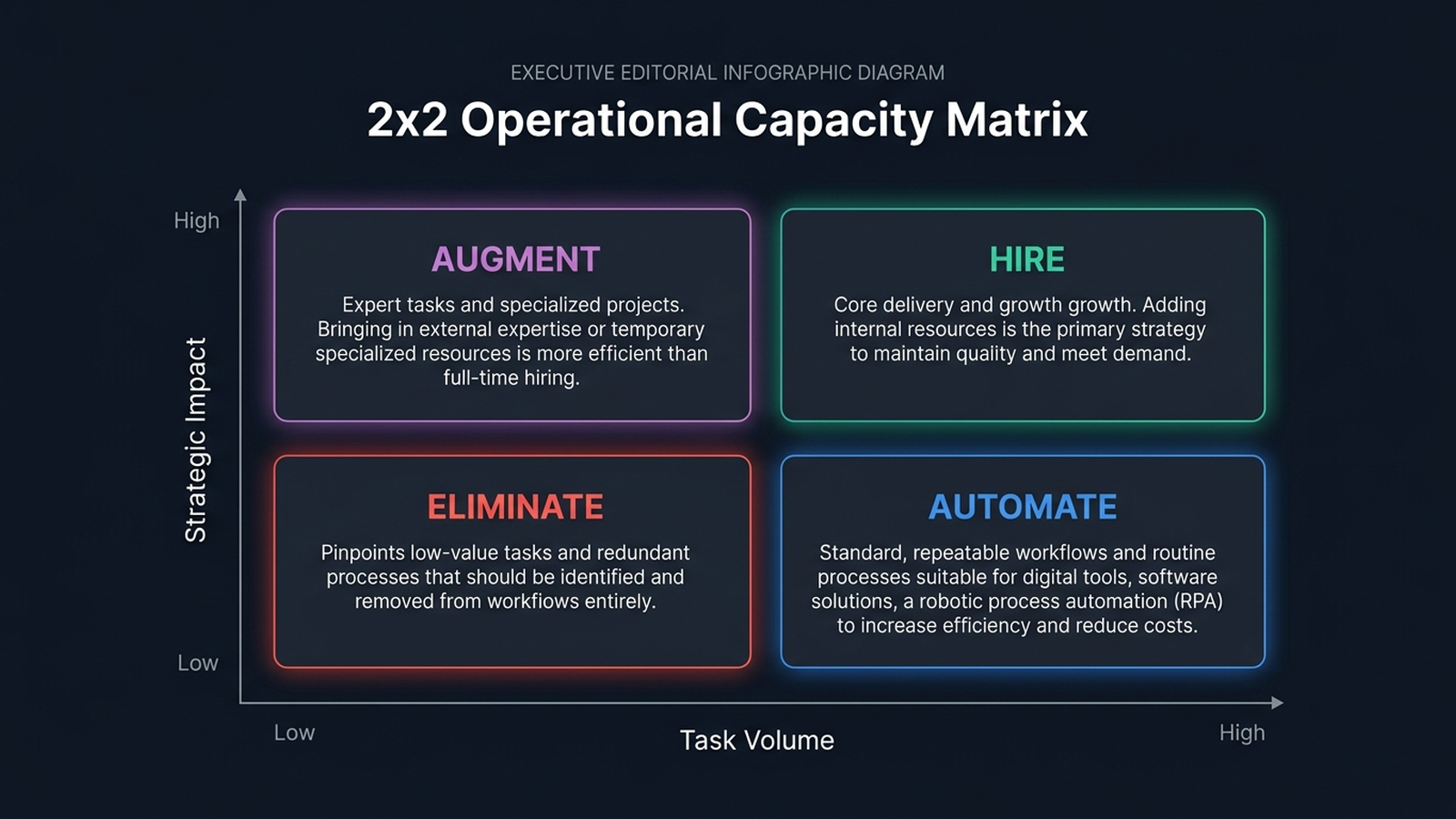
To determine how to allocate your operational capital, evaluate your business needs against this four-quadrant matrix:
Operational Quadrant | Strategic Value & Volume | Core Tasks & Roles | Strategic Action |
|---|---|---|---|
Quadrant 1: Hire | High Strategic Impact / High Volume | Core service delivery, technical leads, client retention managers | Invest in full-time in-house human capacity. |
Quadrant 2: Augment | High Strategic Impact / Low Volume | Key account negotiations, custom proposals, architecture | Equip seasoned experts with automated tools to remove administrative friction. |
Quadrant 3: Automate | Low Strategic Impact / High Volume | Standard invoice delivery, payment reconciliation, calendar logging | Deploy deterministic or rule-based software automation. |
Quadrant 4: Eliminate | Low Strategic Impact / Low Volume | Status check-ins, vanity metric reports, internal newsletters | Eliminate the task completely rather than wasting software subscriptions. |
Pure Automation (High Volume, Low Strategic Value): Routine invoicing, payment reconciliation, appointment reminders, and basic data entry. Use standard software tools.
Augmentation (Low Volume, High Strategic Value): Strategic proposals, client relationship management, high-value sales negotiations, and custom product development. Keep your experienced personnel and equip them with tools to eliminate administrative friction.
Dedicated Hiring (High Volume, High Strategic Value): Core client delivery, specialized project management, and relationship-driven account expansion. Hire qualified professionals and budget their loaded costs accurately using our guides to working-capital planning for growth and gross margin vs markup for pricing decisions.
Task Elimination (Low Volume, Low Strategic Value): Excessive internal status meetings, redundant internal newsletters, and vanity analytics reporting. Eliminate these activities altogether rather than spending money to automate them.
Frequently Asked Questions About the AI Layoffs Excuse
Are AI layoffs real, or are companies using tech as an excuse?
In the vast majority of cases, artificial intelligence serves as an operational excuse rather than the direct technical catalyst for layoffs. While generative tools can accelerate specific tasks like first-draft writing, basic code generation, and standard data summarization, are AI layoffs real as an autonomous replacement for workers? No. Most companies citing AI are utilizing the narrative to justify restructuring decisions driven by high interest rates, slowing revenue growth, and the unwinding of overstaffing that occurred between 2020 and 2022.
What is "AI-washing" in the context of corporate layoffs?
AI-washing occurs when corporate leadership frames routine cost-cutting measures, margin defense, or business contractions as forward-looking technological modernization. By attributing workforce reductions to artificial intelligence and automation in investor calls, executives protect their company's valuation multiple and avoid public scrutiny over poor operational planning, declining market demand, or mismanaged capital investments.
Why do public markets reward companies that blame AI for workforce cuts?
Equity markets value operational leverage—the ability to generate increasing revenue without corresponding linear increases in operating expenses. When a company claims it can maintain its productivity while permanently eliminating payroll obligations through automation, investors project widening operating margins and higher free cash flow. This perception drives stock appreciation, giving executives a powerful financial incentive to blame technology rather than softening demand.
How much does it actually cost to replace an employee with AI?
Replacing a human employee with automated systems rarely delivers the paper savings advertised. Beyond initial software seat licenses ($20 to $100 per user monthly), businesses incur costs for specialized API token consumption, vector database architecture, external systems integration, cybersecurity compliance, and ongoing data hygiene. Crucially, companies must account for human-in-the-loop review costs, as senior personnel must spend billable hours validating and correcting automated deliverables.
How should small-to-midsize business operators approach AI without making layoff mistakes?
Independent operators should approach artificial intelligence as a task-augmentation framework rather than a role-elimination strategy. Instead of attempting to cut headcount, identify specific operational bottlenecks in your existing workflows, such as invoice data extraction, scheduling, or preliminary research, and automate those individual friction points. This unlocks billable capacity for your existing team, expanding your gross margins without risking the customer attrition and rehire costs associated with premature layoffs.
Making Workforce Decisions on Math, Not Headlines
The modern corporate news cycle is designed to capture attention through radical claims of technological disruption. When Fortune 500 tech firms lean on the ai layoffs excuse to explain sweeping job cuts, remember that their executive incentives are entirely different from yours. They are managing public market sentiment, multi-billion-dollar debt facilities, and volatile valuation multiples.
As an operator, your survival and growth depend on balance-sheet realities: cash conversion cycles, contribution margins, billable capacity, and client retention. Treating human employees as instantly replaceable commodities based on software vendor promises is one of the fastest ways to compromise product quality, burn out key leadership, and alienate your customer base.
Use automation where it belongs: to eliminate mechanical friction, standardize repetitive tasks, and empower your core team to focus on high-value client outcomes. When you evaluate your operational model, look past the ai layoffs excuse dominating corporate press releases and run the actual numbers.
Explore our full suite of business calculators, benchmark margins with our profit margin calculator, model your staffing investments with our payroll calculators, and review our transparent pricing and plan limits to build a sustainable, profitable operational workspace.