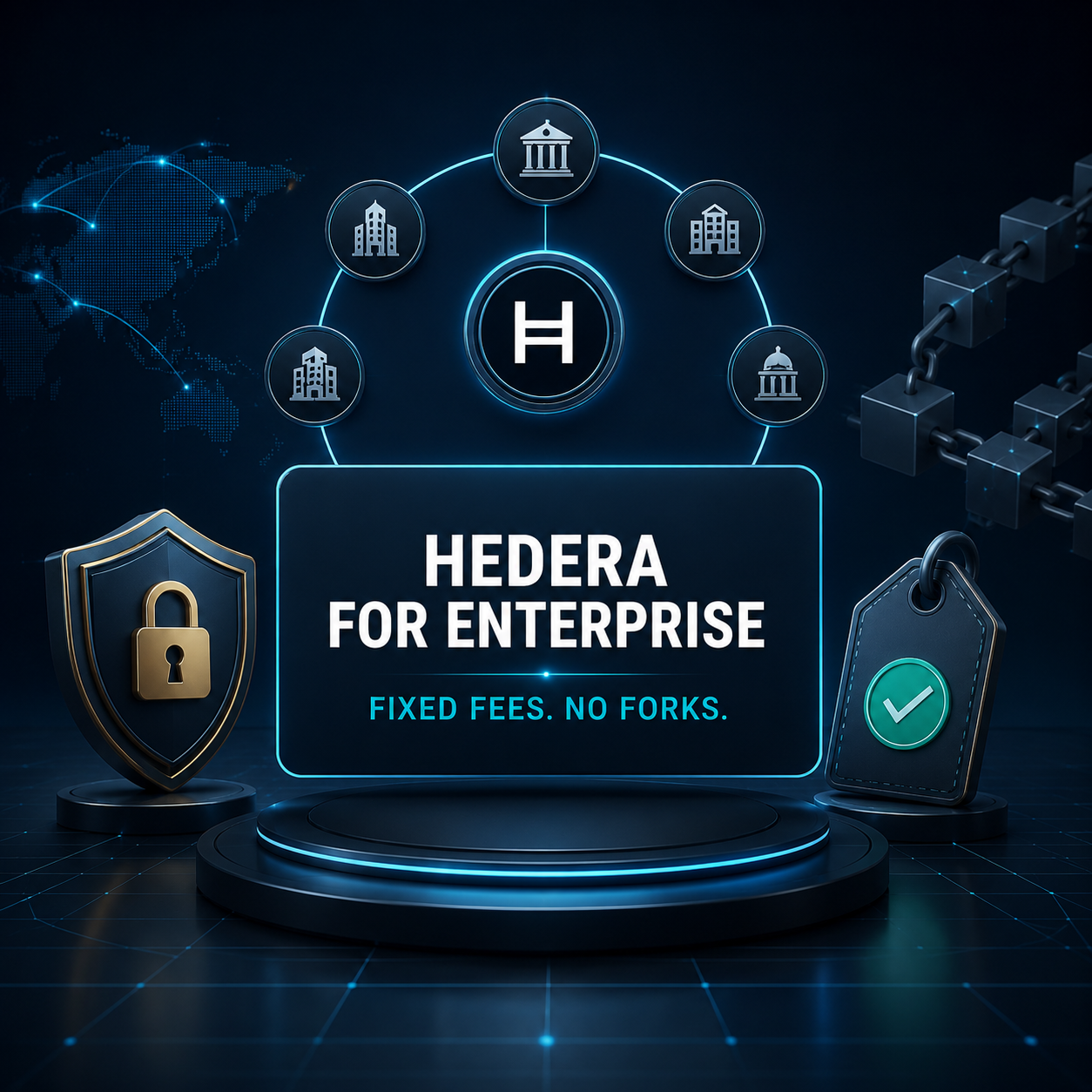
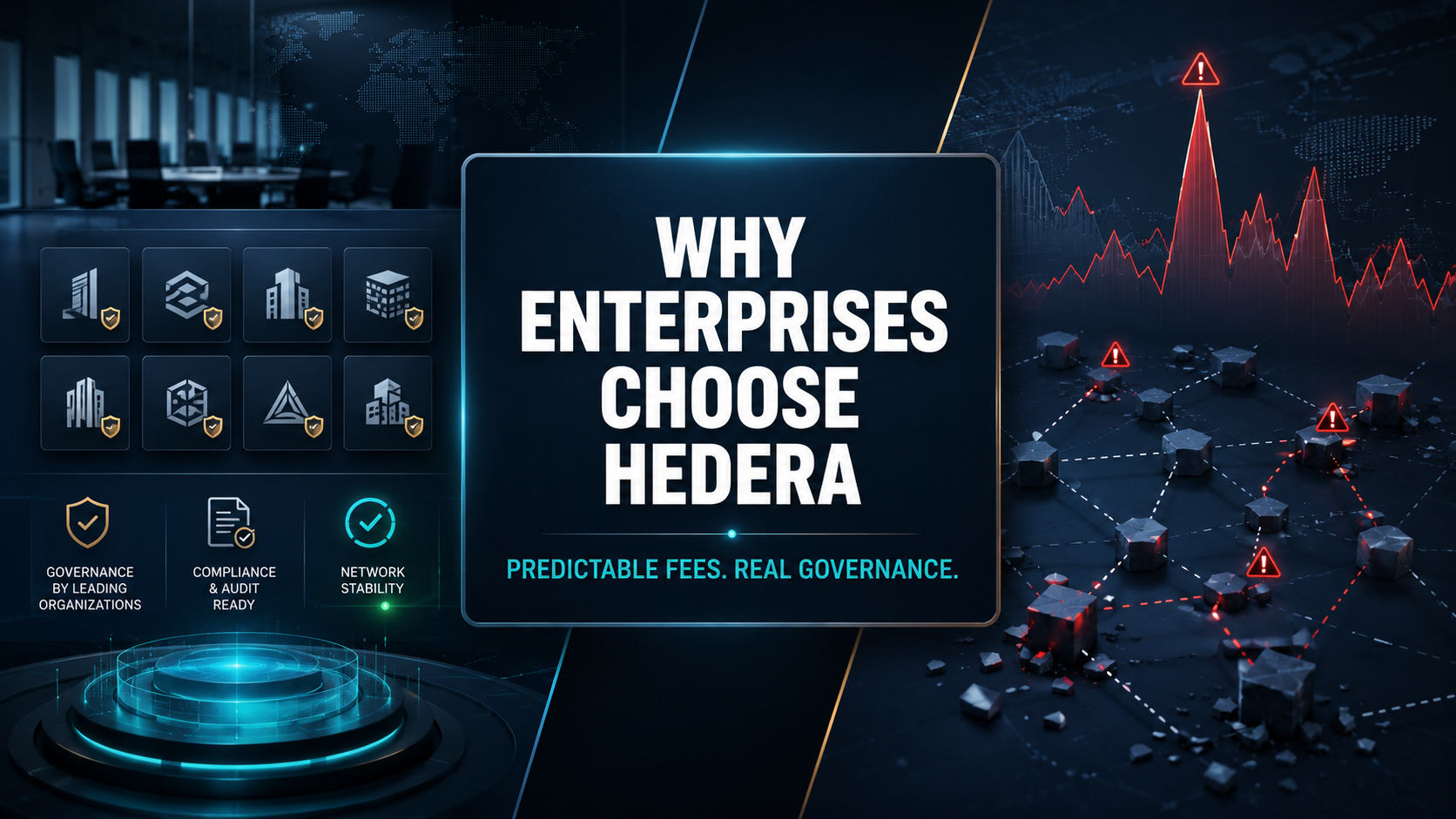
Enterprises are choosing Hedera over traditional blockchains because it offers a unique combination of fixed USD-pegged transaction fees, institutional governance by 39 global giants like Google and IBM, and aBFT-level security that meets the rigorous demands of regulated industries. Unlike variable-cost networks like Ethereum or Solana, Hedera provides the predictability and stability required for production-scale deployments in the "Agentic Economy" of 2026.
What if the "free" or "low-cost" blockchain pilot your team started last year is actually a $50,000-a-month liability waiting to happen? For many Fortune 500 companies, the honeymoon phase of blockchain experimentation has ended, replaced by the cold reality of gas fee spikes and governance uncertainty. You've likely felt the frustration: a network that works perfectly in testing suddenly becomes unusable when retail trading volume surges, or a "decentralized" community votes on a fork that threatens your legal department's peace of mind.
If you’re tasked with building the trust layer for your organization, you aren't looking for a playground; you're looking for an operating system. You need to know that a transaction today will cost the same as a transaction next quarter, and that the network won’t split into two competing versions overnight. This article breaks down exactly why Hedera Hashgraph has emerged as the infrastructure of choice for the world’s most demanding enterprises in 2026.
Key Takeaways
Institutional Stability: Hedera is governed by 39 global organizations (Google, IBM, Accenture, Dell), ensuring the network evolves with enterprise needs rather than anonymous validator whims.
Cost Predictability: Transaction fees are pegged to the USD ($0.0001 for a consensus message), allowing 100% accurate operational budgeting regardless of token price volatility.
Mission-Critical Security: As the only public ledger with aBFT (Asynchronous Byzantine Fault Tolerance) security, Hedera is resistant to DDoS attacks and transaction manipulation.
The AI Audit Trail: In 2026, Hedera has become the "Verifiable AI" layer, logging AI agent decision-making for NVIDIA-powered clusters to prevent hallucination fraud.
ESG Compliance: Hedera is carbon-negative by design, meeting the strict environmental reporting requirements of modern corporate governance.
Institutional Governance: The 39-Member Shield
When Marcus, a senior logistics architect at a global retailer, first proposed using a public ledger to track 500 million inventory items, his legal team almost laughed him out of the room. Their concern wasn't the technology, it was the "who." Who owns the network? Who decides when it updates? What happens if a group of anonymous miners in a different jurisdiction decides to change the rules?
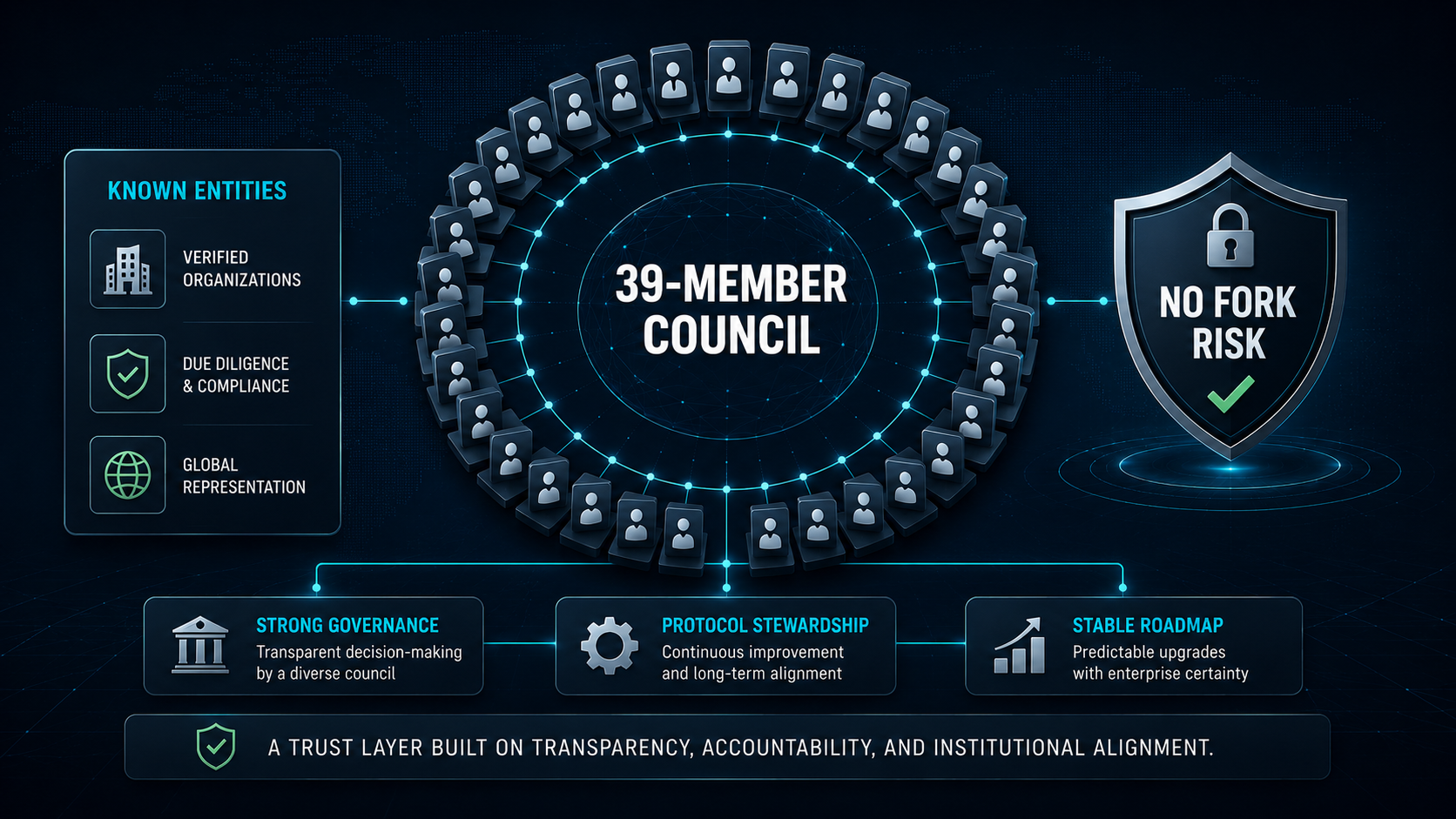
Marcus solved this by showing them the Hedera Governing Council. In May 2026, the council reached its full 39-member capacity with the addition of Accenture, joining the ranks of Google, IBM, Dell, Boeing, and Deutsche Telekom. This isn't just a list of names; it's a legal shield.
The Council Advantage
Unlike Ethereum, where updates are driven by a mix of developers and miners (often with conflicting incentives), Hedera is governed by a rotating council of the world's most reputable organizations. These members have equal voting power and a vested interest in the network's long-term stability. For an enterprise, this means:
No-Fork Guarantee: The Hedera codebase is protected by a commitment from Council members to never fork the network. This eliminates the "split-risk" that haunts networks like Ethereum Classic or various Bitcoin forks.
Regulatory Alignment: Because the Council members are known, regulated entities, they ensure the network remains compliant with global standards like GDPR and HIPAA.
Enterprise-Grade Roadmap: Features are prioritized based on what businesses actually need, such as privacy-preserving sidechains and high-throughput consensus, rather than what might drive the highest "yield" for validators.
Legal Compliance: Known Entities vs. Anonymous Validators
Legal departments prioritize the stability of a network where the "nodes" are accountable. If there is a systemic issue, there are offices to call and legal frameworks to reference. This accountability is the primary reason the Georgia National Real Estate Registry moved its entire property database to Hedera in 2025. They needed a system that was as decentralized as a public ledger but as responsible as a government agency.
Fixed Costs in a Volatile World (The USD-Pegged Advantage)
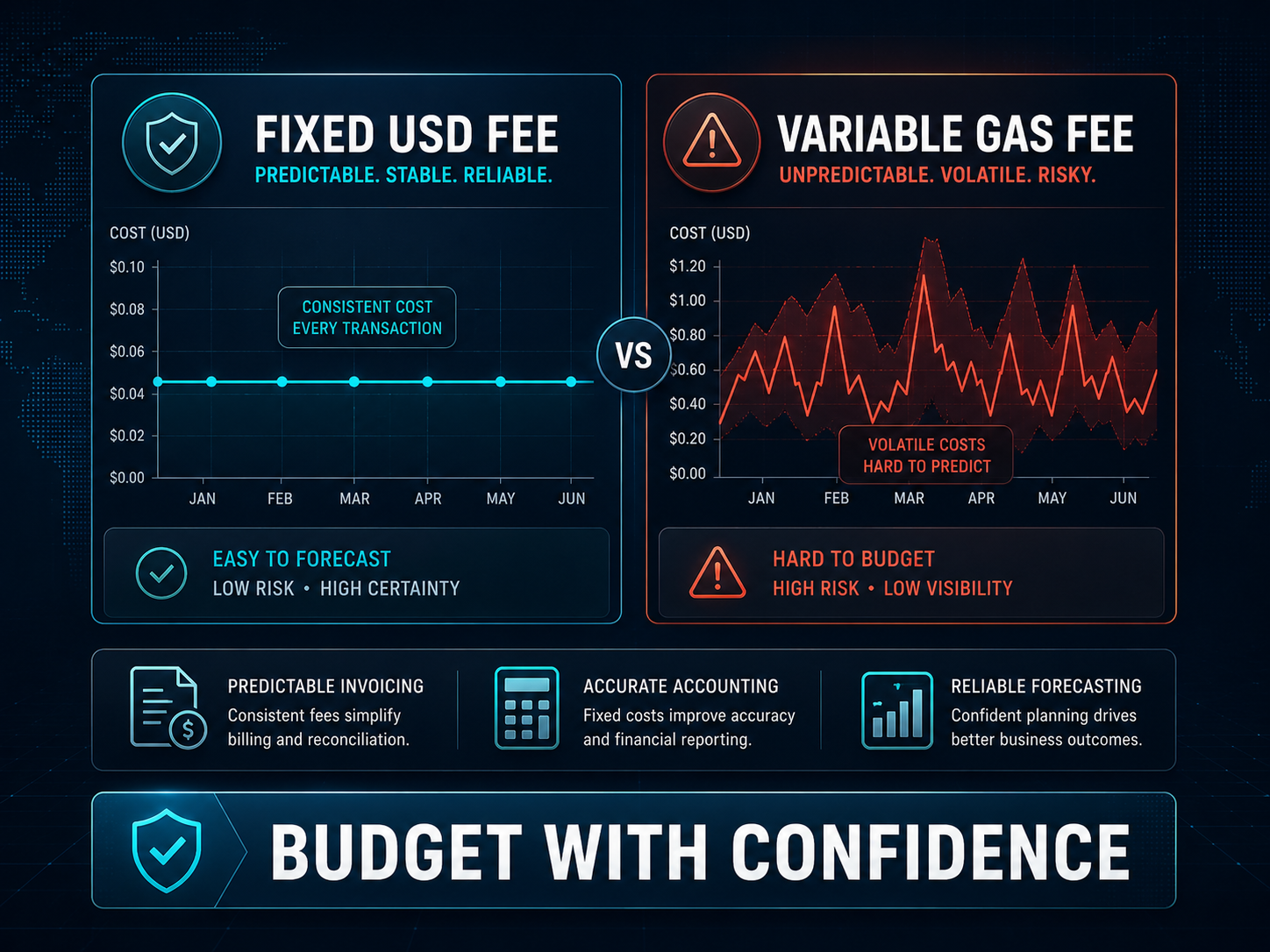
The single biggest barrier to enterprise adoption of DLT has always been cost volatility. Imagine trying to run a manufacturing plant where the price of electricity fluctuated 400% in a single Tuesday because a new NFT collection launched. That is the reality of "gas fees" on traditional blockchains.
Beyond Gas Fees: The $0.0001 Flat Fee
Hedera solved this by decoupling the transaction fee from the token price (HBAR). While you pay in HBAR, the cost is calculated in USD. A simple message on the Hedera Consensus Service (HCS) costs exactly $0.0001.
Network | Fee Mechanism | Predictability |
|---|---|---|
Ethereum | Auction-based (Gas) | Low (spikes during congestion) |
Solana | Priority fees + Base fee | Moderate (variable under load) |
Hedera | USD-Pegged Fixed Fee | 100% (fixed regardless of load) |
Budgeting for Scale: The atma.io Success Story
Avery Dennison, through its atma.io platform, currently tracks billions of individual items, from apparel to food, using Hedera. Because their fees are pegged to the dollar, they could forecast exactly what it would cost to log every point in their supply chain for the next five years.
If they had used a variable-fee network, a single "gas spike" could have wiped out their entire quarterly margin for a specific product line. By using Hedera, they maintained their manufacturing unit economics without the risk of external market forces inflating their operational overhead.
HBAR vs. USD: How it Works
When a company like Avery Dennison sends a transaction, the network checks the current HBAR/USD exchange rate via a decentralized oracle. If HBAR is $0.10, the $0.0001 fee costs 0.001 HBAR. If HBAR rises to $1.00, the fee automatically drops to 0.0001 HBAR. The enterprise's cost remains exactly the same.
Performance and Security: The Hashgraph Difference
Most "traditional" blockchains are based on a chain of blocks. This creates a bottleneck: if two people produce a block at the same time, the network has to pick one and discard the other (leading to inefficiency and security risks).
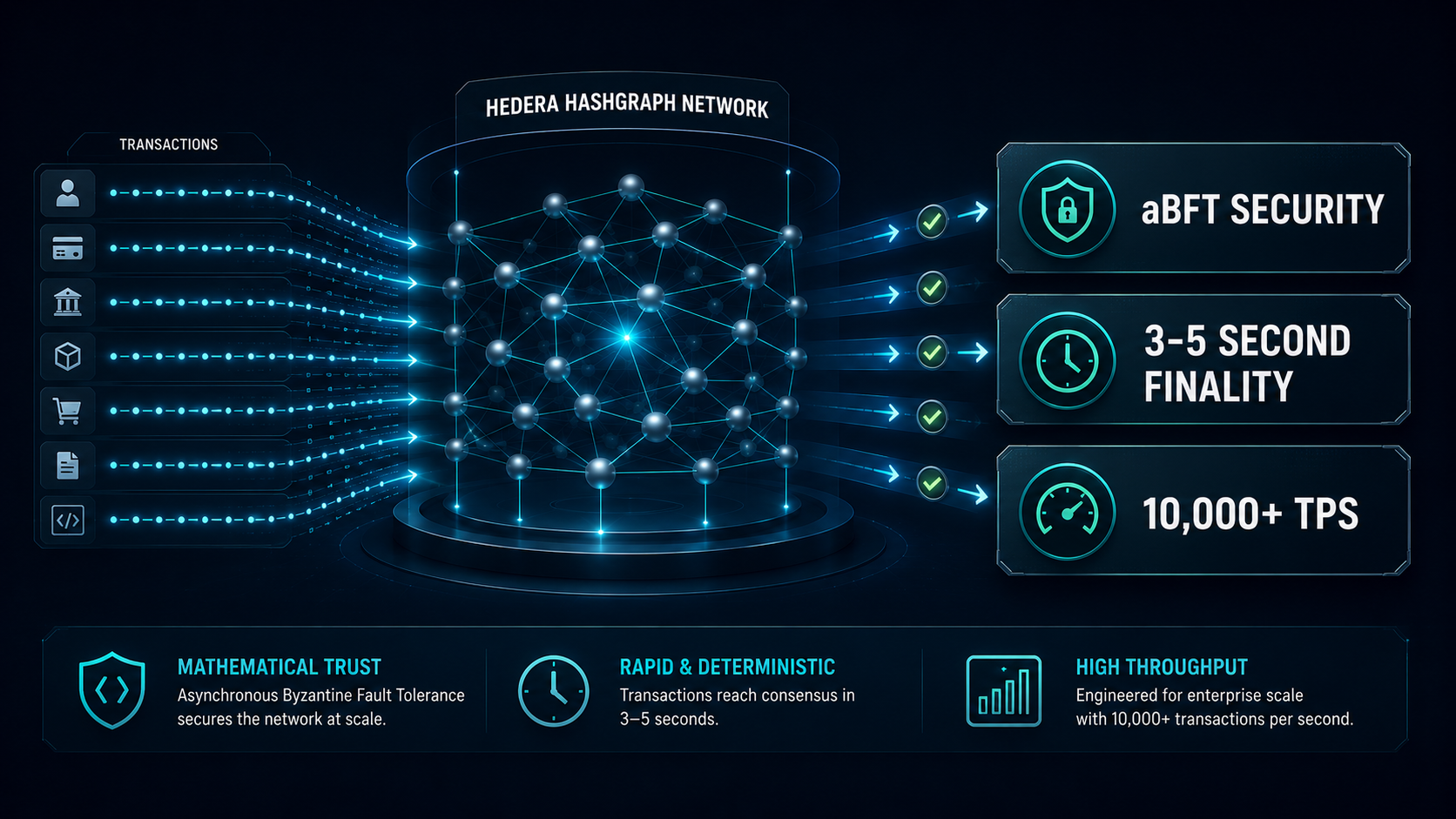
Hedera uses the Hashgraph consensus algorithm. Instead of a chain, it’s a "gossip about gossip" protocol where no information is ever discarded. This leads to three mission-critical advantages:
1. aBFT Security: The Gold Standard
Asynchronous Byzantine Fault Tolerance (aBFT) is the highest possible level of security for a distributed network. It means the network can reach consensus even if some nodes are malicious or if messages are delayed or lost. In an era of increasing state-sponsored cyberattacks, aBFT is the only security level acceptable for national infrastructure or global bank settlements. It prevents "front-running" (where a validator sees your transaction and puts theirs in front of it) and DDoS attacks that can paralyze slower networks.
2. Instant Finality
In the retail and finance worlds, "probabilistic finality" isn't good enough. If you’re at a checkout counter, you can’t wait 10 minutes for "three block confirmations" to ensure the payment went through. Hedera offers consensus finality in 3-5 seconds. When the network says the transaction is done, it is immutable and irreversible.
3. High Throughput: 10,000+ TPS
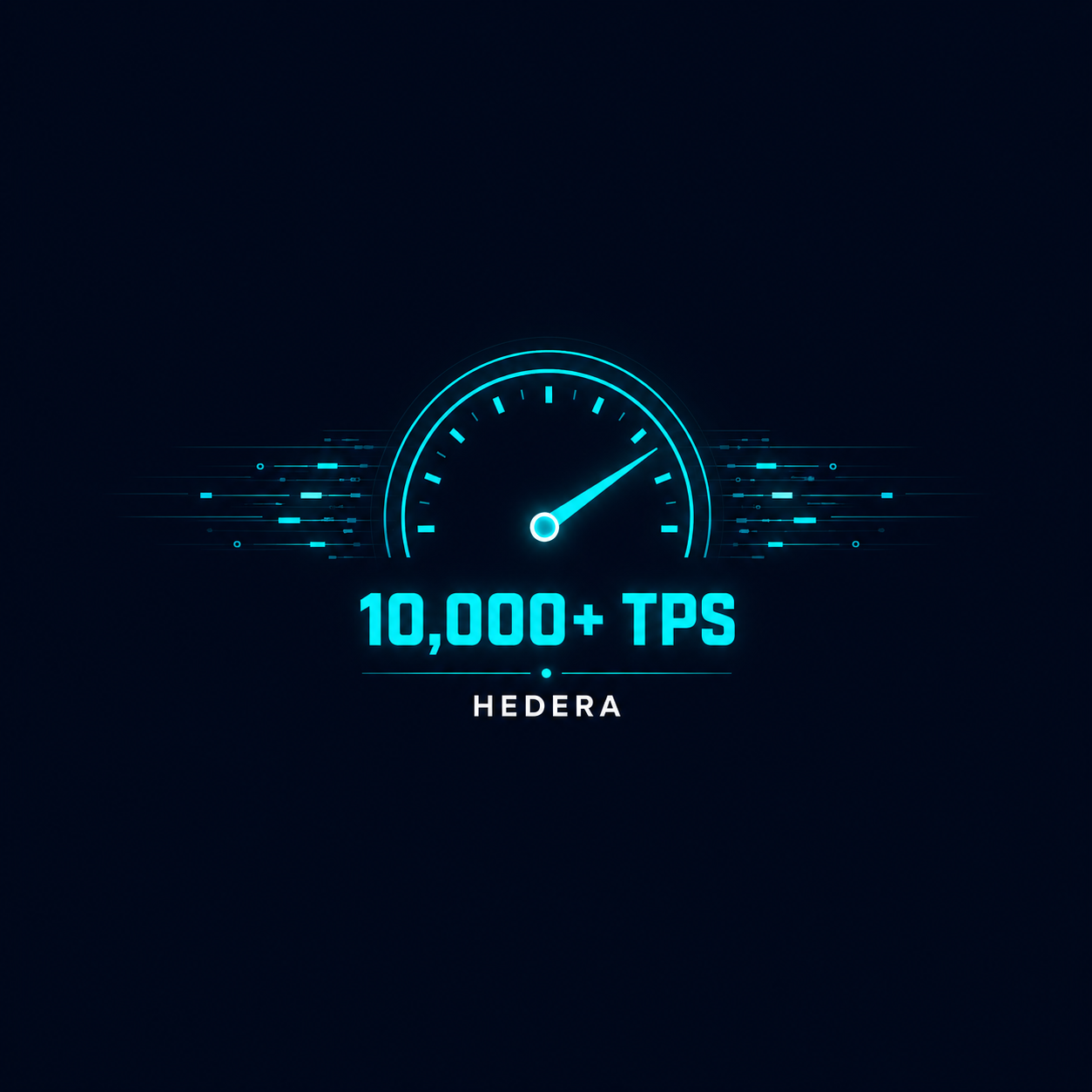
While Ethereum struggles with 15-30 transactions per second (TPS), Hedera handles 10,000+ TPS on a single shard. This isn't just a theoretical number; the network regularly processes billions of transactions per month for real-world applications.
The 2026 Narrative: Hedera and the Agentic Economy
By mid-2026, the conversation shifted from "What can DLT do for data?" to "How do we trust AI agents?" As companies deployed autonomous AI agents to handle procurement, customer service, and even financial trading, a new problem emerged: The Accountability Gap.
Verifiable AI
Sarah, a Chief Information Security Officer (CISO) at a mid-sized healthcare firm, faced a nightmare scenario: her company's AI agent had authorized a $50,000 medical equipment purchase that seemed irregular. Without an audit trail, she couldn't prove if the agent had hallucinated, been prompted incorrectly, or been "poisoned" by a malicious actor.
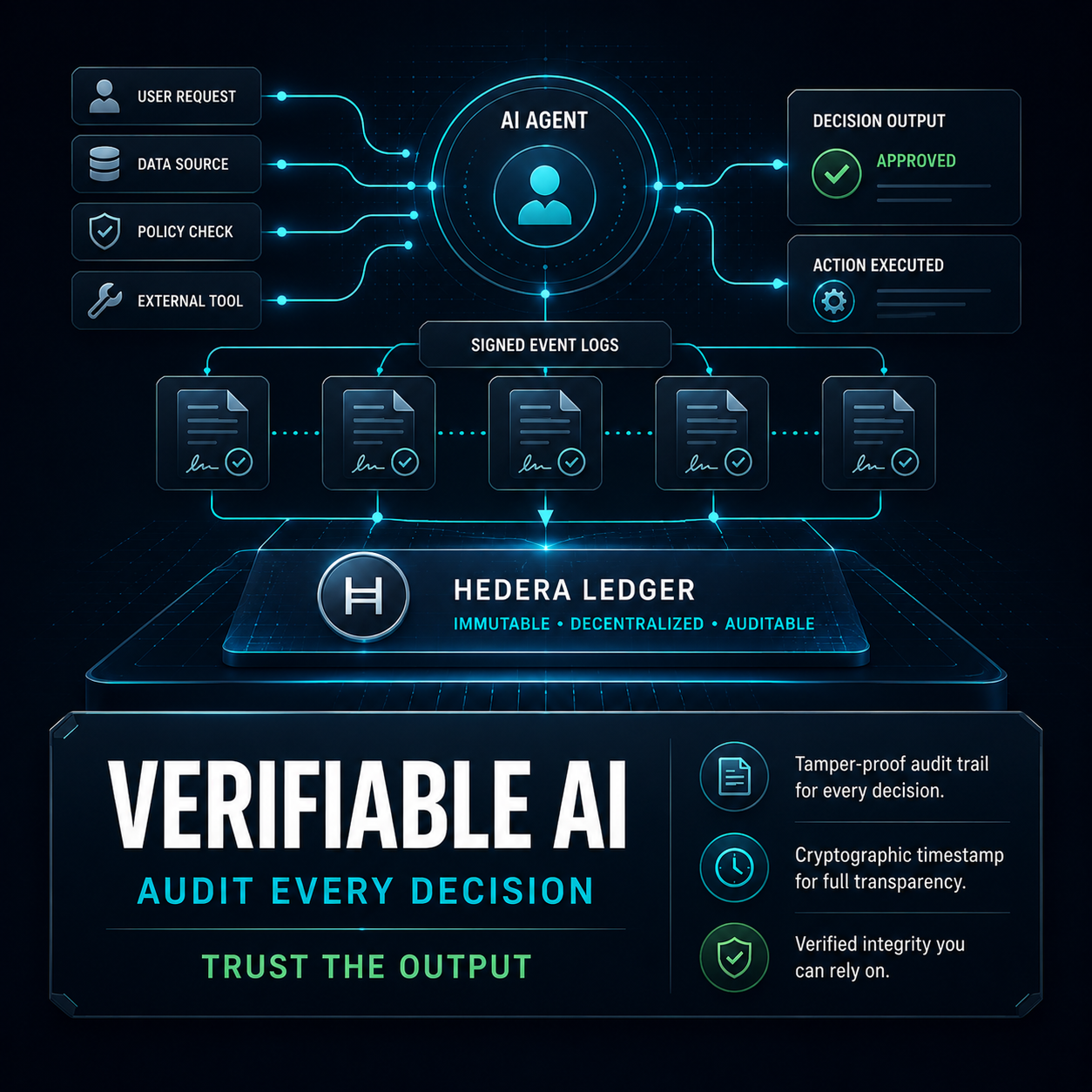
This is where NVIDIA and EQTY Lab stepped in. By integrating Hedera's Consensus Service (HCS) directly into NVIDIA's Blackwell GPU architecture, every decision an AI agent makes is cryptographically signed and logged to the Hedera ledger.
The Proof of Training: Organizations use Hedera to prove which dataset was used to train a specific model.
The Proof of Output: Every response from an AI agent is timestamped and anchored to the ledger.
The Audit Trail: Auditors can verify the entire decision-making chain without needing access to the "black box" of the AI's internal weights.
NVIDIA & EQTY Lab: Preventing Fraud
In 2026, the collaboration between NVIDIA and EQTY Lab has become the industry standard for "Verifiable AI." By using Hedera as the trust layer, they've created an ecosystem where machines can trade with other machines (micro-payments) with 100% certainty of the transaction's provenance.
Case Studies: Hedera in Production
It’s easy to talk about theoretical throughput, but in 2026, the evidence is in the production logs. Hedera has moved past the "Proof of Concept" (PoC) phase into the "Proof of Value" phase.
Finance: abrdn and Asset Tokenization
The global investment company abrdn has successfully tokenized billions in money market funds on Hedera. By moving these assets to the ledger, they’ve reduced settlement times from days to seconds and drastically lowered the administrative costs of working capital planning. They chose Hedera because it was the only public network that met the "Institutional Checklist": fixed fees, aBFT security, and a Governing Council they could trust.
Supply Chain: atma.io Digital Product Passports
As the EU's "Digital Product Passport" (DPP) regulations went into effect, Avery Dennison’s atma.io became the dominant solution. Every item, from a pair of sneakers to a car battery, now has a digital twin on Hedera that tracks its carbon footprint, material origin, and recyclability.
Public Sector: The Georgia National Real Estate Registry
The country of Georgia didn't just experiment with blockchain; they migrated their national property registry to Hedera. By tokenizing real estate, they've enabled fractional ownership and instant title transfers, eliminating the fraud that previously plagued the paper-based system.
Payments: Dropp and FedNow
Dropp, a micropayments platform, is now a featured service provider for the U. S. Federal Reserve's FedNow service. This allows consumers to make "pay-per-use" purchases, like $0.25 for a single news article or $0.10 for a high-speed EV charge, using Hedera as the low-cost recording layer and FedNow as the instant settlement rail.
Hedera vs. The Field: A Comparative Matrix
To understand why Hedera is winning the enterprise race, we have to look at how it stacks up against the "big three" alternatives.
Feature | Hedera Hashgraph | Enterprise Ethereum (Besu) | Hyperledger Fabric | Solana |
|---|---|---|---|---|
Network Type | Public (Enterprise Gov) | Private / Hybrid | Private (Permitted) | Public (Permissionless) |
Transaction Fee | $0.0001 (Fixed USD) | Variable (Gas) | N/A (Internal) | Variable (Low) |
Security | aBFT (Highest) | PBFT / PoS | PBFT / Kafka | PoH / PoS |
Governance | 39 Global Corps | Fragmented / DAO | Individual Consortiums | DAO / Large Validators |
Finality | 3-5 Seconds | 1-2 Minutes | Variable | 2-10 Seconds |
Fork Risk | None | High | Low | Low |
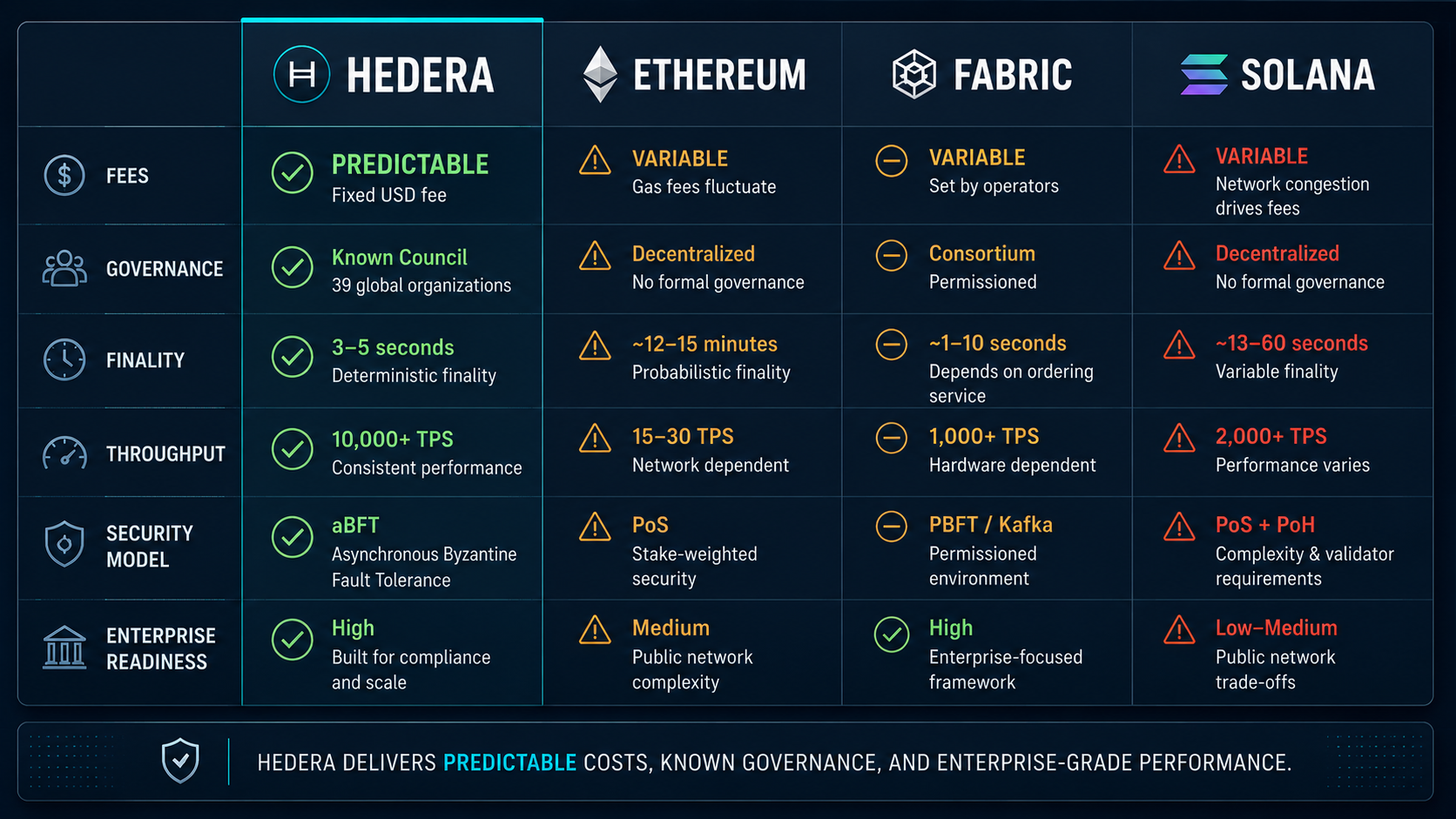
Hedera vs. Enterprise Ethereum (Besu/Quorum)
Many enterprises start with a private version of Ethereum (like Hyperledger Besu) but quickly realize the limitations: a private chain is only as trustworthy as the people running it. If you want to prove your supply chain data to an outside auditor or a customer, a private chain doesn't carry the same weight as a public, immutable ledger. Hedera provides "Public Proof" with the "Private Isolation" through tools like HashSphere, which allows for hybrid architectures.
Hedera vs. Hyperledger Fabric
Hyperledger Fabric is excellent for a small group of companies that already trust each other. However, it requires a massive amount of technical overhead to maintain the "ordering service" and manage certificates. Hedera offers a "Plug-and-Play" consensus service (HCS) that provides the same benefits without the infrastructure nightmare.
Hedera vs. Solana
Solana is incredibly fast and has gained massive retail traction. However, for a Fortune 500 company, Solana’s history of network outages and its permissionless validator set are significant risks. Hedera offers comparable speed with the added "Adults in the Room" governance that insurance and legal departments demand.
Conclusion: The "Silent" Infrastructure Winner
In the early days of the internet, there were many competing protocols. Eventually, the world settled on TCP/IP because it was robust, scalable, and predictable. In 2026, the DLT space is reaching its "TCP/IP moment," and Hedera has emerged as the silent winner for regulated industries.
By focusing on the boring but essential parts of infrastructure, fixed costs, stable governance, and mathematical security, Hedera has built the trust layer that the global economy actually needs. Whether you are tokenizing assets, tracking carbon footprints, or auditing the decisions of autonomous AI agents, your choice of ledger will determine your methodology for long-term growth.
The shift from "blockchain pilots" to "institutional DLT" is complete. The question is no longer if your company will use a public ledger, but when you will move your critical operations to the network built specifically for the task.