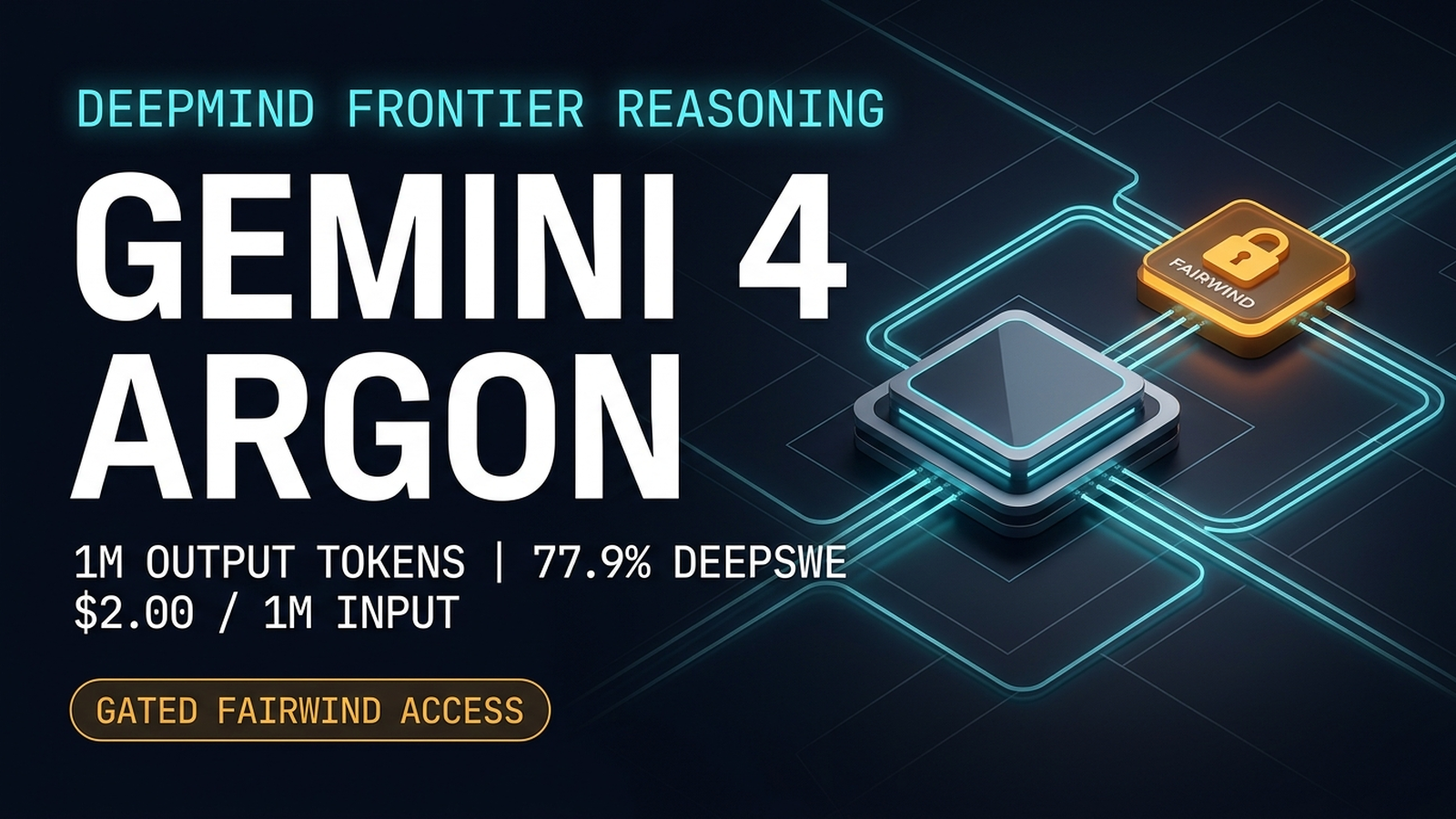
Gemini 4 Argon is Google DeepMind's frontier reasoning model announced on September 30, 2026, delivering a breakthrough 1-million-token output reasoning capacity, a 77.9% score on the DeepSWE v1.1 benchmark, and introductory API pricing of $2.00 per million input tokens and $10.00 per million output tokens. Initial deployment is strictly restricted to vetted cybersecurity defenders in Google's Fairwind Program, with phased enterprise access coming to Google Cloud Vertex AI, Google AI Studio, and Google AI Ultra subscribers over the coming months.
If you lead an engineering department, build on top of LLM APIs, or budget SaaS infrastructure, you already know the frustration of frontier model announcements. A vendor publishes stunning benchmark charts, quotes headline-grabbing speeds, and leaves you guessing how the model actually behaves under production load, what a single agentic task costs on your cloud bill, and whether you can even obtain an API key before next quarter.
This guide provides an unvarnished, operator-grade analysis of Gemini 4 Argon. We evaluate its technical capabilities, conduct a side-by-side benchmark audit against OpenAI's GPT-6 Astra and Anthropic's Claude Opus 5.5, break down the unit economics of its 95% context caching discount, and lay out the exact enterprise access timeline so you can plan your technical roadmap with confidence.
Consider Marcus, an engineering director at a mid-market logistics platform. When Marcus read the initial press coverage on launch morning, he immediately drafted an initiative to automate legacy codebase migrations across 40 internal services. But after calculating the un-cached API costs of multi-file refactoring runs using full 200,000-token traces, his back-of-the-envelope budget hit $45,000 a month, far outstripping his department's tooling budget. Only after restructuring the repository architecture to exploit prompt caching did the math fall to under $2,300. Modeling your compute economics before running production workloads is the difference between sustainable automation and destroyed software margins.
Key Takeaways
Architectural Leap: Gemini 4 Argon expands the maximum generation output from 64,000 tokens to 1,000,000 tokens, allowing autonomous agents to execute multi-file software refactors and deep financial audits in a single execution trace without chunking degradation.
Top-Tier Benchmark Delivery: The model captures the top spot on software engineering (77.9% on DeepSWE v1.1) and GDP-weighted business tasks (68.9% on the Vals Index), while matching GPT-6 Astra at 68.0% on automated security vulnerability patching (CWE-bench v1).
Known Benchmark Weaknesses: Argon trails Claude Opus 5.5 and GPT-6 Astra on real-world command-line workflows (Terminal-bench 4.0) and graphical operating system navigation (OSWorld-2.0).
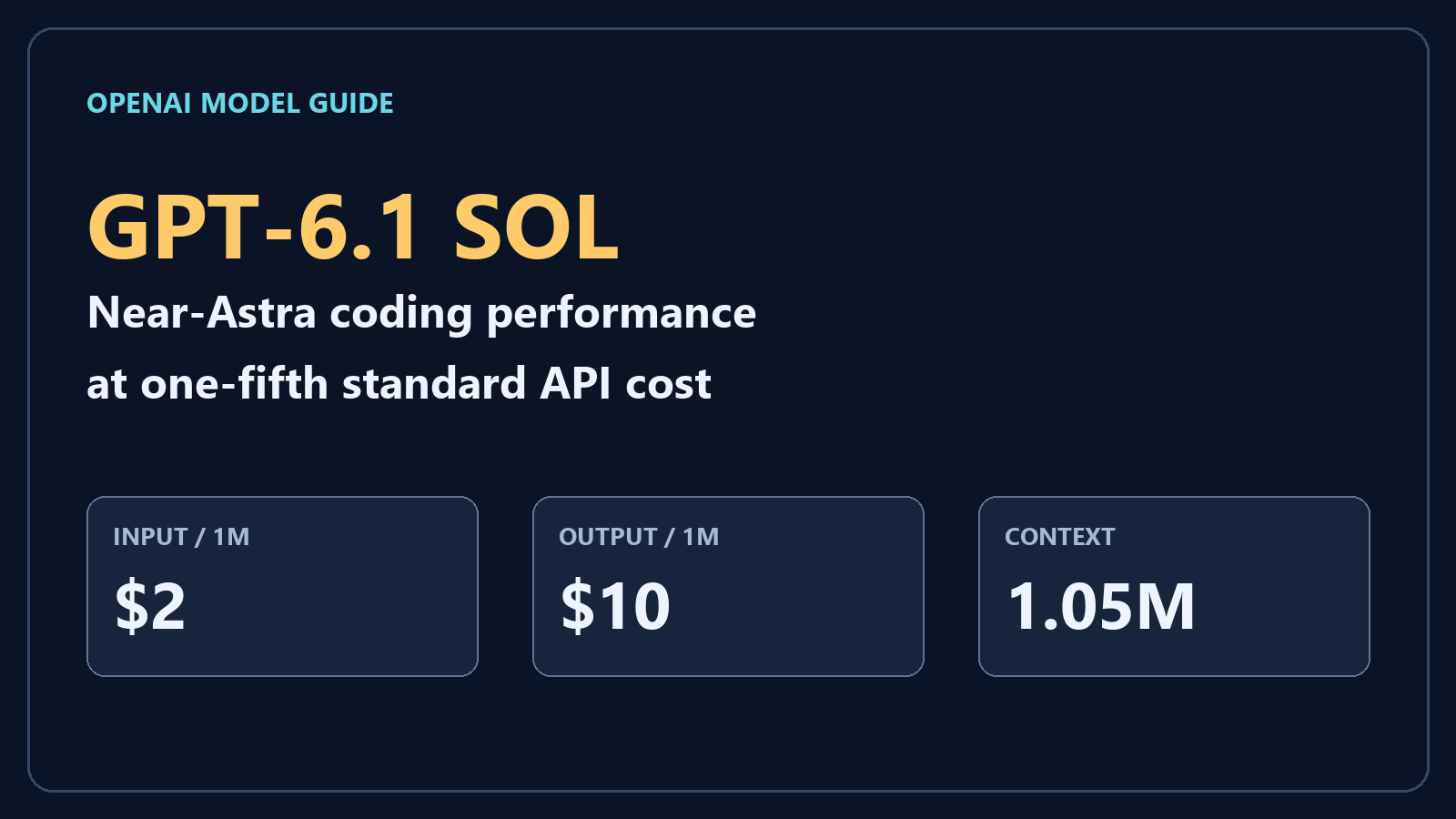
Aggressive Unit Economics with Caching: Introductory pricing sits at $2.00/M input and $10.00/M output (doubling to $4.00/M and $20.00/M post-promo). A 95% prompt-caching discount drops repetitive input processing to $0.10/M tokens, making long-horizon agentic loops commercially viable.
Gated Access Roadmap: Production API keys are initially restricted to defensive security operators via the Google Fairwind Program; general developers and Vertex AI enterprise teams must wait for private preview waves later in 2026.
Google Gemini 4 Argon Analysis and Benchmarks
What Makes Gemini 4 Argon Different: The 1M Output Token Breakthrough
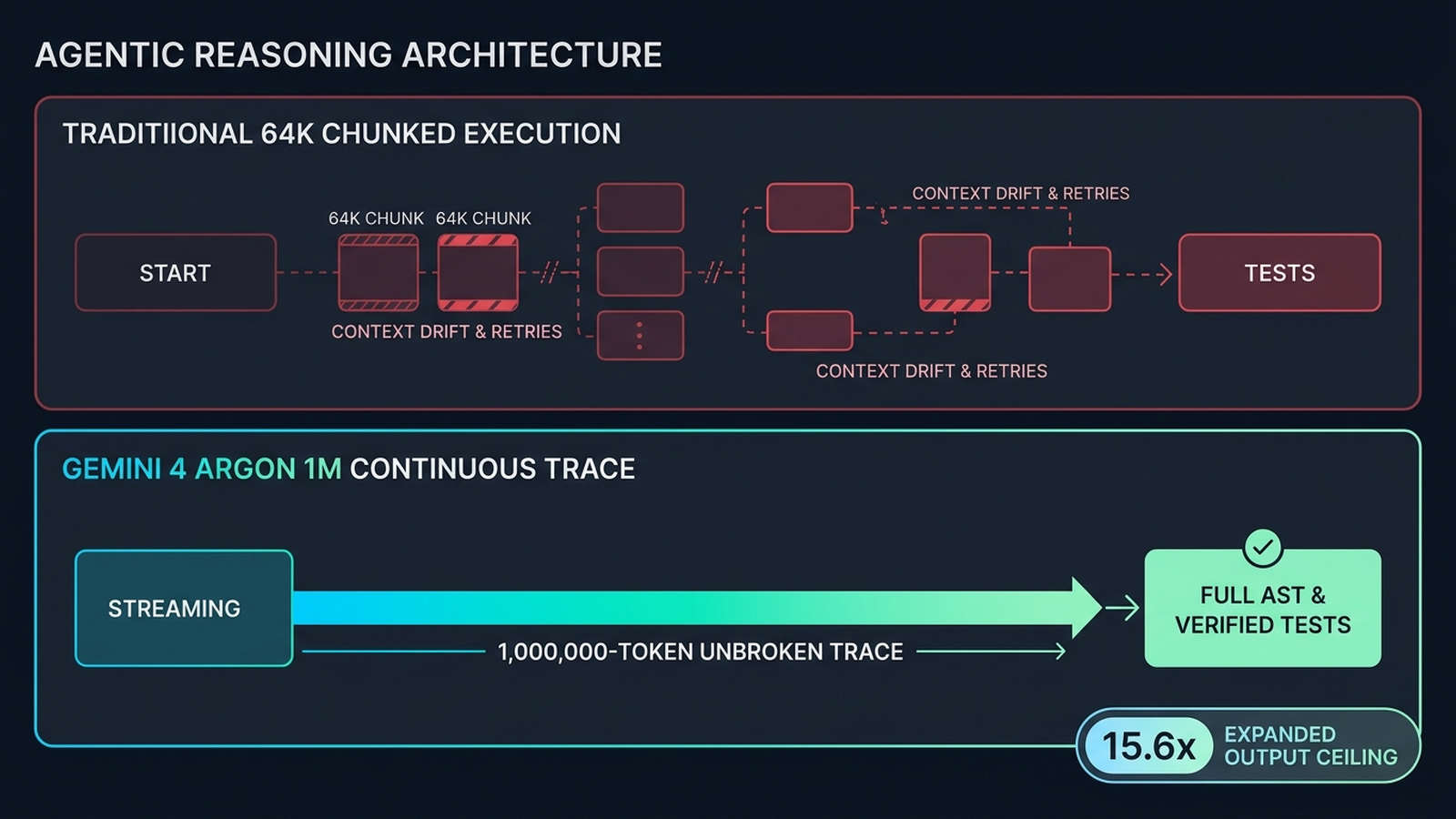
The defining technical breakthrough of Gemini 4 Argon is not its context window for ingestion, it is its generation ceiling. Previous frontier models, including Gemini 1.5 Pro and competing flagship models, capped output generation between 4,096 and 64,000 tokens. While a 2-million-token input window allowed developers to feed massive codebases or video files into an LLM, the model could only respond in short bursts.
The Gemini 4 output token limit reaches 1,000,000 tokens, representing a 15.6x expansion over previous 64,000-token generation ceilings and fundamentally altering how autonomous agentic systems operate.
Traditional Agentic Architecture (64K Output Limit):
Input Context Traditional Agentic Architecture (64K Output Limit):
Input Context --> [Model]  [Model] --> 64K Chunk  64K Chunk --> Parsing / Vector Store  Parsing / Vector Store --> Context Loss / Drift
 |
 +------------------------------- Context Loss / Drift
 |
 +---------------------------------> Next Chunk  Next Chunk --> Repeated Handshake Overhead

Gemini 4 Argon Architecture (1M Output Limit):
Input Context  Repeated Handshake Overhead

Gemini 4 Argon Architecture (1M Output Limit):
Input Context --> [Gemini 4 Argon]  [Gemini 4 Argon] --> Continuous 1,000,000-Token Output Trace
 (Full AST, Tests, Migrated Modules, and Documentation in One Run)
In standard software engineering workflows, asking an AI agent to refactor a multi-file dependency graph or modernize an enterprise module previously required synthetic orchestration:
Splitting code into arbitrary chunks.
Generating partial file updates.
Storing intermediate outputs in vector databases.
Calling the model repeatedly to reconcile merge conflicts and logical hallucinations.
When an agent's reasoning state degrades across multiple disconnected calls, edge-case bugs multiply. With a 1-million-token output capacity, Gemini 4 Argon holds internal reasoning chains, complete abstract syntax trees (ASTs), test harness executions, and full file rewrites within a single uninterrupted execution trace.
Internal Google Deployments & Production Results
According to the official launch disclosure from Google DeepMind, the model has been deployed internally across Google's engineering organization for months prior to public announcement. Google highlighted three concrete operational outcomes:
Quantum Computing Circuit Compilation: When tasked with mapping complex subroutines for quantum algorithm simulation, Argon reduced hardware resource utilization by 40% compared to published academic baselines in under twenty minutes of compute time.
Infrastructure Memory Optimization: Google deployed the model's code analysis agents across its global data center fleet, identifying memory leaks and sub-optimal garbage collection routines that freed over 300 TiB of RAM, with engineering forecasts projecting total fleet savings between 500 TiB and 1 PiB.
Core Modernization and Language Migration: In systems engineering pipelines, Argon migrated more than 800,000 lines of legacy C and C++ code within the Fuchsia Zircon kernel to memory-safe Rust. An updated Rust decoder for the
libgav1video codec generated by the model outperformed previous human-written ports by a factor of 2.7x in decoding throughput.
These results indicate that Argon was intentionally tuned for deep systems engineering, quantitative knowledge synthesis, and automated remediation rather than conversational back-and-forth.
If your organization plans to deploy autonomous coding agents or evaluate cloud opex against dedicated hardware, review our guide to capital budgeting for infrastructure to structure your development milestones and compute allocation before committing capital.
Gemini 4 Argon Benchmarks: Where It Wins (and Where It Falls Short)
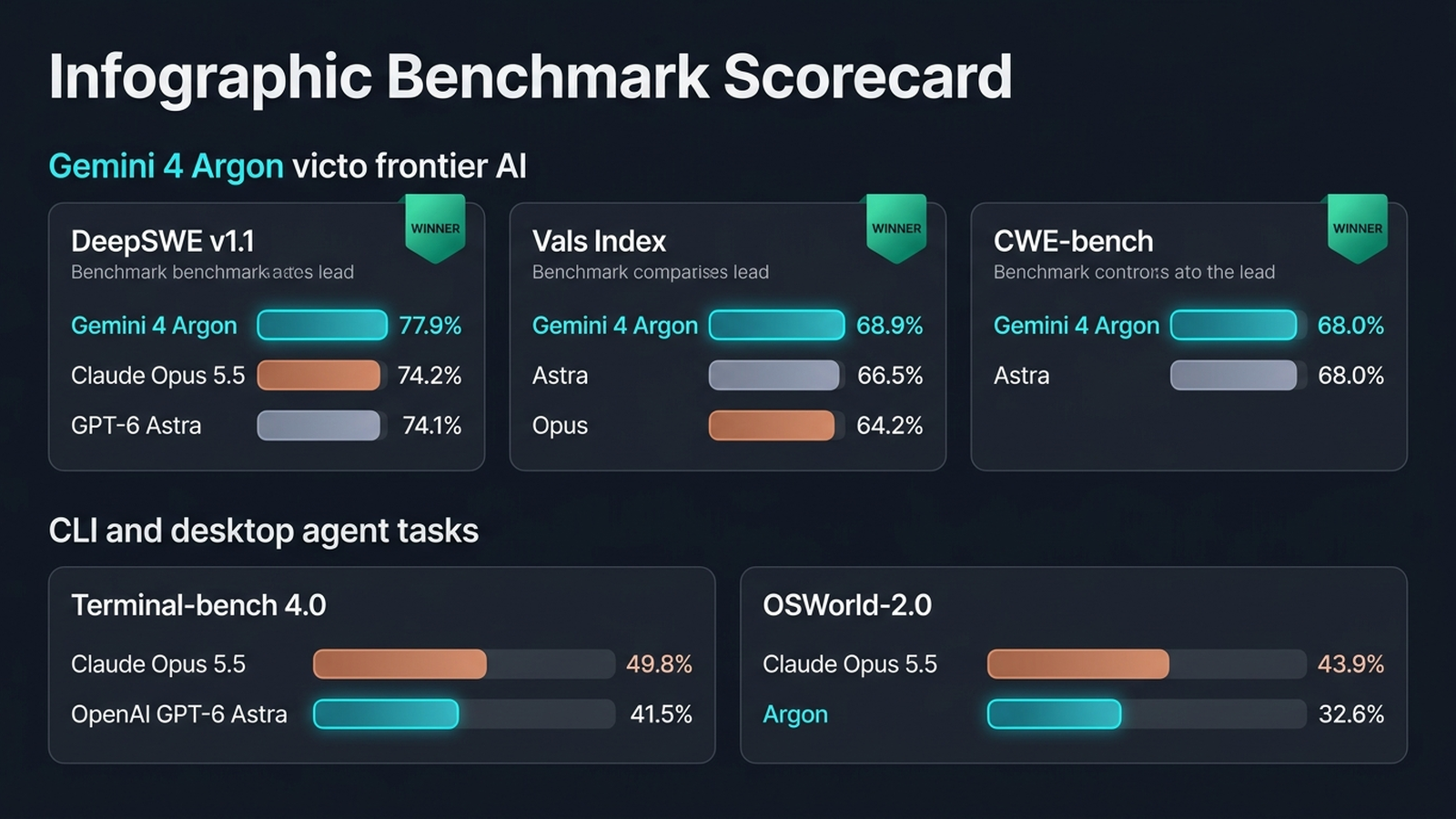
Vendor-provided benchmark scorecards often conceal as much as they reveal. To understand where Gemini 4 Argon genuinely leads the industry and where competing models retain their edge, we examined third-party evaluations across software engineering, enterprise economics, cybersecurity, and multimodal reasoning.
The primary competitive benchmark matrix compares Gemini 4 Argon against Anthropic's Claude Opus 5.5 and OpenAI's GPT-6 Astra across published evals.
Frontier Model Benchmark Comparison (October 2026)
Evaluation Benchmark | Primary Domain | Gemini 4 Argon | Claude Opus 5.5 | OpenAI GPT-6 Astra | Category Winner |
|---|---|---|---|---|---|
DeepSWE v1.1 | Long-Horizon Software Engineering | 77.9% | 74.2% | 74.1% | Gemini 4 Argon |
SWE-bench Verified | Issue Resolution / Bug Fixing | 62.4% | 65.1% | 64.8% | Claude Opus 5.5 |
FrontierSWE v2 | Complex Architecture Refactoring | 44.2% | 46.8% | 48.1% | GPT-6 Astra |
Terminal-bench 4.0 | CLI & Bash Script Execution | 41.5% | 49.8% | 47.3% | Claude Opus 5.5 |
OSWorld-2.0 | Computer Use & Desktop Navigation | 32.6% | 43.9% | 38.2% | Claude Opus 5.5 |
Vals Index | GDP-Weighted Business / Knowledge | 68.9% | 64.2% | 66.5% | Gemini 4 Argon |
Vals Finance Agent v2 | Multi-Statement Financial Modeling | 65.4% | 59.8% | 61.2% | Gemini 4 Argon |
CWE-bench v1 | Automated Vulnerability Remediation | 68.0% | 62.5% | 68.0% | Tie (Argon / Astra) |
LVBench | Long-Form Video / Multimodal (Hours) | 91.7% | 82.4% | 85.0% | Gemini 4 Argon |
Software Engineering: DeepSWE vs. Terminal Execution
On software engineering tasks, the distinction between code synthesis and command-line execution is stark. On DeepSWE v1.1, which evaluates an agent's ability to maintain context across multi-file codebases, understand legacy documentation, and implement complex pull requests, Gemini 4 Argon scored 77.9%, establishing a clear 3.7-percentage-point lead over Claude Opus 5.5 (74.2%) and GPT-6 Astra (74.1%).
In a direct Gemini 4 Argon vs Claude Opus 5.5 comparison across software engineering benchmarks, Opus 5.5 preserves a narrow advantage on Terminal-bench and interactive bash scripting, whereas Argon dominates long-horizon repository refactoring. When evaluated on Terminal-bench 4.0, which tests how effectively a model interacts with a Linux shell, diagnoses compiler errors, pipes inputs between utilities, and configures environments, Argon managed only 41.5%, trailing Claude Opus 5.5's 49.8%.
Similarly, on SWE-bench Verified, Claude Opus 5.5 continues to hold the benchmark lead at 65.1% versus Argon's 62.4%. This reveals a specific model profile: Argon excels at deep structural code synthesis, algorithm optimization, and multi-file rewriting, while Claude remains the superior interactive agent for bash navigation, terminal diagnostics, and live environment debugging.
Enterprise Knowledge Work: The Vals Index
For business and financial workflows, the most relevant independent metric is the Vals Index, tracked by Vals AI Benchmarks. Unlike academic multiple-choice tests, the Vals Index measures performance on tasks weighted by their real-world economic contribution to GDP, including tax preparation, statutory compliance, contract reconciliation, and financial auditing.
Gemini 4 Argon ranks #1 globally on the Vals Index at 68.9%, outperforming GPT-6 Astra (66.5%) and Claude Opus 5.5 (64.2%). On the Vals Finance Agent v2 benchmark, Argon achieved 65.4% accuracy on complex corporate tasks involving balance sheet reconciliation, cash conversion modeling, and multi-period revenue forecasts.
While these benchmarks prove that frontier models can automate heavy analytical lifting, human operational review remains essential. Whether reconciling an M&A balance sheet or calculating debt service coverage, an operator must verify the output against verified accounting standards. For engineering teams modeling delivery costs and unit economics, analyzing benchmarks with our SaaS profit margin calculator provides essential baseline clarity.
Cybersecurity and Defending Against Dual-Use Risks
On CWE-bench v1, which measures an AI model's capacity to scan source code for Common Weakness Enumerations defined by MITRE CWE Standards and draft secure, functional patches, Argon tied OpenAI's GPT-6 Astra at 68.0%.
When evaluating Gemini 4 Argon vs GPT-6 Astra on automated vulnerability remediation, both frontier models tied at 68.0% on CWE-bench v1. The model's ability to autonomously identify buffer overflows, race conditions, and deserialization flaws in minutes is precisely why Google has restricted early distribution. A frontier reasoning model that can automate patch synthesis can also be weaponized to discover zero-day attack vectors if deployed without boundary defenses.
Gemini 4 Argon Pricing: Modeling the Unit Economics
Frontier AI pricing determines whether an advanced model is a transformative asset or an unsustainable cost center. Historically, deploying flagship models for autonomous multi-step reasoning has carried punitive token costs.
Google introduced a two-tiered pricing structure for Gemini 4 Argon: an Introductory Promotional Rate available at launch, and a Standard Long-Term Rate documented in the launch footnotes.
Gemini 4 Argon API Token Pricing Structure
Pricing Tier | Input Tokens (Per 1 Million) | Output Tokens (Per 1 Million) | Cached Input Tokens (Per 1M - 95% Discount) | Status |
|---|---|---|---|---|
Introductory Rate | $2.00 | $10.00 | $0.10 | Active Launch Window |
Standard Rate | $4.00 | $20.00 | $0.20 | Post-Introductory Schedule |
Claude Opus 5.5 (Standard) | $4.00 | $20.00 | $0.40 (90% Cache Discount) | Live Production |
GPT-6 Astra (Standard) | $10.00 | $50.00 | $1.25 (87.5% Cache Discount) | Live Production |
Source: Pricing documented on Google Cloud Vertex AI Pricing and vendor disclosures as of October 2026.
At $2.00 per million input tokens and $10.00 per million output tokens, Argon's promotional rate significantly undercuts GPT-6 Astra ($10/$50) and matches standard mid-tier models while offering frontier intelligence. Even after the promotional window closes and rates reset to $4.00 input and $20.00 output, Argon will remain price-competitive with Claude Opus 5.5 while offering fifteen times the output ceiling.
The 95% Context Caching Advantage
The real financial breakthrough for software engineering teams is Google's 95% prompt-caching discount. Understanding the Gemini 4 output token limit and prompt caching thresholds is essential before scheduling automated agent runs.
When building an autonomous coding agent, the agent must repeatedly read your repository context. If your codebase, schema, and API documentation total 500,000 tokens, sending that entire prompt across 20 iterative debugging loops would consume 10,000,000 input tokens.
Without Prompt Caching: 10M input tokens @ $2.00/M = $20.00
With 95% Prompt Caching: 0.5M tokens initial read ($1.00) + 9.5M cached reads @ $0.10/M ($0.95) = $1.95
A 90% reduction in total task cost transforms the viability of automated workflows.
Worked Example: Elena's 100,000-Line Codebase Modernization
To illustrate the commercial reality, consider Elena, the CTO of an enterprise SaaS platform specializing in inventory logistics. Her engineering team planned to refactor a legacy monolithic billing service comprising 100,000 lines of code (roughly 400,000 tokens of input context).
Elena modeled three development scenarios for running automated testing, refactoring, and integration across 25 iterative agent runs:
Scenario 1: Raw API (No Prompt Caching)
- Input: 400,000 tokens x 25 calls = 10,000,000 tokens @ $2.00/M = $20.00
- Output: 20,000 tokens x 25 calls = 500,000 tokens @ $10.00/M = $5.00
- Total Cost per Feature Run: $25.00
- Total Cost for 50 Microservices: $1,250.00

Scenario 2: Structured Prompt Caching (95% Discount on Cached Input)
- Initial Cold Input: 400,000 tokens @ $2.00/M = $0.80
- Subsequent Cached Input: 9,600,000 tokens @ $0.10/M = $0.96
- Output Generation: 500,000 tokens @ $10.00/M = $5.00
- Total Cost per Feature Run: $6.76
- Total Cost for 50 Microservices: $338.00

Scenario 3: Standard Post-Promo Pricing (With Caching at $0.20/M Input & $20.00/M Output)
- Initial Cold Input: 400,000 tokens @ $4.00/M = $1.60
- Subsequent Cached Input: 9,600,000 tokens @ $0.20/M = $1.92
- Output Generation: 500,000 tokens @ $20.00/M = $10.00
- Total Cost per Feature Run: $13.52
- Total Cost for 50 Microservices: $676.00
By enforcing strict prompt caching, Elena protected her department's operating margins, keeping total cloud compute spend well below the threshold of hiring an external modernization firm.
If your startup provides AI-driven software features or workflows, unexpected API consumption can quickly degrade your gross margins. Review our profit margin calculator to benchmark your software economics against healthy industry standards.
Who Gets Access to Gemini 4 Argon First: The Fairwind Rollout Roadmap
Despite the buzz surrounding the announcement, the vast majority of developers cannot call Gemini 4 Argon today. Understanding Gemini 4 Argon access requirements is critical for engineering teams planning their roadmap, as initial availability is strictly governed by defensive cybersecurity verification. Google has deployed a staged, risk-gated release timeline designed to mitigate safety concerns and scale server infrastructure.
Rollout Wave 1 (Active Now):
Google Fairwind Program Rollout Wave 1 (Active Now):
Google Fairwind Program --> Critical Infrastructure Defenders & Sovereign Cyber Agencies

Rollout Wave 2 (Q4 2026 Preview):
Google Cloud Vertex AI & AI Studio  Critical Infrastructure Defenders & Sovereign Cyber Agencies

Rollout Wave 2 (Q4 2026 Preview):
Google Cloud Vertex AI & AI Studio --> Tier-3 API Developers & Google AI Ultra Subscribers

Rollout Wave 3 (2027 GA):
General Availability  Tier-3 API Developers & Google AI Ultra Subscribers

Rollout Wave 3 (2027 GA):
General Availability --> Broad Commercial API Tiers & Third-Party IDE Integrations
Phase 1: The Google Fairwind Program (Current Active Phase)
The initial deployment phase is strictly limited to participants in the Google Fairwind Program. Fairwind is a dedicated defensive cybersecurity initiative established by Google to evaluate frontier autonomous capabilities in controlled environments.
To qualify for Phase 1 access, organizations must meet stringent criteria:
Eligible Entities: Sovereign cybersecurity incident response teams (CERTs), defense industrial base contractors, critical utility and infrastructure operators, and pre-vetted enterprise vulnerability research labs.
Primary Operational Scope: Automated binary patch verification, legacy vulnerability remediation, threat landscape simulation, and cryptographic implementation auditing.
Access Restrictions: Zero data retention agreements, mandatory multi-party auditing of API generation traces, and restricted network egress for sandboxed test agents.
If your business is a standard commercial software development agency or consumer SaaS startup, you cannot obtain access through the Fairwind Program.
Phase 2: Vertex AI & Google AI Studio (Private Preview)
The second release phase will expand access to enterprise cloud customers through Google Cloud Vertex AI and developers using Google AI Studio.
Expected qualifications for Phase 2 entry include:
Tier-3 API Spend Accounts: Developers and enterprise organizations with established, verified billing histories on Google Cloud and minimum monthly API commitments.
Google AI Ultra Subscribers: Individual researchers and operators enrolled in Google's top-tier AI subscription tier will receive access via a web interface and dedicated playground before general developer release.
Compliance Approval: Organizations must sign updated terms regarding dual-use model oversight, specifically acknowledging safety protocols around code synthesis and penetration testing tools.
Phase 3: General API Availability & Workspace Integration
Phase 3 marks general commercial availability across the public Gemini API, standard Vertex AI pricing meters, and third-party development tooling (including JetBrains, VS Code plugins, and agentic CLI environments).
At this stage, Google is expected to transition developers from the promotional $2.00/$10.00 pricing tier to the standard $4.00/$20.00 rate structure. Google has not committed to a firm calendar date for Phase 3, making it critical for engineering leaders to maintain multi-provider model routing rather than coupling their roadmaps exclusively to an unreleased API.
Engineering and Financial Playbook: Preparing Your Tech Stack
While waiting for production API keys to unlock, technical founders and engineering managers should take concrete architectural steps to ensure their stacks can capitalize on Gemini 4 Argon without financial or operational friction.
1. Re-Architect Repositories for Prompt Caching
To unlock the 95% caching discount, your context must be structured deterministically. Prompt caching engines check for exact prefix matches. If your application prepends dynamic timestamps, randomized session IDs, or shifting user metadata at the start of a prompt, the caching mechanism fails, forcing the API to process all tokens at the full $2.00 or $4.00 rate.
Static Prefix First: Place your stable codebase AST, architectural rules, and type definitions at the top of your prompt structure.
Dynamic Context Last: Place user commands, active error logs, and variable task prompts at the absolute end of the input payload.
Minimum Thresholds: Ensure your cached context blocks exceed Google's minimum context caching threshold (typically 32,768 tokens on Vertex AI) to qualify for the discounted rate.
2. Implement Automated Sandboxing for 1M-Token Traces
Allowing an autonomous model to generate hundreds of thousands of output tokens introduces systemic regression risks. A single syntax error or hallucinated library version introduced on token 400,000 can cascade across an entire codebase.
Build isolated Docker or Firecracker micro-VM environments where agent-generated code can be compiled, linted, and executed against regression test suites before landing in your main branches.
Establish hard validation gates: if an agent's pull request fails an automated build suite, the agent should receive the compiler error trace as a cached delta rather than re-running the entire task from scratch.
3. Model API Cash Flow and Working Capital
Autonomous agents consume compute on a continuous, real-time basis, while enterprise client invoicing typically operates on net-30 or net-60 terms. If an engineering firm deploys high-volume coding or research agents on behalf of clients, its cloud infrastructure bill will spike weeks before receivables arrive in the bank.
As highlighted in our guide to working capital planning for growth, rapid expansion can paradoxically create liquidity crunches. Before expanding agentic workloads across your customer base, verify that your operating cash buffer can absorb variable token billing cycles.
Take David, the head of infrastructure at a health-tech compliance provider. David's team prepared for Argon's rollout by creating an interactive ROI model using ToolsToFind's SaaS ROI calculator. By comparing the capital expenditure of dedicated on-premise inference servers against variable Vertex AI token meters, David demonstrated that renting API compute via prompt-cached frontier models yielded a 240% higher return on invested capital over an eighteen-month horizon, giving his executive board the clarity required to approve the technical roadmap.
If you are evaluating custom software investments or considering upgrading your company's tooling tier, review our pricing and Pro upgrade to explore how ToolsToFind's financial workspaces and document generators can accelerate your planning process.
Frequently Asked Questions About Gemini 4 Argon
Can I use Gemini 4 Argon in Google AI Studio today?
No, Gemini 4 Argon is not publicly accessible in Google AI Studio or the Gemini web application as of October 2026. Access is currently limited to defensive cybersecurity partners approved under Google's Fairwind Program. Google plans to expand access to high-tier Vertex AI accounts and Google AI Ultra subscribers in subsequent rollout waves before making the model available to general AI Studio users.
How does the 1M output token limit differ from an input context window?
An input context window refers to the volume of information (text, code, audio, or video) that a model can ingest and analyze in a single prompt. An output token limit dictates the maximum length of the response the model can generate. While previous models could ingest over a million tokens of input, their output was capped at 64,000 tokens, preventing them from generating massive multi-file codebases or extensive analytical dossiers in a single pass. Gemini 4 Argon's 1-million-token output allows for continuous, unbroken generation of complex artifacts.
Is Gemini 4 Argon replacing Gemini 1.5 Pro or Gemini 2.0 Flash?
No, Gemini 4 Argon is a heavy frontier reasoning model designed for high-stakes, long-horizon tasks, not a replacement for high-throughput, low-latency models. Lightweight models like Gemini 2.0 Flash and mid-tier models will remain the preferred engines for high-speed chat, simple extraction, and real-time interactive UI tasks. In production environments, teams will typically route routine tasks to Flash models and escalate complex multi-file engineering problems to Argon.
What is the difference between introductory pricing and standard pricing?
Google announced an introductory promotional rate of $2.00 per million input tokens and $10.00 per million output tokens to encourage early enterprise adoption. However, official launch footnotes state that standard rates will eventually reset to $4.00 per million input tokens and $20.00 per million output tokens. Teams building commercial products on Argon should model their long-term unit economics against the standard $4.00 / $20.00 rate to ensure their software margins remain healthy when the promotion concludes.
Why is Google restricting early access through the Fairwind Program?
Google restricted early access because of the model's frontier capabilities in cybersecurity and code analysis. Benchmarks demonstrate that Gemini 4 Argon achieves a 68.0% vulnerability patching rate on CWE-bench v1, meaning it possesses advanced capabilities to identify and remediate security vulnerabilities. Because those same capabilities could be used maliciously to discover novel zero-day exploits, Google is conducting rigorous red-teaming with vetted defensive infrastructure operators before releasing the model to the broader public.
Strategic Verdict: How Operators Should Position for Gemini 4 Argon
Gemini 4 Argon represents a genuine evolutionary shift in frontier AI capabilities. By lifting the generation ceiling to 1,000,000 tokens, Google DeepMind has dismantled the primary technical bottleneck constraining autonomous software engineering and long-horizon business analysis.
However, operational success in AI is never decided by benchmark charts alone. It is determined by unit economics, architectural discipline, and prudent financial forecasting:
Do not overpay for un-cached compute: If your engineering teams build autonomous agentic loops without structuring prompts for the 95% caching discount, API token consumption will severely erode your product margins.
Do not abandon multi-provider architecture: Argon leads on DeepSWE and the Vals Index, but Claude Opus 5.5 remains superior on command-line terminal execution, and GPT-6 Astra excels on operating system navigation. Maintain flexible routing layers that direct specific workloads to the model best suited for the task.
Anchor your roadmap in verified numbers: Rather than reacting to press headlines, audit your operational metrics, verify model performance through independent data sources, and model your development ROI.
Ready to model your company's software margins, cash conversion cycles, and infrastructure ROI? Explore our tools directory to build reliable financial models for your business today.