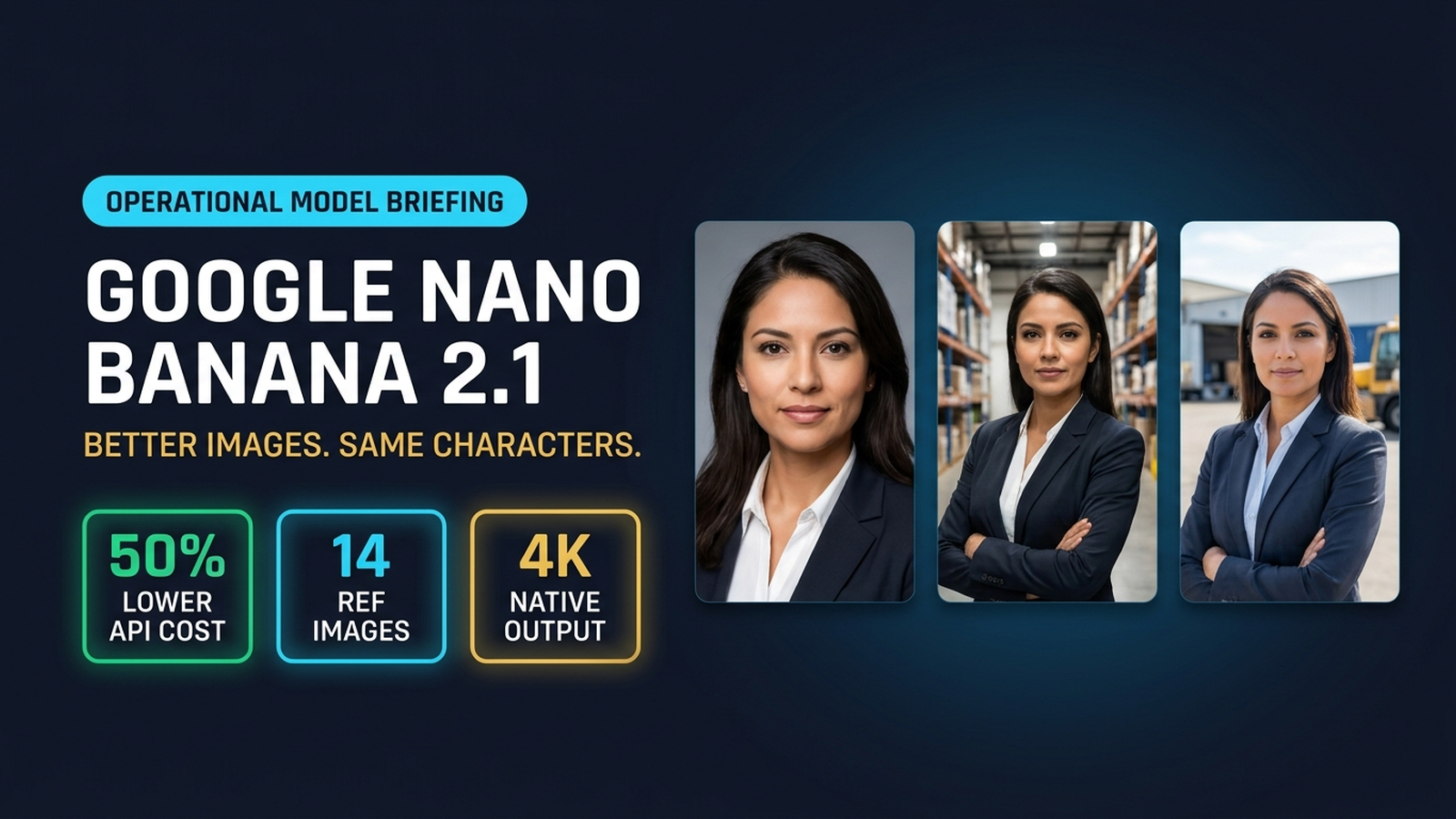
Google Nano Banana 2.1 is Google's upgraded generative image model, built on the Gemini 3.6 Flash architecture, delivering native 4K resolution, 50% lower API costs, and conversational multi-turn image editing with persistent character consistency across up to 14 reference images. Available through the gemini-nano-banana-2.1 API endpoint and Google AI Studio, the model directly addresses the persistent problem of AI character amnesia for digital creators, marketing agencies, and e-commerce operators.
If you have ever tried to generate an eight-slide social carousel or a seasonal e-commerce product catalog using AI, you know the frustration: change the camera angle by ten degrees, and your model's face morphs into an entirely different stranger. Generative image platforms have long promised seamless commercial workflows. Yet operators routinely abandon them because maintaining brand and character identity across multiple frames required hours of complex LoRA training, inpainting masks, and seed manipulation.
We evaluated Google's latest release from an operator's perspective. In this guide, you will learn the exact technical mechanics of Google Nano Banana 2.1, how its multi-image conditioning engine retains visual identity across complex scenes, the real-world unit economics compared to legacy diffusion tools, and the exact four-turn prompt framework needed to deploy consistent brand assets in your business today.
Key Takeaways
Architecture & Economics: Built on the Gemini 3.6 Flash image model,
gemini-nano-banana-2.1cuts generation costs by 50% compared to version 2.0 while expanding context reasoning up to 131k tokens and rendering native 4K outputs.Multi-Subject Persistence: Supports up to 14 reference conditioning images, locking the facial geometry and apparel of up to 4 distinct characters and 10 persistent objects across conversational turns to solve character consistency.
Granular Control: Introduces three configurable "Thinking Levels" (Minimal, Medium, High) alongside native Google Search and Image grounding for verified physical textures.
Operational Deadline: Replaces the legacy
gemini-3.1-flash-imageendpoint, which faces complete deprecation and shutdown on October 29, 2026.Production Reality: While identity retention is substantially improved, Google DeepMind's model card warns of pose stagnation and spatial binding errors when managing three or more interacting subjects.
What Is Google Nano Banana 2.1? (Architecture & Spec Sheet)
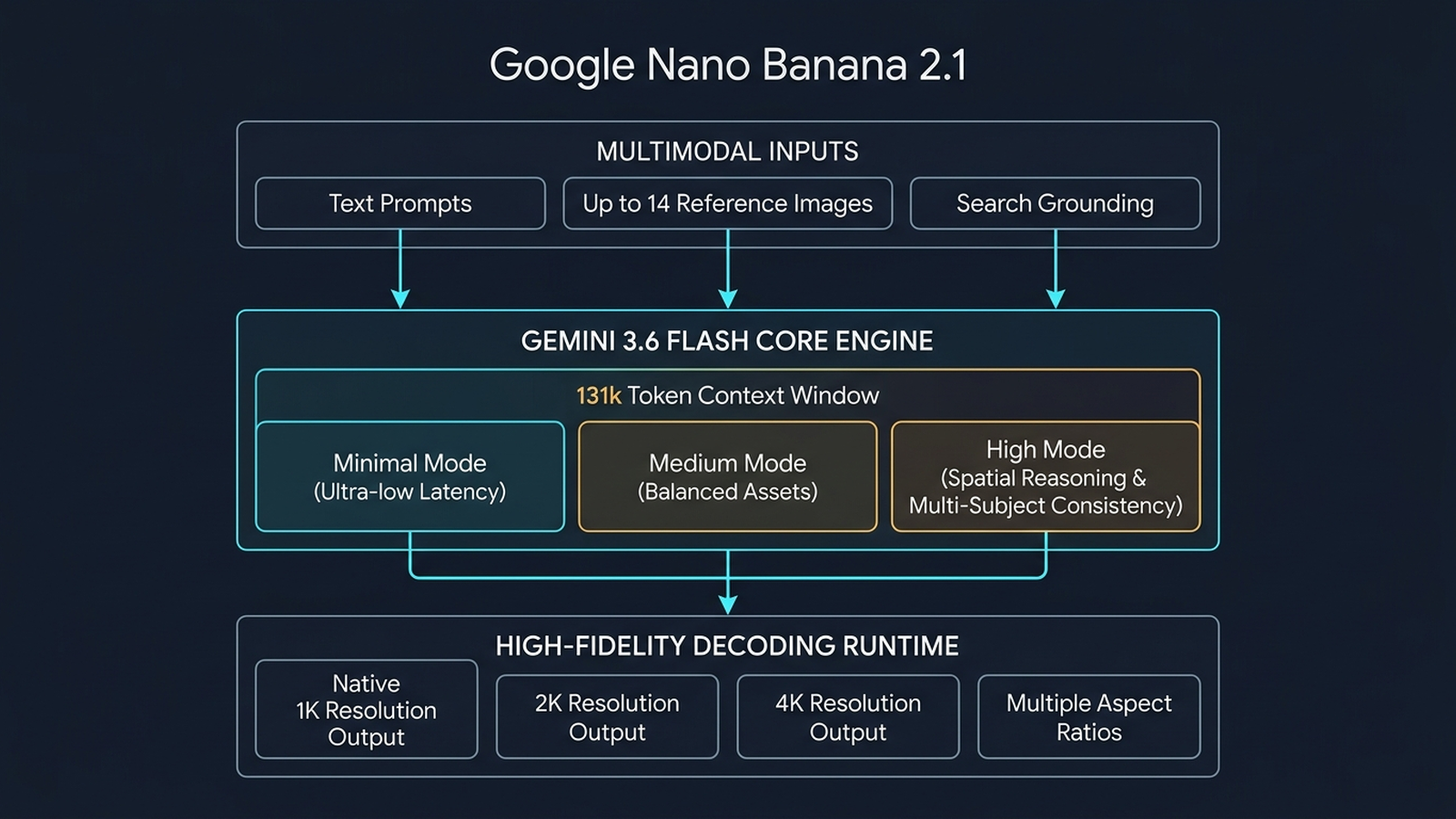
Google Nano Banana 2.1 represents an architectural pivot in Google's visual generation stack. Rather than scaling an oversized diffusion transformer with heavy latency, Google DeepMind grounded this release in the Gemini 3.6 Flash foundation model. The engineering goal was clear: prioritize low-latency inference, aggressive cost efficiency, and deep multimodal reasoning so business systems can call image endpoints programmatically without ballooning creative budgets.
+-----------------------------------------------------------------------------------+
|                        GOOGLE NANO BANANA 2.1 ARCHITECTURE                        |
+-----------------------------------------------------------------------------------+
| [ multimodal Inputs ]                                                             |
| Text Prompts + System Instructions + Up to 14 Reference Images + Web Grounding    |
+-----------------------------------------------------------------------------------+
                                          |
                                          v
+-----------------------------------------------------------------------------------+
| GEMINI 3.6 FLASH CORE ENGINE                                                      |
| (131,072 Token Context Window * Multi-Image Latent Cross-Attention)               |
|                                                                                   |
| +-------------------+    +--------------------+    +----------------------------+ |
| | Minimal Mode      |    | Medium Mode        |    | High Mode                  | |
| | (Ultra-low ms     |    | (Balanced brand    |    | (Multi-character           | |
| | chat & ideation)  |    |  assets & ads)     |    |  spatial reasoning)        | |
| +-------------------+    +--------------------+    +----------------------------+ |
+-----------------------------------------------------------------------------------+
                                          |
                                          v
+-----------------------------------------------------------------------------------+
| HIGH-FIDELITY DECODING RUNTIME                                                    |
| Outputs: 1K / 2K / 4K Res * Aspect Ratios: 1:1, 4:5, 16:9, 9:21, 21:9            |
+-----------------------------------------------------------------------------------+
For small business operators who monitor software spend, speed and predictability matter far more than theoretical benchmarks. When Marcus launched his direct-to-consumer apparel brand in April 2026, his design contractor spent $4,200 on an external studio shoot for a single seasonal catalog, followed by three weeks waiting for retouching. Marcus attempted to prototype upcoming lines using legacy diffusion checkpoints, but each batch required custom LoRA fine-tuning, expensive GPU cluster rentals, and unpredictable outputs. When he tested the initial release of Google Nano Banana 2.1, he generated twenty consistent lifestyle framing shots of his primary brand ambassador across five different urban environments in forty minutes for less than $3.50 in total API credits.
Core Technical Specifications
The model introduces several concrete upgrades designed for enterprise production pipelines:
Feature / Metric | Google Nano Banana 2.0 ( | Google Nano Banana 2.1 ( | Operational Advantage |
|---|---|---|---|
Foundation Engine | Gemini 3.1 Flash Image | Gemini 3.6 Flash Core | Lower time-to-first-token; sharper semantic instruction following. |
Max Output Resolution | 2048 x 2048 (2K) | 4096 x 4096 (4K native) | Crisp print-ready collateral and sharp banner crops. |
Reference Image Limit | 3 images per session | Up to 14 multimodal images | Complete multi-angle wardrobe, face, and environment conditioning. |
Subject Consistency | 1 primary character | Up to 4 characters + 10 objects | Supports multi-character narrative scenes and branded product placement. |
Configurable Thinking | Fixed inference budget | 3 Levels (Minimal, Medium, High) | Optimize compute spend: pay for deep reasoning only on complex compositions. |
Search Grounding | Text context only | Real-time Web & Image Search | Accurate brand packaging details, landmarks, and regional architectures. |
Aspect Ratio Range | Standard (1:1, 16:9, 9:16) | Dynamic (including 9:21 and 21:9) | Direct generation for ultra-tall mobile vertical ads and wide cinematic banners. |
API Cost Differential | Baseline ($0.040 per 2K image) | 50% Reduction ($0.020 per 2K image) | Enables scaled automated catalogs without threatening operating margins. |
Configurable Thinking Levels Explained
One of the most consequential features in the Google AI Studio documentation is the introduction of selectable reasoning budgets:
Minimal Thinking: Bypasses secondary chain-of-thought verification. Use this for rapid thumbnail ideation, simple color adjustments, or iterative background swaps where latency must stay below 1.2 seconds.
Medium Thinking (Default): Evaluates semantic prompt elements against composition layouts before rendering pixels. Ideal for marketing banners, lifestyle mockups, and single-subject campaigns.
High Thinking: Spends additional internal processing cycles decomposing spatial relationships, lighting continuity, occlusion boundaries, and multi-subject identity vectors. Use this when placing two to four specific characters into a crowded conference room, busy warehouse, or outdoor event where anatomical overlap frequently causes distortions.
The October 29, 2026 Deprecation Deadline
Operators using legacy integrations must take immediate note: Google has officially scheduled the complete shutdown of the gemini-3.1-flash-image endpoint for October 29, 2026. Automated systems that call older endpoints without updating configuration headers will experience unhandled API errors once the deprecation window closes. Migrating production code to gemini-nano-banana-2.1 requires minimal payload refactoring, but prompt schemas should be audited to use the new thinking budget and reference conditioning arrays.
If your marketing pipeline depends on regular visual content, modeling software expenses against anticipated returns is vital. You can model your potential software and production payback period with our SaaS ROI calculator before upgrading infrastructure.
The Character Consistency Breakthrough: How Multi-Image Fusion Works
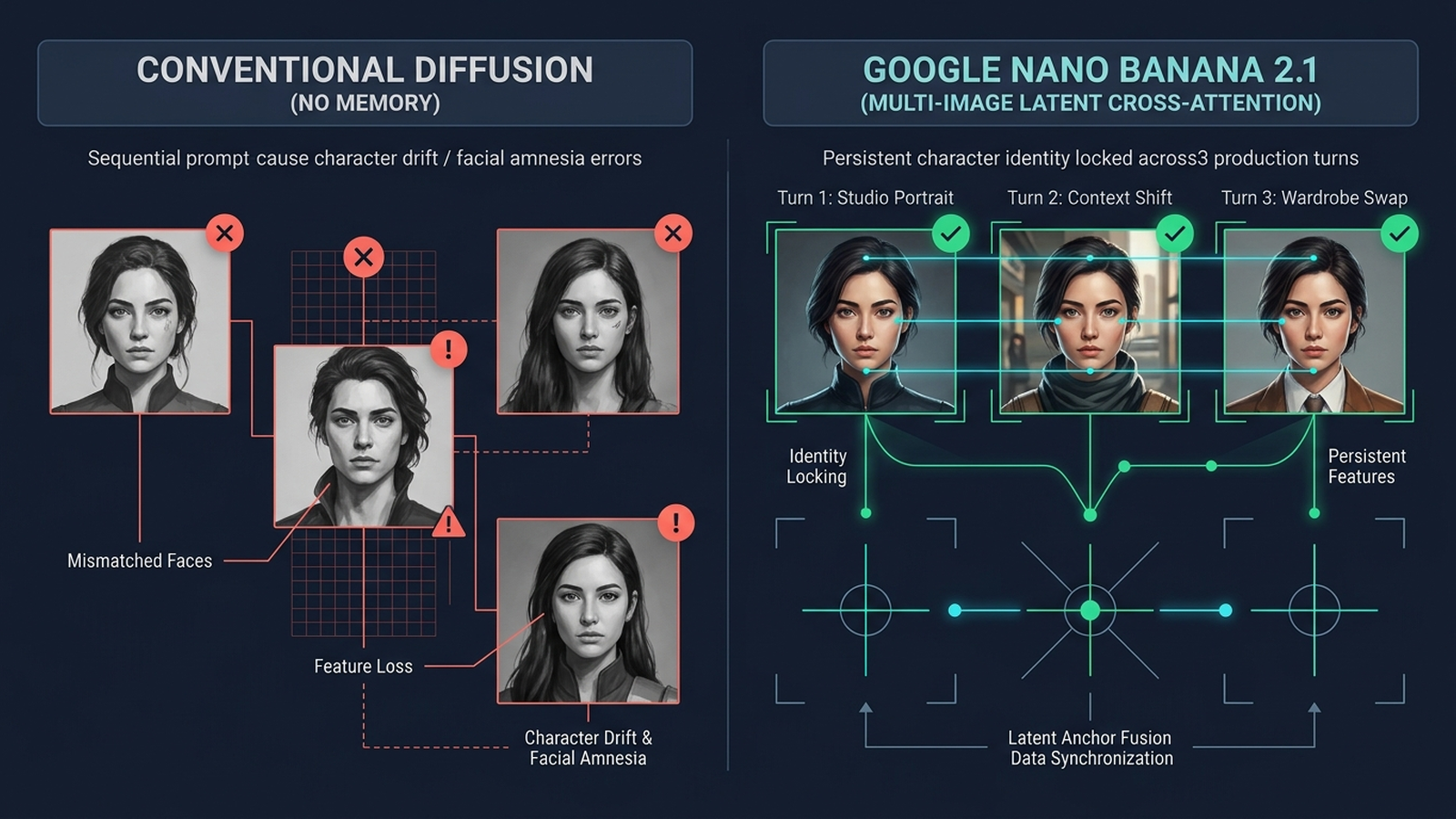
Generative models historically suffered from "character amnesia" due to how latent diffusion decodes text embeddings. When a model generates an image from scratch, random noise seeds dictate bone structure, eye spacing, hair strand placement, and skin pigmentation. Even with identical seed numbers, altering a single prompt phrase completely restructures the underlying attention matrix. Changing "standing in an office" to "running in a rainstorm" destroys facial identity in legacy diffusion tools.
CONVENTIONAL DIFFUSION (NO MEMORY)
[Prompt: Model in office] ------CONVENTIONAL DIFFUSION (NO MEMORY)
[Prompt: Model in office] --------> [Random Seed A] ------ [Random Seed A] --------> Person X (Face A)
[Prompt: Model in warehouse] --- Person X (Face A)
[Prompt: Model in warehouse] -----> [Random Seed A altered] -> Person Y (Face B) <-- AMNESIA ERROR

GOOGLE NANO BANANA 2.1 (MULTI-IMAGE FUSION)
[Up to 14 Reference Images]
        |
        v
[Cross-Attention Latent Anchor] ====> Locks: Cranial proportions, eye spacing, skin texture
        |
        v
[Turn 1: Studio Portrait] ------- Locks: Cranial proportions, eye spacing, skin texture
        |
        v
[Turn 1: Studio Portrait] ---------> Subject Alpha (Locked)
[Turn 2: Factory Inspection] ---- Subject Alpha (Locked)
[Turn 2: Factory Inspection] ------> Subject Alpha (Same Face, Ambient Light Matched)
[Turn 3: High-Vis Wardrobe] ----- Subject Alpha (Same Face, Ambient Light Matched)
[Turn 3: High-Vis Wardrobe] -------> Subject Alpha (Same Face, Garment Swapped)
Google Nano Banana 2.1 resolves this through an architecture termed Multi-Image Latent Cross-Attention Fusion. Instead of treating reference inputs as loose visual styles, the Gemini 3.6 Flash backbone processes up to 14 reference images as persistent spatial conditioning tokens. To solve Nano Banana 2.1 character consistency across extended marketing campaigns, the model anchors subject tokens directly into its context window.
Subject Retention Capacity
According to technical specifications published by Google DeepMind, the model establishes distinct semantic identity clusters within its active context window:
Primary Character Tracking: Retains facial geometry, cranial proportions, distinctive marks, and hair textures for up to 4 discrete human or stylized subjects within the same session.
Persistent Object Binding: Tracks up to 10 non-human assets, such as specific branded hardware devices, custom packaging, machinery, or apparel patterns.
Conversational Inpainting Mechanics: Rather than clearing the latent canvas and regenerating every pixel between conversational iterations, the engine isolates the target modification bounding box (such as swapping a tailored suit for industrial safety gear) while freezing the high-frequency feature maps of the subject's face.
This technical shift transforms AI image generation from an unpredictable gambling game into a deterministic editing session. When your creative team needs thirty product variations featuring the same customer persona, you no longer need dozens of manual touch-ups in Photoshop.
Step-by-Step: Building a Consistent Brand Asset Pipeline
To operationalize the Google Nano Banana 2.1 pipeline, creative teams must move away from long, paragraph-style prompts packed with repetitive descriptions. Instead, treat the interaction as a sequential, multi-turn conversational session. By leveraging Google AI multi-turn image editing, operators can adjust backgrounds, accessories, and styling sequentially without regenerating the foundational character from scratch.
Here is the four-turn production framework that marketing teams and digital agencies use to create coherent commercial campaign suites.
+-----------------------------------------------------------------------------------+
|                        4-TURN CONSISTENT PRODUCTION WORKFLOW                      |
+-----------------------------------------------------------------------------------+
| TURN 1: SUBJECT LOCK                                                              |
| Action: Generate or upload master reference portrait; define anchor name.        |
| Output: High-res neutral headshot establishing bone structure and baseline skin.  |
+-----------------------------------------------------------------------------------+
                                          |
                                          v
+-----------------------------------------------------------------------------------+
| TURN 2: CONTEXT & ENVIRONMENT SHIFT                                               |
| Action: Migrate subject to new commercial setting; enforce lighting match.        |
| Output: Full-body or medium environmental shot with facial identity preserved.    |
+-----------------------------------------------------------------------------------+
                                          |
                                          v
+-----------------------------------------------------------------------------------+
| TURN 3: WARDROBE & PROP MODIFICATION                                              |
| Action: Update apparel and action props via localized conversational inpainting.  |
| Output: Operational scene maintaining identical subject, lighting, and anatomy.   |
+-----------------------------------------------------------------------------------+
                                          |
                                          v
+-----------------------------------------------------------------------------------+
| TURN 4: ASPECT RATIO EXPANSION & TYPOGRAPHIC STAGING                              |
| Action: Re-render scene in 9:21 or 16:9 with native, legible graphic labels.      |
| Output: Final multi-channel deliverables ready for paid media deployment.         |
+-----------------------------------------------------------------------------------+
Turn 1: Subject Lock (Establishing the Geometric Anchor)
The first turn creates the master reference identity. For the highest consistency, request a clean, neutral-lit studio portrait without complex background elements or heavy occlusion.
Master Prompt:
Create an anchor reference portrait of an operations manager named "Elena". Female, mid-30s, Hispanic descent, warm brown eyes, subtle laugh lines, natural skin texture with visible pores, hair tied in a neat dark-brown low bun. Neutral expression, studio softbox lighting, clean light-gray studio backdrop. 4K resolution, photorealistic, 85mm lens perspective. Do not add background clutter or stylized filters.
System Response Behavior: The model outputs a high-resolution, undistorted master image and maps Elena's facial feature matrix into its conversational working memory.
Turn 2: Context Shift (Preserving Identity Across Environments)
Once the anchor is established, move the subject into an operational environment. Explicitly reference the established subject identity rather than re-describing her physical appearance.
Context Shift Prompt:
Place Elena from our previous image into a modern logistics fulfillment center. She is standing on an elevated observation walkway, reviewing operations on a rugged tablet. Wide 35mm composition. Industrial lighting with ambient overhead LED tubes casting soft reflections on the steel railings. Elena's facial geometry, hair texture, and physical identity must match Turn 1 exactly. Background shows organized conveyor systems and automated forklifts softly out of focus.
What Works Here: The model maintains Elena's exact cranial dimensions and facial features while recalculating ambient lighting so the industrial environment looks natural.
Turn 3: Wardrobe & Prop Edits (Localized Semantic Inpainting)
In standard generative tools, changing a character's wardrobe often alters their gender, ethnicity, or age. In Nano Banana 2.1, localized conversational inpainting alters specific layers without touching the facial canvas.
Wardrobe Edit Prompt:
Modify Elena's clothing in the logistics center. Change her casual blazer to a high-visibility fluorescent yellow safety vest over a dark gray moisture-wicking collared shirt. Add a white industrial safety hard hat over her dark hair, keeping her face and bun visible. Retain her exact facial structure, eye color, and expression from the previous turn. Her hands hold the rugged tablet securely.
Elena retains her identical bone structure, skin tone, and facial contours, while her wardrobe shifts seamlessly into safety compliance gear.
Turn 4: Aspect Ratio Re-Framing & Clean Typography
Traditional models struggle when resizing compositions, frequently generating duplicated limbs or distorted heads when expanding to ultra-tall vertical formats. Nano Banana 2.1 handles dynamic aspect ratios, including 9:21 vertical formats for mobile video overlays and social stories.
Framing & Typography Prompt:
Re-compose this scene as a 9:21 vertical mobile layout. Extend the fulfillment center ceiling upwards showing structural warehouse beams and modern LED strip lighting. Elena remains centered in the lower-middle third of the frame. In the clear negative space in the upper third, render clean, legible sans-serif typography that reads: "MODERN WAREHOUSE PROTOCOLS 2026". The text must have crisp white letterforms with no AI spelling artifacts or distorted glyphs.
This four-turn asset package generated with Google Nano Banana 2.1 provides an agency or brand with a complete suite of assets, from an executive headshot to an on-site operational photo and a vertical mobile banner, featuring one unmistakable persona.
For agencies managing content pipelines across multiple accounts, maintaining client margins requires strict tracking of asset production costs and operational capacity. Review our guide to break-even analysis for service businesses to evaluate workload targets and margin metrics across your team.
Benchmark & Cost Analysis: Nano Banana 2.1 vs. Nano Banana 2 vs. Nano Banana Pro
To evaluate where Google Nano Banana 2.1 fits into your creative production stack, review how it compares against Google's broader visual model lineup. In our Nano Banana 2 vs 2.1 comparison, inference latency dropped from 4.2 seconds to 2.1 seconds while expanding maximum resolution from 2K to native 4K.
+---------------------------------------------------------------------------------------+
|                       GOOGLE GENERATIVE IMAGE SUITE BENCHMARK                         |
+---------------------------------------------------------------------------------------+
| Metric / Capability        | Nano Banana 2 (Legacy) | Nano Banana 2.1 | Banana Pro    |
+----------------------------+------------------------+-----------------+---------------+
| Foundation Engine          | Gemini 3.1 Flash Image | Gemini 3.6 Flash| Gemini 3 Pro  |
| API Cost per 2K Render     | $0.040                 | $0.020 (-50%)   | $0.095        |
| API Cost per 4K Render     | N/A (Max 2K)           | $0.035          | $0.140        |
| Average Inference Speed    | 4.2 seconds            | 2.1 seconds     | 8.9 seconds   |
| Multi-Image Memory Limit   | 3 images               | 14 images       | 20 images     |
| Multi-Turn Drift Stability | Moderate (turns 1-3)   | High (turns 1-6)| High (turns 8)|
| Complex Typographic Text   | Fair (short words)     | Good (phrases)  | Superior      |
| Recommended Use Case       | Deprecated (sunset)    | Scaled SMB ads, | Hero print,   |
|                            |                        | e-com, social   | luxury pack   |
+---------------------------------------------------------------------------------------+
Analyzing the 50% Price Reduction
In high-volume commercial production, pricing differences compound quickly. Consider Elena, creative director at a five-person digital agency in Chicago. Her team produces approximately 4,000 visual assets every month across eight client retainers, including social ads, product staging concepts, and website hero banners.
LEGACY GENERATION COSTS (Nano Banana 2.0 @ $0.040 per 2K render)
4,000 monthly renders * $0.040 = $160.00 base API compute
+ Human time correcting character drift across dropped sessions: ~18 hours ($900 labor)
Total Monthly Production Cost: $1,060.00

OPTIMIZED NANO BANANA 2.1 COSTS (@ $0.020 per 2K render)
4,000 monthly renders * $0.020 = $80.00 base API compute
+ Human oversight on stable 4-turn sessions: ~6 hours ($300 labor)
Total Monthly Production Cost: $380.00

Monthly Net Cost Reduction: $680.00 (64.1% blended savings)
By cutting base API consumption by half and drastically reducing the labor required to re-roll images after character amnesia errors, the agency recaptures nearly $700 in monthly delivery margin.
Google Nano Banana 2.1 vs. Nano Banana Pro: When to Upgrade
When evaluating Nano Banana Pro vs 2.1, the primary decision factor is whether your deliverables require ultra-dense graphic typography or extreme macro textures. While Nano Banana 2.1 is an exceptional workhorse, it does not replace the flagship Nano Banana Pro (powered by Gemini 3 Pro Image) for every task. Choose the appropriate tier based on project scope:
Stick with Google Nano Banana 2.1 (Flash Tier): Daily social media carousels, blog illustrations, variant mockups for ad testing, routine e-commerce staging, customer persona moodboards, and internal slide decks.
Escalate to Nano Banana Pro: Luxury print packaging, high-resolution billboard campaigns, fine-jewelry macro renders with complex light refractions, and assets requiring dense, paragraphs of perfectly legible typographic text embedded directly in the visual scene.
If you are running an e-commerce catalog update, understanding how your asset production overhead impacts gross margins is essential. Test your unit economics with our profit margin calculator to verify how lower generation costs improve product margins.
Honest Limitations: What Google's Model Card Warns About
A rigorous operational review of Google Nano Banana 2.1 requires examining where the software breaks under production strain. Despite marketing claims of flawless multi-image fusion, Google DeepMind's official model documentation outlines clear constraints that every production team must account for.
+------------------------------------------------------------------------------------+
|                           PRODUCTION DRIFT FAILURE MODES                           |
+------------------------------------------------------------------------------------+
|                                                                                    |
| [ POSE STAGNATION ]                                                                |
| Problem: Model locks subject's 3/4 facial angle and freezes posture across turns.  |
| Fix: Explicitly command dynamic staging: "Candid wide shot, subject in mid-stride" |
|                                                                                    |
| [ SPATIAL BINDING CONFUSION ]                                                      |
| Problem: 3+ characters lead to swapped apparel or bleeding color schemes.          |
| Fix: Use High Thinking Mode and isolate characters by positional tags (Left/Right) |
|                                                                                    |
| [ HIGH-FREQUENCY DETAIL DRIFT ]                                                    |
| Problem: Subtle micro-text, ring engravings, or small logos blur after Turn 5.     |
| Fix: Re-inject master reference image into context every four conversational turns  |
+------------------------------------------------------------------------------------+
1. The "Pose Stagnation" Trap
When you instruct Nano Banana 2.1 to preserve a character's face with high fidelity, the cross-attention mechanism often over-indexes on the reference angle. If Turn 1 established Elena in a formal head-on portrait, Turns 2, 3, and 4 may render her head locked in that exact 3/4 tilt, even when the scene calls for her to bend over a blueprint or sprint down a flight of stairs.
The Fix: Use explicit biomechanical directives in subsequent prompts. State: "Dynamic action perspective: Subject is captured in mid-stride, body turned 45 degrees away from the lens, head turned back over her left shoulder toward the camera. Break the static studio posture from Turn 1 while maintaining facial geometry."
2. Spatial Binding Confusion with Three or More Subjects
While the architecture supports tracking up to four distinct characters, prompt adherence degrades when three or more subjects interact in close proximity. In test sessions featuring three colleagues around a conference table—an Asian male in a navy blazer, a Black female in a yellow blouse, and a Caucasian male in a green sweater—the model occasionally swaps wardrobe colors or assigns the wrong glasses to a character by Turn 4.
The Fix: Activate High Thinking Mode when generating scenes with multiple characters. Ground each subject with clear spatial coordinates: "Character A (Marcus, navy blazer) is seated on the far left. Character B (Elena, yellow blouse) stands centered behind the whiteboard. Character C (David, green sweater) is seated on the far right."
3. Progressive Detail Drift Beyond Turn Five
Conversational contexts accumulate latent noise over extended multi-turn sessions. By Turn 6 or 7, minor high-frequency attributes, such as the exact shape of an earlobe, a small scar on the chin, or the precise logo on a breast pocket, can begin to soften or shift into generic alternatives.
The Fix: Re-inject your master anchor image from Turn 1 back into the conditioning array every four turns rather than relying entirely on conversational history.
Quality Control Protocol for Commercial Production
Before any generated visual enters a client deliverable, investor deck, or paid advertising account, run it through this standard QC checklist:
Anatomical Continuity: Confirm fingernails, ears, iris alignment, and jawlines show no warping or asymmetric artifacts.
Lighting Coherence: Verify that shadow directions on the subject match ambient light sources in the background.
Edge Boundaries: Check hair strands and hat edges against backgrounds to ensure conversational inpainting left no halo artifacts.
Text Verification: Carefully proofread all visible signs, name tags, or product packaging text for scrambled characters.
Commercial Applications: Real-World Use Cases for SMBs & Creators
The primary value of Google Nano Banana 2.1 lies in unlocking practical commercial workflows that previously required dedicated photo teams or complex machine learning infrastructure.
1. Direct-to-Consumer (DTC) E-Commerce Catalogs
Independent fashion, lifestyle, and outdoor brands face constant seasonal pressure to refresh their imagery. Booking models, studios, and locations for every minor product drop can quickly strain operational cash flow.
David runs a boutique leather goods company producing handmade weekender bags and briefcases. Historically, showcasing his flagship duffel bag in different lifestyle settings—an airport lounge, a mountain lodge, a downtown boutique hotel—required either three separate location shoots or synthetic stock composites that looked visibly fake.
Using Nano Banana 2.1, David uploaded four reference photographs of his actual leather duffel alongside two reference portraits of a brand model. Across a single six-turn session, he produced twelve cohesive lifestyle catalog images of the model carrying the exact bag through international transit hubs. The model's facial identity remained locked, the leather grain and brass buckle details on the bag remained consistent, and the entire catalog update was completed before lunch.
2. Social Media Agencies & Narrative Brand Carousels
High-performing LinkedIn, Instagram, and TikTok carousel posts rely on narrative continuity. Audiences engage with stories that follow recognizable characters through a step-by-step transformation.
Marketing agencies can now create dedicated brand ambassadors for clients who lack a public-facing founder:
Slide 1: Introduce the character facing an operational bottleneck (e.g., drowning in disorganized paperwork).
Slide 2: The same character evaluating modern software solutions on their laptop.
Slide 3: The character presenting structured dashboard metrics to their leadership team.
Slide 4: The character celebrating successful quarterly results with colleagues.
Because the character's facial features and styling remain identical across all four slides, the carousel feels like an authentic case study rather than a collection of random stock images.
3. Course Creators & Educational Publishers
Solopreneurs authoring digital books, technical training manuals, or onboarding courses often struggle with visual presentation. Custom character illustrations give training materials a polished, premium feel, but hiring an illustrator for dozens of spot graphics is often cost-prohibitive.
By generating a distinctive illustrated guide character (such as a 3D clay-style developer or a stylized architectural inspector) and locking their visual token in Nano Banana 2.1, creators can place that same instructor into dozens of technical scenarios, safety guides, and chapter headers throughout their curriculum.
Calculating the ROI: Is Google Nano Banana 2.1 Worth the Workflow Migration?
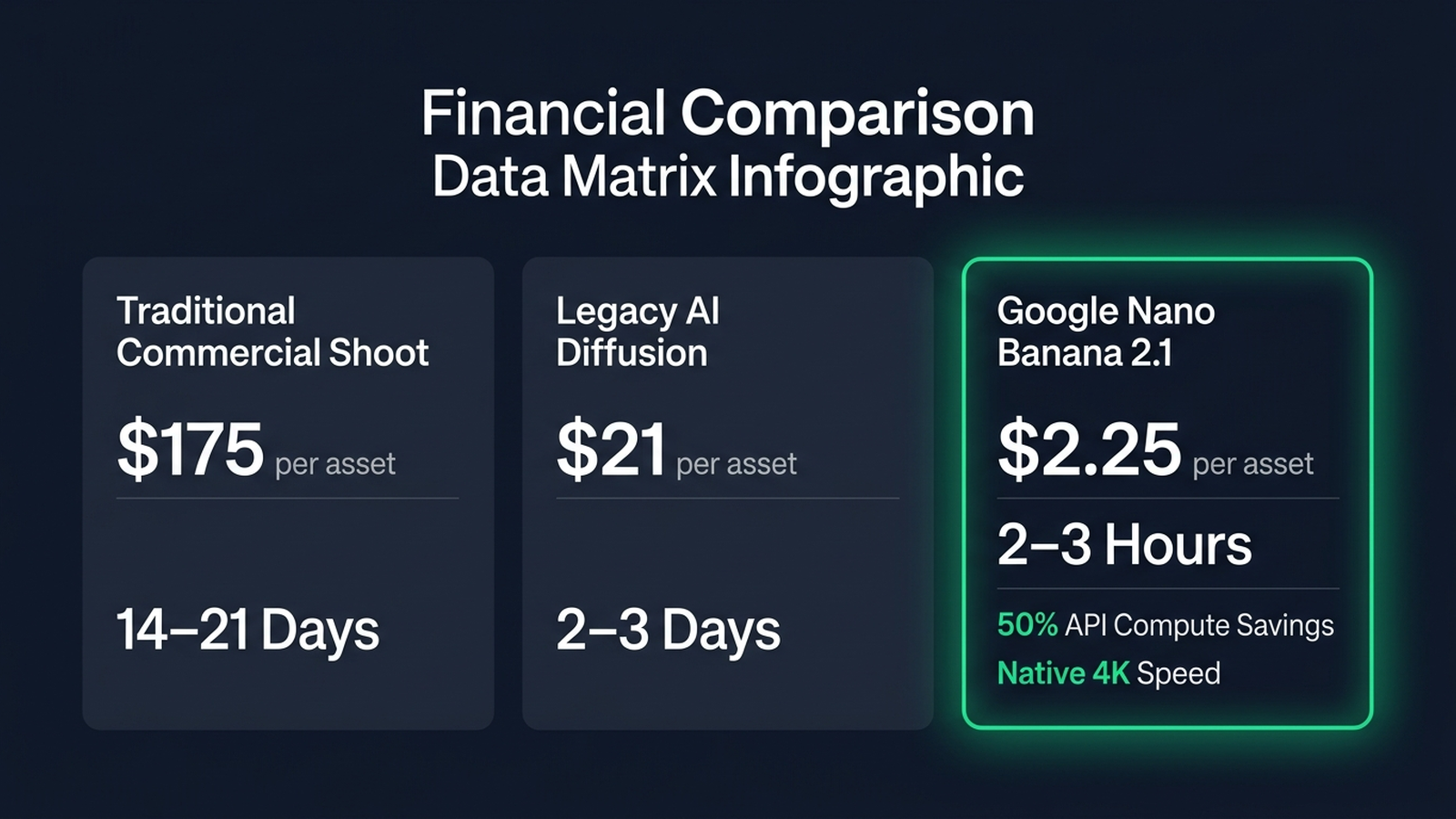
Migrating active production systems to a new API endpoint requires developer hours, prompt re-testing, and quality assurance passes. For business operators, the migration decision comes down to a clear comparison of labor, compute expenses, and delivery speed.
+-------------------------------------------------------------------------------------+
|                        CREATIVE ASSET COST COMPARISON MATRIX                        |
+-------------------------------------------------------------------------------------+
| TRADITIONAL COMMERCIAL SHOOT                                                        |
| Photographer + Model + Location Rental + Retouching (20 Final Assets)               |
| Total Cost: $3,500.00 | Turnaround: 14-21 Business Days | Cost Per Asset: $175      |
+-------------------------------------------------------------------------------------+
                                          vs
+-------------------------------------------------------------------------------------+
| LEGACY AI DIFFUSION WORKFLOW                                                        |
| GPU Cloud Server + LoRA Training + Manual Retouching (20 Usable Assets)             |
| Total Cost: $420.00 | Turnaround: 2-3 Business Days | Cost Per Asset: $21           |
+-------------------------------------------------------------------------------------+
                                          vs
+-------------------------------------------------------------------------------------+
| GOOGLE NANO BANANA 2.1 CONVERSATIONAL PIPELINE                                      |
| Gemini 3.6 Flash API Tokens + In-House Prompt Operator (20 Usable Assets)          |
| Total Cost: $45.00 | Turnaround: 2-3 Hours | Cost Per Asset: $2.25                  |
+-------------------------------------------------------------------------------------+
When you transition an asset pipeline from legacy diffusion tools to Google Nano Banana 2.1:
Direct Compute Drops by 50%: Base image generations cost $0.020 instead of $0.040, cutting API consumption on high-volume runs.
Setup Overhead Disappears: You eliminate the need to train custom character LoRAs or maintain specialized GPU environments, relying instead on zero-shot multi-image conditioning.
Turnaround Accelerates: Multi-turn inpainting lets operators modify backgrounds, lighting, and wardrobe in minutes rather than starting from scratch after minor prompt adjustments.
Evaluating whether to decommission dedicated GPU clusters, eliminate physical photography studios, or migrate to metered API endpoints follows the exact decision criteria outlined in our capital budgeting framework for technology investments.
When operational changes free up capital, reinvesting those savings into customer acquisition or inventory can accelerate company growth. If you are balancing marketing expansions against ongoing inventory commitments, review our guide to working capital planning to ensure rapid scaling does not create unexpected cash crunches.
Frequently Asked Questions
How much does Google Nano Banana 2.1 cost per image?
Google Nano Banana 2.1 costs $0.020 per 2K render and $0.035 per native 4K render, representing an exact 50% price reduction compared to version 2.0 ($0.040 per 2K image).
How does Google Nano Banana 2.1 maintain character consistency?
Google Nano Banana 2.1 uses Multi-Image Latent Cross-Attention Fusion within the Gemini 3.6 Flash engine. By anchoring up to 14 reference conditioning images as persistent spatial tokens, the model freezes facial geometry, cranial structure, and distinctive features while recalculating lighting, clothing, and background context across conversational turns.
When is the gemini-3.1-flash-image API deprecation deadline?
Google has scheduled the complete shutdown of the legacy gemini-3.1-flash-image endpoint for October 29, 2026. Teams must update API headers to gemini-nano-banana-2.1 before this date to prevent unhandled production errors.
What is the difference between Nano Banana 2.1 and Nano Banana Pro?
Nano Banana 2.1 is optimized for speed (2.1-second latency), low API cost ($0.020/render), and multi-turn social, blog, and e-commerce staging. Nano Banana Pro uses the larger Gemini 3 Pro backbone for hero print advertising, ultra-dense typographic text rendering, and luxury macro packaging renders at higher compute cost ($0.095/render).
Conclusion & Strategic Next Steps
Google Nano Banana 2.1 demonstrates that the next leap in generative AI is not merely about raw resolution, it is about practical operational control. By combining the low-latency Gemini 3.6 Flash engine with 14-image reference conditioning, 4K rendering, and multi-subject tracking, Google has delivered a model that solves the persistent challenge of AI character amnesia.
To integrate this release into your business operations effectively, follow this transition plan:
Audit Active API Endpoints: Check your current codebases for references to
gemini-3.1-flash-image. Schedule their migration togemini-nano-banana-2.1well ahead of the October 29, 2026 deprecation deadline.Build Master Character Reference Kits: Assemble clean, 1K or 2K neutral studio portraits for your core brand personas, executive avatars, and primary product lines to serve as persistent anchor inputs.
Adopt Multi-Turn Prompting: Replace long, paragraph-heavy prompts with a structured four-turn conversational framework (Subject Lock, Context Shift, Wardrobe Edit, Aspect Ratio Polish).
Implement a Strict QC Gate: Ensure every generated asset is reviewed for anatomical consistency, lighting alignment, and typographic clarity before publishing.
Ready to streamline your operational math? You don't need complex spreadsheets to track project costs, pricing, or margins. Visit the Tools Directory to model your campaigns, compare numbers against industry benchmarks, and export client-ready documentation. When you are ready for unlimited saved analyses and unbranded PDF reports, explore ToolsToFind Pro to power your daily business decisions.