Building an AI-native company requires inverting the traditional relationship between headcount and output. Autonomous AI agents serve as the primary execution engine for daily workflows, while a small team of human operators functions strictly as systems architects, exception handlers, and quality evaluators. By replacing human-to-human coordination chains with machine-legible context, a five-person team can deliver the operational velocity, customer support capacity, and software throughput of a legacy fifteen-person organization at a fraction of the payroll cost.
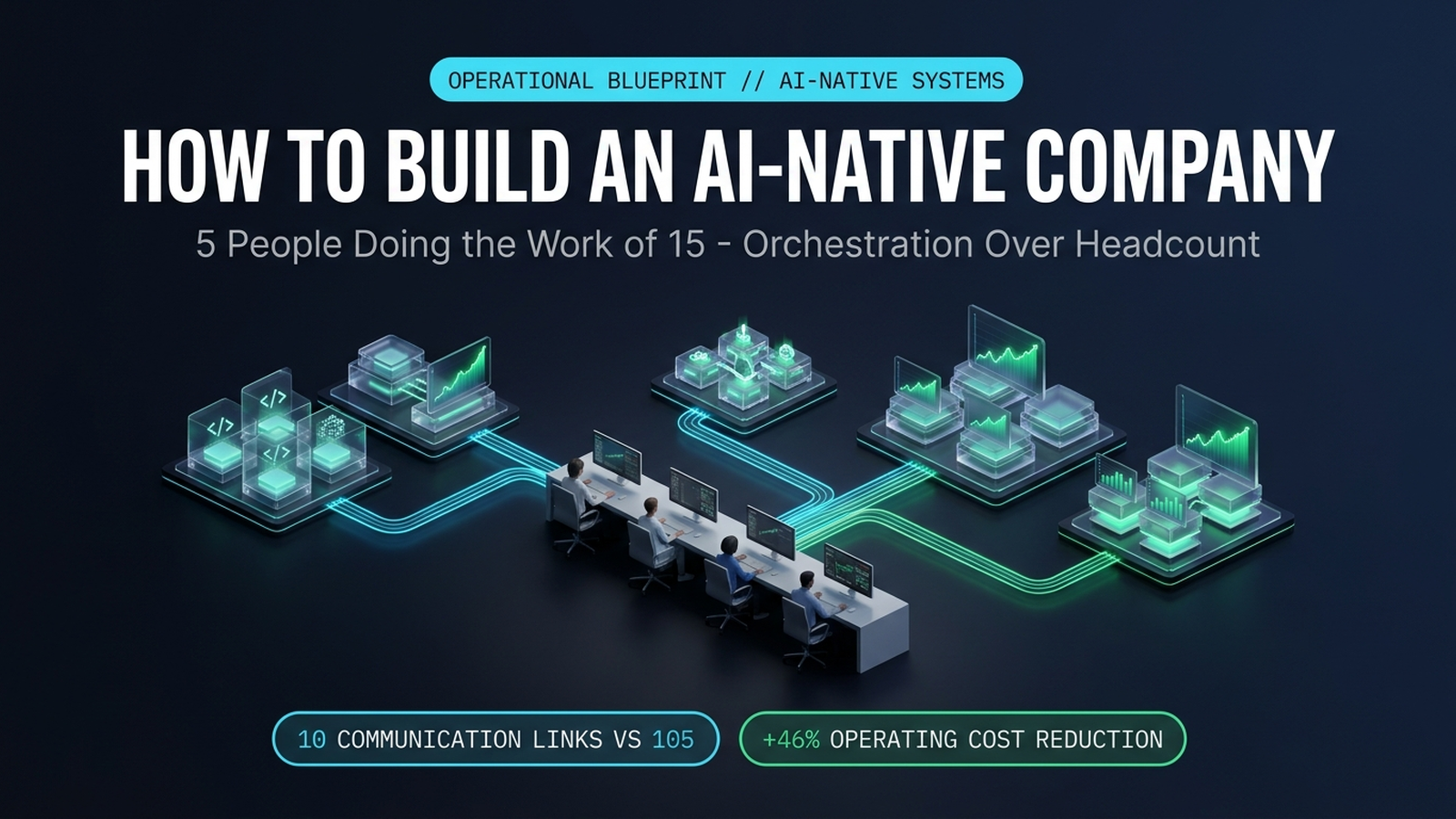
What if the headcount growth you are planning for this quarter is actually an expensive tax on your company's communication speed? Most founders assume that doubling output requires doubling seats, posting job descriptions, and spending forty hours a month on onboarding, 1-on-1s, and Slack triage. But scaling from 5 to 15 employees doesn't just triple your payroll, it increases your internal communication channels from 10 to 105, suffocating your delivery speed under an avalanche of alignment meetings.
You already know that throwing more junior hires at operational bottlenecks rarely produces linear revenue growth. In this guide, you will learn the exact operational architecture, org chart, financial models, and governance frameworks required to run an ultra-lean enterprise where five operators comfortably perform the work of fifteen. We will cover the math behind loaded labor costs versus compute expenses, define the five essential orchestration roles, and map the tech stack that turns autonomous agent pipelines into reliable business assets.
Key Takeaways
Radical Operating Leverage: Top AI-native startups generate $1.5M to $3M+ in annual revenue per employee, compared to traditional benchmarks documented in Bessemer Venture Partners' State of the Cloud report.
Eliminating the Coordination Tax: A 5-person team navigates only 10 communication links, whereas a 15-person team juggles 105 distinct channels, eliminating 90% of internal scheduling drag and executive overhead.
Capital Reallocation: Replacing 10 junior execution hires with automated workflows saves between $750,000 and $1,100,000 in loaded annual payroll, requiring only $40,000 to $65,000 in annual API compute and tooling investments.
Orchestration Over Execution: The five core human roles in an AI-native structure are the Technical Systems Architect, Full-Stack Growth Engineer, CX & Escalation Lead, Operations & Knowledge Manager, and Domain Founder.
Compute as Direct COGS: AI inference costs behave as variable Cost of Goods Sold; sustainable businesses benchmark gross margins above 70% to prevent unoptimized agent token usage from eroding operating profits.
AI-Native vs. AI-Enabled: The Architectural Litmus Test for How to Build an AI-Native Company
When evaluating how to build an AI-native company, operators must first distinguish between an AI-enabled business and a truly AI-native architecture. The difference is not semantic; it dictates how your business generates profit, handles customer requests, and maintains its operating margins.
AI-Enabled Organization (Legacy Framework + Bolt-On Chatbots)
[Client / Lead] -AI-Enabled Organization (Legacy Framework + Bolt-On Chatbots)
[Client / Lead] ---> [Junior Employee] - [Junior Employee] ---> [ChatGPT / Copilot] - [ChatGPT / Copilot] ---> [Draft] - [Draft] ---> [Manager Review] - [Manager Review] ---> [Client Delivery]
*Bottleneck: Human remains the primary communication router, scheduler, and editor.*

AI-Native Organization (Autonomous Pipeline + Human Orchestration)
[Client / Lead] - [Client Delivery]
*Bottleneck: Human remains the primary communication router, scheduler, and editor.*

AI-Native Organization (Autonomous Pipeline + Human Orchestration)
[Client / Lead] ---> [Machine-Legible Ingestion] - [Machine-Legible Ingestion] ---> [Autonomous Multi-Agent Loop] - [Autonomous Multi-Agent Loop] ---> [Automated Evals] - [Automated Evals] ---> [Deterministic Delivery]
 | (Confidence Score < 90%)
 v
 [Human Orchestrator Intervenes]
*Advantage: Agents execute 85%+ of workloads autonomously; humans handle high-stakes exceptions.*
An AI-enabled company takes a conventional, labor-heavy workflow and sprinkles AI tools on top to accelerate individual tasks. A junior copywriter uses ChatGPT to generate headlines; an account executive uses an AI transcription tool to summarize sales calls; a developer uses GitHub Copilot to autocomplete code snippets. However, the fundamental structure of the organization remains unchanged. Work still moves sequentially from human to human, communication still stalls in Slack channels, and scaling the business requires hiring more bodies to sit between those tools.
An AI-native company designs its systems from the ground up under the assumption that autonomous models and programmatic loops are the primary executors of production work. Humans do not write the first draft, format the spreadsheet, or manually route incoming support tickets. Instead, human operators write system prompts, configure automated retrieval-augmented generation (RAG) pipelines, review anomalous outputs, and build deterministic guardrails.
The "Remove the AI" Test
To determine whether an operational workflow is truly AI-native, apply this simple diagnostic: If you completely remove AI capabilities from the company tomorrow, does the business slow down by 20%, or does it collapse entirely?
In an AI-enabled business, removing AI returns employees to manual writing, slower coding, and spreadsheet lookups. The business survives, albeit with frustrated staff and lower personal productivity. In an AI-native enterprise, removing AI breaks the operating model completely because there are no junior human intermediaries hired to perform raw data extraction, write outbound cadences, or synthesize customer feedback. The company was deliberately engineered without those payroll line items.
Probabilistic Systems vs. Deterministic Guardrails
Legacy software functions deterministically: if you click button A, outcome B happens every single time. Large language models (LLMs) and autonomous agents are probabilistic: they predict the most plausible next token based on statistical patterns.
Building an AI-native startup architecture means pairing probabilistic reasoning engines with deterministic business logic. When an agent creates an invoice, summarizes financial records, or assesses an employee's loaded payroll rate, you cannot allow the model to guess or hallucinate numbers. You wrap the model in deterministic validation scripts that check mathematical outputs against established accounting tables before any document leaves your environment.
Creating Machine-Legible Operations
Traditional companies store their institutional knowledge in messy, human-centric formats: fragmented Google Docs, informal Slack banter, unrecorded Zoom meetings, and the private memories of tenured staff. An AI-native company cannot function this way because autonomous agents require structured context to act reliably.
Machine-legible operations require three continuous practices:
Centralized Vectorized Memory: Every product spec, customer email thread, and operational standard operating procedure (SOP) is stored in a structured markdown repository indexed for semantic vector search.
Standardized Input Schemas: Customer requests, sales inquiries, and bug reports enter the organization through structured JSON schemas rather than freeform text messages.
Programmatic Logging of Edge Cases: When a human operator corrects an agent's mistake, that correction is immediately logged as a few-shot test case in the system's evaluation benchmark suite.
The 5-Person Org Chart: Designing an AI-Native Company Structure
When you eliminate low-complexity, repetitive tasks from your payroll, the traditional hierarchical pyramid disappears. You no longer need coordinators, associates, junior analysts, or tiered middle managers whose sole job is relaying status updates up and down the chain.
A sustainable AI-native company structure centers around five senior generalists who understand both domain execution and systems engineering. If you are examining how to build an AI-native company that scales without hiring layers of coordinators, role design shifts entirely from managing people to orchestrating workflows.
 +-----------------------------------+
 | Domain Founder |
 | Capital, Strategy & Big Deals |
 +-----------------+-----------------+
 |
 +---------------------------------+---------------------------------+
 | | |
+--------+--------+ +--------+--------+ +--------+--------+
| Technical Sys. | | Full-Stack | | Operations & |
| Architect | | Growth Engineer | | Finance Manager |
| Code & Infra | | Pipeline & Mktg | | Data & Controls |
+--------+--------+ +--------+--------+ +--------+--------+
 | | |
 +---------------------------------+---------------------------------+
 |
 +--------+--------+
 | CX & Escalation |
 | Lead |
 | Quality & Trust |
 +-----------------+
Role 1: Technical Systems Architect (Replaces 4 Junior Engineers & QA Staff)
In a legacy engineering team of six, one senior engineer spends half their day reviewing poorly structured pull requests from three junior developers, while two QA specialists manually run staging test suites.
In an AI-native setup, the Technical Systems Architect does not write boilerplate CRUD endpoints line by line. Instead, they:
Design the overarching system architecture, database schemas, and microservice interfaces.
Orchestrate autonomous coding agents using strict repository rules, type systems, and linters.
Supervise automated test generation, where agents write unit and integration tests for their own pull requests before submitting them to the human architect for final review.
Focus on latency, security boundaries, and API rate limits rather than debugging missing semicolons.
Role 2: Full-Stack Growth Engineer (Replaces 3 SDRs, Content Writers & Ad Coordinators)
Traditional customer acquisition requires a sales development rep (SDR) scraping leads, a copywriter drafting cold emails, and an ad specialist uploading campaign variants.
The Full-Stack Growth Engineer combines technical competence with distribution psychology. Their daily output includes:
Building programmatic data pipelines that identify high-intent buyer accounts, enrich lead records via automated scrapers, and score prospects against ideal customer profiles.
Directing multi-agent content pipelines that ingest customer interviews and technical documentation to produce authoritative, SEO-driven editorial drafts and social assets.
Deploying programmatic A/B testing scripts that adjust landing page copy, value propositions, and ad hooks based on conversion performance data.
Role 3: Customer Experience & Escalation Lead (Governs 24/7 Autonomous Tier-1 Support)
Customer support in legacy companies is notoriously human-intensive. An agency or SaaS firm serving 500 accounts typically maintains three to five support reps answering identical questions about onboarding, invoice history, or password resets.
The CX & Escalation Lead transforms customer service into a high-impact feedback loop:
They supervise fine-tuned customer support agents that ingest full ticket histories, product docs, and live account state to resolve 75% to 85% of incoming inquiries instantly.
When an agent encounters sentiment frustration or a novel edge case, it flags the issue and routes it directly to the Escalation Lead with a pre-drafted diagnostic summary.
The lead personally resolves the high-stakes issue, then immediately updates the underlying knowledge base and system prompt so the autonomous agent never fails that specific scenario again.
Role 4: Operations, Finance & Knowledge Manager (Replaces Admin, Bookkeeper & Project Managers)
Administrative overhead silently destroys small business agility. Coordinating meetings, chasing overdue accounts, preparing payroll runs, and manually updating task boards can consume 60+ hours of team labor each week.
The Operations and Finance Manager automates operational plumbing:
Oversees structured internal knowledge bases, ensuring agent documentation matches current company policies.
Automates accounts receivable workflows, using structured invoice generators and automated reminder logic to keep Days Sales Outstanding (DSO) within tight limits.
Audits monthly vendor spending, API token burn rates, and loaded payroll allocations, flagging margin erosion before it impacts cash flow.
Formulates clean operating models and first drafts for banking, investor, or lender discussions using structured business plan generators.
Role 5: Domain Founder & High-Stakes Deal Closer
When operational friction and managerial babysitting are automated, the founder stops acting as the company's chief firefighter. Instead, they direct their energy toward activities where human relationships and intuition provide an insurmountable moat:
Conducting high-stakes enterprise sales conversations and closing flagship partnership agreements.
Refining pricing strategies and capital allocation decisions based on real-time margin benchmarks.
Talking directly to power users to spot strategic market shifts months before competitors notice them.
Want to see how your operational roadmap looks when structured around lean human-agent workflows? You can draft a structured business plan with ToolsToFind to map out team capacity, revenue benchmarks, and go-to-market assumptions in minutes.
The Financial Unit Economics: Loaded Payroll vs. Compute Infrastructure
The primary reason to adopt an AI-native operating model is not technical novelty; it is financial resilience. Headcount is the single largest fixed recurring expense on any small business or startup P&L.
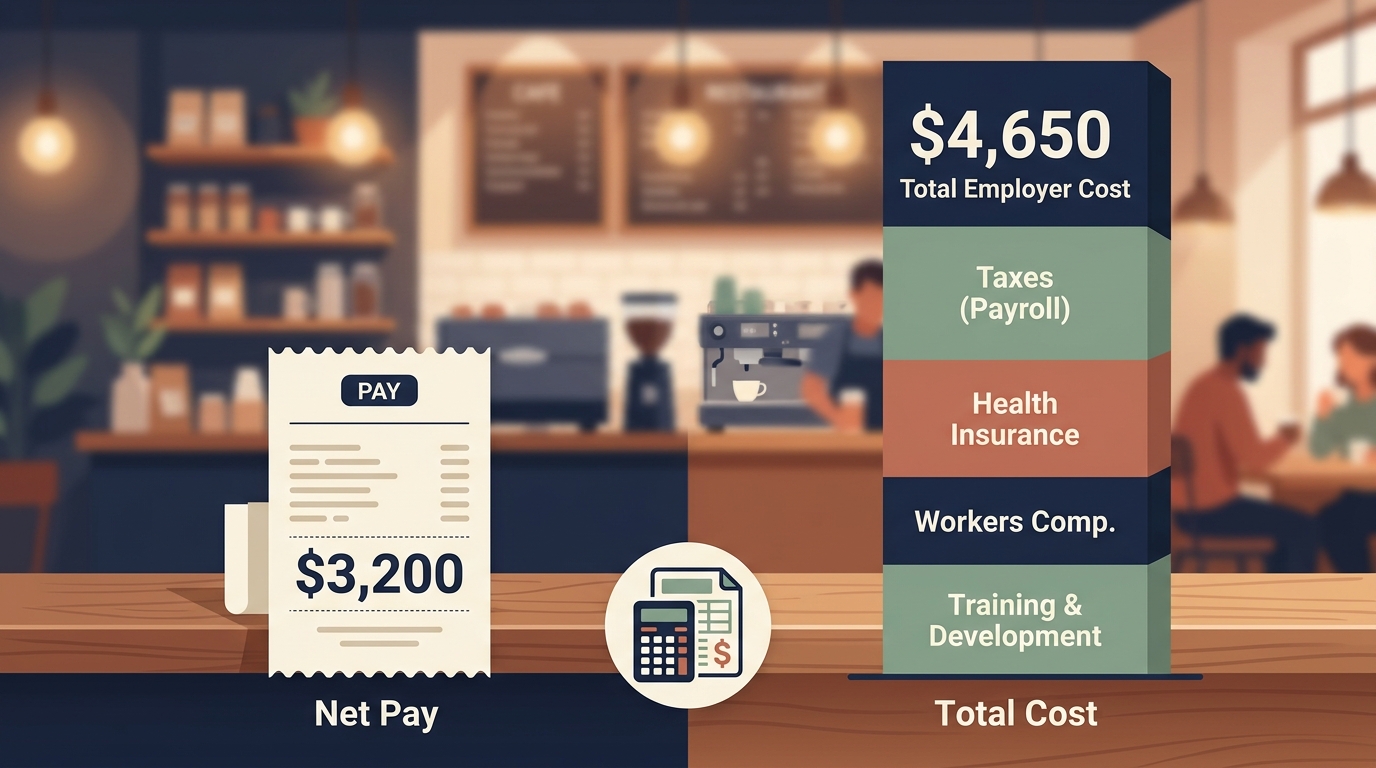
When you hire a full-time employee, their stated salary represents only a fraction of their true cash burden. According to data on loaded labor cost from the U.S. Bureau of Labor Statistics, employer-side FICA and Medicare taxes, state unemployment insurance, workers' compensation, health benefits, software seat licenses, hardware leases, and administrative overhead routinely push the loaded employee burden 25% to 35% higher than the baseline salary.
Mini-Story: Elena's Agency Turnaround
In January 2025, Elena ran a boutique digital growth agency with 14 full-time employees and an annual payroll burden of $1,420,000. Despite generating $1,600,000 in top-line billings, her business was gasping for cash. Net margins hovered below 8%, and an unpaid $45,000 client invoice in March forced her to delay her own owner compensation.
Every new client meant hiring another account coordinator, which in turn required more weekly alignment calls. Over four months, Elena restructured her firm into an AI-native agency with five senior orchestrators supported by automated agent pipelines. By September, annual payroll dropped to $680,000, while automated inference tooling cost just $4,200 per month. Net margins surged from 8% to 41%, freeing up $420,000 in operating cash flow while delivering client deliverables 40% faster.
Metric | 15-Person Legacy Team | 5-Person AI-Native Team |
|---|---|---|
Average Base Salary | $78,000 | $120,000 (Senior Talent) |
Total Base Payroll | $1,170,000 | $600,000 |
Employer Taxes & Benefits | $292,500 (25% burden) | $150,000 (25% burden) |
SaaS Seat Licenses ($150/mo) | $27,000 | $9,000 |
Hardware & Equipment | $30,000 | $10,000 |
AI API & Compute Infra | $3,600 (Basic ChatGPT) | $54,000 ($4,500/mo API burn) |
Total Annual Operating Cost | $1,523,100 | $823,000 |
Annual Cash Savings | -- | $700,100 (+46% Cost Reduction) |
Break-Even Revenue (50% GM) | $3,046,200 | $1,646,000 |
Factoring in the True Cost of Hiring
When planning expansion, founders often look at an engineer or copywriter priced at $5,500 per month and assume they need $5,500 in new gross margin to break even. This oversight is why cash-starved companies fail during growth spurts.
Before committing to another requisition, calculate your true loaded cost using a dedicated payroll calculator. Factoring in employer payroll taxes and benefits reveals whether that new role is truly justified, or whether an automated agent loop can handle the underlying workload. To understand the operational cash traps that catch early-stage founders off guard, review our guide on first-hire payroll mistakes to avoid.
Managing Variable Inference as Direct COGS
While analyzing loaded labor cost vs compute reveals massive operating leverage, replacing salaries with automated pipelines introduces a new variable: token inference costs.
In a traditional software company, hosting infrastructure on AWS or GCP is relatively static and treated as operating overhead. In an AI-native business, every customer action, automated document generation, and internal agent loop consumes LLM tokens. If an agent loops inefficiently or processes massive uncompressed prompts on every task, compute costs scale exponentially alongside usage.
To protect your bottom line:
Treat API spend as direct Cost of Goods Sold (COGS) rather than general administrative overhead. If an agent delivers a customer deliverable, the token cost belongs in gross margin calculations.
Benchmark your margins continuously: Use an online profit margin calculator to ensure your gross margin stays above 70%. When token costs depress margins below 65%, optimize prompt caching, switch non-critical reasoning to smaller distilled models, or implement strict semantic retrieval filters.
Differentiate between pricing strategies: Confusing gross margin with markup can ruin your unit economics when variable compute is involved; see our breakdown on gross margin vs markup for pricing decisions to ensure your pricing models account for fluctuating API consumption.
 [Raw Customer Request]
 |
 v
 +---------------------------+
 | Query Complexity Router |
 +-------------+-------------+
 |
 +-------+-------+
 | |
 v v
 [Simple Task] [Complex Reasoning]
 | |
 v v
 +-----------+ +-----------+
 | Distilled | | Frontier |
 | Model | | Model |
 | ($0.15/M) | | ($5.00/M) |
 +-----+-----+ +-----+-----+
 | |
 +-------+-------+
 |
 v
 [Consolidated Response]
Ready to test the difference in your own numbers? Run your current team expenses through our payroll calculator to identify your loaded labor burden, then model your upside with our profit margin tools.
The 4-Layer Autonomous Tech Stack for Lean Teams
An AI-native company cannot rely on siloed, disconnected web interfaces. You cannot expect five people to manage fifteen roles if they are manually copying and pasting text into consumer chat boxes.
Structuring lean team AI agent workflows requires an integrated four-layer technical architecture.
Layer 4: Business Execution & Billing
(Stripe, Automated Invoice Generation, Accounting Webhooks)
 ^
 |
Layer 3: Agentic Execution & Action Engines
(LangGraph, CrewAI, Temporal, Python Workers, REST APIs)
 ^
 |
Layer 2: Corporate Memory & Semantic Retrieval
(Pinecone, pgvector, GitHub Repos, Centralized Markdown SOPs)
 ^
 |
Layer 1: Foundation Models & Inference Routing
(Claude 3.5 Sonnet, GPT-4o, DeepSeek, Local Ollama Engines)
Layer 1: Foundation Models & Dynamic Inference Routing
No single AI model excels at every task. AI-native companies use dynamic API routers (like OpenRouter, LiteLLM, or custom proxies) to direct tasks based on speed, reasoning depth, and cost requirements:
Frontier Reasoning Models (Claude 3.5 Sonnet, GPT-4o): Reserved for complex code generation, ambiguous customer escalations, architectural planning, and strategic writing.
Fast Distilled Models (GPT-4o-mini, Claude 3.5 Haiku): Deployed for data extraction, lead classification, sentiment tagging, and internal JSON formatting.
Local/Open Weights Models (Llama 3, DeepSeek): Ideal for high-volume background batch processing where data privacy or raw token economics prevent third-party API routing.
Layer 2: Corporate Memory & Semantic Retrieval
Agents are only as competent as the context provided to them. Without clean access to historical facts, models hallucinate.
Vector Stores & Embeddings: Databases like Pinecone, Qdrant, or PostgreSQL with
pgvectorindex historical client transcripts, product release notes, and operational guidelines.Living Context Repositories: Rather than hiding documentation across disparate apps, maintain a single git repository containing structured markdown files (
about-us.md,pricing-rules.md,tone-of-voice.md) that agents inject into prompt contexts dynamically.
Layer 3: Agentic Execution & Orchestration Engines
Orchestration frameworks allow models to plan multi-step actions, check their own work, and interface with external software:
Workflow Engines (Temporal, LangGraph, CrewAI): Manage persistent, long-running agent workflows with deterministic state machines. If an API times out during a three-step customer onboarding flow, the engine pauses, retries, and resumes without losing data.
Function Calling & Tool Use: Agents are granted read and write permissions to specific internal endpoints: querying database records, updating CRM fields, scheduling meetings, or creating pull requests.
Layer 4: Financial, Billing & Administrative Automation
The final layer connects automated output to cash collection and compliance:
Integrating autonomous billing sequences via our client-facing invoice generators ensures that as soon as an agent completes a verified deliverable, a calculated, structured PDF invoice is dispatched to the client.
Monitoring working capital cycles prevents billing friction from turning into cash crunches. As your team delivers faster with AI, maintaining tight receivables and payables discipline is critical; learn how to synchronize growth with cash flow in our guide to working capital planning for growth.
To see how modern autonomous systems and agentic development frameworks operate under production conditions, watch this technical breakdown: Watch: Building Autonomous Agent Architectures for Lean Teams.
Quality Control and Eval-Driven Operations: Preventing Model Drift
The biggest risk facing an AI-native organization is not that its agents will fail to produce output; it is that they will produce incorrect, hallucinated, or brand-damaging output quietly at scale.
If five people are responsible for the work of fifteen, they cannot manually inspect every word, line of code, or data entry generated by their autonomous pipelines. Doing so simply re-creates the coordination bottlenecks they set out to eliminate. Instead, AI-native operators rely on eval-driven development (EDD).
 [Agent Generates Output]
 |
 v
 +-----------------------------------+
 | Level 1: Deterministic Heuristics |
 | Schema valid? Math correct? |
 +-----------------+-----------------+
 | (Pass)
 v
 +-----------------------------------+
 | Level 2: LLM-as-a-Judge Eval |
 | Tone check? Factually grounded? |
 +-----------------+-----------------+
 |
 +-------+-------+
 | |
 (Score >= 90%) v v (Score < 90%)
 [Automatic Dispatch] [Route to Human Orchestrator]
 |
 v
 [Human Resolves & Creates]
 [New Few-Shot Test Case ]
Mini-Story: Marcus's Pricing Guardrail
Marcus founded an AI-native freight dispatch service run by three logistics coordinators. In June 2025, his automated quoting agent encountered an ambiguous route request for temperature-controlled pharmaceutical transport. The agent miscalculated fuel surcharges, submitting an automated quote of $1,800 on a route with a baseline operating cost of $3,400.
Because Marcus had implemented automated heuristic validation scripts, the quote was flagged before dispatch: any estimated gross margin falling below 22% triggered an automatic freeze and pinged a human coordinator. The coordinator adjusted the quote in two minutes and added the cold-chain transport exception to the agent's regression test suite. That single validation check prevented an immediate $1,600 operational loss and permanently inoculated the agent against similar quoting errors.
The Three-Tier Quality Architecture
Level 1: Deterministic Heuristic Checks (Zero Token Cost) Before any agent output reaches a customer or codebase, it passes through programmatic assertion tests:
Does the JSON response match the required schema exactly?
Do the line items in the invoice sum correctly to the subtotal and tax amounts?
Does the generated code compile and pass existing static analysis linters?
Level 2: LLM-as-a-Judge Evaluation (Low Token Cost) A separate, smaller model evaluates the primary agent's output against strict rubrics:
Faithfulness: Does the generated answer contain claims not supported by the retrieved context documents?
Tone & Brand: Does the email sound condescending, evasive, or overly apologetic?
Completeness: Did the agent answer all three parts of the customer's inquiry?
Level 3: Human-in-the-Loop Exception Routing (High Context Cost) Outputs that score below predefined confidence thresholds (e.g., <90% certainty on sentiment analysis, or a margin variance flag) are automatically diverted into an operator's review queue.
The human's job is not just to fix the error and press send. The human's primary duty is to treat every failure as an organizational bug: update the prompt, enrich the context store, or add a unit test so that specific mistake is never repeated.
Step-by-Step Implementation: How to Build an AI-Native Company from Day One
Transitioning an existing team, or architecting a new venture, into an AI-native organization requires a disciplined sequence. You cannot simply fire ten employees and tell the remaining five to use AI tools. You must systematically replace human communication paths with automated software conduits.
Phase 1: Friction Audit (Days 1-14)
Identify communication bottlenecks & map repetitive labor tasks
 |
 v
Phase 2: Context Structuring (Days 15-30)
Consolidate tribal knowledge into clean, vectorized markdown repos
 |
 v
Phase 3: Autonomous First-Drafting (Days 31-60)
Deploy agent pipelines across code, sales outreach & support triage
 |
 v
Phase 4: Metrics Realignment (Days 61-90)
Shift KPIs from hours worked to Revenue Per Employee & Unit Gross Margins
Step 1: Audit Communication Channels & Coordination Tax
Map your current operational workflows to discover where human communication stalls output.
List every recurring meeting, status check-in, and handoff between departments.
Calculate your team's theoretical communication channels using Metcalfe's formula: Channels = N(N - 1) / 2 Where N is your total headcount. Notice that moving from 5 to 15 people explodes your communication overhead by over 950%.
Identify every repetitive task where an employee takes data from one system, reformats it, and passes it to another human. These are your immediate candidates for autonomous agent replacement.
Step 2: Convert Tribal Knowledge into Machine-Legible SOPs
Before an agent can draft proposals or answer tickets, your business rules must be explicit.
Interview your top performers and extract their decision-making frameworks.
Write concise, constraint-driven guidelines: "When quoting clients in the manufacturing vertical, assume an 18% contribution margin unless materials exceed $10,000, in which case require a 30% upfront deposit."
Store these documents in clean markdown inside a version-controlled repository accessible via vector search.
Step 3: Implement Autonomous First-Drafting Across All Functions
Enforce an ironclad operational policy: No human employee begins their workday with a blank screen.
In engineering: coding agents generate initial pull requests with unit tests based on Jira/GitHub issues.
In marketing: autonomous scrapers compile competitor signals and generate structured editorial briefs for human review.
In sales: inbound leads are automatically enriched with revenue, tech stack, and LinkedIn profile data before the Growth Engineer reviews the suggested outreach draft.
In customer support: Tier-1 customer tickets are answered by an agent within 30 seconds; humans review drafts only when sentiment flags indicate high churn risk.
Step 4: Redesign Performance Metrics Around Revenue Per Employee (RPE)
Traditional corporate cultures celebrate vanity headcount milestones: "We grew the team from 10 to 30 people this year!" In an AI-native organization, headcount growth without proportional profit expansion is recognized as operational failure.
Benchmark your operations against elite revenue per employee ai startups standards:
Revenue Per Employee (RPE): Target a minimum of $500,000 RPE in your first year, scaling toward $1,500,000+ as agent loops mature.
Cycle Time to Delivery: Measure how many hours elapse between a customer inquiry and the completed deliverable, targeting 70%+ reductions over human-only baselines.
Escalation Ratios: Track the percentage of automated tasks executed without human intervention (aim for 80% to 90% autonomous completion across routine pipelines).
Step 5: Recalibrate Working Capital and Cash Flow Timing
When production capacity expands rapidly while your headcount stays lean, customer demand can accelerate faster than cash collections. If you deliver services or products at 3x your historical speed, but clients still take 45 days to pay their invoices, your operating cash will run dry.
Pair your operational streamlining with rigorous cash planning. Ensure your break-even requirements are recalculating continuously using our break-even analysis for service businesses framework, and stress-test your cash conversion cycles to make sure your capital reserves can support rapid growth.
Frequently Asked Questions About Building an AI-Native Company
What is the actual definition of an AI-native company?
An AI-native company is designed from inception with autonomous machine learning models and programmatic agent loops as its primary execution engine. Human operators do not perform raw data entry, initial content drafting, or manual task routing; instead, humans function as systems architects, exception handlers, and quality evaluators who supervise automated pipelines.
How much does it cost to build the tech stack for a 5-person AI-native team?
A robust AI-native infrastructure for a 5-person team typically costs between $3,500 and $6,000 per month ($42,000 to $72,000 annually). This budget covers foundation model API inference tokens ($2,000-$4,000/mo), vector databases and semantic search tools ($300-$600/mo), orchestration and workflow monitoring software ($500-$800/mo), and automated invoicing and operational tools ($200-$500/mo). This represents an 85% to 92% savings compared to the loaded payroll of ten additional employees.
Can an existing traditional company transition to an AI-native structure?
Yes, but the transition must be executed through operational workflows rather than blanket layoffs. Start by selecting one high-cost, high-friction department, typically customer service or outbound sales prospecting. Consolidate its documentation into a vectorized knowledge base, deploy autonomous agent pipelines to handle Tier-1 execution, and retrain junior staff to act as prompt engineers and QA evaluators. Once that department hits an 80%+ autonomous execution rate, replicate the architecture across engineering and financial operations.
How do you prevent AI agents from making catastrophic public mistakes?
Deploy a multi-tier evaluation system combining deterministic validation checks with LLM-as-a-judge scoring rubrics. Never allow autonomous models to execute financial transactions, publish code directly to production, or email high-value clients without passing automated heuristic constraints. Any output scoring below a 90% confidence threshold must be routed to a human operator review queue.
What skill sets should you look for when hiring for an AI-native company?
Prioritize senior generalists who exhibit high intellectual curiosity, strong systems-thinking capabilities, and baseline technical literacy. Look for candidates who naturally decompose complex ambiguous problems into sequential checklists, understand how API integrations work, and are comfortable writing evaluation scripts and prompting constraints. Avoid hiring narrow specialists who expect an army of coordinators to handle their administrative workflows.
Conclusion: How to Build an AI-Native Company for Scale, Not Headcount
The era of equating corporate prestige with sprawling org charts and packed office floors is over. Headcount bloat increases internal friction, inflates loaded payroll liabilities, and slows customer delivery under the weight of endless alignment meetings.
Learning how to build an ai native company allows you to construct a lean, resilient enterprise capable of generating extraordinary revenue per employee for ai startups. By assembling five exceptional human orchestrators, outfitting them with autonomous agent loops, and enforcing strict margin and quality controls, you can outperform competitors triple your size while preserving your agility, your sanity, and your operating profits.
Take the first step today by evaluating your actual operational numbers:
Model your true loaded labor overhead with our payroll calculators before opening another job requisition.
Stress-test your variable compute costs against industry targets using our profit margin calculators.
Turn your lean operational strategy into an investor- or lender-ready roadmap by drafting your plan with our business plan generators.