What Is a Good Profit Margin for a Small Business? Profit Margin Insights Every Entrepreneur Must Know to Build a Sustainable Business
A good profit margin for a small business is the one that is healthy for your industry and business model, not a universal percentage. If you run retail, a net margin that looks average in software might be unrealistic, while a services firm can post high gross margin and still struggle if delivery and overhead are unmanaged.
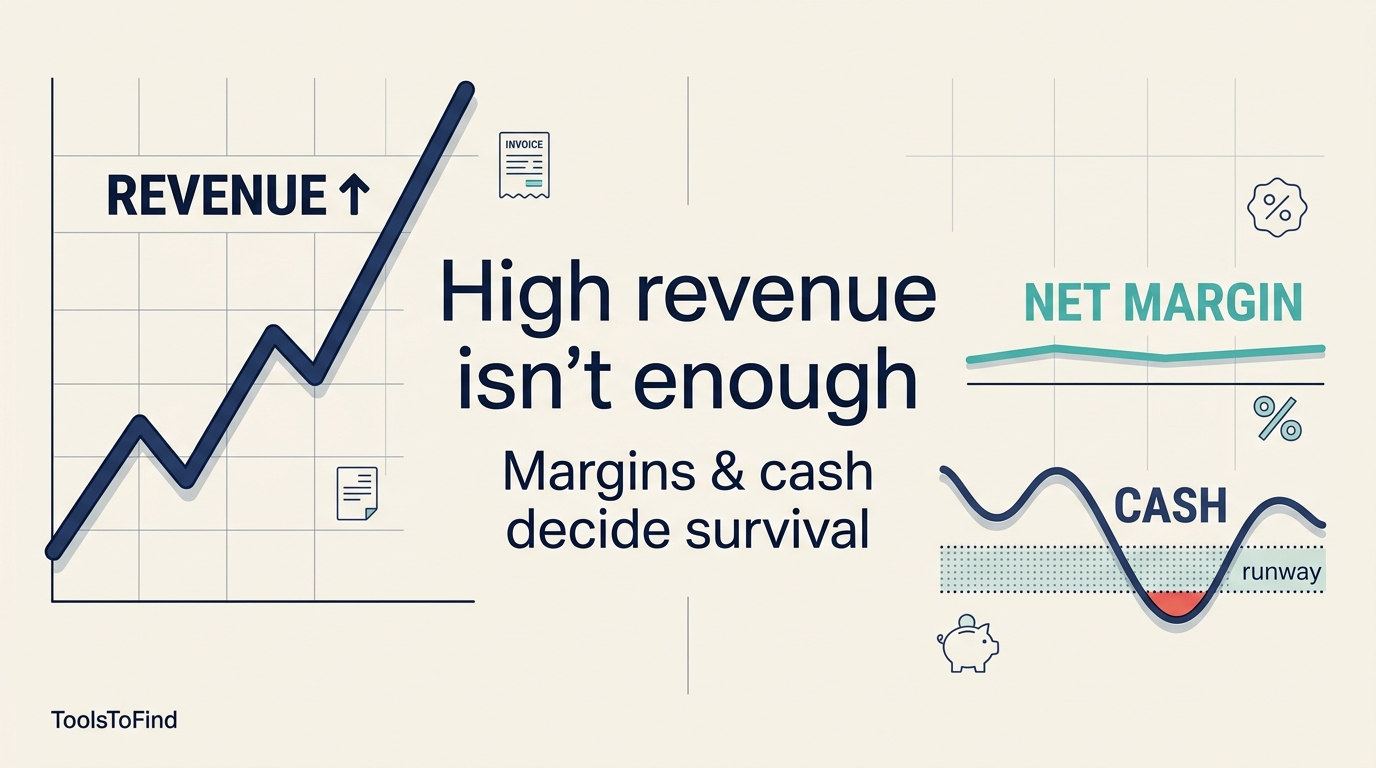
That gap is why many founders feel busy and even hit revenue goals, but still feel cash pressure every month. Margin is not just an accounting metric. It is the operating signal that tells you whether pricing, costs, and delivery discipline are working together.
In this guide, you get a practical margin framework you can use in real decisions: pricing, hiring, discounts, and product/service mix. YouΓÇÖll also see industry benchmark context, common erosion patterns, and a 30-minute review workflow you can repeat every quarter.
Key Takeaways
A good margin is industry-relative: compare your numbers to the right peer group before making big pricing or hiring moves.
Gross margin shows offer-level health; net margin shows business-level sustainability. You need both.
Revenue growth can hide margin decline when discounts, revisions, returns, or overhead rise faster than sales.
Markup and margin are different math; confusing them leads to weak pricing decisions.
One disciplined quarterly margin review can prevent months of low-profit work.
If you want a fast baseline before reading further, run your numbers in the profit margin calculator, then come back and interpret the result with the framework below.
What a Good Profit Margin Actually Means
Gross, Operating, and Net Margin in Plain Language
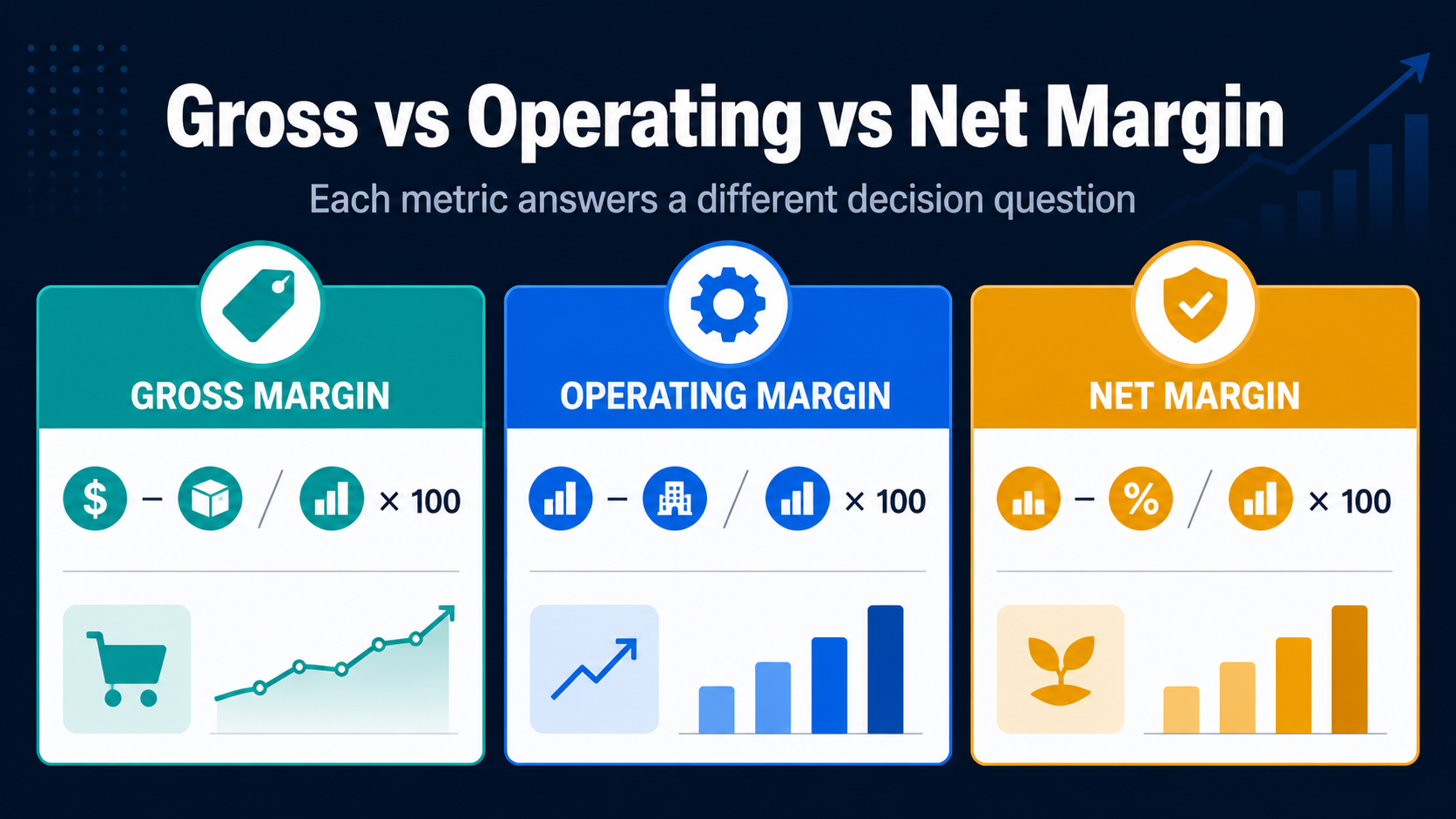
Most entrepreneurs ask one number: What's my margin? The better question is: "Which margin?"
Margin type | Formula (simple) | What it tells you | Common decision use |
|---|---|---|---|
Gross margin | (Revenue - direct costs) / Revenue | How much is left after delivering the product/service | Pricing, COGS control, offer viability |
Operating margin | (Operating profit) / Revenue | Profit after delivery + operating expenses, before taxes/interest | Team structure, overhead discipline |
Net margin | Net profit / Revenue | What remains after all expenses | Sustainability, retained earnings, resilience |
If gross margin is weak, the issue is usually pricing, COGS, discounting, or delivery model.
If gross margin is healthy but net margin is weak, overhead, inefficiency, financing cost, or admin bloat is often the problem.
For a deeper breakdown of price math, read gross margin vs markup for pricing decisions.
Why One Percentage Can Be Healthy in Retail and Weak in SaaS
A margin number has to be interpreted in context:
A lower net margin can be normal in high-volume retail with inventory and shipping pressure.
A software business often carries higher gross margin expectations, but can still compress net margin if sales and support overhead scale too quickly.
Professional services may show strong gross margin on paper, then lose it in revisions, utilization gaps, and scope creep.
So if you're asking what is a good profit margin for a small business, the practical answer is: good means competitive for your industry and durable under real operating pressure.
Insight 1-3: The Margin Fundamentals Entrepreneurs Miss
Insight 1: Revenue Growth Can Hide Margin Deterioration
It is possible to grow top-line revenue and become less healthy every quarter.
Mini-story: In February, Aisha's boutique marketing agency grew monthly revenue from $62,000 to $79,000. Great headline. But project revisions increased, senior review time doubled, and discounting became routine to close deals. Gross margin slipped by 6 points in two months, and net margin dropped into single digits. Revenue was up, but owner stress and cash tightness got worse.
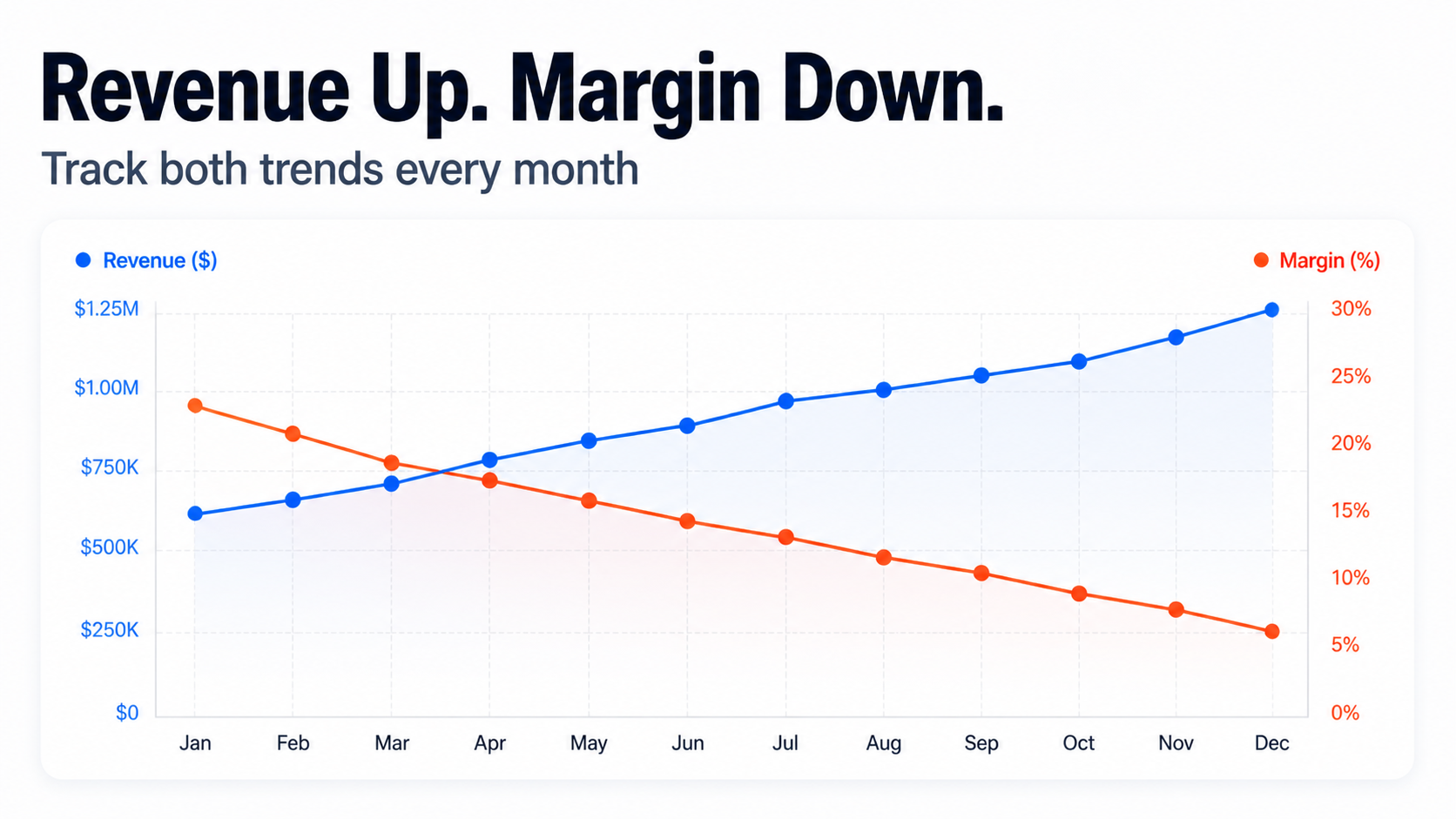
The lesson: always pair growth reporting with margin trend reporting. "We grew" is incomplete unless you can also say and margin held.
Insight 2: Markup and Margin Are Not Interchangeable
This mistake quietly breaks pricing:
Markup: percent added on top of cost.
Margin: percent of selling price left after cost.
If cost is $100 and you apply a 50% markup, price is $150.
Your margin is not 50%. It is $50 / $150 = 33.3%.
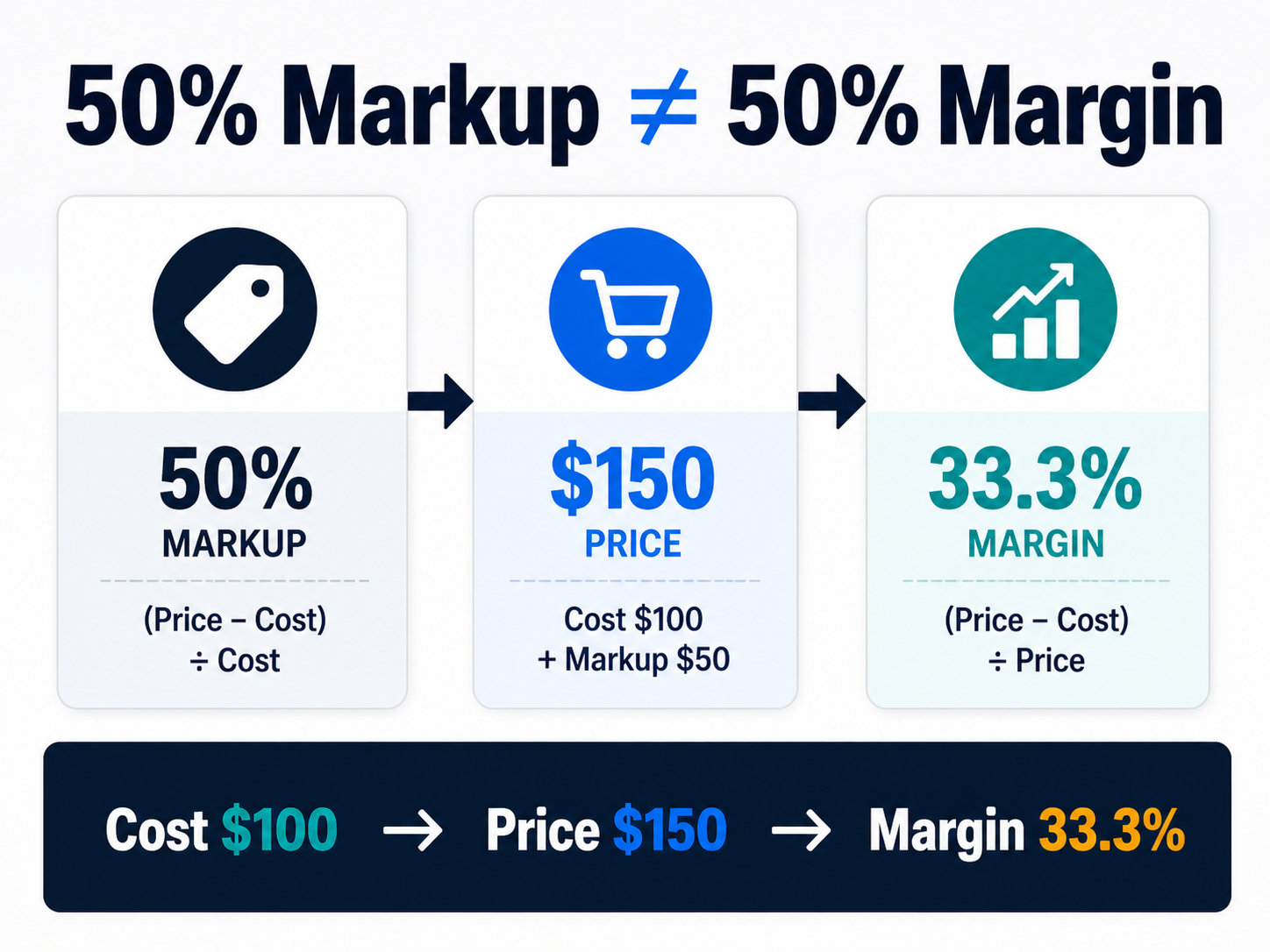
That gap matters most when discounts are frequent. Teams that quote by markup but review performance by margin often approve work that looks busy but underperforms financially.
Insight 3: Contribution Margin Drives Mix Decisions
Contribution margin asks: after direct cost, how much does this offer contribute to fixed overhead and profit?
This is where entrepreneurs make better choices about what to sell more of, what to redesign, and what to stop. A lower-ticket offer with clean delivery can outperform a "premium" offer that consumes senior time and rework.
If you run services, this complements break-even analysis for service businesses. Break-even tells you how much contribution you need. Contribution margin tells you which offer gets you there.
CTA: If your sales mix changed in the last 90 days, run each major offer through the profit margin calculator separately before your next pricing call.
Insight 4-5: Why Margins Erode Even When Sales Rise
Insight 4: Hidden Costs Quietly Expand COGS and Delivery Expense
Margins often erode through costs owners don't classify well at first:
Freight and return handling in e-commerce
Subcontractor overages in construction
Rework and QA loops in services
Rush fees and expedite shipping
Payment processing and platform fees
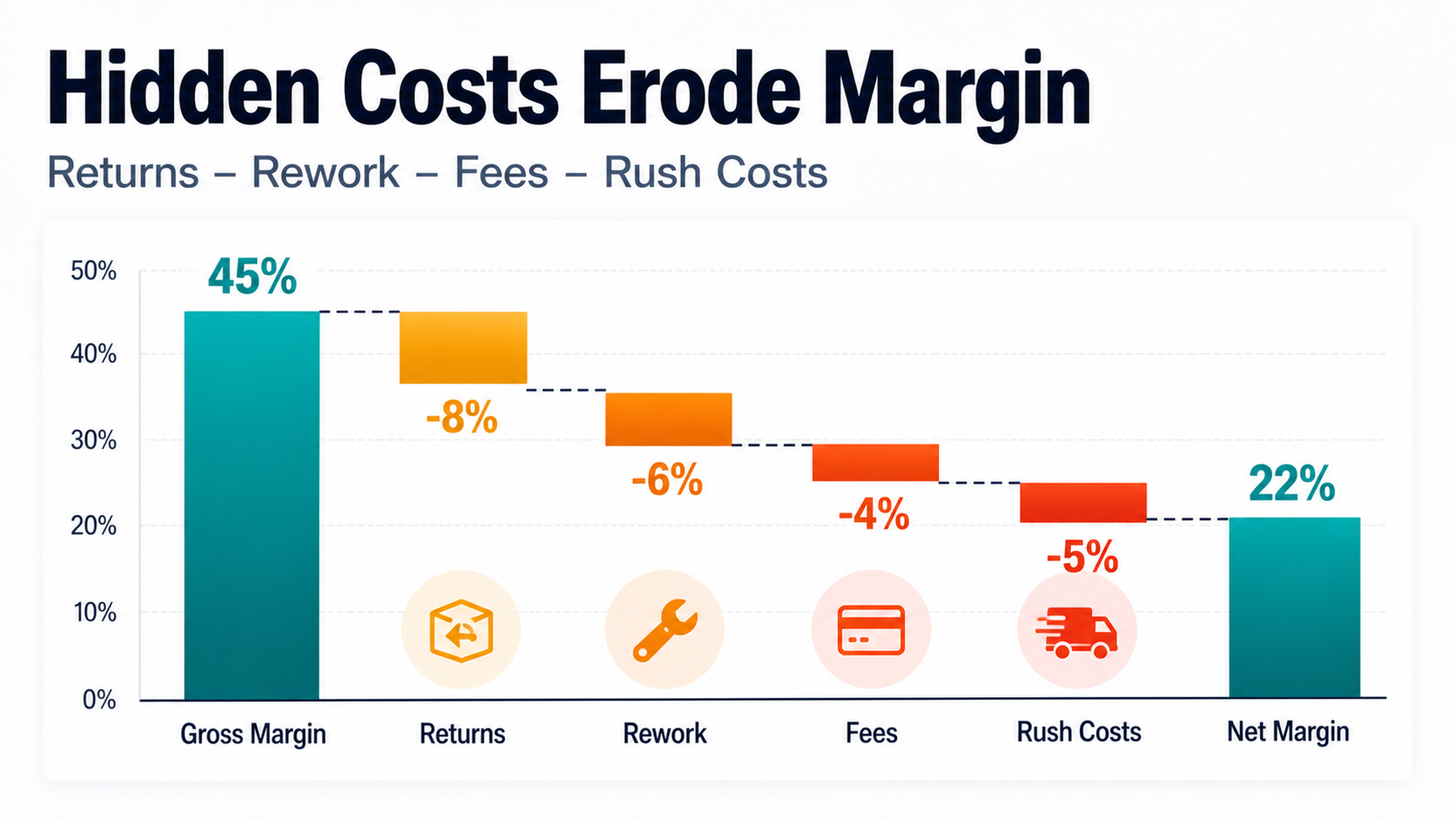
Mini-story: Diego runs a small e-commerce brand with a headline gross margin near 48%. Looks strong. But return shipping, damaged inventory replacement, and ad spend volatility pushed net margin below 7%. The business was profitable, but vulnerable. When one ad channel got more expensive, cash cushion disappeared within two cycles.
The fix is not just "cut costs". It is category-level visibility: know which costs are direct, which are operating, and which are one-time.
Insight 5: Discounting Habits, Scope Creep, and Founder Time Destroy Net Margin
Many entrepreneurs give away margin in ways that feel customer-friendly in the moment:
Small, repeated discounts without guardrails
Scope additions without change orders
Founder "free labor" treated as invisible
Founder time is a real business cost. If your model works only because you absorb unpaid senior work, your margin is overstated.
This is also why some businesses look healthy on P&L but strain in day-to-day liquidity. See working capital planning for growth: profitable operations can still create cash stress if timing and overhead are unmanaged.
Insight 6-7: How to Build Margin Resilience
Insight 6: Set a Pricing Review Cadence, Not One-Off Price Changes
Sustainable business profit margins come from rhythm, not random reaction. Build a recurring pricing review:
Monthly quick scan: discount rate, win rate, average deal value
Quarterly pricing review: by offer and segment
Rule-based adjustments: if COGS rises by X%, trigger price review within 30 days
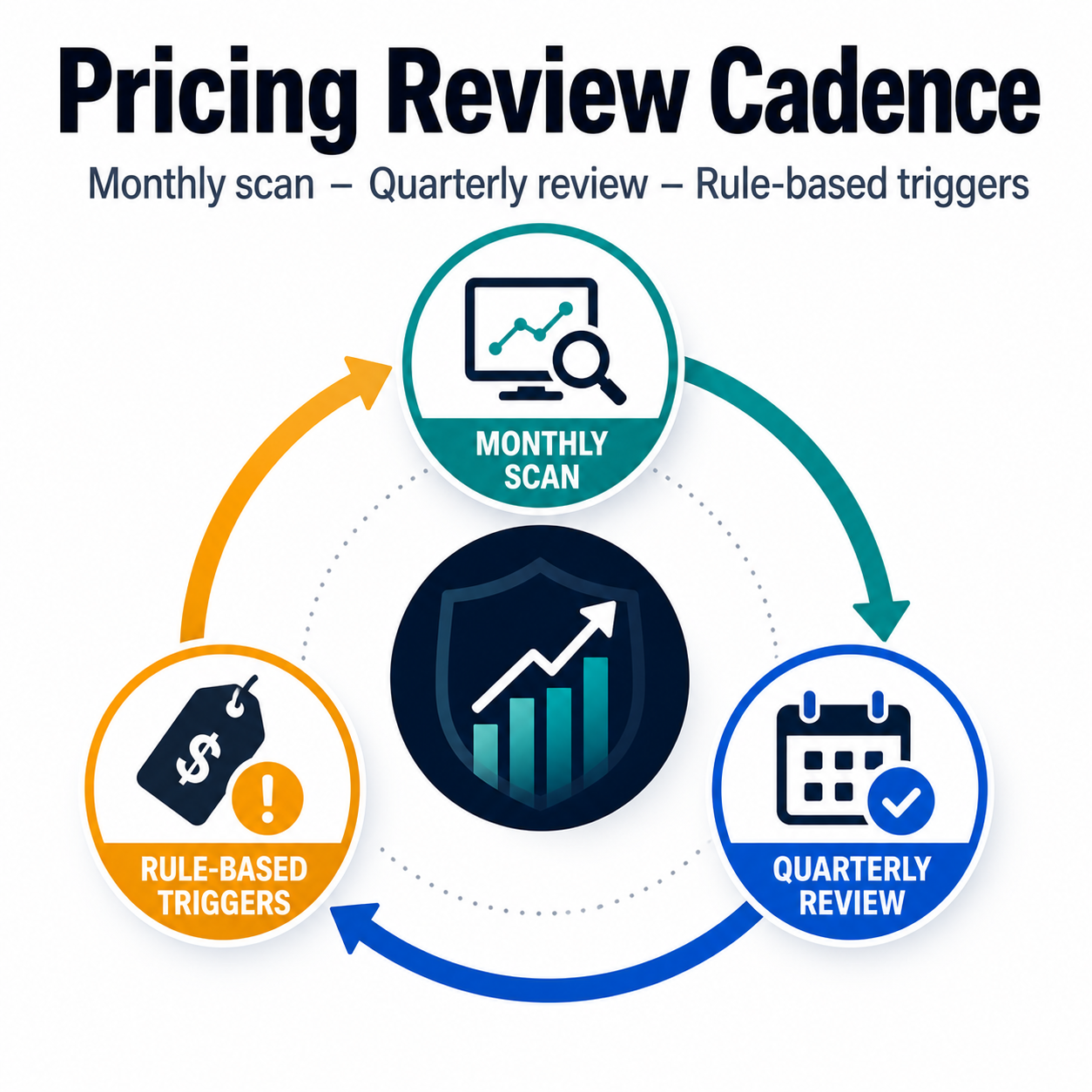
This removes emotion from pricing conversations and protects margin when costs move.
Insight 7: Manage Costs by Category and Benchmark Quarterly
Not all cost control has equal impact. Prioritize categories that materially move margin:
Direct labor / fulfillment
Input costs (materials, shipping, software stack)
Overhead expansion tied to growth assumptions
Waste drivers (returns, rework, downtime)
Mini-story: Kamal's small contracting firm grew from $140,000 to $190,000 monthly revenue after winning bigger jobs. He added vehicles and supervisory overhead quickly, assuming scale would absorb it. Net margin compressed from 12% to 6%. A quarterly benchmark check showed peers with similar growth pacing overhead expansion more gradually. He reset staffing sequence and restored margin over two quarters.
You can also use industry-specific pages like consulting tools (or your matching sector page) to keep comparisons relevant to your model.
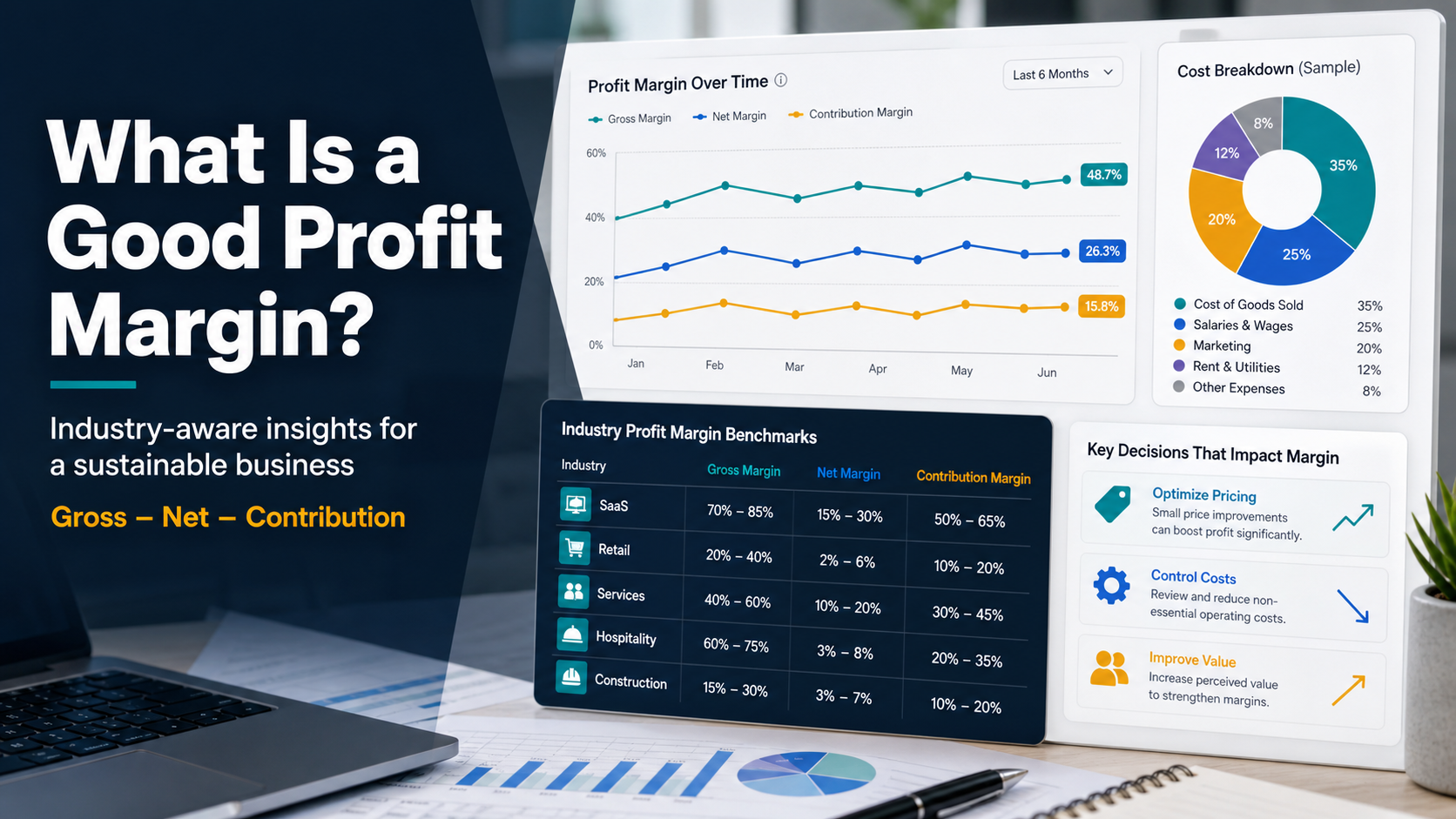
What Is a Good Profit Margin for a Small Business in Your Industry? Benchmark Context That Actually Helps
There is no single good margin across all sectors. Use ranges as directional context, then compare against your business stage, geography, and model complexity.
Industry (typical SMB context) | Gross margin (directional) | Net margin (directional) | Practical interpretation |
|---|---|---|---|
SaaS / software | ~60-80%+ | ~10-25% (varies by growth stage) | High gross is common; net can compress during aggressive growth |
Retail / e-commerce | ~25-50% | ~2-10% | Inventory, shipping, returns, and ad spend pressure net |
Professional services | ~40-70% | ~10-25% | Utilization, scope control, and pricing discipline drive outcomes |
Hospitality / restaurants | ~55-70% food gross varies by format | ~3-10% | Labor, occupancy, waste, and traffic swings create tight net margins |
Construction / manufacturing | ~20-45% (model-dependent) | ~3-12% | Project execution, input volatility, and overhead timing are key |
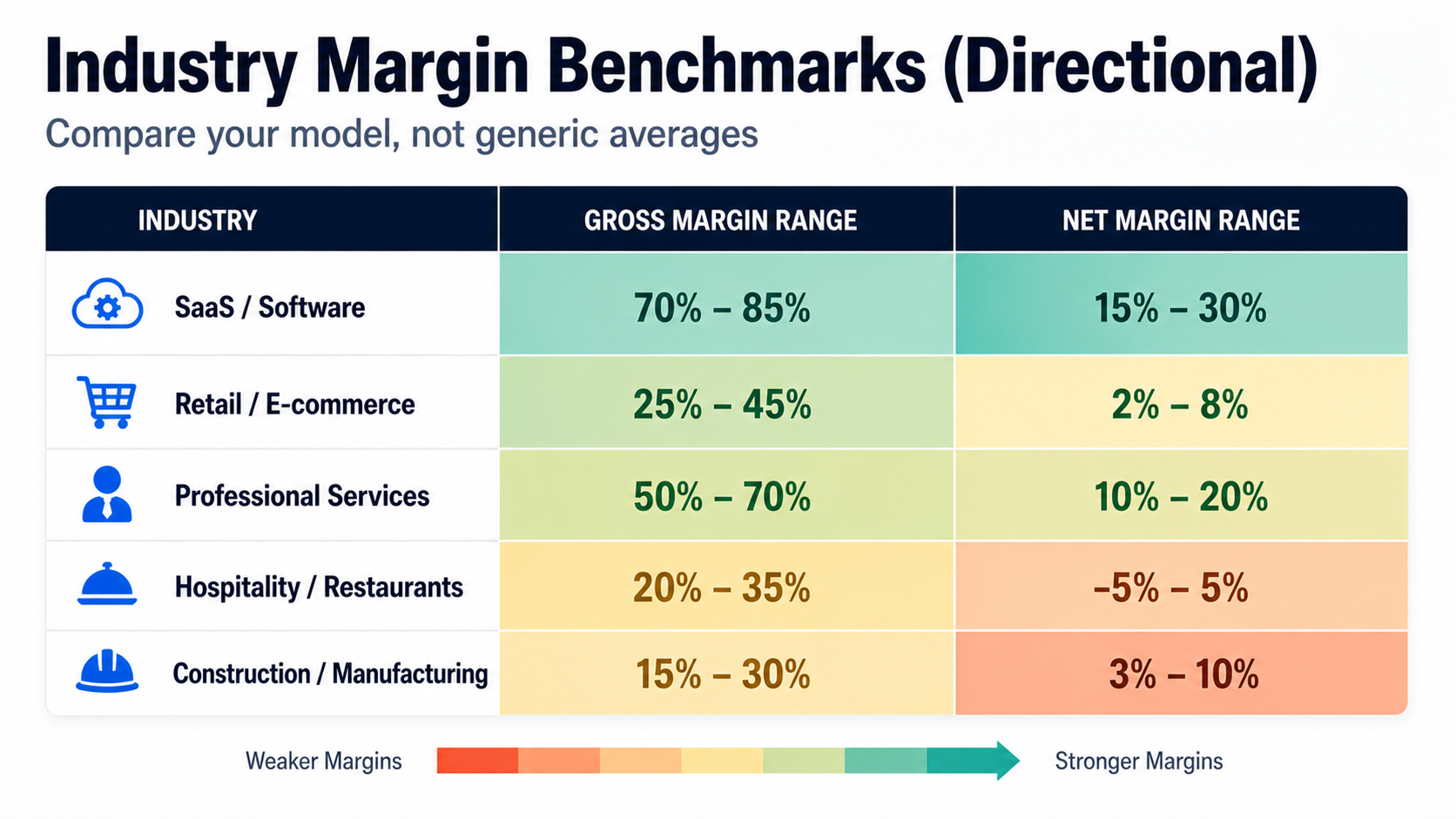
These are planning ranges, not guarantees. Always adjust for your exact offer mix, maturity stage, and local market.
For external benchmark grounding, use:
NYU Stern (Damodaran) margin datasets by industry: pages.stern.nyu.edu/~adamodar/New_Home_Page/datafile/margin.html
Profit margin definition refresher: Investopedia profit margin
Cash and financing context for small firms: Federal Reserve Small Business Credit Survey
Restaurant economics context: National Restaurant Association
The point is not to chase an abstract best number. The point is to know whether your current margin supports payroll, reinvestment, and resilience in a slower month.
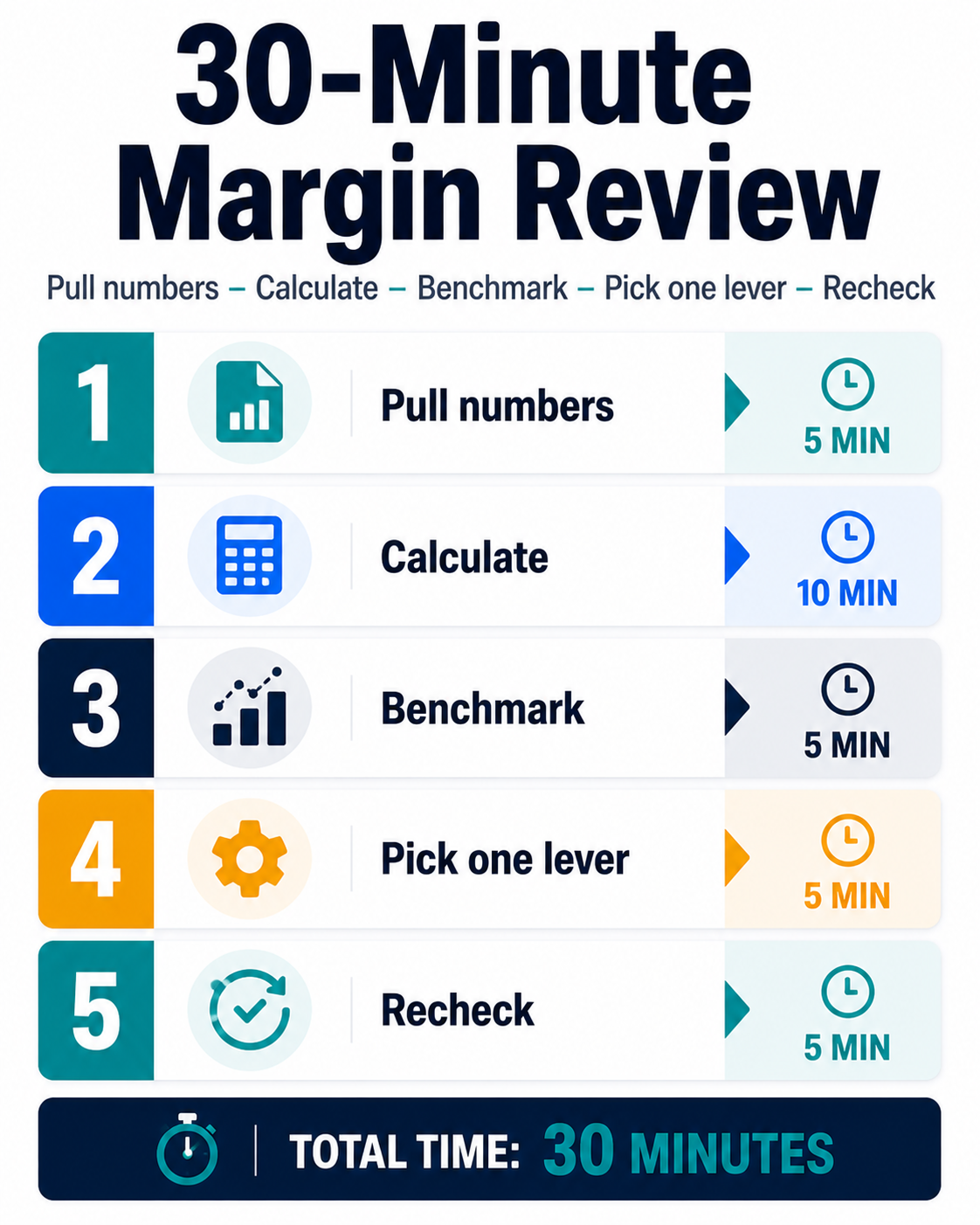
30-Minute Margin Review Workflow (Repeat Quarterly)
If you only do one financial operating review this quarter, do this one.
1. Pull Current Numbers (10 minutes)
Gather the last full month or quarter:
Revenue by major product/service line
Direct costs (COGS, fulfillment, direct labor)
Operating expenses (team, software, rent, admin, marketing)
Discounts and returns (if relevant)
Keep this simple. Precision improves over time.
2. Calculate Gross and Net Margin (5 minutes)
Use your own spreadsheet or a tool, but compute both:
Gross margin by offer
Net margin for the business
Then compare this period vs last period. Direction matters as much as level.
3. Compare to Relevant Industry Benchmarks (5 minutes)
Match your model, not just your broad industry label. A niche consulting firm and a high-volume agency will not benchmark the same way.
Run the comparison in the profit margin calculator and document where you are above, within, or below range.
4. Pick One Lever for the Next 30-90 Days (5 minutes)
Choose one primary lever only:
Price lever: reduce discounting, increase minimums, repackage offers
Cost lever: reduce key COGS drivers, renegotiate input costs
Mix lever: sell more high-contribution offers, sunset weak ones
Trying to optimize everything at once usually creates noise, not progress.
5. Recalculate, Save Baseline, and Set Review Date (5 minutes)
Re-run margin with your chosen change scenario. Save the baseline and target.
If you need a client- or lender-facing export, use clean PDF outputs when appropriate.
If youΓÇÖre regularly saving many scenarios, compare Free and Pro limits on pricing.
CTA: Do this workflow today, then schedule your next review before you close the file. Sustainable margin is built through repetition, not one heroic spreadsheet session.
FAQ: Profit Margin Questions Entrepreneurs Ask Most
Is 20% profit margin good for a small business?
It can be excellent in some sectors and unrealistic in others. In many services businesses, 20% net may indicate strong execution. In retail or restaurants, it may be far above typical net outcomes. Judge 20% against industry benchmarks and your business stage, not in isolation.
What's the difference between gross margin and net margin?
Gross margin measures what remains after direct delivery costs. Net margin measures what remains after all expenses. Gross helps with pricing and delivery decisions; net tells you whether the whole business model is sustainable.
How often should I review margins?
At minimum, quarterly. Monthly is better if your costs are volatile (ads, materials, labor variability) or if you discount heavily. A short recurring review catches erosion early.
Should I raise prices or cut costs first?
Start with diagnosis. If gross margin is weak, check pricing, discounting, and direct costs first. If gross is healthy but net is weak, focus on overhead and operational efficiency. Don't default to price increases without understanding the root cause.
Can a high-margin business still fail from cash flow?
Yes. A business can report acceptable profit margin and still face cash stress due to receivables timing, inventory commitments, debt service, or payroll cadence. Profitability and liquidity are related but not identical.
What is a good profit margin for a small business that is still in growth mode?
In growth mode, temporary net margin compression can be normal if investments are intentional and tracked. The key is planned compression with clear payback, not unmanaged erosion. You should still protect gross margin and monitor runway.
Conclusion: Build Sustainable Margins With Repeatable Decisions
If you remember one thing, make it this: what is a good profit margin for a small business is a context question, not a universal target. The right margin is one that fits your industry, supports your operating model, and stays resilient when costs or demand shift.
Use margin as a decision system, not a vanity metric. Track gross and net. Compare to the right benchmark set. Pick one lever at a time. Review quarterly. That's how entrepreneurs turn margin from a finance report into a practical operating advantage.
When you are ready, run your numbers in the profit margin calculator, save your baseline, and use each quarter review to tighten pricing, cost control, and offer mix. That is how sustainable businesses are built: one clear margin decision at a time.