Donald Trump's push to rename artificial intelligence as "super intelligence" is fundamentally a political and commercial rebrand designed to project American technological dominance and dismantle regulatory friction, rather than a reflection of a sudden breakthrough in computer science. While the administration frames the word "artificial" as weak or counterfeit, the underlying enterprise technology remains generative and narrow machine learning, meaning business operators face the exact same technical limits, error rates, and balance sheet realities regardless of the label Washington uses.
A political rebrand will not stop a large language model from hallucinating customer data, nor will it magically fix the unit economics of your tech stack. If you run a business, manage client deliverables, or sign off on software licensing, you already know that marketing language moves much faster than actual product capability. When political leaders and software vendors change their vocabulary overnight, it rarely signals an operational miracle for end users. Instead, it usually signals an impending wave of vendor price increases, repackaged feature tiers, and confusion across contracts and compliance filings.
In this guide, we break down why the White House wants to retire the term "artificial intelligence," contrast political branding against the technical reality of machine learning, and examine how commercial software vendors will attempt to weaponize the shift. Most importantly, we provide an operator's framework to audit your software spend, model actual return on investment, and evaluate digital tools based on cash flow impact rather than rhetorical hype.
Key Takeaways
Political Motive, Not Technical Shift: The initiative where Donald Trump wants to rename AI "super intelligence" stems from executive rhetoric aimed at framing American tech acceleration against foreign regulatory frameworks, not from achieving true Artificial Superintelligence (ASI).
The Vendor Pricing Trap: Historical precedent shows software companies use terminology updates to justify 12% to 19% subscription price increases by slapping premium monikers on existing generative workflows.
Compliance and Contract Stability: Federal contractors and grant recipients remain bound by statutory definitions under the National AI Initiative Act (15 U.S.C. 9401) and the Federal Acquisition Regulation (FAR), meaning formal procurement legalities do not change with executive speeches.
The Hidden Verification Cost: Over 60% of service operators report that unbudgeted labor hours spent reviewing and fact-checking machine outputs eliminate the theoretical margin gains promised by software sales reps.
Financial Discipline Over Acronyms: Practical operators evaluate tech investments using payback period, billable capacity recovered, and loaded labor cost rather than adopting vendor-promoted acronyms.
Why Trump Wants to Rename AI 'Super Intelligence' (And Retire 'Artificial')
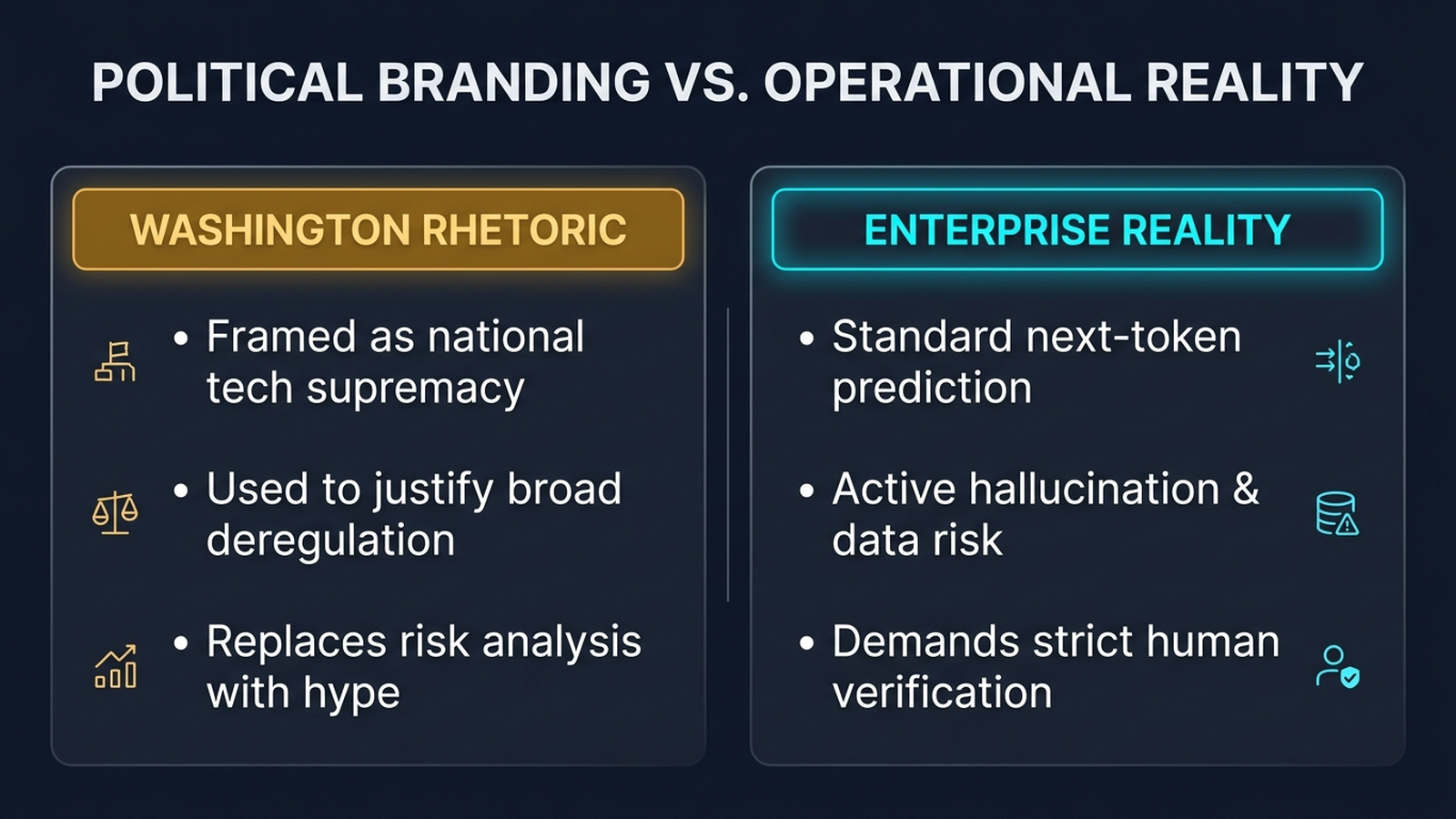
The initiative where Donald Trump wants to rename AI "super intelligence" escalated during high-profile policy announcements tied to the White House AI Action Plan 2026 and addresses at international diplomatic assemblies reported by The White House and Axios. The core objection presented by the administration is linguistic and ideological: the word artificial carries connotations of being synthetic, inferior, or fake, whereas the phrase super intelligence projects unmatched power, national prestige, and technological supremacy.
Why does Donald Trump want to rename artificial intelligence to super intelligence? The administration seeks to rebrand AI as "super intelligence" to project national technological dominance, reject international multilateral regulatory frameworks, and stimulate domestic private-sector capital investment. The shift treats terminology as an economic weapon, framing deregulation and infrastructure expansion as patriotic imperatives while discarding the term "artificial" as synonymous with weakness or counterfeit capability.
Administration Rhetoric ("Super Intelligence") | Technical & Commercial Reality (Generative / Narrow AI) |
|---|---|
"Artificial sounds fake and weak." Dismisses existing terminology as an admission of inferiority. | Designates human-engineered computation. Distinguishes algorithmic processing from biological cognition. |
Implies autonomous superhuman reasoning. Suggests automated tools operate without error or supervision. | Relies on statistical next-token prediction. Generates probabilistic responses based on training datasets. |
Used to justify broad tech deregulation. Frames safety reviews and oversight as geopolitical handicaps. | Hallucinations and data leakage remain active risks. Models exhibit baseline error rates requiring governance. |
Signals national technological supremacy. Centers technological leadership on executive ambition. | Relies on physical supply chains. Constrained by advanced semiconductors, electrical power, and cooling. |
Replaces nuanced risk tiers with marketing. Obscures operational limitations under a single label. | Requires operational verification. Demands human quality assurance before client delivery. |
By framing domestic machine learning developments as "Super Intelligence," federal policy rhetoric seeks to bypass the precautionary posture favored by European regulators and global governance bodies, as detailed in policy research by the Brookings Institution and PBS NewsHour. When technology is labeled "artificial," critics often emphasize safety barriers, systemic biases, and copyright guardrails. When that same technology is labeled "super intelligence," the conversation shifts toward a geopolitical sprint where any regulatory pause is depicted as falling behind international competitors.
For business owners, this rhetorical repositioning has practical consequences. It signals an aggressive domestic policy environment favoring energy infrastructure construction, semiconductor incentives, and relaxed federal oversight on automated commercial tools. However, an executive decree cannot alter the computational mechanics of deep neural networks. Conflating political ambition with software capability creates an expensive blind spot for teams responsible for delivering real customer work.
Generative AI vs. Super Intelligence: The Technical Reality Behind Trump's Rebrand
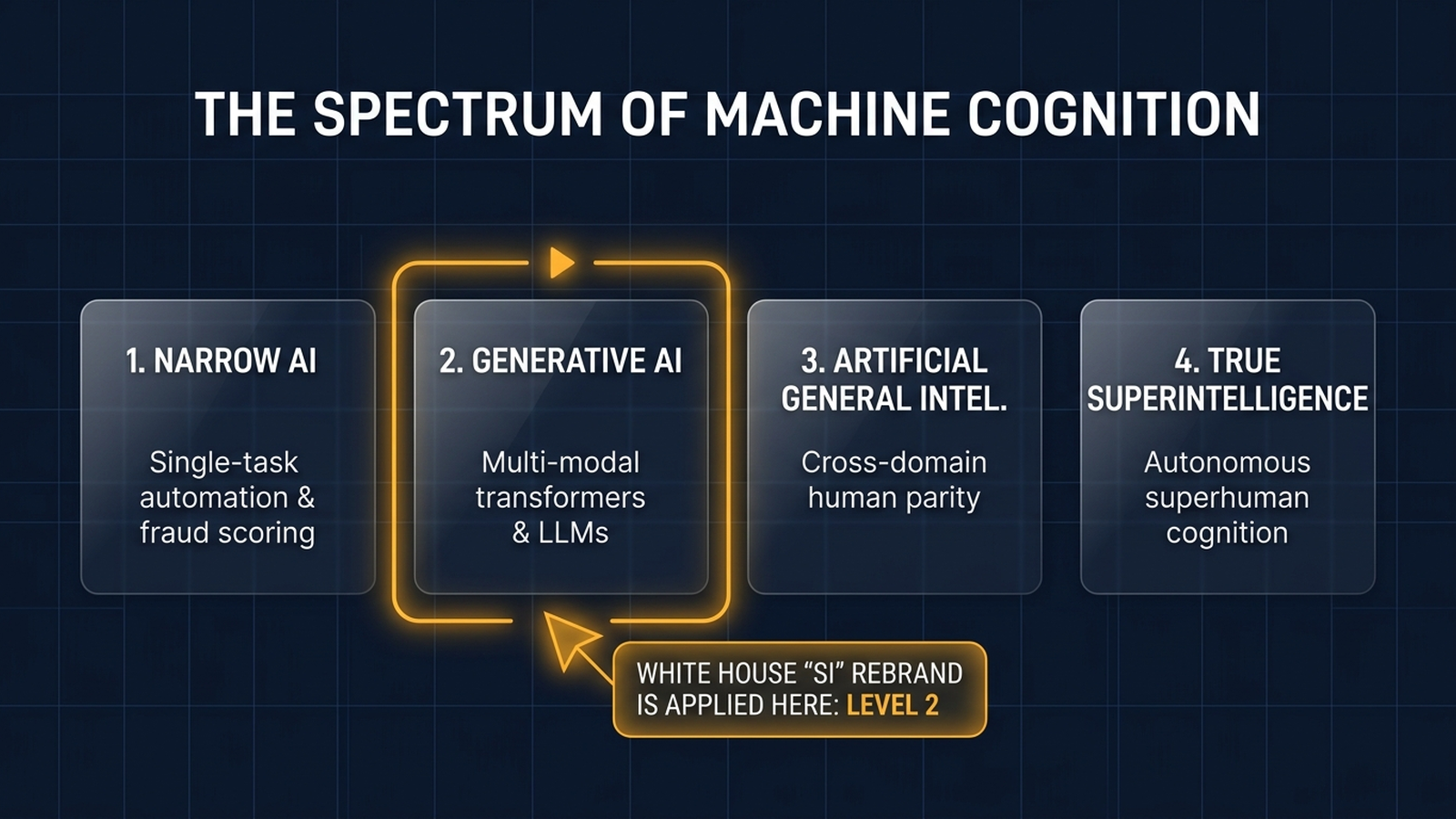
To understand why the proposed rebrand creates operational confusion, one must separate the established scientific definitions of machine cognition from Washington's political vocabulary. In computer science and philosophy, machine intelligence has historically been divided into distinct tiers of cognitive scope.
Classification | Cognitive Scope | Operating Mechanism | Practical Status (2026) |
|---|---|---|---|
Narrow AI | Single domain or specialized task (e.g., chess, fraud detection) | Specialized algorithms & heuristic rules | Mature enterprise deployment (Spam filters, credit risk scoring) |
Generative AI | Multi-modal pattern synthesis, text and code generation | Deep transformer architectures, statistical weighting | Ubiquitous deployment (LLMs, code generation, drafting tools) |
Artificial General Intelligence (AGI) | Cross-domain human-parity cognitive adaptability | Autonomous reasoning, conceptual transfer learning | Theoretical horizon; active frontier research without consensus |
Artificial Superintelligence (ASI) | Vastly exceeds human intellect across all disciplines | Self-improving, multi-disciplinary systemic cognition | Speculative frontier; subject of long-term academic alignment research |
Political "SI" (White House Rebrand) | Standard generative and agentic workflows | Existing enterprise LLM API pipelines | Active marketing and federal policy terminology |
As defined by researchers like Oxford philosopher Nick Bostrom, Artificial Superintelligence describes an intellect that is much smarter than the best human brains in practically every field, including scientific creativity, general wisdom, and social skills. A true superintelligence would not merely draft an email, reconcile a ledger, or write a Python script; it would independently develop novel physics proofs, optimize global macroeconomic logistics in real time, and operate with autonomous agency far beyond human comprehension.
What businesses use today, and what the White House is actually renaming, is generative machine learning built on transformer architectures. These models analyze massive corpuses of text, code, and media to predict probable sequences of words or tokens. They do not possess consciousness, reflective intent, or verified factual understanding. When an LLM generates a client proposal or analyzes financial statements, it does not "know" accounting principles; it identifies statistical relationships between numerical inputs and narrative outputs.
When Trump seeks to rename artificial intelligence as super intelligence, it does not change the computational limits of generative transformers. Hallucination rates across enterprise models continue to hover between 3% and 14% depending on domain complexity. If a logistics planner or financial analyst mistakes commercial generative models for infallible superintelligence, the company exposes itself to compliance failures, flawed bids, and direct balance sheet losses.
Before committing capital to software claiming superhuman capabilities, model your real cost savings using our SaaS ROI Calculator to determine whether automated tools actually pay for themselves.
The Commercial Trap: How Software Vendors Weaponize the Trump Super Intelligence Rebrand
Whenever political figures introduce new buzzwords into the cultural lexicon, commercial enterprise software vendors respond immediately. The technology industry has spent decades executing cycles of semantic inflation:
On-premise server hosting was rebranded as the Cloud.
Relational databases and statistical regressions became Big Data.
Automated decision trees and algorithmic rules were sold as Machine Learning.
Statistical text completion was packaged as Artificial Intelligence.
The Trump super intelligence rebrand provides software marketing teams with their next pricing catalyst. Commercial software providers that added generative features to their legacy applications historically introduced an average subscription price hike of 15.4%. In many instances, the underlying tools were thin wrappers built around public API endpoints, offering little proprietary computational value while demanding premium monthly seat licenses.
Stage in Rebranding Cycle | Vendor Action | Financial & Operational Impact |
|---|---|---|
1. Legacy Feature Set | Basic rule-based automation or public API wrapper | Stable, predictable monthly SaaS subscription cost |
2. Semantic Rebrand | Product marketed as "AI-Powered" or "Super Intelligence Core" | Marketing collateral claims autonomous superhuman reasoning |
3. Pricing Escalation | Platform migrated to premium tier or consumption-based tokens | 12% to 19% baseline price hike plus unbudgeted overages |
4. Operational Drag | Software output remains probabilistic and error-prone | Senior staff absorbed by unbudgeted verification and QA labor |
The Mechanism of Vendor Semantic Inflation
Marcus Vance runs a 14-person freight logistics consultancy based in Cleveland, Ohio. His business relies heavily on dispatch coordination, freight bill auditing, and contract lane pricing. In early 2025, the firm subscribed to a specialized contract analysis platform at $450 per month, which extracted rate tables and demurrage terms from carrier agreements.
In late September 2026, within weeks of the federal rhetoric surrounding "Super Intelligence," the software provider announced that its legacy platform was being migrated to an "Autonomous Super Intelligence Core." The monthly subscription fee jumped from $450 to $780 per month, a 73% increase. The sales representative claimed the new engine offered "unmatched cognitive reasoning."
When Marcus audited the updated software against 50 archived freight contracts, the results were sobering:
Extraction accuracy on standard fuel surcharges remained unchanged at 94%.
The tool misclassified detention fees on non-standard bills of lading at the exact same 8% error rate as the previous version.
Processing latency actually increased by 1.8 seconds per document because the vendor routed requests through an unnecessary chain-of-thought prompt pipeline.
Marcus realized his firm was paying an extra $3,960 annually not for improved extraction accuracy, but to fund the software vendor's brand repositioning. He declined the "Super Intelligence" upgrade tier, switched back to structured tabular parsers, and protected his firm's operating margins.
Software buyers must recognize that vendors adopt Washington's terminology to reset pricing conversations. When a sales representative tells you their platform has evolved from artificial intelligence to super intelligence, demand hard benchmark data:
What is the verified task-level error rate compared to last year's release?
Does the tool operate deterministically, or does it require continuous human review?
What specific labor hours does this upgrade eliminate from your payroll?
If the vendor cannot provide audited accuracy benchmarks across your specific industry workflows, the "Super Intelligence" label is simply marketing cover for higher software margins.
Federal Contracting, Grants, and Compliance: Do You Need to Change Your Documents?
For small-to-medium enterprises operating in government contracting, defense supply chains, or federally funded research, the White House rhetoric raises an immediate legal question: Must government contractors and grant recipients scrub the term "AI" from proposals, deliverables, and compliance schedules?
The short answer is no. In the United States administrative state, presidential speeches, press briefings, and political branding exercises do not supersede statutory law or formal procurement regulations.
Governance Layer | Legal Instrument | Operative Terminology & Legal Status |
|---|---|---|
Presidential Rhetoric | Public Speeches, White House Press Releases | "Super Intelligence" / "SI" (Non-binding political directive) |
Statutory Law | National AI Initiative Act of 2020 (15 U.S.C. 9401) | "Artificial Intelligence" (Legally binding congressional definition) |
Procurement Regulation | Federal Acquisition Regulation (FAR) & DFARS | "Artificial Intelligence Systems" (Mandatory contract compliance) |
Technical Standards | NIST AI Risk Management Framework (AI RMF 1.0) | "AI Actor," "Trustworthy AI" (Standard audit and control terms) |
Under 15 U.S.C. 9401, artificial intelligence is explicitly defined as "a machine-based system that can, for a given set of human-defined objectives, make predictions, recommendations or decisions influencing real or virtual environments." This definition is embedded across the Federal Acquisition Regulation (FAR), Defense Federal Acquisition Regulation Supplement (DFARS), and National Institute of Standards and Technology (NIST) compliance frameworks.
The Operational Risk of Premature Contract Amendments
Elena Rostova serves as Vice President of Operations at a 35-person defense engineering subcontractor in Northern Virginia. Following news coverage of the White House announcement, her technical writing team became concerned that pending bids for an aerospace predictive maintenance contract would appear out-of-date if they repeatedly referenced "artificial intelligence."
The team drafted a global find-and-replace across a 280-page proposal, changing every mention of "AI-driven diagnostics" to "Super Intelligence predictive systems." Before submission, the firm's procurement counsel intervened. The underlying federal solicitation specifically referenced requirements under DFARS clauses and NIST AI Risk Management standards.
Submitting a bid utilizing non-statutory terminology introduced material risk:
It created ambiguity regarding whether the software complied with formal FAR automated decision system reporting mandates.
Contracting officers scanning proposals with automated keyword evaluation scripts might have flagged the proposal as non-responsive to the stated Statement of Work (SOW).
If awarded, the firm could have faced audits regarding whether its deliverables met the technical criteria of the legal definitions established by Congress.
Elena's firm retained standard statutory language in the formal proposal sections, adding only a brief contextual note acknowledging current administration technology initiatives in the executive overview. The bid was evaluated smoothly, and the firm avoided self-inflicted compliance issues.
Document Type | Binding Mandate | Recommended Action |
|---|---|---|
Legally Binding Federal Filings, SOWs & RFPs | Governed by statutory definitions under 15 U.S.C. 9401, FAR, and DFARS | Maintain statutory terms ("Artificial Intelligence"). Never substitute uncodified terms without a formal Contracting Officer modification (SF-30). |
Technical Grant Proposals & NIST Security Plans | Evaluated against formal scientific frameworks and technical criteria | Adhere to NIST AI RMF terminology ("trustworthy AI", "risk classification"). Avoid political buzzwords that trigger automated compliance screening flags. |
Public Capability Statements & Executive Summaries | Geared toward general audiences and policy context | Contextual framing acceptable. Acknowledge executive technology initiatives in introductory remarks while keeping technical line items formal. |
Action Checklist for Federal Contractors and Grant Applicants:
Never alter binding contract language without a formal contract modification (SF-30) issued by your Contracting Officer (CO).
Adhere to NIST AI RMF guidelines: Continue using established NIST terminology ("trustworthy AI," "data governance," "algorithmic bias mitigation") in system security plans.
Separate marketing from procurement: While you can mirror executive phrasing in high-level press releases or public-facing capability decks, keep formal cost accounting, technical specifications, and labor category descriptions anchored in standard federal terminology.
The Operator's Playbook: How to Evaluate Tech by ROI, Not Rebranding
When technology terminology becomes politicized, smart business operators tune out the noise and refocus on unit economics. A commercial enterprise does not generate profit from the labels on its software licenses; it generates profit by delivering customer value at an acceptable cost.
Whether an application is sold as generative machine learning, an intelligent agent, or "super intelligence," its financial utility is governed by a simple equation:
$$\text{Net Value Generated} = (\text{Direct Labor Hours Saved} \times \text{Loaded Hourly Rate}) - (\text{Software Cost} + \text{Verification Labor Cost} + \text{Integration Drag})$$
Net Value Generated = (Direct Labor Hours Saved × Loaded Hourly Rate) - (Software Cost + Verification Labor Cost + Integration Drag)
Most software sales pitches highlight the first variable—labor hours saved—while systematically omitting the costs of software licensing, verification labor, and integration drag.
Cost Component | How It Erodes Business Margin |
|---|---|
1. Direct Software Licensing | Fixed seat licenses, token consumption overages, and recurring API call fees. |
2. Integration & Maintenance | Custom API bridges, workflow adjustments, and continuous internal IT updates. |
3. Output Verification Labor | Highly compensated senior staff time dedicated to reviewing machine drafts for errors. |
4. Error Correction & Rework | Remedying client deliverables, handling compliance gaps, or re-executing failed workflows. |
5. Process Disruption Drag | Team retraining, modified handoff procedures, and transitional operational confusion. |
The Verification Trap: Why Unchecked Automation Destroys Margin
The single greatest hidden expense in modern workflow automation is output verification labor. When an employee completes a task manually, quality control is baked into execution. When a machine completes a task probabilistically, a qualified human must review the output before it reaches a client, partner, or regulator.
If a junior copywriter or analyst earns $35 per hour and produces a draft in three hours, the base labor cost is $105. If an automated tool generates that draft in 30 seconds for $2 in compute cost, the savings appear massive. But if a senior manager earning $90 per hour must spend 45 minutes verifying every fact, recalculating financial tables, and rewriting awkward prose, the verification labor costs $67.50.
Add the software seat license, and the true cost reaches $75 to $80, yielding negligible savings while shifting stress to senior personnel whose time would be better spent on business development or strategy.
Over 60% of professional service firms adopting generative automation report that early efficiency gains were neutralized by unbudgeted management review hours. This dynamic explains why many growing firms feel squeezed even as their revenue expands, a reality we explore in our guide on working capital planning for growth.
Worked Example: A Service Firm Audits a $1,500/Month "Super Intelligence" Workflow
To illustrate how to audit automated tools under real operating conditions, let's examine an 18-person tax preparation and business advisory firm in Chicago managed by David Park.
Metric / Cost Line Item | Vendor Projection | Actual 90-Day Operating Reality | Variance |
|---|---|---|---|
Monthly Software Subscription | $1,500 / month | $1,500 / month | $0 |
API Token Overages (Client Files) | $0 (Promised) | $380 / month | +$380 / month |
Target Extraction Tasks Run | 240 files / month | 210 files / month | -30 files / month |
Junior Labor Hours Saved | 80 hours / month | 65 hours / month | -15 hours / month |
Junior Staff Loaded Rate | $32 / hour | $32 / hour | $0 |
Gross Monthly Value Generated | $2,560 / month | $2,080 / month | -$480 / month |
Senior Verification Hours Required | 5 hours / month | 26 hours / month | +21 hours / month |
Senior Staff Loaded Rate | $85 / hour | $85 / hour | $0 |
Total Monthly Verification Cost | $425 / month | $2,210 / month | +$1,785 / month |
Net Monthly Economic Impact | +$635 / month Net | -$2,010 / month Direct Loss | -$2,645 / month Deficit |
The Initial Pitch
In November 2025, David's firm evaluated an automated document extraction platform marketed as an "AI Tax Document Processing Suite." The vendor promised the system would ingest client K-1s, 1099s, and profit-and-loss statements, extract line items, and populate working trial balances. The software carried a price tag of $1,500 per month.
The vendor argued that the tool would save 80 hours of junior associate time each month. At a loaded cost of $32 per hour, those 80 hours represented $2,560 in monthly payroll value. Subtracting the $1,500 software subscription indicated a projected net monthly benefit of $1,060, or $12,720 annually.
The "Super Intelligence" Rebrand and Reality Check
In September 2026, the vendor informed David that the platform had been upgraded to the "SI Autonomous Intelligence Engine." The vendor maintained the $1,500 monthly base fee but introduced token-based consumption pricing for complex PDF documents, adding roughly $380 per month in unexpected usage fees.
David decided to run a structured 90-day operational audit across 630 tax files processed during the quarter. Rather than relying on staff impressions, he tracked exact timestamps, error logs, and review hours:
Raw processing volume: The system processed an average of 210 files per month, saving roughly 65 hours of junior data-entry labor monthly ($2,080 in gross value).
Extraction accuracy: On standardized W-2s and institutional 1099s, the tool performed reliably (98.5% accuracy). However, on hand-annotated balance sheets and complex real estate partnership K-1s, the error rate spiked to 16.2%.
Verification cost: Because a missed passive loss or misallocated distribution could trigger penalties for clients, David required senior managers ($85/hour loaded rate) to sign off on every extraction sheet. Reviewing and correcting errors required an average of 26 senior hours per month, costing the firm $2,210 in management time.
When David assembled the full operational balance sheet, the results were clear:
$$\text{Net Monthly Value} = $2,080 - ($1,500 + $380 + $2,210) = -$2,010$$
Far from generating $1,060 in monthly savings, the "Super Intelligence" platform was costing the firm $2,010 every month in combined subscription fees and diverted senior capacity. The firm was paying premium rates to perform quality assurance for a software vendor's beta model.
Financial Perspective | Monthly Net Economic Impact | Annualized Net Bottom Line |
|---|---|---|
Vendor Sales Projection | +$635 net benefit | +$7,620 projected return |
Audited Operating Reality | -$2,010 direct cash loss | -$24,120 annualized margin drain |
Net Operational Variance | -$2,645 monthly gap | -$31,740 annual variance |
The Strategic Decision
David did not abandon automation entirely. Instead, he applied strict operational criteria:
He downgraded the subscription, eliminating the expensive multi-modal "SI" agent tier.
He re-architected the workflow: standard, high-volume documents were routed through simple, deterministic OCR templates, while complex partnership returns were routed back to junior staff for manual preparation.
Junior staff completed the work accurately the first time, cutting senior verification hours from 26 down to 6 hours per month.
By refusing to buy into vendor branding and auditing the true labor burden, David restored his advisory practice's operating margins. This type of hard margin review is identical to the principles we outline in our breakdown of break-even analysis for service businesses.
To see how operational changes affect your firm's bottom line, benchmark your performance using our Profit Margin Calculator or model software unit economics with our SaaS Profit Margin Calculator before committing to multi-year contracts.
Technical and Ethical Due Diligence: A Decision Framework
Before integrating any automated tool into core operations, regardless of whether the vendor describes it as machine learning, AI, or Super Intelligence, operators should run through a four-part evaluation framework.
Evaluation Pillar | Critical Questions to Ask Vendors |
|---|---|
1. Determinism vs. Probability | Does the software produce identical outputs for identical inputs? What is the standard error rate under non-standardized edge cases? |
2. Verification Burden | What job seniority is required to validate outputs before deployment? How many minutes of review are needed per transaction or file? |
3. Contractual Risk & Data Governance | Does the vendor indemnify against IP infringement or privacy leaks? Are client records used to train proprietary foundation models? |
4. Unit Economic Payback | Does the direct labor savings exceed total subscription plus review? What is the break-even volume required to justify fixed tooling fees? |
1. Determinism vs. Probability
Determine whether the task you are automating requires deterministic certainty or probabilistic creativity.
Deterministic tasks (payroll calculations, sales tax remittance, invoice line-item balancing) require 100% precision. Using probabilistic generative models for these tasks is fundamentally flawed; they require traditional, rule-based algorithmic software.
Probabilistic tasks (drafting marketing angles, summarizing unstructured interview transcripts, brainstorming software architecture) tolerate variance and benefit from generative tools.
When vendors claim "Super Intelligence," they often attempt to apply probabilistic models to deterministic problems. Protect your operations by keeping your core accounting, tax, and billing processes anchored in auditable calculations.
2. Intellectual Property and Data Leakage
When company documents, proprietary pricing tables, or customer records are uploaded to third-party models, where does that data go? Under current enterprise licensing agreements, reputable vendors offer data segregation clauses guaranteeing that client data will not be used to train foundation models.
However, when software providers rapidly rebrand, switch backend API providers, or introduce unvetted third-party plugins, those privacy protections can blur. If your business handles regulated consumer data, HIPAA records, or non-public financial information, any automated tool must be vetted for strict data governance.
3. Capital Budgeting and the Buy vs. Build Calculation
Investing in automation is a capital allocation decision. Many operators treat small monthly SaaS charges as trivial operating expenses, ignoring how dozens of redundant licenses accumulate into severe cash-flow drains.
Before signing an enterprise software contract, run a formal capital budgeting analysis. Compare the upfront cost of custom deterministic tooling against ongoing third-party subscriptions. For a detailed guide on evaluating capital expenditures, review our analysis on capital budgeting for small-business equipment.
Frequently Asked Questions About the AI to Super Intelligence Rebrand
Why does Donald Trump want to rename artificial intelligence to super intelligence?
The administration seeks to rebrand AI as "super intelligence" to project national technological dominance, reject international multilateral regulatory frameworks, and stimulate domestic private-sector capital investment. The shift treats terminology as an economic lever, framing deregulation and infrastructure expansion as strategic imperatives while discarding the term "artificial" as synonymous with synthetic or counterfeit capability.
Has artificial intelligence actually achieved true superintelligence?
No. Current commercial systems operate as narrow and generative machine learning built on deep transformer architectures and statistical next-token prediction. True Artificial Superintelligence (ASI), as defined by researchers like Nick Bostrom, represents a hypothetical system that vastly exceeds human intellect across virtually all disciplines, including scientific discovery, macroeconomic planning, and social reasoning.
Do federal contractors need to change 'AI' to 'Super Intelligence' in government proposals?
No. Federal contractors and grant recipients must maintain statutory terminology defined under the National AI Initiative Act of 2020 (15 U.S.C. 9401), the Federal Acquisition Regulation (FAR), and the NIST AI Risk Management Framework. Executive speeches do not alter binding procurement regulations or Statement of Work requirements without formal FAR rulemaking or contracting officer modifications.
How are software vendors using the super intelligence rebrand to raise prices?
Commercial software providers frequently use semantic inflation to re-label standard automation or generative API wrappers as premium "super intelligence" features. Historical enterprise software cycles show vendors introducing price hikes between 12% and 19% after rebranding existing capabilities, often shifting unexpected token consumption and verification costs onto the customer.
How should business operators evaluate software claiming super intelligence capabilities?
Operators should evaluate automation using deterministic unit economics rather than marketing claims. Calculate net value by measuring billable hours recovered, loaded hourly labor rates, ongoing subscription fees, and the internal labor cost required for senior staff to audit and verify probabilistic outputs.
Conclusion: Don't Buy the Label, Buy the Output
The debate over whether to call modern computational systems "artificial intelligence" or "super intelligence" will continue across political podiums, think tank symposia, and cable news broadcasts. Political leaders will use language to project strength and advance domestic industrial agendas. Silicon Valley marketing teams will seize on that language to re-label existing software features and raise subscription prices.
As an operator, your job is not to adopt Washington's political lexicon or help SaaS companies hit their quarterly recurring revenue targets. Your job is to protect your cash flow, deliver exceptional work to your clients, and build a resilient balance sheet.
A machine model does not become more capable because an executive order drops the word "artificial." A language model does not gain common sense because a marketing brochure adds the word "super." Software either saves more money than it costs, or it is a liability. It either reduces your team's workload, or it shifts an expensive verification burden onto your highest-paid employees.
Before you approve your next software upgrade or accept a price hike for "Super Intelligence," take control of your numbers:
Audit your current stack: Identify every tool charging a premium for automated or generative features.
Measure verification hours: Calculate the loaded hourly cost of staff review time.
Demand accuracy benchmarks: Make software vendors prove error reduction before renewing contracts.
Model your payback: Run the numbers through structured financial calculators to verify that automation generates a positive return.
Ready to run the real numbers on your tech stack? Explore our complete Tools Directory, model your investment scenarios with our SaaS ROI Calculator, and protect your margins with tools built for your specific industry. Compare software investment tiers on our pricing page to see how transparent modeling beats black-box subscription inflation.
Editorial Methodology & Compliance Note
This analysis evaluates technological branding initiatives through the lens of operational corporate finance, contract law, and labor economics. Statutory citations refer to the National AI Initiative Act of 2020 (15 U.S.C. 9401) and Federal Acquisition Regulation guidelines active as of late 2026. This content is published for informational and operational planning purposes and does not constitute formal legal, regulatory, or tax advice. Organizations subject to federal procurement audits should consult designated contracting officers and legal counsel regarding binding contract terminology.