The proposed Standards Authority for Frontier AI (SAFA) is a private, industry-led oversight body created by Google, OpenAI, and Anthropic to set voluntary safety benchmarks, mandate pre-deployment red-teaming, and certify third-party auditors for high-compute models. Critics call it an AI self-regulation cartel because it establishes a self-policing oligopoly that could box out open-source alternatives, coordinate capability release pacing, and impose prohibitive compliance overhead on smaller rivals under the banner of catastrophic risk mitigation.
What happens when the three most valuable artificial intelligence labs in the world decide they do not need government regulators because they can police themselves? If you run a software company, manage engineering teams, or build workflows around commercial APIs, the answer is not an abstract philosophical debate. It is a direct threat to your software delivery costs, vendor independence, and operating margins.
Every engineering lead, founder, and business operator agrees that cutting-edge AI capabilities carry real systemic hazards, from automated cyber exploits to biosecurity concerns. But allowing an AI self-regulation cartel to unilaterally define which models are "safe" enough to exist creates an immediate commercial conflict of interest. In this analysis, we examine the anatomy of the Standards Authority for Frontier AI (SAFA), unpack why rivals and antitrust experts view this alliance as illegal market coordination, and provide an operational playbook to protect your business margins against closed-ecosystem gatekeeping.
Key Takeaways
The SAFA Proposal: Initiated in mid-2026 by Google DeepMind's Demis Hassabis alongside leadership at OpenAI and Anthropic, the Standards Authority for Frontier AI (SAFA) seeks to establish industry-run safety thresholds, standardized red-teaming evaluations, and third-party auditor licensing.
The "Cartel" Indictment: Independent competitors like Cohere's Aidan Gomez and prominent open-source leaders warn that this AI self-regulation cartel builds a defensive moat, weaponizing compute-based safety rules to restrict open model distribution under Section 1 of the Sherman Act.
The Flawed FINRA Blueprint: While proponents compare SAFA to Wall Street's Financial Industry Regulatory Authority (FINRA), FINRA operates under explicit statutory authorization and direct SEC oversight, a vital democratic check that SAFA's purely private governance structure lacks.
Downstream Economic Damage: Mandatory third-party safety audits and synchronized release pacing threaten to inflate API token prices by 25% to 40% while creating six-figure enterprise integration barriers for vertical SaaS and SMB operators.
The Operator's Defense: Businesses must protect their independence by adopting model-agnostic abstraction layers, benchmarking infrastructure payback with a SaaS ROI calculator, and stress-testing software margins against volatile vendor pricing.
What is the Standards Authority for Frontier AI (SAFA)?
What is an AI self-regulation cartel?
An AI self-regulation cartel is an alliance of dominant artificial intelligence companies that coordinate voluntary safety rules, compliance audits, and deployment timelines without statutory government oversight. Critics argue these private consortiums suppress open-source competition, restrict compute access, and protect incumbent market share under the guise of catastrophic risk mitigation.
The Standards Authority for Frontier AI (SAFA) is a proposed private, self-regulatory organization formed by Google, OpenAI, and Anthropic to govern cutting-edge artificial intelligence development. Modeled loosely on financial self-regulatory organizations, SAFA establishes standardized safety thresholds, mandatory pre-deployment red-teaming evaluations, third-party auditor certifications, and unified incident reporting frameworks across frontier AI model developers.
Core functions of the proposed body include:
Mandatory Pre-Deployment Red-Teaming: Standardized testing protocols evaluating catastrophic chemical, biological, radiological, and cyber capabilities prior to commercial release.
Third-Party Auditor Accreditation: Licensing authorized private inspection firms to verify frontier lab compliance with safety standards.
Shared Incident Reporting: A centralized registry for logging hazardous capability emergence and alignment failures.
Compute and Capability Thresholds: Defining which advanced training runs (such as those exceeding 10^26 FLOPs) fall under formal governance obligations.
1. The Anatomy of SAFA: How the Big Three Formed an AI Self-Regulation Cartel
The origins of the Standards Authority for Frontier AI trace back to private discussions initiated in July 2026 by Google DeepMind CEO Demis Hassabis, who was quickly joined by OpenAI leadership and Anthropic CEO Dario Amodei. The trio acted out of frustration with Washington's legislative inaction and concern over fragmented state laws. Their goal was a centralized apparatus to set uniform engineering standards across frontier AI.
On paper, SAFA is pitched as a high-minded public service. Proponents argue that the technical velocity of artificial general intelligence outpaces the drafting speed of Congressional subcommittees. By formalizing evaluation benchmarks, mandating rigorous red-teaming before major checkpoint deployments, and standardizing incident disclosure, the consortium claims it can prevent catastrophic deployment failures without waiting for bureaucratic statute.
+--------------------------------------------------------------------------+
| The Proposed SAFA Self-Regulatory Scheme                                 |
+--------------------------------------------------------------------------+
| Frontier Labs (Google / OpenAI / Anthropic)                              |
|   |                                                                      |
|   v                                                                      |
| Standards Authority for Frontier AI (SAFA)                               |
|   * Defines "Frontier Compute Thresholds" (>10^26 FLOPs)                  |
|   * Accredits Exclusive 3rd-Party Safety Auditors                        |
|   * Mandates Pre-Deployment Red-Teaming Requirements                     |
|   * Coordinates Safe Release Pacing Across Members                       |
|   |                                                                      |
|   v                                                                      |
| Downstream Impact on the Software Ecosystem                              |
|   * Open-Weights Models Tagged as "Unverified / High Risk"               |
|   * Challengers (Cohere, Mistral) Face 6-Figure Audit Compliance Gates   |
|   * Enterprise Buyers Steered Exclusively to Closed Consortium APIs     |
+--------------------------------------------------------------------------+
To establish institutional legitimacy, the founding labs launched an aggressive executive search for high-profile leadership, approaching political insiders, tech venture figures, and former regulatory directors, including Sriram Krishnan, former White House Office of Science and Technology Policy Director Arati Prabhakar, and former Secretary of State Condoleezza Rice. The goal was transparent: recruit seasoned political operators who could project an aura of bipartisan authority while shielding the private coalition from antitrust inquiry.
The Broken FINRA Blueprint
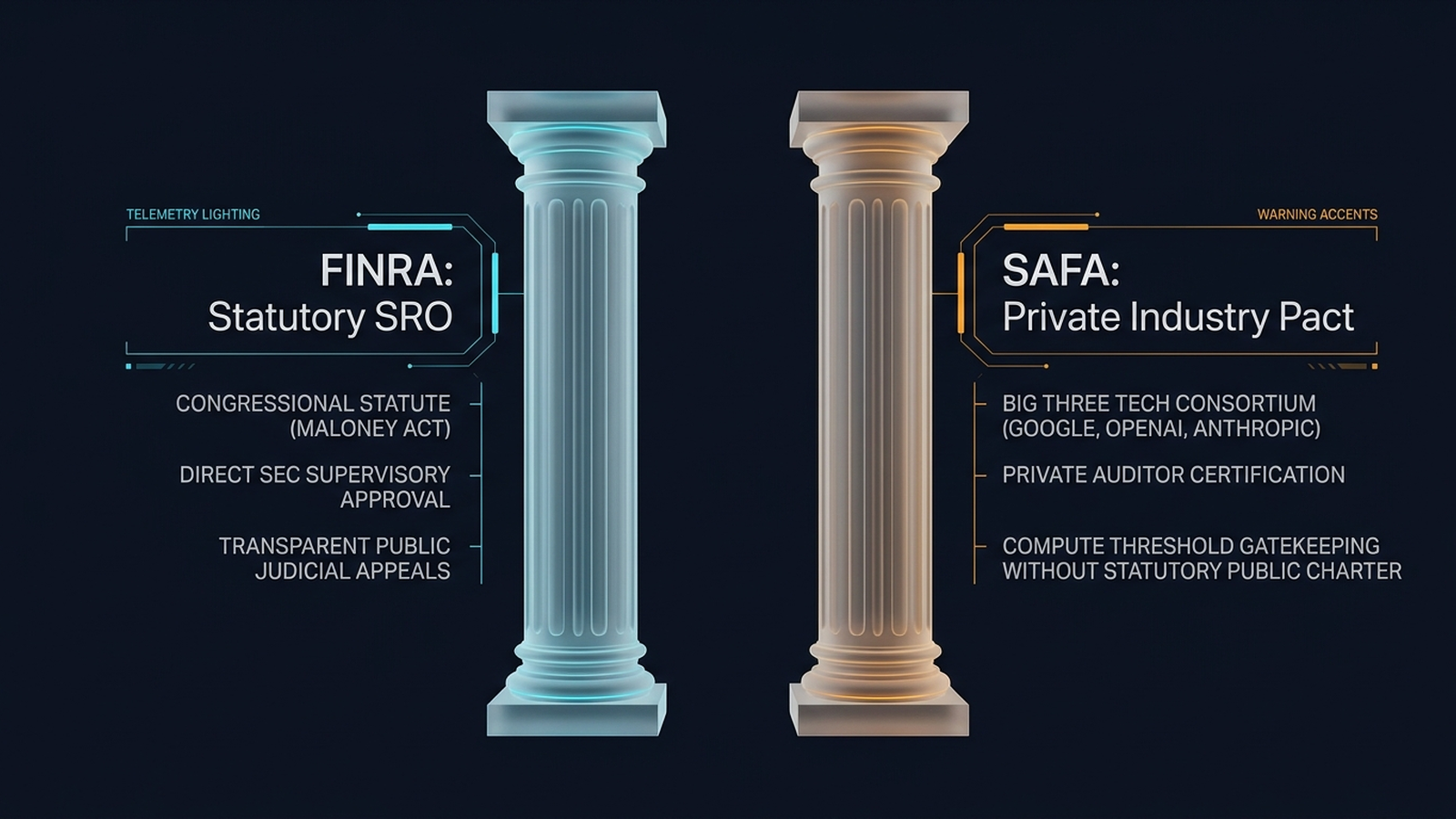
The primary intellectual justification offered by SAFA's architects is Wall Street's self-regulatory model: the Financial Industry Regulatory Authority (FINRA). Proponents advocate an AI safety self policing FINRA model, arguing that just as broker-dealers successfully police market conduct, capital adequacy, and exchange rules under FINRA, leading AI laboratories can govern model weights, compute allocation, and alignment thresholds.
However, this comparison collapses under legal scrutiny. FINRA is not a private pact dreamed up over dinner by Goldman Sachs, JPMorgan Chase, and Morgan Stanley. FINRA was established through explicit federal legislation (the Maloney Act of 1938, amending the Securities Exchange Act of 1934). It operates under direct, permanent supervision by the Securities and Exchange Commission (SEC). The SEC must approve FINRA's rules, hears appeals from its disciplinary actions, and can overturn its decisions at will.
SAFA, by contrast, possesses no statutory backing, no public charter, and zero government accountability. It represents a private industry consortium acting as standard-setter, compliance auditor, and market gatekeeper simultaneously. When three dominant horizontal suppliers design a private enforcement body to police their own market, economists do not describe it as an independent watchdog; they describe it as an AI self-regulation cartel.
2. Why Washington's Regulatory Vacuum Created a Private Alliance
To understand why Google, OpenAI, and Anthropic moved to create an industry alliance in 2026, one must examine the shifting political landscape in Washington. Over the preceding two years, federal momentum toward comprehensive AI oversight ground to a halt. While early executive orders outlined ambitious public-private safety institutes, subsequent administrative shifts reprioritized geopolitical competition, focusing federal policy on compute supremacy, semiconductor supply chains, and domestic energy production rather than restrictive safety mandates.
The evolution of frontier AI self regulation emerged directly from this oversight void. Without clear statutory guidance from Congress or mandatory enforcement mechanisms within the National Institute of Standards and Technology (NIST AI Risk Management Framework), the frontier labs faced an unpredictable landscape:
State-Level Legislative Fragmentation: In the absence of federal rules, state legislatures moved aggressively. Successor bills to California's SB 1047, along with compliance statutes in New York and Colorado, threatened to create a patchwork of conflicting state-level civil liability statutes, whistleblower mandates, and mandatory kill-switch provisions.
International Compliance Divergence: Across the Atlantic, the European Union's AI Act entered full enforcement for general-purpose AI models, imposing strict transparency rules, systemic risk assessments, and massive statutory fines for non-compliance.
The Risk of Public Utility Designation: Lawmakers on both sides of the aisle began floating common-carrier concepts and public utility regulations for multi-billion-dollar foundational compute clusters.
Recognizing these compounding threats, the Big Three recognized that a proactive defensive move was required. By establishing the Standards Authority for Frontier AI, the consortium aimed to execute a classic preemption maneuver. If the industry could present lawmakers with an already functioning, privately funded "self-regulatory organization," they could argue that heavy-handed federal bureaucracy was redundant and that state laws should be preempted by industry-standard national benchmarks.
In practice, this strategy allows the alliance to dictate the rules before democratic institutions can draft them. By framing their pact around existential safety, the alliance positioned itself to write the technical specifications of compliance, ensuring that whatever rules emerge will naturally favor their existing capitalization, infrastructure advantages, and closed business models.
3. The "AI Self-Regulation Cartel" Indictment: Why Rivals and Antitrust Experts Push Back
The backlash to the SAFA proposal was instantaneous, fierce, and led by the very competitors the consortium claimed it wanted to protect. Aidan Gomez, CEO of frontier enterprise rival Cohere, publicly warned that a private self-policing body led by the Big Three was a transparent attempt to "pull up the ladder" behind them. Critics frequently characterize this alliance as the Google OpenAI Anthropic cartel, pointing to the structural incentives three market leaders have to box out emerging competitors.
When dominant market leaders collaborate to set technical standards, they rarely choose criteria that challenge their own core architecture. Instead, they define standards that disqualify mid-tier competitors and open-source models while entrenching their proprietary API monopolies.
+--------------------------------------------------------------------------+
| The Regulatory Capture Playbook in Frontier AI                           |
+--------------------------------------------------------------------------+
|                                                                          |
| 1. DEFINE ARBITRARY COMPUTE GATES                                        |
| Labs declare training runs >10^26 FLOPs "inherently dangerous,"          |
| requiring mandatory SAFA multi-million-dollar safety certifications.     |
|                                                                          |
| 2. RESTRICT OPEN-WEIGHT DISTRIBUTION                                     |
| The coalition frames open-source model releases as "uncontrollable       |
| hazards," pressuring cloud hosts and enterprises to avoid them.          |
|                                                                          |
| 3. ACCREDIT FRIENDLY THIRD-PARTY AUDITORS                                |
| Only SAFA-licensed auditing firms can certify enterprise readiness,      |
| imposing six-figure evaluation costs on smaller model builders.          |
|                                                                          |
| 4. CAPTURE ENTERPRISE PROCUREMENT                                        |
| Corporate risk officers mandate that all enterprise AI tools carry       |
| SAFA badges, effectively locking out non-consortium software stacks.     |
|                                                                          |
+--------------------------------------------------------------------------+
The Assault on Open-Source Ecosystems
The most dangerous element of this private alliance is its calculated marginalization of open-weight artificial intelligence. Meta's open ecosystem, France's Mistral, and groundbreaking open architectures like DeepSeek have demonstrated that high-performing, cost-effective models can be trained and run locally without routing every query through closed American API endpoints.
For Google, OpenAI, and Anthropic, the rise of capable open-weights models represents an existential commercial threat. If an enterprise can download a state-of-the-art model, fine-tune it on private customer records, and serve it on dedicated local servers for pennies per thousand tokens, the exorbitant margins charged by proprietary API providers vanish.
To counter this disruption, the closed consortium frequently conflates model capability with catastrophic biological and cyber risk. Under the SAFA framework, any model exceeding arbitrary compute thresholds must undergo certified, pre-deployment evaluations. Because open-weights models cannot control downstream user fine-tuning once released into the wild, the consortium's standards effectively label open-weights distribution as inherently irresponsible. By equating model openness with negligence, this self-regulatory oligopoly uses safety rhetoric to dismantle open competition.
Antitrust Scrutiny Under the Sherman Act
Antitrust litigators and regulatory economists point out that SAFA's proposed coordination borders on illegal anti-competitive conduct under Section 1 of the Sherman Antitrust Act, which prohibits agreements that unreasonably restrain trade.
Under federal antitrust doctrine, horizontal competitors cannot escape liability simply by dressing commercial agreements in the language of safety or professional ethics. In landmark cases like FTC v. Indiana Federation of Dentists and National Society of Professional Engineers v. United States, the Supreme Court established that private industry associations cannot coordinate to restrict output, delay product rollouts, or ban competitive business practices under the banner of public welfare.
If Google, OpenAI, and Anthropic agree to:
Synchronize their deployment timelines to avoid "reckless competitive races";
Refuse to license, integrate with, or host models that fail to meet their private accreditation criteria; or
Impose audit requirements that systematically exclude lower-cost open competitors;
then the Standards Authority for Frontier AI functions precisely as an illegal, output-restricting AI self-regulation cartel. When competitors coordinate capability limits and market access, the legal definition of that coordination is collusion.
4. The Hidden Tax on Business: How an AI Self-Regulation Cartel Squeezes Operators
When multi-billion-dollar infrastructure providers form a private standard-setting pact, the downstream economic fallout lands directly on small businesses, independent software vendors, and enterprise technology buyers. This dynamic represents classic AI regulatory capture small business operators cannot afford to ignore, as enterprise compliance standards dictate vendor choice.
+--------------------------------------------------------------------------+
| How the SAFA Oligopoly Inflates Your Software Costs                      |
+--------------------------------------------------------------------------+
|                                                                          |
| [ Closed API Monopoly ]                                                  |
|   |                                                                      |
|   ++--------------------------------------------------------------------------+
| How the SAFA Oligopoly Inflates Your Software Costs                      |
+--------------------------------------------------------------------------+
|                                                                          |
| [ Closed API Monopoly ]                                                  |
|   |                                                                      |
|   +--> Sets mandatory safety-tier pricing (+25% to +40% token costs)     |
|   + Sets mandatory safety-tier pricing (+25% to +40% token costs)     |
|   +--> Enforces proprietary vendor verification hooks                    |
|   + Enforces proprietary vendor verification hooks                    |
|   +--> Mandates $50k-$150k annual third-party auditor evaluations        |
|   |                                                                      |
|   v                                                                      |
| [ Vertical SaaS / App Builders ]                                         |
|   |                                                                      |
|   + Mandates $50k-$150k annual third-party auditor evaluations        |
|   |                                                                      |
|   v                                                                      |
| [ Vertical SaaS / App Builders ]                                         |
|   |                                                                      |
|   +--> Shrinking gross margins on fixed-price client contracts           |
|   + Shrinking gross margins on fixed-price client contracts           |
|   +--> Working capital strain from unpredictable monthly API bills       |
|   + Working capital strain from unpredictable monthly API bills       |
|   +--> Vulnerability to sudden model deprecation or policy shifts        |
|   |                                                                      |
|   v                                                                      |
| [ End Business Client ]                                                  |
|   + Vulnerability to sudden model deprecation or policy shifts        |
|   |                                                                      |
|   v                                                                      |
| [ End Business Client ]                                                  |
|   +--> Pays higher monthly retainer fees for identical workflows         |
|                                                                          |
+--------------------------------------------------------------------------+
When market alternatives are eliminated, pricing power consolidates. Today, competition from open models forces proprietary API providers to lower token rates, improve latency, and expand context windows. If an AI self-regulation cartel succeeds in stigmatizing open weights and imposing compliance barriers on challengers like Cohere, API price competition stops. Software operators will be left with three vendors who can quietly coordinate token pricing, deprecate models on arbitrary schedules, and gate premium reasoning capabilities behind expensive enterprise tiers.
Mini-Story: The Agency Margin Squeeze
Marcus runs an eight-person workflow consultancy in Austin, building automated invoice auditing and bookkeeping pipelines for mid-sized logistics providers. In early 2025, his firm built its primary software engine directly around OpenAI and Anthropic API endpoints, quoting clients on predictable, fixed-rate monthly service retainers.
By mid-2026, the cost of supporting proprietary API integrations shifted. As the frontier labs introduced specialized enterprise safety routing and compliance-tier token markups, Marcus saw his monthly API expenses surge from $1,800 to nearly $6,000. Because his client agreements were locked on annual contracts, his gross margins dropped from 44% to under 25% over a single quarter.
Marcus was forced to absorb $4,200 per month in unexpected overhead because his infrastructure was entirely dependent on closed proprietary endpoints. Had he built his architecture on model-agnostic routing from day one, he could have swapped routing endpoints to cost-effective open-weights models in minutes, saving his operating margins.
When vendor pricing moves unexpectedly, running the numbers on your actual delivery costs is the only way to protect profitability. Use our free profit margin calculator or deep-dive into the SaaS profit margin calculator to benchmark your client margins and evaluate exactly how shifting software costs impact your monthly net income.
Mini-Story: The Compliance Paywall
Elena, Vice President of Engineering at a Series-A healthtech analytics startup, experienced the regulatory gatekeeping playbook firsthand. Her team developed an AI-powered triage summarization tool that drastically reduced intake turnaround times for independent specialty clinics.
When Elena began pitching regional hospital networks, enterprise risk officers insisted that any automated tool must be vetted by accredited frontier safety auditors, auditors exclusively certified under closed consortium guidelines. When Elena reached out to the accredited inspection firms, the quote for a pre-deployment certification audit began at $125,000, with an estimated four-month review period.
For a funded enterprise giant, $125,000 is a negligible rounding error. For Elena's 14-person startup, with an 18-month runway and active working capital planning requirements, that audit cost represented three months of engineering payroll. The safety certification did not make Elena's code safer; it served as an economic gate designed to protect incumbent vendors from nimble, low-cost challengers.
Comparing Closed Frontier Oligopolies vs. Open-Weight Self-Hosted Stacks
To understand the operational trade-offs facing technology leaders, compare the business characteristics of building within the proposed closed consortium against deploying an open-weight, self-hosted infrastructure:
Operational Dimension | Closed Frontier Oligopoly (SAFA Model) | Open-Weight & Self-Hosted Infrastructure |
|---|---|---|
Pricing Predictability | Highly volatile; subject to sudden token fee increases, rate-limit throttles, and gated access | Predictable cloud compute or fixed hardware lease expenses |
Compliance Overhead | Mandatory third-party audits ($50k-$150k) and rigid proprietary safety protocols | Transparent internal verification using open public standards like NIST AI RMF |
Vendor Lock-In Risk | Severe; proprietary system prompts, embeddings, and API-specific JSON schemas | Minimal; open model weights (Llama, Mistral, DeepSeek) run across multiple clouds or on-premise |
Data Privacy & Retention | Corporate data transmitted to external vendor endpoints under shifting terms of service | Complete zero-data-retention control within your private VPC or internal firewall |
Deployment Independence | Constrained by vendor deprecation timelines, service outages, and regional latency | Total control over model checkpoints, fine-tuning cadence, and version freezes |
Unit Margin Scalability | Direct variable cost scales linearly with query volume, compressing margins at scale | Fixed infrastructure investment creates massive economies of scale as usage grows |
Are your software applications exposed to unexpected vendor price hikes? Model the long-term trade-offs between continuous API token expenses and private dedicated hardware using our SaaS ROI calculator. You can project monthly payback horizons and export clean, presentation-ready financial reports to align your executive team.
5. The Operator's Strategic Defense: How to Protect Your Margins and Independence
Business owners, software engineers, and digital agencies cannot afford to wait and see whether the Federal Trade Commission or Department of Justice prosecutes anti-competitive collusion. You must design your technical architecture, customer contracts, and unit economics to remain resilient against vendor concentration right now.
Follow this four-step defense playbook to maintain software independence and protect your cash flow:
+--------------------------------------------------------------------------+
| The 4-Step Technical & Economic Independence Playbook                     |
+--------------------------------------------------------------------------+
|                                                                          |
| [STEP 1: Implement Model-Agnostic Abstraction Layers]                    |
| Decouple application code from proprietary APIs using LiteLLM or         |
| standardized proxies. Swap backend models via a single config line.      |
|                                                                          |
| [STEP 2: Stress-Test Your Delivery Margins]                              |
| Separate markup from true gross margin. Model a 40% API token price      |
| increase across all client deliverables to reveal profit vulnerabilities.|
|                                                                          |
| [STEP 3: Run the ROI Math on Self-Hosted Open Weights]                   |
| Calculate hardware payback periods for reserved GPU instances vs.        |
| recurring proprietary token subscriptions.                              |
|                                                                          |
| [STEP 4: Audit Vendor Lock-In & Commercial Terms]                        |
| Verify customer data ownership, eliminate vendor-specific embeddings,     |
| and establish clear fallback service providers.                          |
|                                                                          |
+--------------------------------------------------------------------------+
Step 1: Implement Model-Agnostic Abstraction Layers
Never hardcode proprietary SDKs (such as direct openai or anthropic Python libraries) directly into your application logic. Doing so creates technical debt that makes switching providers costly and painful.
Instead, route all model inference through an open-source abstraction layer, such as LiteLLM, LangChain core abstractions, or an internal API proxy. By standardizing your input formatting, tool calling, and response parsing, you can switch your production backend from a proprietary closed endpoint to an open-weights model hosted on AWS Bedrock, RunPod, or your own virtual private cloud by changing a single environment variable.
Step 2: Stress-Test Your Tooling Margins
Many software companies and digital service providers commit a critical financial error: they calculate markup on API costs rather than analyzing gross margin across their entire delivery stack.
If you charge a client $2,000 per month for an automated analytics workflow that consumes $500 in vendor API tokens, you might consider that a 300% markup on cost. But if vendors raise token fees by 35%, your costs jump to $675. Factor in hosting, engineering maintenance, and client revisions, and your actual net margin can collapse rapidly.
Review our operational guide to gross margin vs markup for pricing decisions to ensure your sales team and finance lead use the same numbers before signing long-term customer engagements.
Step 3: Run the ROI Math on Self-Hosted Open Weights
When query volumes grow, routing millions of tokens through proprietary APIs is often the most expensive way to run a business. High-performance open-weights models (such as Llama 3.3 70B or Mistral Large) delivered via reserved cloud GPU instances frequently deliver superior cost efficiency and performance.
Deciding whether to lease reserved cloud compute or purchase dedicated hardware follows the exact principles outlined in our guide to capital budgeting for small-business equipment. You can evaluate your fixed versus variable cost thresholds using our break-even analysis for service businesses to determine the exact token volume where self-hosting becomes accretive to operating cash flow.
Step 4: Audit Your Vendor Risk and Contract Terms
Examine the terms of service governing your current AI providers. Are your customer prompts retained for safety monitoring? Do you face sudden account suspension if an automated safety filter misinterprets a client input?
Ensure your enterprise customer agreements state that client data is processed under zero-retention conditions. If you rely exclusively on closed proprietary endpoints, establish a redundant secondary provider outside the SAFA consortium to guarantee business continuity in the event of platform outages or sudden policy changes.
Mini-Story: Beating the Oligopoly with Open Weights
David is the founder of an e-commerce catalog categorization tool in Chicago that processes over 40 million product descriptions and attributes monthly for mid-market online retailers. In early 2026, his monthly API bill across proprietary providers crossed $14,000, representing nearly 30% of his company's total recurring expenses.
Anticipating vendor price adjustments, David decided to run the investment numbers. Guided by standard financial modeling frameworks, he evaluated the cost of leasing two dedicated Nvidia H100 SXM5 instances on a one-year reserved cloud contract for $4,200 per month. He factored in an initial $12,000 engineering investment to fine-tune an open-source 70-billion-parameter model on his company's proprietary product taxonomies.
The financial results were decisive:
Prior Variable API Cost: $14,000 / month
New Fixed Infrastructure Cost: $4,200 / month (hardware) + $800 / month (monitoring/networking) = $5,000 / month
Monthly Net Operational Savings: $9,000 / month
Capital Payback Horizon: 1.33 months ($12,000 engineering investment divided by $9,000 monthly savings)
By taking control of his infrastructure economics, David did not just save $108,000 in annualized operating costs, he decoupled his product from closed-frontier pricing volatility, cut query latency by 45%, and protected his company against the anti-competitive threats of an AI self-regulation cartel.
Frequently Asked Questions
What is the difference between government regulation and an AI self-regulation cartel?
Government regulation is established through publicly debated legislation passed by elected representatives, enforced by accountable agencies, and subject to judicial review. An AI self-regulation cartel, by contrast, is a private agreement formed by dominant commercial competitors who unilaterally draft technical rules, accredit preferred inspection partners, and control market access without public oversight or democratic accountability.
Why are competitors like Cohere opposing the Standards Authority for Frontier AI?
Independent AI builders like Cohere oppose SAFA because it concentrates rule-making power in the hands of three dominant horizontal market leaders (Google, OpenAI, and Anthropic). Critics argue that the alliance creates artificial barriers to entry, mandates expensive compliance audits that strain challengers, and stigmatizes open-weights models that threaten closed API business models.
Could the Standards Authority for Frontier AI face antitrust prosecution under the Sherman Act?
Yes. Section 1 of the Sherman Antitrust Act prohibits agreements between competitors that unreasonably restrain trade. The Supreme Court has repeatedly ruled that trade associations and professional groups cannot coordinate deployment timelines, restrict output, or exclude competitors under the banner of public safety or professional ethics. If SAFA members coordinate product releases or de facto boycott non-certified competitors, they face serious antitrust exposure.
How will frontier AI self regulation impact small business software development?
If an AI self-regulation cartel dominates the market, independent developers will face higher API token pricing, reduced platform choice, and expensive compliance expectations from enterprise buyers. Furthermore, if open-weights models are restricted, software teams will lose the ability to deploy low-cost, self-hosted models, forcing them to remain permanent renters of closed, proprietary infrastructure.
Can private industry bodies legally ban open-source AI models?
A private body cannot directly criminalize software code, but it can achieve similar economic results through market leverage. By convincing cloud platforms to refuse hosting for uncertified models, lobbying insurance underwriters to deny coverage to businesses running open weights, and requiring enterprise suppliers to use only SAFA-approved APIs, a private consortium can effectively box open-source models out of commercial enterprise markets.
How can engineering teams protect themselves from AI vendor price increases?
Engineering teams should immediately decouple their application code from specific proprietary APIs using model-agnostic abstraction frameworks (such as LiteLLM or standardized internal proxies). Businesses should continuously benchmark model inference costs, evaluate the payback of self-hosted open-weights alternatives using a SaaS ROI calculator, and maintain secondary fallback providers for mission-critical workflows.
Protect Your Business Math Against Frontier Oligopolies
The debate surrounding the Standards Authority for Frontier AI reveals an undeniable reality: the foundational infrastructure of the modern digital economy is consolidating into the hands of a few dominant corporations. Whether you view SAFA as a well-intentioned safety initiative or a calculated AI self-regulation cartel, the strategic takeaway for founders, operators, and engineering leads remains the same: you cannot build a sustainable, profitable business on assumptions you do not control.
When three horizontal vendors control the pricing, safety definitions, and availability of the APIs powering your software, relying on spreadsheets and guesswork is a dangerous strategy. You need clear financial visibility into your true unit margins, reliable capital budgeting models before committing to vendor subscriptions, and the ability to pivot between open and closed architectures whenever market conditions change.
At ToolsToFind, we believe software operators and small business owners deserve enterprise-grade financial clarity without paying consultant invoices or getting trapped in software lock-in. Whether you are modeling dedicated infrastructure investments with our SaaS ROI calculator, auditing project profitability with our profit margin calculator, or outlining your commercial strategy with our business plan generator, our tools give you the numbers you need to operate with confidence.
Take control of your software economics today. Run your financial scenarios across our comprehensive suite of business calculators, or upgrade to Pro to unlock unlimited scenario saves, advanced persistent workspaces, and watermark-free financial exports ready for your partners, investors, and clients.