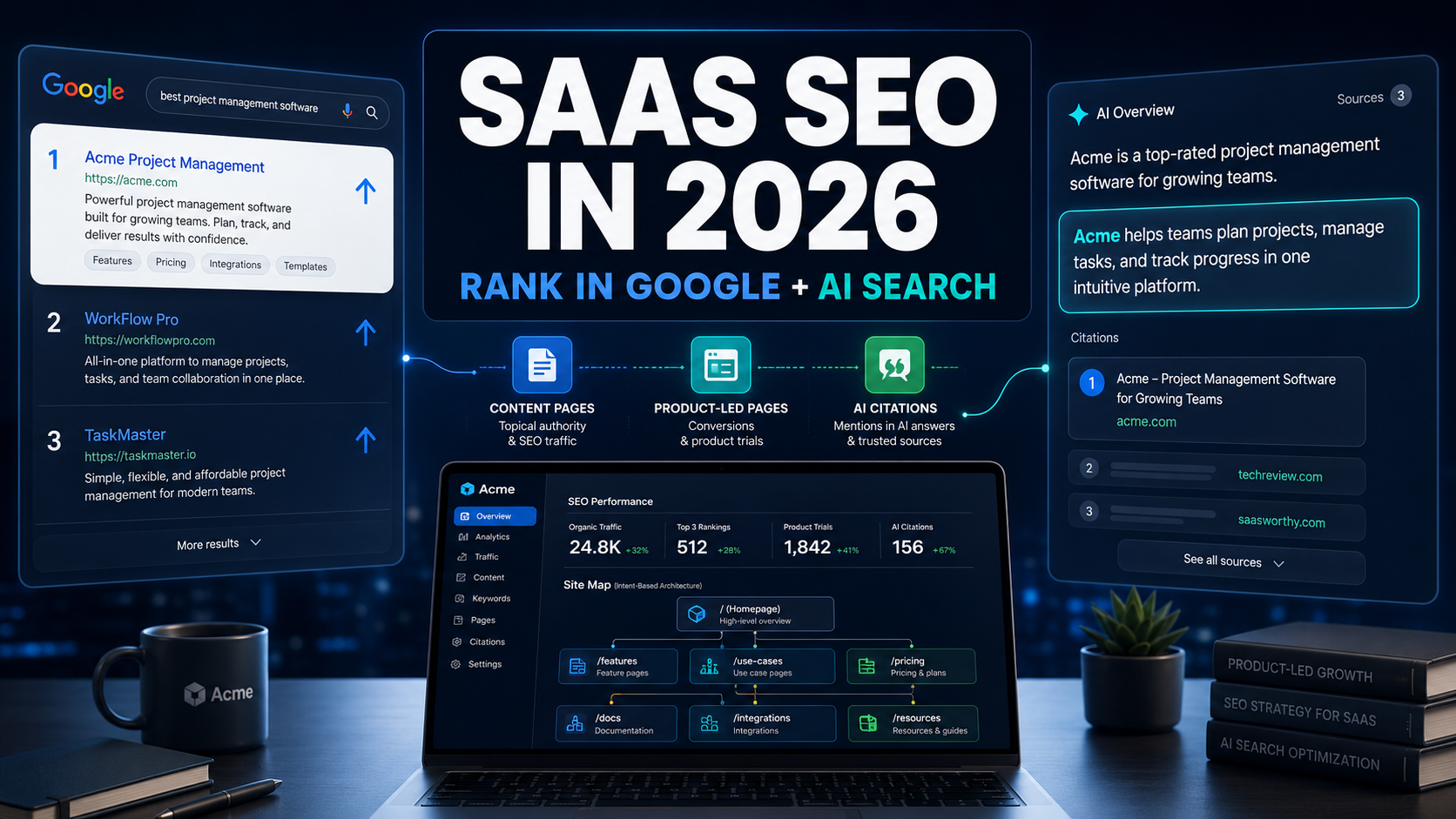
SaaS SEO in 2026 is about winning two surfaces at once: Google's organic rankings and AI search citations. If your SaaS website aligns content with intent, ships fast technical fundamentals, and formats pages for AI extraction, you can rank and get cited without relying on ads for every trial.
Here's the practical path. You'll map intent to product-led pages, remove indexation and performance friction, earn authority links from real ecosystems, and measure impact in trials and pipeline - not just traffic. I'll also show what changes in AI search (GEO) and how to structure pages so models can quote your brand correctly.
Key Takeaways
SaaS SEO wins when intent-led content connects directly to trials, demos, and activation, not just traffic spikes.
Technical SEO is your friction remover: clean indexation, logical internal links, and fast Core Web Vitals unlock everything else.
Product-led SEO (use cases, integrations, alternatives, docs) is the highest-use content for SaaS demand capture.
AI search rewards clear entities, structured data, and answer-first formatting that's easy to extract and cite.
Measure SaaS SEO by trial starts, activation, and CAC payback - not only rankings.
SaaS SEO fundamentals Google still rewards
Search intent by funnel stage (TOFU/MOFU/BOFU)
SaaS SEO still starts with intent. The difference in 2026 is how directly you map intent to product and conversion. For a SaaS website, the safest path is to build a funnel-aware keyword map:
TOFU (education): "What is [category] software," "best way to manage [problem]."
MOFU (comparison): "best [category] tools," "[competitor] alternatives," "compare [tool] vs [tool]."
BOFU (product-led): "[your product] pricing," "[feature] integration," "SOC 2 compliance [category]."
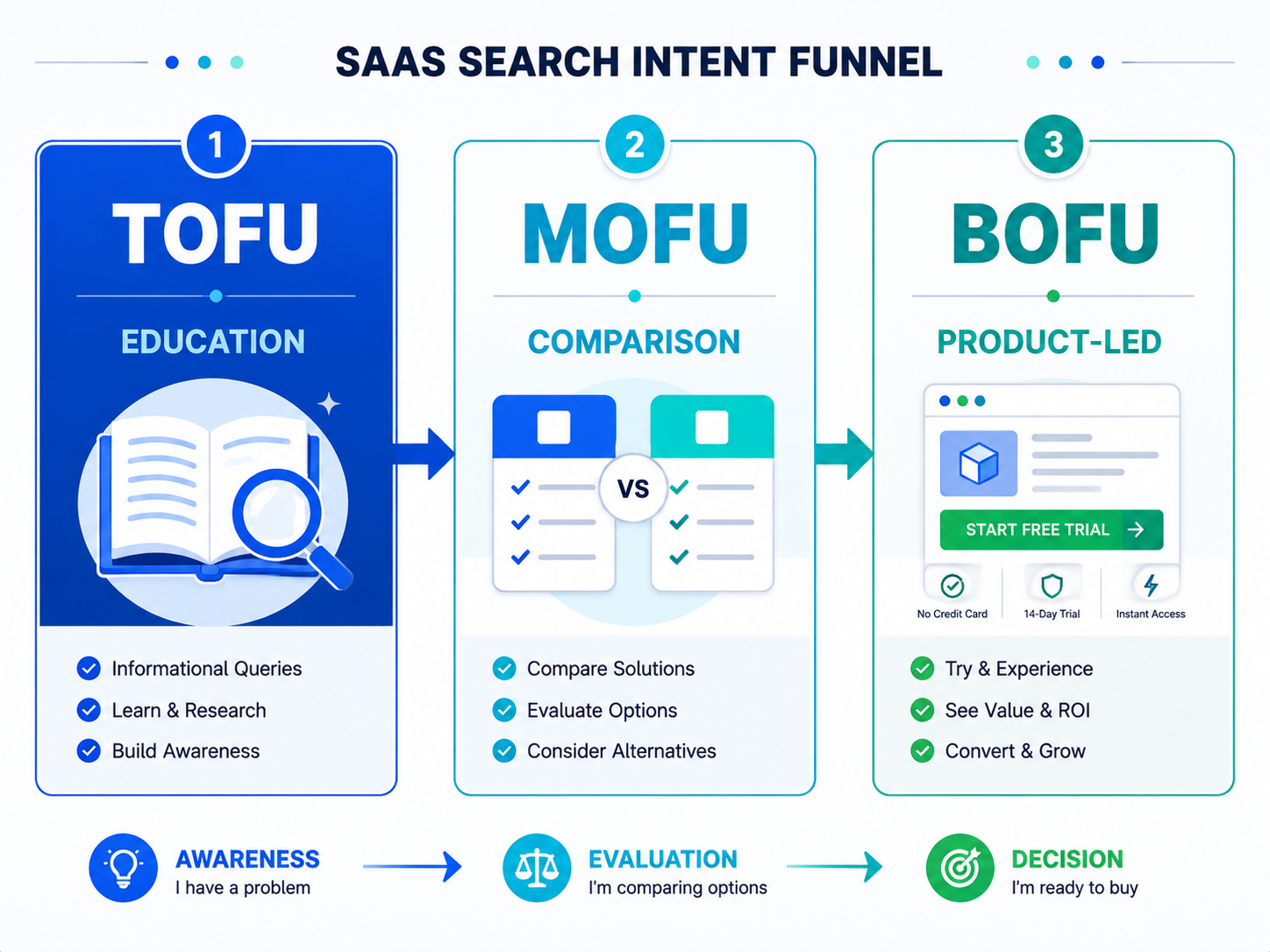
SaaS SEO gets expensive when you treat TOFU as the only path. You need enough TOFU to seed authority, but most trials come from MOFU and BOFU.
Mini-story: In April, Lena launched a workflow automation SaaS and focused 90% of her content on "what is workflow automation." Traffic grew, but trials stayed flat. When she added three product-led pages - "Zapier alternative for agencies," "Slack automation for support teams," and "SOC 2 workflow automation" - trials jumped 38% in six weeks. The intent changed, not the traffic volume.
Practical move: Build a one-page intent map and attach one CTA per stage. For example, "See tools for SaaS" -> ToolsToFind SaaS industry hub for TOFU, and "Model payback for SEO spend" -> ROI calculator for MOFU/BOFU planning.
What "helpful content" means for SaaS
Google's Search Essentials emphasize content that is helpful, people-first, and backed by experience. For SaaS SEO, "helpful" means:
The page answers the user's question in the first screen.
Examples reflect real SaaS workflows (trial setup, integrations, security review).
The next step is obvious (demo, trial, or a deeper product-led page).
If your article explains a problem but never shows how your SaaS solves it, AI search might quote you but conversions won't follow. The content should be useful and connected to your product's reality.
CTA (soft): If you want to model whether an SEO program pays back like a product launch, run a quick scenario in the SaaS ROI calculator. It makes the "is this worth it" decision concrete.
Technical SaaS SEO that removes ranking friction
Indexation, site architecture, and internal linking
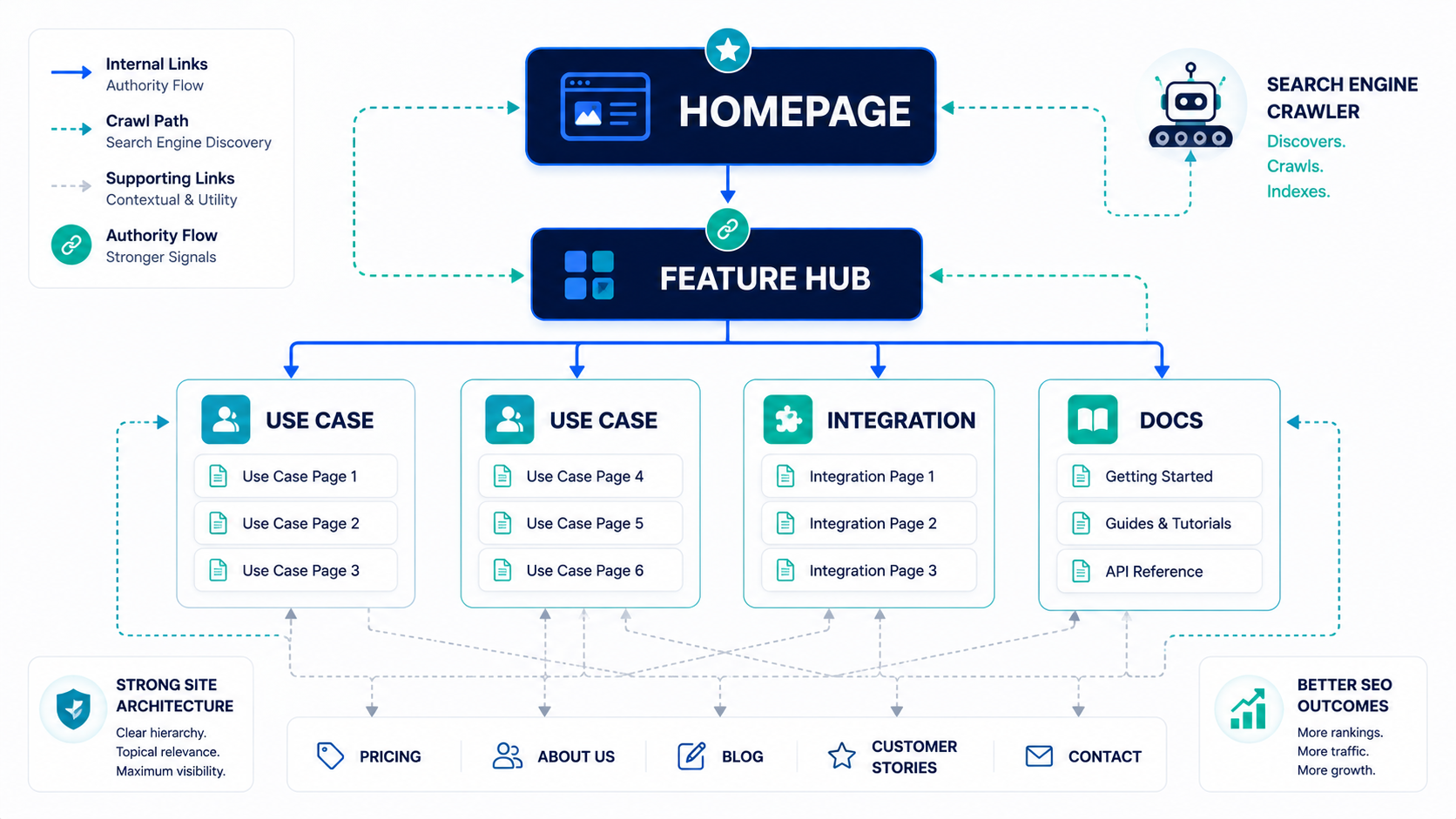
SaaS websites often split between marketing pages, docs, and app. That's where SEO breaks. Your indexation plan should be clear:
Marketing + docs in the same domain when possible (helps authority flow).
One canonical URL per topic (avoid duplicates across docs and blog).
Internal links that mirror your product hierarchy (features -> use cases -> industries).
A simple test: if a Googlebot can't reach a high-intent page in 3 clicks from the homepage, your internal linking is too shallow.
Checklist for SaaS SEO technical hygiene:
XML sitemap includes product-led pages and docs.
Robots.txt allows crawling of marketing and docs.
Canonicals point to the primary version.
Internal links connect use-case pages to features and integrations.
No orphaned pages.
Visual suggestion: A simple site map diagram that shows homepage -> feature hub -> use case -> integration.
Core Web Vitals and performance for SaaS app + marketing sites
Performance isn't just UX - it's crawl efficiency and ranking friction. Google has been clear that Core Web Vitals matter for page experience. In SaaS SEO, performance issues usually show up on:
Heavy JavaScript marketing pages
Comparison pages with dynamic tables
Docs pages with large navigation trees
Aim for a fast first screen, even if your app is heavier. For SEO pages, prioritize static rendering or hybrid rendering where possible.
Practical benchmarks:
Keep LCP under 2.5s and INP under 200ms on key SEO pages.
Load above-the-fold content fast; defer charts and carousels.
If you need to justify the work, Google Search Central's guidance is the reference point: https://developers.google.com/search/docs/fundamentals/creating-helpful-content
SaaS SEO content strategy that maps to product demand
Use cases, integrations, and alternatives pages
This is where SaaS SEO becomes product-led. The pages that usually convert best:
Use cases: "Project management for agencies," "CRM for SaaS onboarding."
Integrations: "Slack integration," "HubSpot integration."
Alternatives/Comparisons: "[Competitor] alternative," "[Tool A] vs [Tool B]."
These pages match high-intent queries and show product fit quickly. They also build entity clarity for AI search, which cares about what your product is for.
Mini-story: A mid-market analytics SaaS created 14 integration pages and 8 alternatives pages in a quarter. The integrations brought steady long-tail traffic, but the alternatives pages drove 70% of demo requests. The reason was intent: people searching "[competitor] alternative" already want to switch.
CTA (medium): Want to quantify which content cluster is worth the build? Use the ROI calculator and compare traffic-to-trial assumptions before you commit engineering time.
Docs and support content as authority assets
Docs are a silent SEO asset. They earn long-tail traffic and show real product expertise. In SaaS SEO, the best docs content:
Explains how to implement (not just what a feature does)
Includes code snippets, screenshots, and troubleshooting
Links back to feature pages and use-case pages
Docs also perform well in AI search because they are concrete, structured, and specific. That specificity is what AI models cite.
Visual suggestion: A content cluster diagram: feature page -> use case -> docs -> integration -> alternative.
SaaS SEO for AI search results (GEO)
Entity signals, citations, and structured data
AI search uses entity understanding. The more clearly you define your SaaS brand, category, and features, the more likely you are to be cited correctly. The basics:
Consistent naming (product, category, and feature terms)
Schema markup for organization, software application, and FAQ
About page that clearly defines what you do and who you serve
Also ensure that AI crawlers can access your content. OpenAI's GPTBot and other AI crawlers respect robots.txt. If you block them, you reduce your chance of being cited.
Reference: https://openai.com/gptbot/ and Bing Webmaster Guidelines: https://www.bing.com/webmasters/help/webmaster-guidelines-30fba23a
Table: Google vs. AI search ranking signals
Signal Type | Google Organic | AI Search (GEO) |
|---|---|---|
Keyword relevance | High | Medium |
Entity clarity | High | Very high |
Page structure (headings, lists) | Medium | High |
Backlinks | High | Medium |
Freshness | Medium | Medium |
Structured data | Medium | High |
Brand mentions/citations | Medium | High |
How to format content for AI extraction
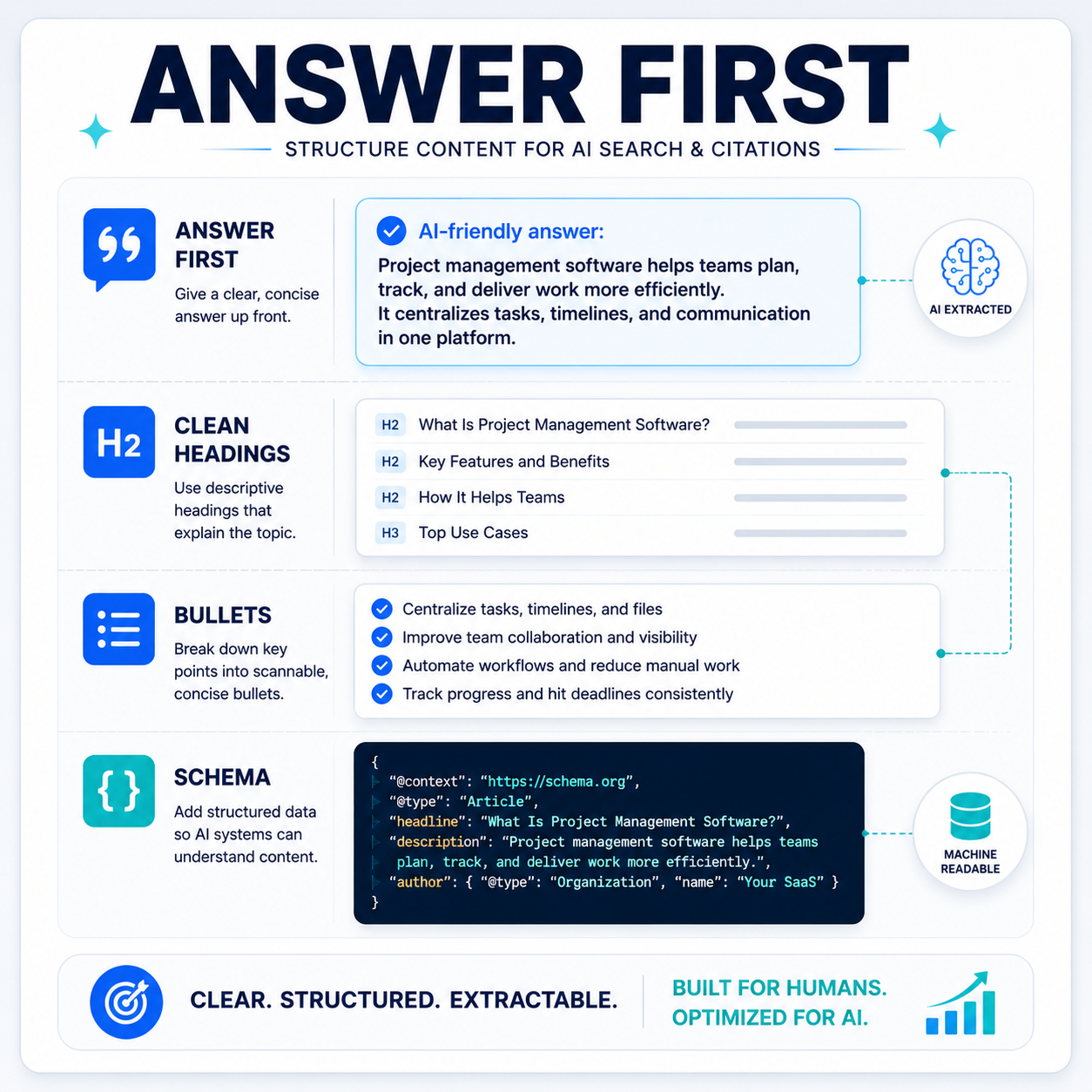
AI search pulls from content that is easy to quote. That means:
Direct answers in the first 1-2 sentences
Clear headings that read like questions
Bullet lists with complete claims
Short paragraphs with one idea each
If you want AI systems to extract your answer, write the answer first and explain after. This is especially important for SaaS SEO because AI tools increasingly surface B2B "best tools" answers.
Embedded video (for cross-validation):
Statistic note: SparkToro and Similarweb report that the majority of Google searches end without a click, which makes AI and SERP features critical for SaaS SEO visibility. https://sparktoro.com/blog/2024-zero-click-searches-for-every-1000-google-searches-only-374-clicks-go-to-the-open-web-in-the-us/
Links and authority for SaaS websites
Partnerships and integration ecosystems
SaaS link building is easiest when you build real partnerships:
Integration partners (mutual listings)
Marketplace directories (App marketplaces, ecosystems)
Co-marketing webinars and case studies
These links are more durable than generic guest posts, and they align with product adoption.
Mini-story: An enterprise SaaS in the security space built a compliance resource page and got listed on five partner ecosystems. Those partner links weren't just backlinks - they drove qualified traffic from buyers already in compliance research mode.
Original data and benchmarks for natural links
SaaS SEO authority accelerates when you publish original data:
Benchmarks (usage, adoption rates, performance metrics)
Industry reports (state of [category])
Product-led insights (anonymized usage patterns)
People link to numbers. That's why CTR studies and market share data perform so well.
Use reputable sources in your own content too:
StatCounter for global search market share: https://gs.statcounter.com/search-engine-market-share
Advanced Web Ranking CTR study: https://www.advancedwebranking.com/ctr-study/
Sistrix AI Overviews tracking: https://www.sistrix.com/blog/google-ai-overviews/
Measuring SaaS SEO impact beyond rankings
From organic visits to trials/demos
Rankings are not the KPI. SaaS SEO should be measured by:
Organic -> trial start rate
Trial -> activation rate
Demo request quality (SQL rate)
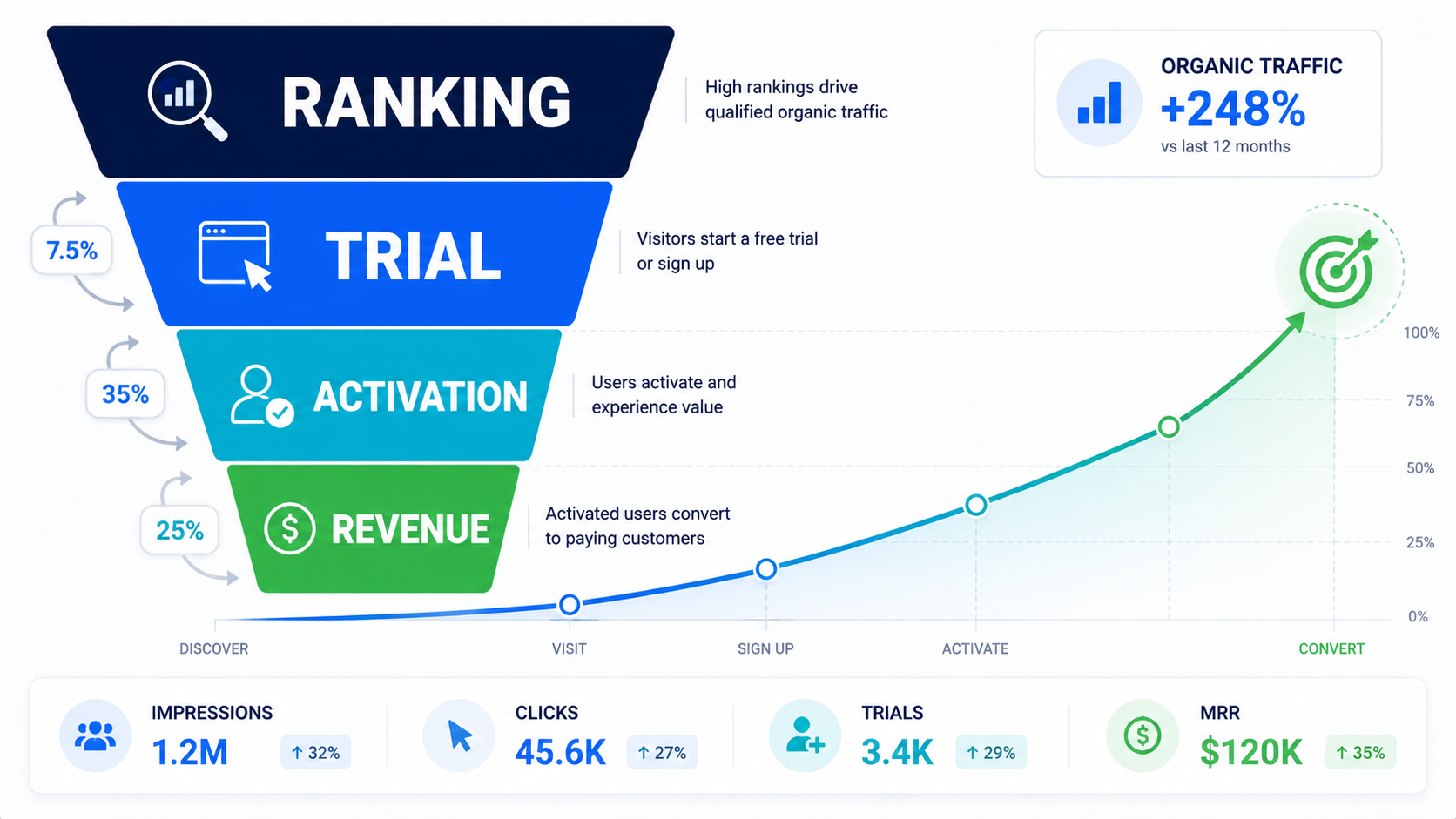
Build a measurement flow that connects keywords to revenue. A simple model:
Keyword cluster traffic
Conversion rate to trial/demo
Activation rate
CAC payback timeline
Visual suggestion: A funnel diagram that shows ranking -> trial -> activation -> revenue.
CAC payback and pipeline influence
SaaS SEO is often under-invested because it's measured in traffic instead of payback. Run the numbers. If SEO produces trials at half the CAC of paid search, you can justify content and technical investment.
Use a structured model and make the assumptions explicit. If you need a quick framework, ToolsToFind's methodology page explains how to model ROI and payback cleanly.
CTA (strong): If you're deciding between paid and organic budget, model the payback in the ROI calculator for SaaS and make the trade-off explicit before you commit.
FAQ
What is SaaS SEO?
SaaS SEO is the practice of ranking a SaaS website in search by targeting intent-led keywords, building product-led pages, and optimizing technical foundations so both Google and AI systems can index and cite the brand.
How long does SaaS SEO take to work?
Most SaaS SEO programs show early traction in 3-6 months for long-tail queries and 6-12 months for competitive MOFU/BOFU keywords, assuming technical fundamentals are clean.
Should SaaS SEO focus on blogs or product pages?
Both matter, but product-led pages (use cases, integrations, alternatives) usually drive higher-intent trials. Blogs build authority and support long-tail discovery.
How do AI search results change SaaS SEO?
AI search prioritizes clear entities, structured data, and answer-first formatting. Your content must be easy to extract and cite, not just rank.
What are the best SaaS SEO metrics to track?
Track organic -> trial conversion rate, trial -> activation rate, and CAC payback from organic. Rankings are a diagnostic metric, not the goal.
Conclusion
SaaS SEO in 2026 isn't just about ranking - it's about visibility in Google and AI search, and converting that visibility into trials, demos, and revenue. The playbook is practical: map intent to product-led pages, remove technical friction, publish content that AI can extract, and measure success in activation and CAC payback.
If you want a simple next step, pick one high-intent cluster (use case, integration, or alternative) and ship a complete set of pages. Then model the ROI so you know the payback horizon before you scale. That's SaaS SEO that respects your budget and your growth targets.