Payroll Calculator for Restaurants: Loaded Cost vs Salary for Your First Hire
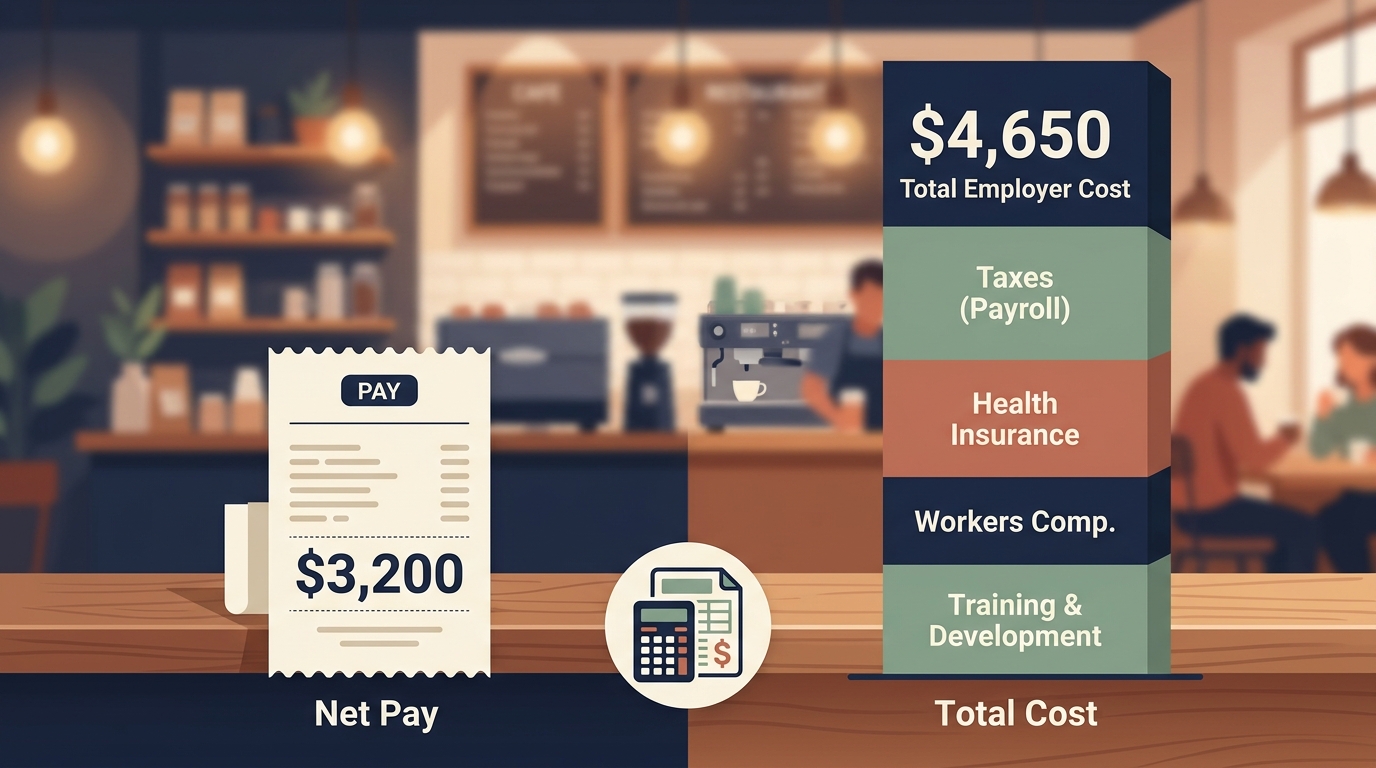
If you are hiring your first employee in a small restaurant, use salary only as your starting number. The real hiring decision should be based on loaded cost: salary plus employer payroll taxes, insurance, setup costs, and cash-timing risk.
That is exactly where a payroll calculator for restaurants helps. It turns a vague "we can probably afford this" into a specific monthly number you can compare against your real sales pattern.
In January, Lena ran a 5-person neighborhood cafe and planned to hire her first shift lead at $50,000. Salary looked manageable on paper. After modeling employer taxes, workers' comp, uniforms, onboarding hours, and two slower winter weeks, her true monthly burden was roughly 30% higher than salary-only math. She still hired, but she adjusted schedules and built a cash buffer first. That decision prevented a spring payroll squeeze.
If you are in the same position, this guide gives you a practical model you can use in one planning session.
Key Takeaways
For a first restaurant hire, salary-only math is incomplete; loaded cost often lands in the 1.25x to 1.4x range depending on state and setup.
Employer FICA is 7.65% of taxable wages (Social Security + Medicare), and FUTA/SUTA add more employer cost.
A $50,000 salary can behave like $5,400 to $6,200+ per month once taxes, insurance, and ramp costs are included.
The biggest first-hire failure mode is often cash timing, not annual salary: payroll leaves on schedule even when weekly sales swing.
Run best-case, base-case, and stress-case scenarios in your payroll model before you post the job.
Salary Is Only the Starting Number
Restaurant owners usually know salary and hourly rates immediately. That is normal, but it is not enough for a hiring decision.
Your first hire affects four layers at once:
Direct pay (salary or hourly wages).
Employer payroll taxes (federal plus state unemployment and other required items).
Non-tax labor burden (workers' comp, uniforms, onboarding, software access, occasional overtime during training).
Cash-timing pressure (payroll and deposits happen on fixed dates while revenue changes week to week).
When you ignore layers 2-4, the hire can look affordable right up until your checking account says otherwise.
What "loaded cost" means in a 5-person team
In a large chain, one bad payroll assumption is spread across dozens of locations. In a 5-person team, one wrong assumption is immediate. A single unplanned $1,200 month can wipe out the cushion you needed for inventory, rent, or equipment service.
Loaded cost is simply your all-in employer cost for that role. It does not need to be perfect on day one. It just needs to be complete enough that you are not surprised.
Why this matters more for restaurant operations
Restaurant payroll is not just math. It is operations:
sales peaks and dips by daypart,
tips and overtime risk,
variable staffing mix across front and back of house,
seasonal volatility.
That means hiring should be modeled as an operating system decision, not a salary decision.
Want a fast baseline before you go deeper? Start with the payroll calculator, then pressure-test the result with the framework below.
Payroll Tax Basics You Must Budget (Employer Side)
You do not need to become a tax specialist to plan correctly. You do need the major employer-side components in your model.
FICA: your employer match
At a high level, employer FICA includes:
6.2% Social Security
1.45% Medicare
That is 7.65% employer share on taxable wages in most common scenarios.
Reference: Patriot's payroll tax explanation and examples (source).
Additional Medicare note
The 0.9% Additional Medicare tax is an employee withholding threshold item; there is no employer match for that additional amount.
Reference: IRS employment tax guidance (source).
FUTA and SUTA
Federal unemployment (FUTA) is employer-paid. State unemployment (SUTA) varies by state and employer history. In many models, FUTA is a small but real cost, and SUTA can be material in early hiring years.
Use this planning rule: treat unemployment taxes as a budget line, not a footnote.
State and local variation
Your final loaded cost will change by state, local taxes, insurance classes, and wage rules. This article is an operating framework, not legal or tax advice. Validate your assumptions against current IRS, state, insurer, and payroll-provider guidance before finalizing offers.
Payroll Calculator for Restaurants: Build a First-Hire Loaded Cost Model
This section is the practical core. You can run it in 15 to 30 minutes.
Step 1: Convert annual salary to monthly gross pay
If target salary is $50,000:
annual salary = $50,000
monthly salary baseline = $50,000 / 12 = $4,167
That is the number most owners stop at. Do not stop here.
Step 2: Add employer payroll taxes
Use your payroll calculator assumptions (state, filing cadence, payroll frequency), then add:
employer FICA baseline,
FUTA estimate,
SUTA estimate.
For planning, convert to monthly averages so you can compare with your monthly sales and expense rhythm.
Step 3: Add non-tax burden
For a first restaurant hire, include at least:
workers' comp premium impact,
uniforms and onboarding setup,
scheduling/training overlap hours,
software/account access where relevant,
contingency for early overtime or shift reshuffles.
These costs are exactly where first-hire models break. They look small line by line, but together they change the decision.
Step 4: Include a ramp-time productivity buffer
Most first hires are not fully productive in week one. Add a temporary ramp buffer for the first 60 to 90 days so your plan reflects reality.
Step 5: Model three scenarios
Use:
Best-case (stable sales, lower overtime, faster ramp).
Base-case (most likely).
Stress-case (slower weeks, higher overtime, slower ramp).
If only best-case works, the role is not yet safely funded.
Example: $50,000 First Restaurant Hire (5-Person Team)
Below is a planning example to show structure. Replace with your state and actual numbers.
Cost Component | Salary-Only View | Loaded Base-Case View |
|---|---|---|
Annual salary | $50,000 | $50,000 |
Employer payroll taxes (FICA + unemployment estimates) | $0 | $4,600 to $6,000 |
Workers' comp and required insurance allocation | $0 | $1,000 to $2,000 |
Onboarding/setup/training drag allocation | $0 | $2,000 to $4,000 |
Estimated annual employer cost | $50,000 | $57,600 to $62,000 |
Estimated monthly employer cost | $4,167 | $4,800 to $5,167 |
Now add a temporary ramp and schedule volatility buffer for the first 90 days and monthly burden can reasonably push into the $5,400 to $6,200+ range in some operating months.
This is exactly why salary-only decisions feel "fine" until the first difficult month.
Mini-story: the hidden first-month stack
In March, Ramon hired a first full-time line lead at a salary he had planned for six weeks. He had also planned taxes, but not the non-tax stack: two weeks of overlap training, uniforms for multiple shifts, and workers' comp adjustments after policy review. His P&L still looked acceptable, but his cash account tightened faster than expected in month one.
He corrected quickly by slowing nonessential purchases and tightening prep scheduling. The role worked out. The lesson was simple: his original salary decision was right, but his timing and ramp assumptions were too thin.
Payroll Calculator for Restaurants and Cash Timing: The Risk Most Owners Miss
A hiring plan can be profitable on annual math and still strain cash in real operations.
Payroll leaves on schedule. Deposits and tax obligations leave on schedule. Sales do not arrive on schedule.
What timing mismatch looks like
Typical warning signs:
payroll dates cluster before strong sales weekends,
supplier payments and payroll hit the same week,
one soft month forces short-term juggling,
overtime spikes after schedule gaps.
The role itself may still be a good hire. But the sequence of cash movement can turn a good hire into a stressful quarter.
Practical timing guardrails
Before posting the role, define:
Minimum cash buffer target in weeks of payroll.
Trigger for schedule correction if labor percentage rises above threshold.
Owner action list for stress-case month (not invented in crisis).
Industry data supports caution here: the National Restaurant Association reported salaries and wages (including benefits) at a median 36.5% of sales for full-service and 31.7% for limited-service in 2024, both elevated versus earlier baselines (source).
And cost pressure is not static. BLS reported private industry compensation up 3.4% year over year in Dec 2025 (source).
If labor cost pressure is structurally higher, first-hire modeling needs to be structurally tighter.
How to Use a Payroll Calculator Before You Post the Job
Use this short checklist with your payroll model.
Inputs to gather in 15 minutes
target salary or hourly equivalent,
payroll frequency,
state and local context,
expected overtime exposure,
onboarding duration and overlap,
workers' comp estimate,
expected first-90-day productivity.
Decision checklist before offer
Can we afford this role in base-case without heroic assumptions?
If sales dip for 4 to 6 weeks, can we carry payroll cleanly?
Do we know exactly which tasks move off the owner in month one?
Is schedule design preventing predictable overtime mistakes?
Have we checked current compliance inputs with payroll/tax sources?
If two or more answers are uncertain, delay the posting by a short period and tighten the model first. Waiting four weeks to prevent six months of cash stress is often the stronger decision.
Need sector-specific context for labor and planning? Review the hospitality tools hub and pair it with your payroll scenario.
A Practical 90-Day Plan for First-Hire Stability
The first hire should be managed like a 90-day rollout.
Days 1-30: protect cash and train for role clarity
Keep a simple labor dashboard by week.
Track planned vs actual training time.
Flag any overtime patterns immediately.
Days 31-60: verify contribution and schedule fit
Measure whether founder workload is actually dropping.
Confirm that shift coverage is reducing service bottlenecks.
Adjust role scope if work mix differs from hiring assumptions.
Days 61-90: decide scale, hold, or redesign
If labor percentage stabilizes and service quality improves, keep scaling responsibly.
If contribution is real but timing pressure remains, revise pay cadence and purchasing rhythm.
If role scope was wrong, redesign now before cost drift becomes permanent.
Mini-story: fixing scope before cost drift
A five-person quick-service team hired a prep and shift coordinator to reduce owner burnout. By week four, the new hire spent too much time on ad hoc tasks and too little on prep flow and schedule stabilization. Labor cost was not catastrophic, but value delivery was unclear.
The owner rewrote responsibilities into three measurable outcomes: prep completion accuracy, shift handoff quality, and overtime reduction. Within a month, overtime dropped and service consistency improved. The salary did not change. Role clarity changed the return on payroll.
Frequently Asked Questions
How much does an employee cost after payroll taxes in a small restaurant?
There is no single national answer, but for first-hire planning, many operators land above salary-only math once employer taxes, unemployment, insurance, and ramp costs are included. A practical planning range is often around 1.25x to 1.4x salary depending on location and setup.
Reference point: SBA small business rule-of-thumb framing (source).
Is a payroll calculator for one employee enough for first-hire planning?
It is necessary but not sufficient. A payroll calculator gives tax and withholding structure. You still need non-tax burden and timing assumptions to make a real hiring decision.
Should I delay a first hire if the stress-case barely works?
Usually yes. If your stress-case is fragile, a short delay to build buffer, tighten scheduling, or improve role scope is often lower risk than hiring immediately.
Do restaurant benchmarks replace my own model?
No. Benchmarks are context, not your operating truth. Use them to sanity-check your plan, then decide based on your actual sales mix, staffing model, and cash cycle.
Recommended Video Walkthrough
Use the video as a quick refresher, then run your own numbers with your state and payroll setup.
Conclusion: Hire on Loaded Cost, Not Salary Headlines
For a first hire in a 5-person restaurant, the right question is not "Can we pay this salary?" It is "Can we fund this loaded role through normal weeks and difficult weeks without destabilizing operations?"
That means modeling employer payroll taxes, unemployment components, non-tax labor burden, and real cash timing. It means running three scenarios before the job post, not one optimistic estimate after interviews begin.
When you do this well, you get better outcomes on both sides: the hire starts with clearer expectations, and the business carries payroll with less stress.
Final action steps
Run your base salary scenario in the payroll calculator hub.
Add your restaurant-specific burden and timing assumptions.
Pressure-test with best/base/stress cases.
Use the hospitality tools page for adjacent planning inputs.
Ready to make the offer with confidence? Build your loaded-cost model first, then hire from numbers you can stand behind.
Meta Title: Payroll Calculator for Restaurants: Loaded Cost vs Salary Meta Description: Payroll calculator for restaurants: estimate loaded labor cost, payroll taxes, and cash timing before your first hire in a 5-person team.
Primary Keyword: payroll calculator for restaurants Secondary Keywords: employer payroll cost calculator, how much does an employee cost after payroll taxes, payroll burden rate small business, payroll calculator for one employee, first employee payroll checklist URL Slug: /blog/payroll-calculator-for-restaurants-loaded-cost-vs-salary-first-hire
Important Links:
https://toolstofind.com/blog/first-hire-payroll-mistakes-to-avoid
https://toolstofind.com/blog/restaurant-labor-cost-benchmarks External Links:
https://www.irs.gov/businesses/small-businesses-self-employed/understanding-employment-taxes
https://www.patriotsoftware.com/blog/payroll/how-much-employers-pay-payroll-taxes/