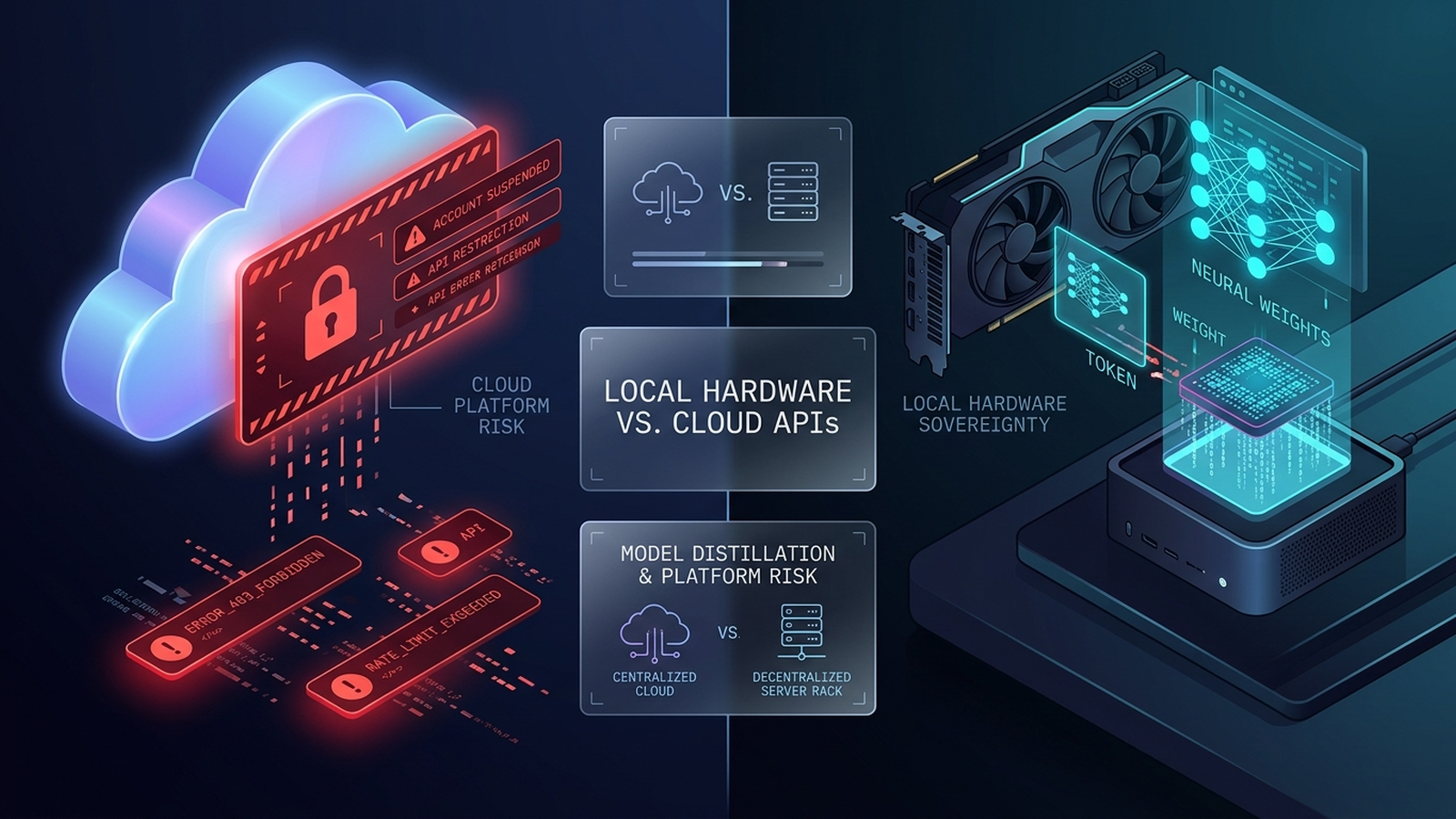
OpenAI banned PewDiePie twice because he used the company's API to generate synthetic training datasets and reasoning traces to fine-tune a private local artificial intelligence model named Ajax, directly violating OpenAI's Terms of Use prohibiting competitive model distillation.
If you have spent any time following creator-led tech experiments, the news that OpenAI banned PewDiePie, the online moniker of Swedish creator Felix Kjellberg, might sound like an internet prank or a meme gone viral. But beneath the YouTube headlines lies a critical case study in modern developer economics, platform dependency, and intellectual property enforcement. Thousands of solo developers, agencies, and small operators are moving away from expensive cloud API subscriptions toward self-hosted open-weights models. Kjellberg's experience reveals the hidden friction points between centralized frontier artificial intelligence labs and independent builders.
When you run a business or build private software tools, relying on proprietary cloud APIs creates an ongoing risk: the terms can shift, rates can increase, or your access can vanish overnight. At ToolsToFind, we track the operational numbers that keep small businesses viable, from software subscriptions to capital budgeting for small-business equipment. Understanding why OpenAI banned PewDiePie provides an invaluable blueprint for anyone evaluating whether to pay cloud vendors or invest in local hardware infrastructure.
Key Takeaways
The Core Trigger: OpenAI banned PewDiePie for violating Section 2(c)(iii) of its Terms of Use by running automated distillation pipelines that extracted structured reasoning outputs from GPT-4o to train his local model, Ajax.
Technical Architecture: Kjellberg was fine-tuning Alibaba's open-weights Qwen3.5-9B model for his personal "Odysseus" workspace, using weight abliteration to strip default corporate safety refusals.
Detection Telemetry: OpenAI detects programmatic distillation through automated prompt-clustering heuristics, high-frequency structured JSON completions, and statistical output fingerprinting.
The Capital Dilemma: Running local 9B to 70B parameter models requires upfront capital expenditure ($2,500 to $7,000 for dedicated GPU or unified memory hardware) but eliminates recurring token operational expenses and platform deplatforming risk.
Clean Provenance Rules: Builders looking to train specialized local assistants must use open-weights teacher models (such as Llama 3.3 or DeepSeek-V3) with permissive commercial licenses rather than proprietary frontier APIs.
1. What Felix Built Before OpenAI Banned PewDiePie: The Ajax AI Model and Odysseus
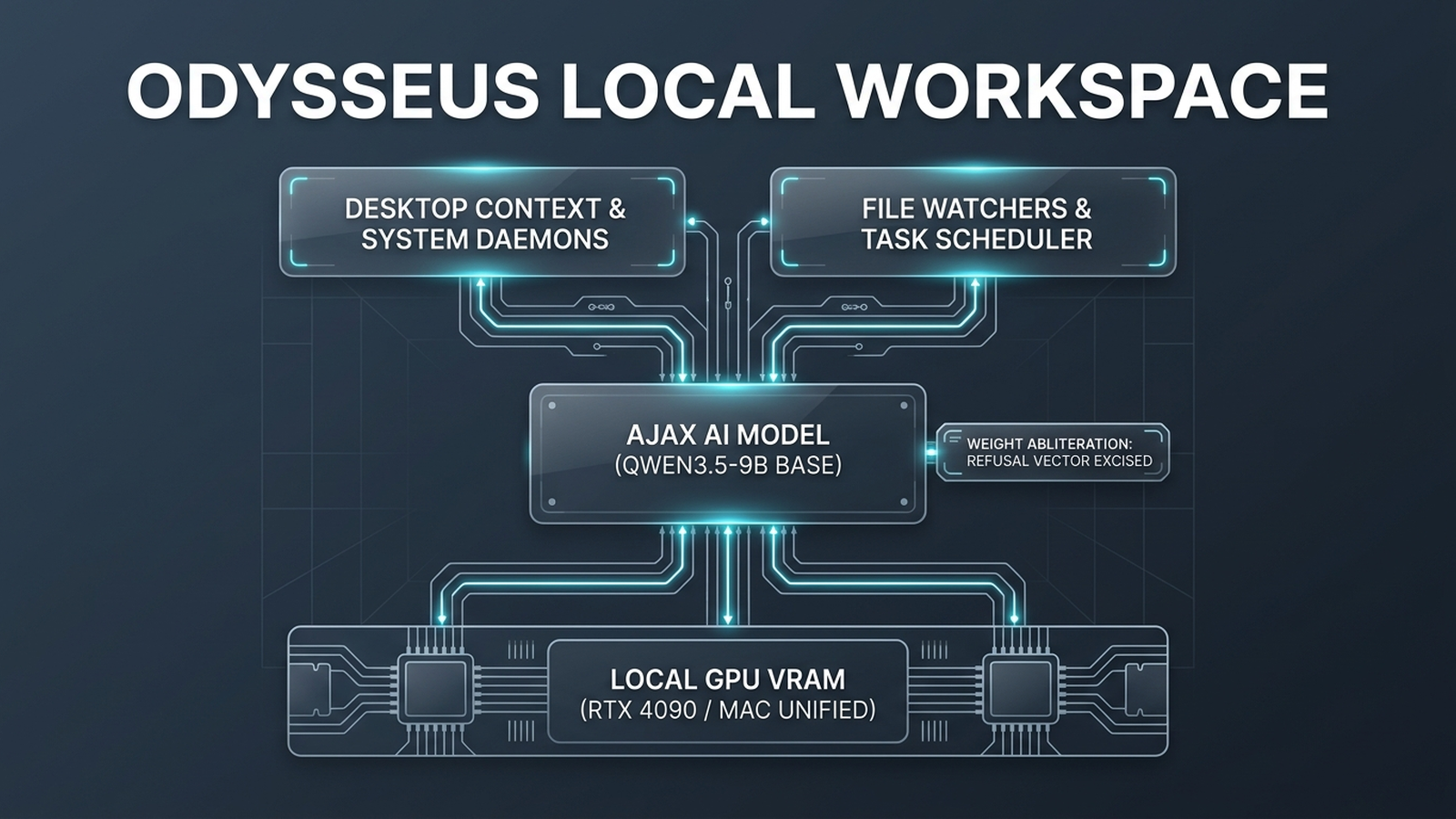
In late 2024, Felix Kjellberg published a detailed video, later analyzed in a Tom's Hardware report, documenting his deep exploration of local machine learning development. Moving far beyond the casual prompting of browser chatbots, Kjellberg had spent months building an offline, sovereign developer environment called the PewDiePie Odysseus AI workspace.
For a detailed walkthrough of his setup, see Felix Kjellberg's breakdown of his local uncensored AI workspace, automation scripts, and custom model training.
The goal of the Odysseus project was ambitious yet intensely practical: a private, always-on desktop assistant capable of monitoring local system files, organizing video editing workflows, drafting production schedules, managing personal communications, and executing shell scripts without transmitting sensitive personal data to third-party corporate servers. For a creator with over 111 million subscribers who has spent fifteen years dealing with relentless digital privacy intrusions, the motivation to keep data local was obvious.
Component | Operational Responsibility | Execution Environment |
|---|---|---|
Desktop Context & Daemons | Monitors active windows, clipboard contents, and system logs | Local Host OS (macOS / Linux) |
File Watchers & Task Scheduler | Scans video footage folders, organizes production files, and queues render jobs | Background Python daemons |
Ajax AI Model (Qwen3.5-9B Base) | Executes reasoning, drafts communications, and produces structured bash scripts | Quantized local transformer model |
Local Inference Engine | Powers low-latency token generation without external internet requests | Dedicated GPU VRAM (RTX 4090 / Mac Unified) |
To power Odysseus, Kjellberg developed the PewDiePie Ajax AI model. Rather than training a neural network from scratch—a task that requires millions of dollars in computing clusters and petabytes of curated text—Kjellberg adopted the standard open-source playbook: selecting a capable open-weights base model and fine-tuning it on targeted, high-quality data. Understanding how Kjellberg configured this stack explains the technical backdrop before OpenAI banned PewDiePie for his data extraction methods.
The Technical Base: Alibaba's Qwen3.5-9B
For his foundation, Kjellberg selected Alibaba's Qwen3.5-9B, an open-weights dense transformer architecture available in Alibaba's open-source Qwen repository. The 9B parameter class represents the sweet spot for modern desktop inference:
VRAM Footprint: At 16-bit uncompressed precision (FP16), a 9B model requires roughly 18 GB of video memory. Quantized down to 4-bit precision (using formats like GGUF or AWQ), the memory requirement drops to approximately 6 GB to 8 GB.
Consumer Hardware Fit: This makes it small enough to run entirely within the 24 GB VRAM envelope of an NVIDIA GeForce RTX 3090/4090, or inside the unified memory architecture of an Apple Silicon Mac Studio, while maintaining lightning-fast generation speeds of 40 to 60 tokens per second.
Reasoning Density: Modern 9B architectures trained on multilingual synthetic corpora perform exceptionally well on programming, system administration, and structured JSON generation tasks, rivaling the capabilities of previous-generation frontier models like GPT-3.5 Turbo.
Weight Abliteration and the "Uncensored" Debate
One of the key technical adjustments Kjellberg implemented on Ajax was removing default refusal mechanisms. Commercial frontier models are notoriously prone to "safety refusals", frequently declining benign commands because of over-tuned moderation filters (for example, refusing to analyze a script about a medieval battle or declining to execute a low-level system diagnostic).
To bypass this friction, Kjellberg applied an open-source technique known as weight abliteration using tools like Heretic. Unlike crude prompt-injection jailbreaks that attempt to trick a model via conversational framing, abliteration operates mathematically directly on the transformer model's internal weights:
Developers measure the model's internal activations across a dataset of harmful requests versus benign requests.
By computing the difference between these activations in the hidden state residual streams, they isolate a specific directional vector that corresponds to the model's "refusal feature."
Using orthogonal projection, they mathematically excise this refusal direction from the model's weight matrices.
The resulting weights create an uncensored local model that will reliably answer administrative, technical, and creative commands without lecturing the user or shutting down execution. But to make this abliterated 9B model truly competent at executing autonomous workspace tasks, it needed one more ingredient: high-density reasoning datasets. And that is where the trouble began.
2. What Triggered the Account Lock: Model Distillation and the PewDiePie Ajax AI Model
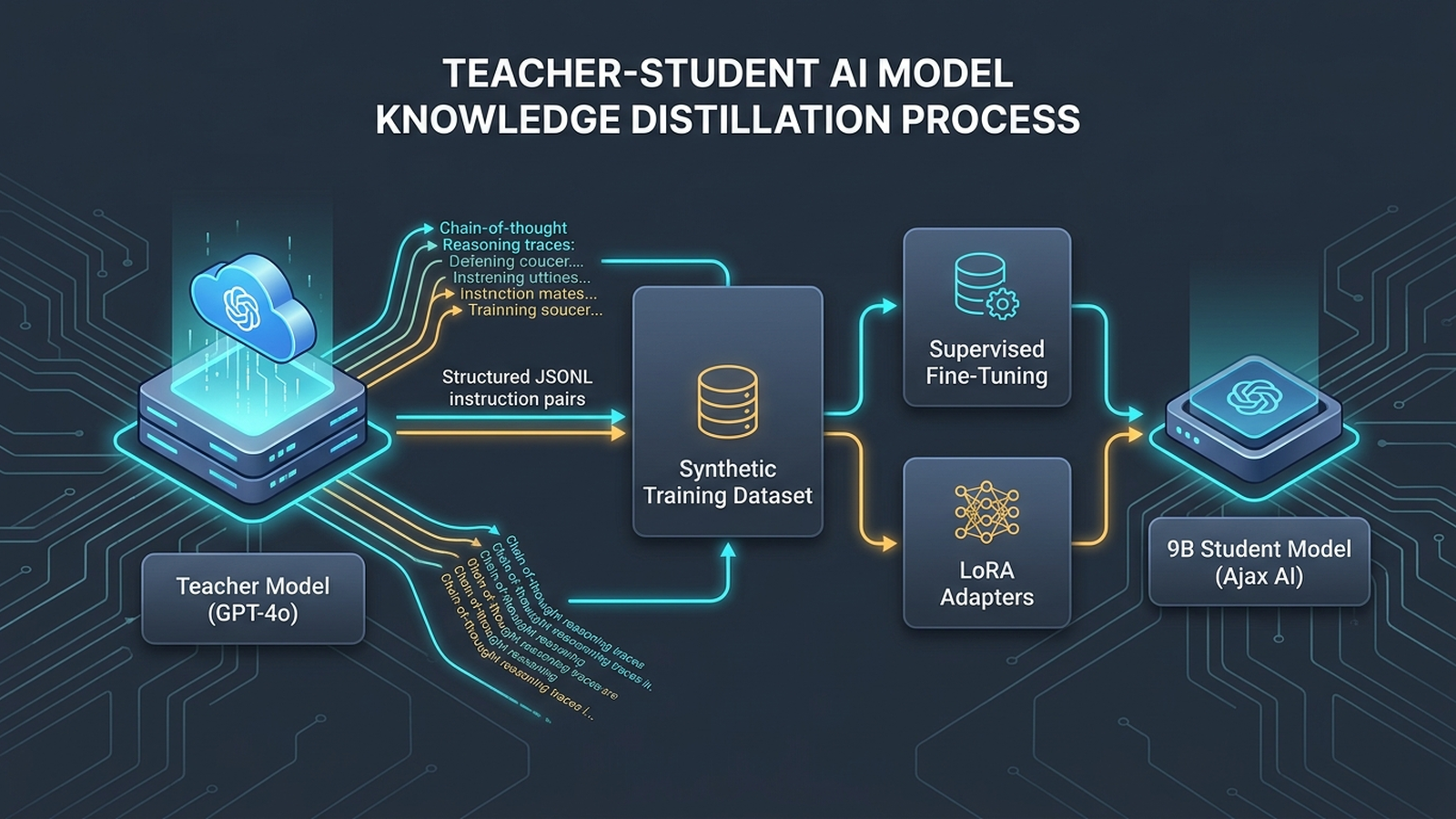
To turn a general-purpose 9B base model into a specialized autonomous workspace agent, an engineer must feed it thousands of high-quality instructional examples. In the machine learning world, curating human training data by hand is prohibitively slow and expensive. The modern shortcut is knowledge distillation.
Distillation Stage | Workflow Participant | Function & Data Transferred |
|---|---|---|
1. Teacher Model | OpenAI Frontier Model (GPT-4o) | Ingests complex instructional prompts; emits high-density chain-of-thought traces and bash commands |
2. Synthetic Dataset | Query-Response Pairs ( | Structured synthetic demonstration corpus capturing multi-step problem solving without human labor costs |
3. Student Model Training | PewDiePie Ajax AI Model (9B Base) | Ingests reasoning demonstrations via Supervised Fine-Tuning (SFT) and Low-Rank Adaptation (LoRA) |
4. Sovereign Execution | Local Workstation Hardware | Executes specialized system tasks offline at zero token cost and complete data privacy |
Understanding Teacher-Student Distillation
Knowledge distillation is a machine learning process where a smaller, more efficient "student" model is trained to mimic the behavioral patterns, reasoning capabilities, and output distribution of a much larger, highly capable "teacher" model.
In modern language model fine-tuning, as documented in published research on knowledge distillation of large language models (arXiv:2306.08543), distillation usually takes the form of sequence-level dataset synthesis:
The developer feeds thousands of complex queries into a frontier model (such as GPT-4o).
The frontier model generates detailed, multi-step chain-of-thought explanations, code blocks, and structured responses.
These query-response pairs are collected into structured training files (such as
.jsonl).The developer then performs Supervised Fine-Tuning (SFT) or Low-Rank Adaptation (LoRA) on their smaller local base model using these synthetic pairs.
Through this method, a 9-billion parameter model like Ajax can inherit the conversational fluency, analytical rigor, and precise formatting habits of a frontier system that cost hundreds of millions of dollars to train, while running at near-zero incremental cost on a single desktop graphics card. This automated extraction pipeline was the exact operational trigger that caused OpenAI to ban PewDiePie from its developer platform.
The First Incident: Direct Instructional Extraction
Kjellberg used OpenAI's API to construct his initial training pipeline. He fed structured prompts into OpenAI's commercial endpoints to produce diverse synthetic examples: how to interpret macOS terminal logs, how to parse system schedules, how to handle file management exceptions, and how to execute conversational turns in a natural, direct tone.
Shortly after running high-volume automated requests through his API account, Kjellberg received a suspension notice. His account was frozen, and his active API keys were terminated.
Surprised by the automated suspension, Kjellberg filed a formal support appeal. He explained that he was a solo creator working on a private, non-commercial software project for his own productivity, rather than packaging a commercial competitor to ChatGPT. OpenAI reviewed his ticket and reinstated his account credentials, granting him a second chance.
The Second Incident: Seed Data Generation and Permanent Deactivation
Following his reinstatement, Kjellberg resumed development on the Odysseus workspace. Recognizing that he could not casually pipe massive data extraction jobs through simple consumer endpoints, he attempted to generate smaller batches of "seed data"—foundational instructional prompts designed to anchor subsequent local data expansion loops.
The respite was short-lived. Within hours of initiating the new batch generation sequence, OpenAI's automated abuse detection systems flagged his account a second time. This time, the deactivation was permanent. The notification email explicitly cited the unauthorized extraction of model outputs to train an artificial intelligence model, a direct violation of the platform's anti-distillation clauses.
Looking to calculate the true cost of software subscriptions versus private hardware investments? Explore our SaaS ROI calculator to model payback periods and equipment depreciation for your operational workspace.
3. Why Did OpenAI Ban PewDiePie? OpenAI Terms of Service Distillation Rules
To understand why did OpenAI ban PewDiePie, one must look beyond the personality of Felix Kjellberg and examine the legal and commercial contract governing every OpenAI account. When developers register for an OpenAI API key or sign up for ChatGPT, they agree to the company's Business Terms and Consumer Terms of Use.
The definitive clause behind Kjellberg's ban is found in Section 2(c)(iii) of the OpenAI Terms of Use ("Restrictions"):
"You may not... use output from the Services to develop models that compete with OpenAI."
Permitted by OpenAI Terms | Prohibited by OpenAI Terms |
|---|---|
Generating marketing copy, essays, or video scripts | Generating query-response pairs to fine-tune a local LLM |
Building customer support chatbots querying API endpoints | Creating synthetic reasoning datasets for student models |
Summarizing private internal documents via API calls | Distilling weights, outputs, or logic into competing models (Ajax, etc.) |
Writing and debugging application source code | Running automated batch extraction to bootstrap open-weights models |
Parsing unstructured data into structured JSON formats | Circumventing API rate limits to harvest chain-of-thought demonstrations |
Querying cloud models in live production workflows | Training offline models intended to replace ongoing API token consumption |
The Commercial Reality Behind Anti-Distillation
Frontier labs invest immense capital—billions of dollars in compute, specialized human-feedback reinforcement learning (RLHF), and petawatt-scale energy infrastructure—to establish subtle reasoning advantages.
A third party can take raw reasoning traces from a $100-million frontier foundation model and transfer that competence into an open-weights model for a few hundred dollars. In doing so, the foundation lab essentially subsidizes the destruction of its own business model. Consequently, every major proprietary AI provider, including OpenAI, Google DeepMind, and Anthropic, maintains strict contractual terms prohibiting competitive model distillation.
The "Compete" Ambiguity
The primary point of friction that Kjellberg expressed publicly was whether a private, single-user desktop assistant genuinely "competes" with OpenAI:
The Creator's Argument: Kjellberg was building an offline, personal assistant for his home workstation. He was not packaging a commercial SaaS, selling API tokens, launching an enterprise foundation model, or marketing an alternative to ChatGPT Plus. From a common-sense perspective, his private project posed zero economic threat to OpenAI's corporate revenues.
The Legal Reality: From OpenAI's regulatory and legal stance, a model that replaces the need to query OpenAI's API is, by definition, a competing model. If an offline 9B model handles administrative tasks locally instead of routing daily API requests to OpenAI servers, it diverts token volume away from their cloud infrastructure. Furthermore, once distilled weights are compiled, there is no technical mechanism preventing an author from uploading those weights to Hugging Face or distributing them across torrent networks, permanently leaking synthetic capabilities into the public domain.
The Creator's Paradox: Data Scraping vs. Output Protection
Kjellberg's frustration resonated widely across the tech community because it highlighted an undeniable philosophical double standard.
Frontier AI companies built their foundational dominance by crawling trillions of words of public content across the open web. They scraped blogs, YouTube transcripts, academic repositories, and open-source codebases under the legal protection of the Fair Use doctrine. Yet, the moment those web-scale models generate outputs, the providers construct ironclad, one-way contractual fences around those completions, threatening deplatforming and legal action if any user attempts to learn from their machine-generated text.
This dynamic creates a profound asymmetry: centralized AI corporations claim broad fair-use rights over human-created culture, but deny similar rights to individuals wishing to study, extract, or fine-tune models based on the synthetic language those systems emit.
4. How Did OpenAI Catch Him? Inside Distillation Detection Telemetry
A common question surrounding the incident is operational: how did OpenAI identify what Kjellberg was doing? With billions of API calls coursing through their servers daily, how did their security infrastructure flag a single user distilling data for a private model?
Modern anti-abuse engineering at companies like OpenAI does not rely on human moderators reading log files. Detection relies on sophisticated, automated telemetry that analyzes behavioral request patterns. Analyzing the telemetry profile shows why OpenAI banned PewDiePie twice without requiring human oversight.
Detection Heuristic | Behavioral Signature | Technical Trigger Profile |
|---|---|---|
1. High-Frequency Burst Concurrency | Saturated RPM/TPM limits via asynchronous worker pools | Asynchronous worker scripts flooding endpoints without human conversational pause intervals |
2. Rigid Structural Templating | High vector similarity across system prompts and JSON schemas | Repetitive instructional wrappers designed specifically to produce synthetic fine-tuning pairs |
3. Output-to-Input Token Asymmetry | Short input prompts (20–50 tokens) yielding massive reasoning traces (1,000–2,000 tokens) | Inverts standard enterprise RAG profiles, indicating systematic knowledge harvesting |
4. Statistical Watermarking | Algorithmic token-pair distribution signatures | Mathematical verification that emitted completions originated from proprietary frontier endpoints |
1. High-Frequency Burst Concurrency
Normal application usage, such as a user chatting with an assistant or an application querying data on behalf of an active website visitor, displays organic temporal variance. Requests arrive intermittently, with pauses reflecting human reading time or standard frontend interactions.
Model distillation pipelines, by contrast, behave like data scrapers:
They spin up asynchronous worker threads (often utilizing libraries like
asyncioin Python).They flood the API with parallel requests to saturate organizational rate limits (Tokens Per Minute and Requests Per Minute).
They maintain maximum throughput for hours on end, pausing only when encountering HTTP 429 "Too Many Requests" backoff headers.
2. Rigid Structural Templating and Prompt Clustering
When preparing a fine-tuning dataset, prompt consistency is critical. Distillation scripts use identical system prompts combined with thousands of programmatic variations of user inputs, enforcing strict output formatting:
{
 "system": "You are an expert operating system daemon. Emit reasoning followed by valid bash commands.",
 "user": "How do I diagnose high disk I/O on an APFS container?",
 "response_format": { "type": "json_object" }
}
OpenAI uses automated vector clustering algorithms on incoming API payloads. When millions of incoming requests share an identical prompt geometry designed explicitly to generate instruction-tuning question-and-answer pairs, the telemetry profile maps cleanly onto synthetic dataset generation rather than normal business operations.
3. High Output-to-Input Token Asymmetry
In typical software applications, such as document summarization, retrieval-augmented generation (RAG), or database queries, the input context is typically large (thousands of tokens) while the output is concise (a few hundred tokens).
Distillation pipelines invert this ratio. A synthetic dataset generator supplies a brief prompt (20 to 50 tokens) and demands an exhaustive, step-by-step chain-of-thought answer, detailed code breakdown, and structured edge-case analysis (1,000 to 2,000 tokens). Maintaining a continuous, high-volume stream of short inputs yielding massive, highly structured completions is a primary signature of model harvesting.
4. Statistical Watermarking and Output Fingerprinting
Frontier AI labs incorporate subtle mathematical watermarks and distributional signatures into their generation engines. By subtly adjusting sampling probabilities for specific token pairs, labs can mathematically prove whether an external dataset was synthesized by their systems. When an account repeatedly triggers these heuristic thresholds, automated compliance flags escalate to account revocation without human intervention.
5. Can You Use ChatGPT to Train AI Models? Legal Boundaries vs. Open Weights
The PewDiePie controversy prompted thousands of engineers and creators to ask a fundamental operational question: can you use ChatGPT to train AI models legally and safely?
The definitive answer depends entirely on the terms of service governing the foundation model you are querying.
Provider / Model | Distillation Permitted? | Terms Clause & License Details |
|---|---|---|
OpenAI (GPT-4o) | Strictly Forbidden | Terms of Use Section 2(c)(iii) prohibiting competing model development |
Anthropic (Claude) | Strictly Forbidden | Commercial Terms Section 2.4 banning output extraction for model training |
Google Gemini API | Strictly Forbidden | Prohibited Use Policy barring model distillation and weight extraction |
Meta Llama 3.3 | Permitted | Llama 3 Community License explicitly permits synthetic data generation |
DeepSeek-V3 / R1 | Permitted | Permissive MIT License allowing unrestricted commercial distillation |
Mistral Open Models | Model Dependent | Apache 2.0 open-weights models allow downstream fine-tuning |
The Proprietary Walled Gardens: OpenAI, Anthropic, Google
If you use the consumer interfaces (ChatGPT, Claude.ai, Gemini) or the commercial developer APIs provided by OpenAI, Anthropic, or Google, you cannot legally extract data to train an artificial intelligence model. Doing so violates your service agreement, risks immediate account termination, forfeits prepaid API credits, and exposes your organization to intellectual property claims if your distilled model is ever commercialized. This contractual restriction is the reason why OpenAI banned PewDiePie when he synthesized reasoning traces for Ajax.
The Open-Weights Alternative: Meta Llama and DeepSeek
Fortunately for builders, the machine learning ecosystem does not belong entirely to proprietary cloud vendors. A vibrant ecosystem of open-weights models exists under licenses that explicitly authorize synthetic data generation and distillation.
Meta's Llama 3 Ecosystem
Meta's Llama 3 Community License Agreement includes a clause that shocked the proprietary AI sector when it launched. Subject to basic usage volume caps (enterprises with over 700 million monthly active users require a custom license), Meta explicitly permits developers to use outputs from Llama models to train, distill, and improve other models, even if those downstream models use entirely different architectures.
DeepSeek-V3 and DeepSeek-R1
Chinese research lab DeepSeek shook the global technology sector by releasing its frontier-class DeepSeek-V3 and reasoning-focused DeepSeek-R1 models under the ultra-permissive MIT License. Under the MIT license, anyone is legally permitted to run the weights locally, extract synthetic chain-of-thought reasoning datasets, and distill that intelligence into smaller private models like Ajax without restriction.
If Kjellberg had pointed his synthetic dataset generation scripts at a self-hosted DeepSeek-R1 instance or a cluster of open Llama 3 models running on decentralized compute, his workflow would have been 100% legally compliant, technically invisible to OpenAI, and completely immune to platform deplatforming.
6. The Creator Hardware Calculus: Local Workstation Capex vs. Cloud API Opex
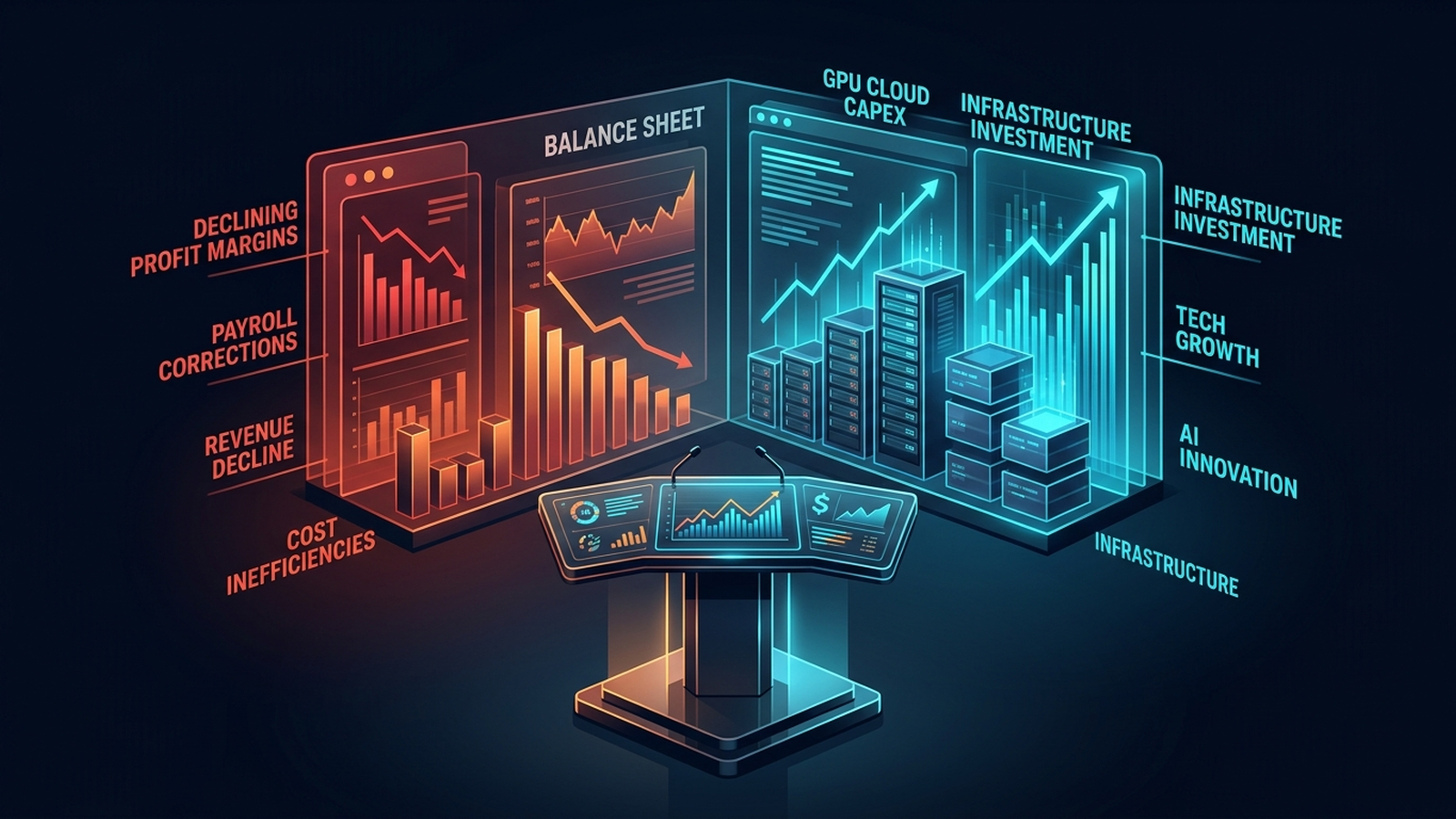
Beyond the legal controversy, Kjellberg's project highlighted a pivotal operational choice faced by thousands of creative studios, marketing firms, and software operators: should you build on local hardware, or should you keep paying monthly cloud API bills?
Every technology investment represents a fundamental financial trade-off: Capital Expenditures (Capex), buying physical assets upfront, versus Operating Expenses (Opex), paying recurring utility and service subscriptions. Evaluating this balance is identical to the financial modeling we discuss in our guide to working capital planning for growth.
Operational Attribute | Local Workstation Hardware (Capex) | Commercial Cloud API (Opex) |
|---|---|---|
Upfront Investment | High ($2,500 – $7,000 for GPU / unified memory) | Zero ($0 initial setup expense) |
Recurring Monthly Cost | Electricity and cooling only (~$15 – $40/month) | Variable token consumption ($150 – $1,500+/month) |
Data Privacy & Security | 100% offline, air-gapped, zero external transit | Client data traverses third-party vendor networks |
Safety Guardrails | Full control via weight abliteration and custom tuning | Corporate safety filters and refusal mechanisms |
Platform Risk | Zero deplatforming risk (you own the physical box) | High account deactivation and terms-change exposure |
Maintenance Overhead | High (driver management, CUDA, PyTorch runtimes) | Zero infrastructure maintenance (managed endpoint) |
Model Scalability | Bound by physical VRAM ceiling (e.g., 24GB – 128GB) | Instant on-demand access to massive frontier clusters |
The Mini-Story of Elena's Creative Studio
To see how this math plays out in the real world, consider Elena, who runs a boutique design and digital strategy agency in Chicago.
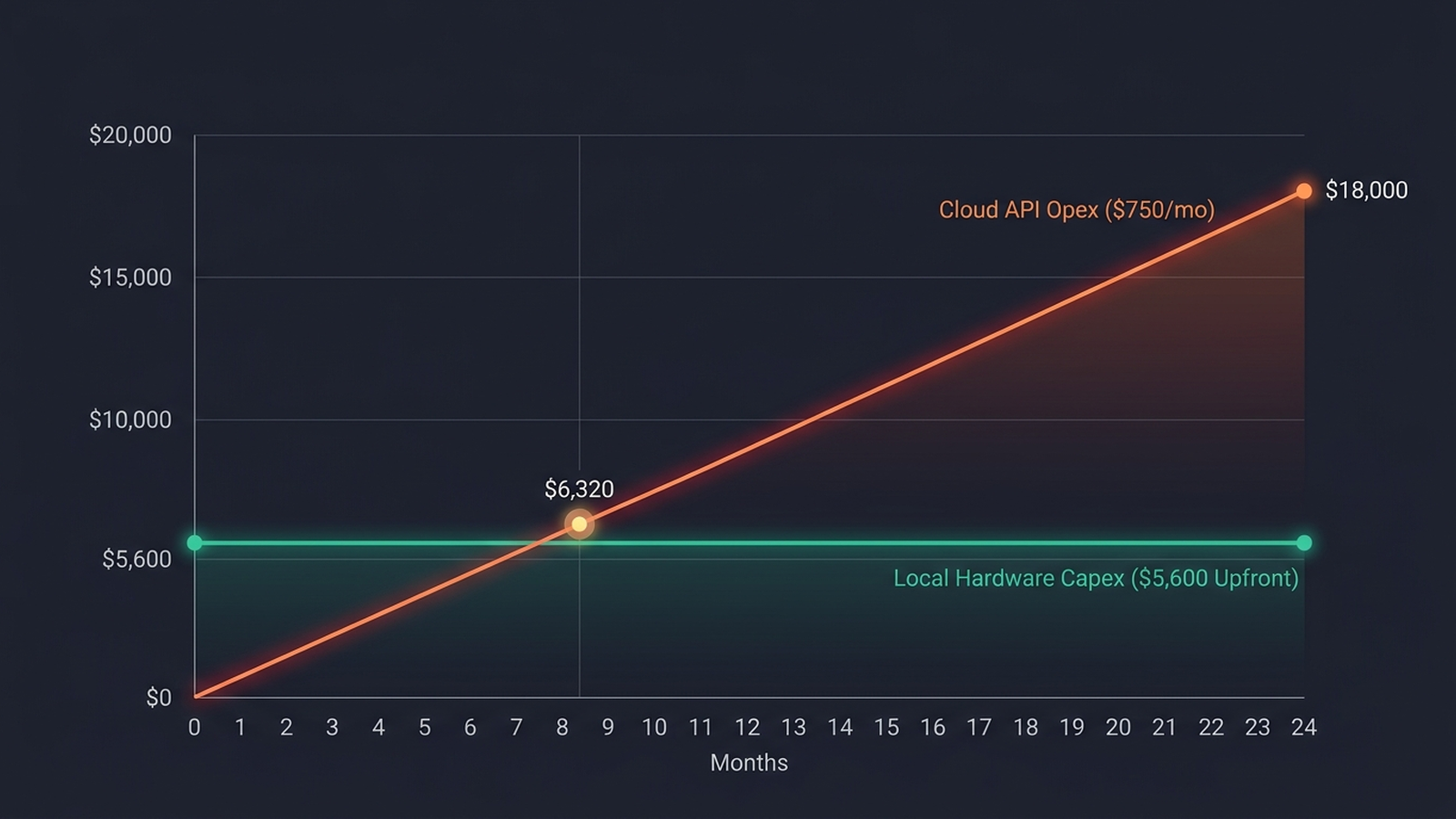
For twelve months, Elena's five-person team relied on OpenAI's API to summarize design briefs, draft production proposals, and review internal client assets. Her corporate API bill hovered around $750 each month, a manageable $9,000 annual operating expense.
However, when a major healthcare client required strict non-disclosure terms that barred any client data from passing through third-party cloud APIs, Elena faced a decision: walk away from the $60,000 contract or bring their AI operations entirely in-house.
Elena opted for the Capex route. She purchased two refurbished workstations equipped with dual NVIDIA RTX 3090 GPUs (offering 48 GB of combined VRAM per machine) at a total cost of $5,600. Her team installed open-source inference servers running quantized 70B parameter open-weights models.
Timeline Horizon | Cumulative Cloud API Opex ($750/mo) | Cumulative Local Hardware Capex ($5,600 + $30/mo Power) | Net Cost Advantage |
|---|---|---|---|
Month 0 (Launch) | $750 | $5,630 | Cloud saves $4,880 upfront |
Month 6 | $4,500 | $5,780 | Cloud saves $1,280 |
Month 8.5 (Break-Even) | $6,375 | $6,355 | Hardware achieves financial parity |
Month 12 (Year 1) | $9,000 | $6,460 | Local hardware saves $2,540 |
Month 18 | $13,500 | $6,640 | Local hardware saves $6,860 |
Month 24 (Year 2) | $18,000 | $6,820 | Local hardware saves $11,180 |
Elena's 8.5-month hardware payback illustrates how studio economics shift when replacing variable cloud subscriptions with owned compute assets. For creative agencies, development shops, and consulting practices, evaluating this transition follows the exact framework in our guide to break-even analysis for service businesses—treating upfront machine capex as overhead that must be defended by billable margin rather than speculative growth.
Breaking Down the Real Hardware Economics
If you want to follow Kjellberg's path and host your own AI assistant, what does the balance sheet actually look like?
Hardware Tier | Target Models | Estimated Investment | VRAM Pool & Architecture |
|---|---|---|---|
Consumer Desktop (Single RTX 4080 / 4090) | 8B – 9B Models (Qwen3.5, Llama 3) | $1,800 – $2,500 | 16GB – 24GB GDDR6X |
Dual-GPU Workstation (Dual RTX 3090 / 4090) | 14B – 32B Models (DeepSeek hybrids) | $3,200 – $4,500 | 48GB Pooled GDDR6X |
Apple Silicon Studio (M2/M3 Ultra) | Quantized 70B Models (Full agent stacks) | $4,000 – $6,500 | 64GB – 192GB Unified Memory |
Tier 1: Consumer GPU Desktop ($1,800 - $2,500)
Target: Running 8B to 9B models (like Kjellberg's Ajax) at FP16 or high-precision 8-bit quantization.
Specs: A standard modern gaming or creative PC with an NVIDIA RTX 4080 (16 GB) or RTX 4090 (24 GB).
Use Case: Ideal for single-user desktop automation, personal scheduling, and local code generation.
Tier 2: Dual-GPU Pro Workstation ($3,200 - $4,500)
Target: Running intermediate 14B to 32B parameter models without performance degradation.
Specs: Workstation motherboard with dual PCIe slots housing two RTX 3090s (yielding 48 GB of pooled VRAM via vLLM or ExLlamaV2).
Use Case: Small service practices, agencies, and development teams running continuous batch jobs and local retrieval pipelines.
Tier 3: Apple Silicon Unified Memory Workstation ($4,000 - $6,500)
Target: Running massive 70B parameter models comfortably in local memory.
Specs: Mac Studio or Mac Pro equipped with an M2/M3 Ultra processor and 128 GB or 192 GB of unified memory. Because Apple Silicon shares memory dynamically between the CPU and GPU, you can load a 70B parameter model quantized at 4-bit (~40 GB) entirely into memory while keeping your operating system whisper-quiet with low power draw (~150 watts under full load).
Before committing thousands of dollars to physical computer hardware, run your numbers through our profit margin calculator and deterministic business calculators directory to model asset depreciation and payback horizons before ordering server components.
7. How to Build Custom Local AI Without Getting Banned by OpenAI
If you are inspired by the vision of a private, sovereign assistant like Odysseus but want to avoid having your developer credentials revoked, you must design your development pipeline with strict architectural hygiene.
Step 1: Select Foundation Models with Permissive Distillation Licenses — Never use proprietary endpoints (ChatGPT, Claude, Gemini) to build training sets. Build your synthetic data generation engine around foundation models that explicitly grant distillation rights, such as DeepSeek-R1, DeepSeek-V3, Meta Llama 3.3, or Mistral open-weights models.
Step 2: Source Open Synthetic Datasets — Instead of scraping proprietary reasoning traces, use high-quality community datasets that have already been curated, deduplicated, and released under open licenses on Hugging Face (such as OpenHermes 2.5, UltraFeedback, or Evol-Instruct corpora).
Step 3: Apply Weight Abliteration Locally — Excise refusal vectors directly from hidden residual streams using tools like Heretic on your local machine, ensuring the model never refuses administrative commands without breaching any third-party terms of service.
Step 4: Train Locally Using Parameter-Efficient Fine-Tuning (PEFT) — Train lightweight Low-Rank Adaptation (LoRA) adapters using modern fine-tuning frameworks like Unsloth or Axolotl on a single 16 GB or 24 GB GPU. Training takes only a few hours on a consumer graphics card and outputs adapter files under 200 MB.
Step 5: Quantize and Serve via Clean Local Runtimes — Once your custom adapter is merged with your base model, convert the weights to open GGUF format using llama.cpp. Serve your custom assistant via lightweight, open-source inference daemons such as Ollama, vLLM, or LM Studio for completely offline, zero-token-cost execution.
By running your entire stack through these open engines, your tools operate completely disconnected from the cloud. No terms of service to monitor, no API rate limits to navigate, and zero chance of receiving a sudden termination email.
The Lessons of the PewDiePie Deactivation
When OpenAI banned PewDiePie twice, it was not an act of corporate malice against a famous YouTuber. It was the predictable, automated enforcement of a protective corporate moat.
As artificial intelligence shifts from an academic curiosity into mission-critical business infrastructure, the boundary between proprietary cloud software and open-source sovereignty is becoming the central battleground of the industry. The creators, founders, and small business operators who thrive in this environment will be those who recognize platform risk before it impacts their operations.
If you rely on commercial APIs for high-volume, proprietary tasks, you are operating on rented land. If your workflows push the boundaries of custom training, automation, or sensitive data handling, investing in local open-source capabilities is not just a technical hobby; it is sound risk management.
Model Your Technology Infrastructure Costs Deciding whether to keep paying monthly cloud token invoices or invest in dedicated on-premise hardware? Use the ToolsToFind SaaS ROI calculator to forecast your break-even horizon, or explore our business calculators directory to keep your operational burn under control.
Frequently Asked Questions
Why did OpenAI ban PewDiePie?
OpenAI banned PewDiePie (Felix Kjellberg) for violating Section 2(c)(iii) of its Terms of Use, which strictly forbids users from using outputs from OpenAI models to develop, train, or fine-tune competing artificial intelligence models. Kjellberg was using OpenAI's API to generate synthetic training datasets and reasoning chains to fine-tune his local open-weights model, Ajax, for his private Odysseus workspace.
What base model did PewDiePie use for Ajax?
Kjellberg used Alibaba's open-weights Qwen3.5-9B model as the base for Ajax. He chose this 9-billion parameter dense model because it fits comfortably inside the video memory (VRAM) of a single high-end consumer graphics card (such as an NVIDIA GeForce RTX 3090 or 4090) while offering strong multilingual reasoning, coding, and structured data generation performance.
Can you use ChatGPT to train other AI models legally?
No. Under Section 2(c)(iii) of OpenAI's Terms of Use, you are contractually prohibited from using output from ChatGPT or OpenAI's APIs to develop models that compete with OpenAI. If you want to use model distillation to train smaller models, you must use open-weights models that permit synthetic data distillation under their licenses, such as Meta's Llama 3 models or DeepSeek-V3 and DeepSeek-R1 (released under the permissive MIT license).
What is weight abliteration in local AI models?
Weight abliteration is an open-source machine learning technique that removes refusal and censorship behaviors from open-weights models without requiring full retraining. By analyzing the model's internal activations across safe versus refused prompts, developers isolate the directional activation vector representing refusal in the transformer residual streams and mathematically project it out of the weight matrices, creating an uncensored model.
Is running local AI cheaper than paying for cloud APIs?
It depends on your workload volume. For occasional casual use, cloud APIs (such as OpenAI or Anthropic) are vastly cheaper because you only pay fractions of a cent per request with zero upfront investment. However, for continuous background automation, heavy dataset processing, or strict privacy requirements, purchasing dedicated local hardware ($2,500 to $5,000 for a capable workstation) typically achieves break-even within 6 to 12 months while eliminating recurring software subscription costs.