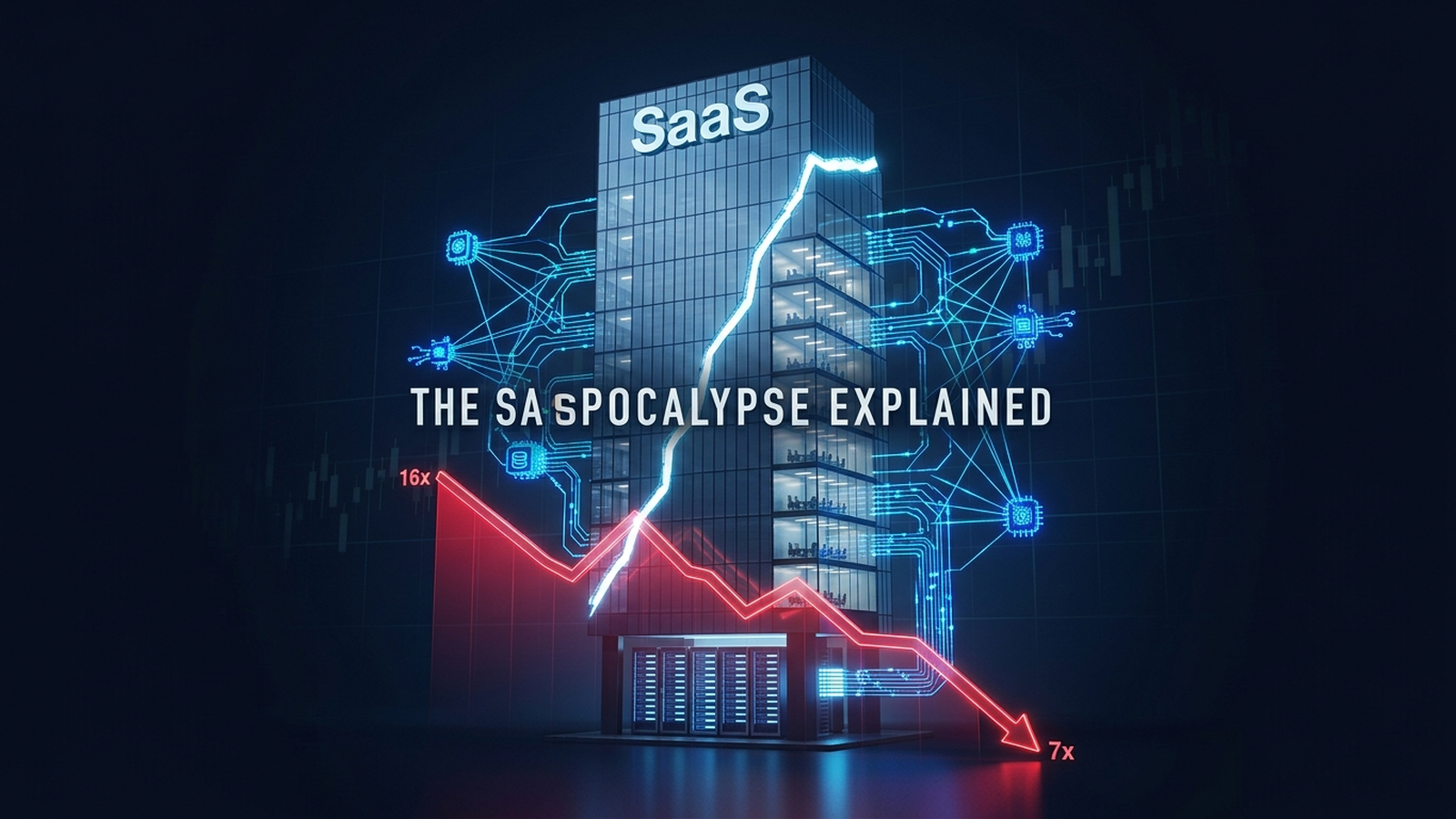
The SaaSpocalypse explained: it refers to the sudden market correction in 2026 that erased more than $1 trillion in enterprise value from cloud software companies as autonomous AI agents began directly dismantling the twenty-year-old per-seat subscription model. When autonomous software agents execute complex workflows independently, businesses no longer need to buy ten, fifty, or five hundred individual user licenses for human employees to click buttons inside a graphical user interface.
For two decades, business-to-business (B2B) software companies scaled on an almost unshakeable premise: as a business hired more knowledge workers, it purchased more software seats. In early 2026, public markets experienced a violent awakening when enterprise software earnings reports revealed that client headcounts were stabilizing or falling while output climbed. Wall Street suddenly realized that if autonomous agents do the actual work, the per-seat revenue engine that powered modern cloud valuations simply stops running.
If you are a business owner, finance leader, or operator, this macro collapse is not just an interesting Wall Street headline. It marks a fundamental shift in how businesses buy, build, and budget for technology. Below is the complete SaaSpocalypse explained: the structural forces that drove the equity crash, the vulnerability of "system of engagement" software, how outcome-based and compute-metered pricing are replacing traditional subscriptions, and a step-by-step operating framework to audit your own software stack and recover immediate margin.
Key Takeaways
The SaaSpocalypse is the 2026 equity wipeout where over $1 trillion in public SaaS market cap vanished after autonomous AI agents broke the direct link between business output and human software seats.
The core casualty is per-seat pricing; selling software licenses pegged to employee headcount collapses when an agent replaces multi-seat workflows with direct API calls.
"Systems of engagement" (thin UI wrappers, form-builders, ticketing boards) are structurally vulnerable, while defensible "systems of record" (audited databases, regulatory backends, compliance ledgers) retain enterprise use.
Enterprise software monetization is rapidly migrating toward outcome-based billing (paying per verified transaction or resolved ticket) and raw compute/token metering.
Operating businesses can immediately capture margin by conducting a software audit, terminating unused "ghost seats," and stress-testing automation payback with financial modeling tools.
Evaluating your team's software spend or modeling how an automation project impacts your bottom line? Explore our SaaS ROI calculator to model payback periods and net cash impact before signing your next software renewal.
What Was the SaaSpocalypse? The 2026 Software Stock Selloff Explained
The term "SaaSpocalypse" gained widespread traction across financial desks and tech corridors during the first quarter of 2026. After two years of treating generative AI as a premium add-on feature—such as charging an extra $20 to $30 per user per month for an AI copilot—cloud software vendors hit a wall. Enterprise buyers stopped renewing seats for junior analysts, copywriters, tier-1 customer service representatives, and administrative coordinators because autonomous agent pipelines took over those tasks.
+-------------------------------------------------------------------------------+
| THE 2026 SAASPOCALYPSE TIMELINE                                               |
+-------------------------------------------------------------------------------+
| Late 2024 - 2025: Copilot Phase                                               |
| - Legacy SaaS vendors add AI copilots as $20-$30/seat upsells                 |
| - Wall Street assumes AI expands average revenue per user (ARPU)              |
+-------------------------------------------------------------------------------+
| Early 2026: The Agentic Breakpoint                                            |
| - Autonomous agents demonstrate direct task completion across multi-app stacks|
| - Enterprise renewals show net-negative seat expansion as headcount shrinks   |
+-------------------------------------------------------------------------------+
| Mid 2026: Equity Multiple Compression                                         |
| - Cloud indices (IGV, EMCLOUD) shed over $1 Trillion in market capitalization |
| - EV/Forward Revenue multiples compress from 12x-16x down to historical 6x-8x |
+-------------------------------------------------------------------------------+
| Today: The Platform Realignment                                               |
| - Shift from per-seat subscriptions to outcome-based and compute billing      |
| - Operators audit shelfware and deploy custom micro-SaaS agent architectures |
+-------------------------------------------------------------------------------+
How $1+ Trillion in Market Capitalization Evaporated
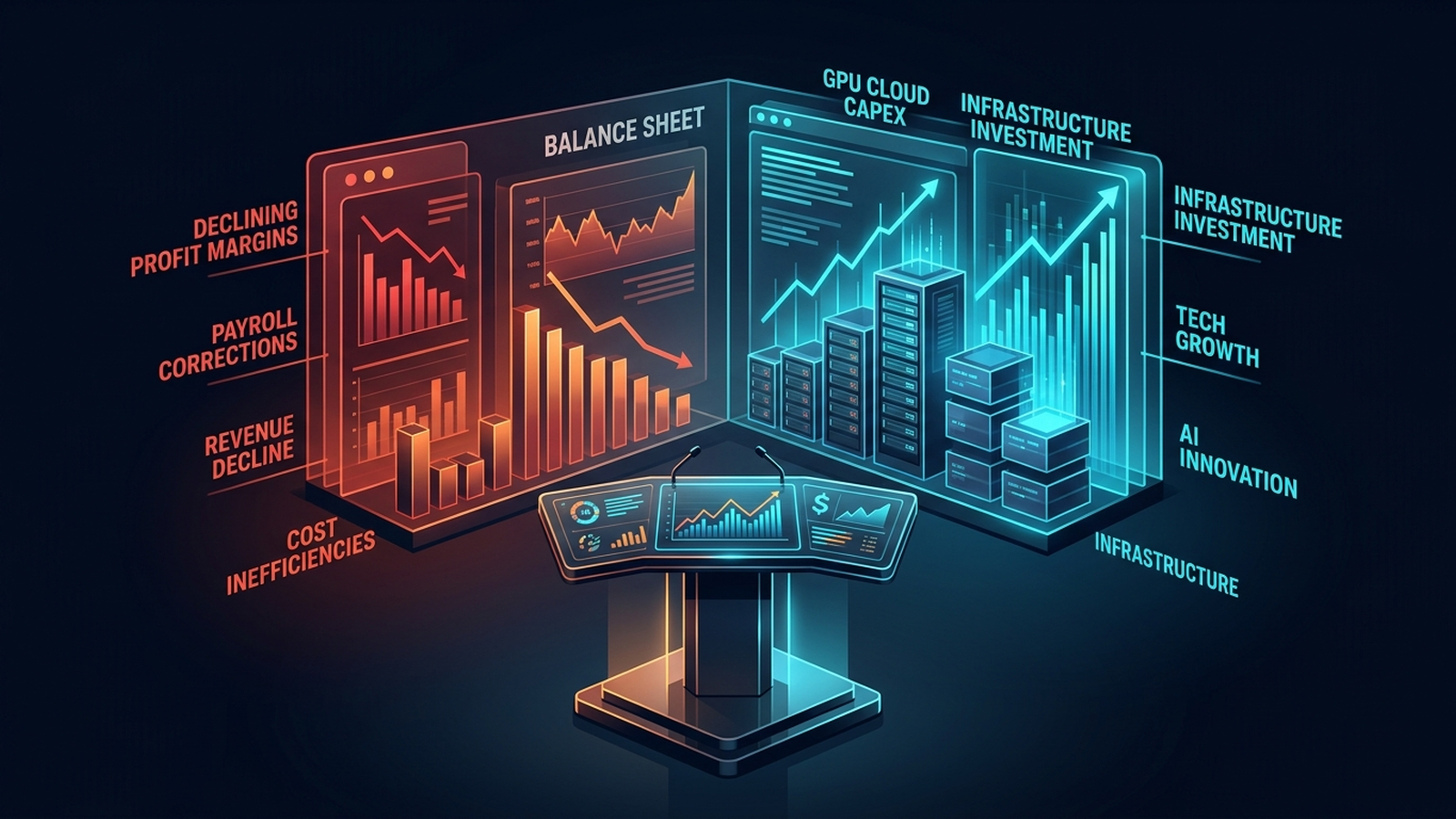
The scale of the sell-off caught conventional equity analysts off guard. Benchmark software barometers, including the iShares Expanded Tech-Software Sector ETF (IGV) and the BVP Nasdaq Emerging Cloud Index (EMCLOUD) tracked by Bessemer Venture Partners, saw valuation multiples violently re-rate downward. Over an eight-week window, enterprise software multiples tumbled from peak forward enterprise value-to-revenue (EV/Revenue) multiples of 14x-18x down to historical median bands of 6x-8x, erasing an aggregate market capitalization exceeding $1 trillion.
Public SaaS companies had traded at generous premiums for more than a decade because their revenue possessed three qualities investors loved:
High Predictability: Annual and multi-year recurring subscription contracts.
Gross Margins Above 75%: Near-zero marginal distribution costs for hosted web code.
Net Revenue Retention (NRR) Over 115%: Automatic top-line expansion as client companies hired more staff and naturally added seats.
When autonomous agent architectures proved capable of orchestrating multi-step business logic across databases, email servers, and operational tools without human manual entry, NRR figures stalled. Enterprise customers did not cancel their contracts entirely; instead, they aggressively downsized their seat tiers upon renewal. An enterprise with 1,200 CRM seats cut its footprint to 400 supervisory seats, allowing API-driven background agents to perform the data hygiene, pipeline updates, and initial outreach. The mathematical consequence was immediate: a business model predicated on perpetual headcount expansion faced structural contraction.
The Bellwethers and Sector Collateral
The initial wave of the software stock selloff of 2026 rippled through horizontal application vendors. Customer relationship management (CRM), customer support ticketing, human resources information systems (HRIS), and basic project collaboration software bore the heaviest initial valuation downgrades.
Meanwhile, market capital flowed decisively down the technology stack. As autonomous AI agents transformed software stocks from defensive growth assets into vulnerable multiples, capital shifted into infrastructure providers, chipmakers, hyperscale cloud data centers, and low-latency database engines that captured the budget enterprise buyers pulled away from application seats. Financial markets recognized that while enterprise demand for work output was rising, the economic rent was no longer being captured by the software user interface layer.
The Core Catalyst: Why Autonomous AI Agents Broke the Per-Seat Model
To understand why the SaaS market cap crash driven by AI caused such panic, one must look at the fundamental unit economics of software licensing over the past twenty years.
The 20-Year Math of Headcount-Driven Software Revenue
Since the early 2000s, commercial software economics rested on a simple pricing equation:
$$\text{Annual Recurring Revenue (ARR)} = \text{Total Customers} \times \text{Average Headcount per Customer} \times \text{Price per Seat}$$
This pricing structure aligned software vendors with macroeconomic corporate expansion. If an e-commerce retailer grew from 50 customer support agents to 200 during a boom cycle, the helpdesk software provider automatically quadrupled its revenue from that account without shipping a single new line of code.
Traditional Per-Seat SaaS Model:
[ Growing Company ] -Traditional Per-Seat SaaS Model:
[ Growing Company ] ---> [ More Human Employees ] - [ More Human Employees ] ---> [ More Software Licenses ] - [ More Software Licenses ] ---> [ Expanding SaaS ARR ]

The Agentic Inversion:
[ Growing Company ] - [ Expanding SaaS ARR ]

The Agentic Inversion:
[ Growing Company ] ---> [ Autonomous AI Agents ] - [ Autonomous AI Agents ] ---> [ Fewer Human Seats Needed ] - [ Fewer Human Seats Needed ] ---> [ Collapsing SaaS ARR ]
Venture capital and public markets priced software companies on this exact flywheel. A company trading at 15x forward revenue was priced with the expectation that human headcount inside corporate America would continue to expand, compounding seat counts year over year.
The Unit Economics Inversion: When One Agent Replaces Ten Seats
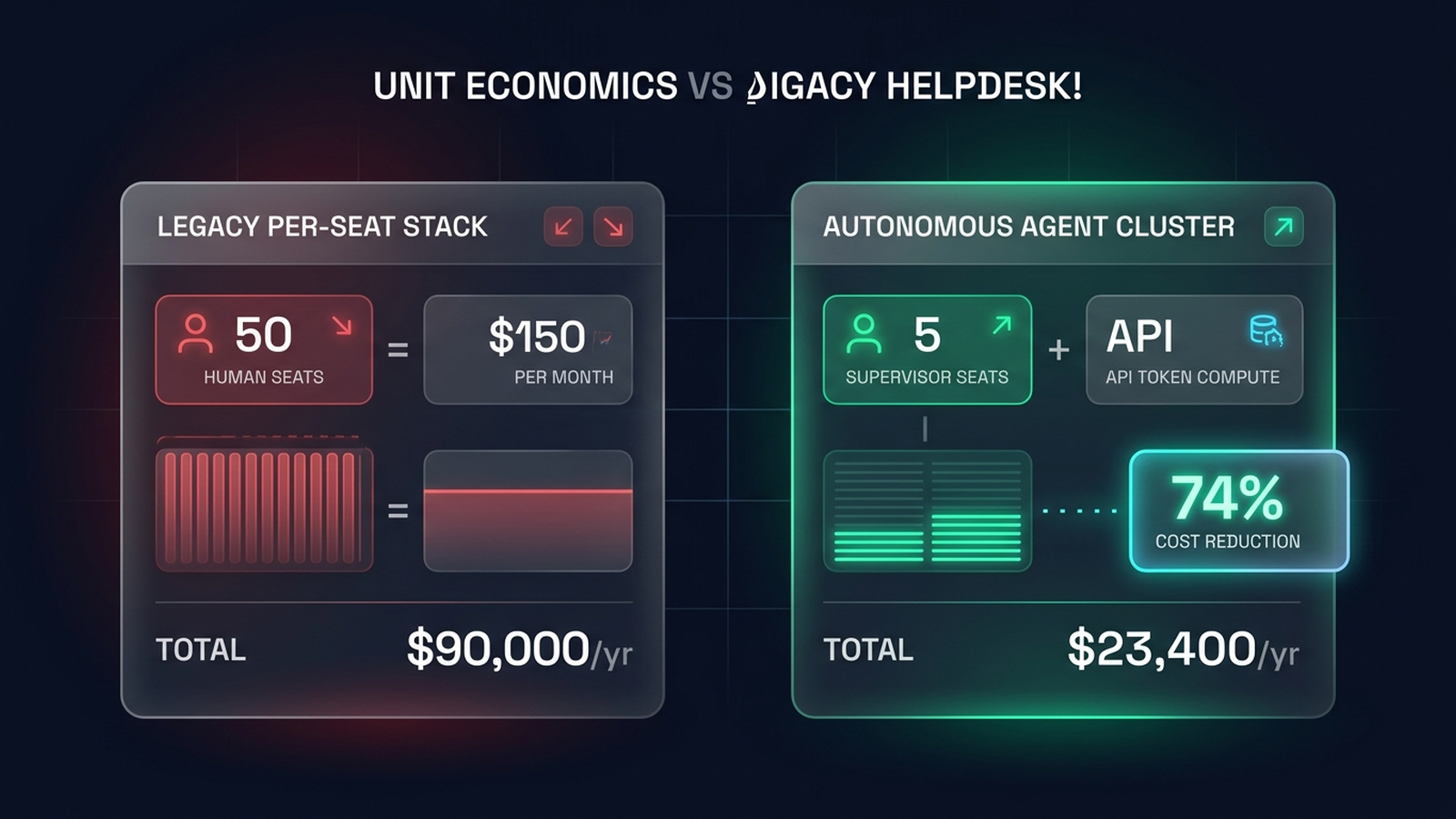
The death of per-seat pricing in B2B SaaS became inevitable the moment generative models transitioned from conversational chatbots into goal-directed, autonomous agents using standards like the Model Context Protocol (MCP) and direct API function calling.
Consider the concrete unit economics that an operational founder or VP of Customer Operations faced in early 2026:
Operational Metric | Legacy Per-Seat Helpdesk Stack | Autonomous AI Agent Framework |
|---|---|---|
Staffing Structure | 50 Customer Support Specialists | 5 Tier-3 Specialists + Autonomous Agent Cluster |
Software Licensing Cost | $150 per seat / month ($7,500/mo) | 5 Administrative Seats ($750/mo) |
Compute & Token Consumption | Included in seat price | ~$1,200/mo (API tokens & tool calls) |
Total Monthly Software/Compute Cost | $7,500 / month | $1,950 / month |
Annual Software Commitment | $90,000 / year | $23,400 / year |
Annual Software Savings | Baseline | $66,600 / year (74% Reduction) |
When an enterprise can resolve 70% to 85% of inbound tickets, lead qualification steps, or routine bookkeeping entries through autonomous agents operating via direct API pipelines, paying $150 per user per month for human beings to log into a browser dashboard becomes impossible to justify. The customer still accomplishes the work—in fact, response times plummet from hours to seconds—but the vendor loses nearly three-quarters of its recurring software contract value.
When assessing whether to retain seats or pivot to automated workflows, operators can run a break-even analysis for service businesses to calculate adjusted workload targets, unit margins, and profitability thresholds.
Mini-Story: How an Austin Support Agency Slashed $125,000 in Software Seats
David runs an 80-person technical support and managed services agency based in Austin, Texas. For four years, his firm operated on a standard enterprise tier of a major cloud helpdesk platform, paying $180 per seat per month across 80 agents, a fixed overhead of $14,400 per month, or $172,800 annually.
In late 2025, David's engineering lead deployed an open-source agent pipeline to handle automated log parsing, triage routine password and permission inquiries, and pre-draft escalation responses directly into their internal messaging channels. By February 2026, the agent cluster resolved 62% of inbound tickets without human intervention, while human agents handled complex escalations twice as fast.
When the agency's annual software renewal arrived in March 2026, David did not cancel the service. Instead, he dropped their licensed human seat count from 80 down to 22. In a single negotiation call, David eliminated over $125,000 in annual recurring software expense from the vendor's balance sheet, reallocating $15,000 toward raw inference compute and banking the remaining $110,000 directly into his agency's net operating margin. Multiply David's decision across hundreds of thousands of businesses worldwide, and the math behind the software stock selloff of 2026 becomes crystal clear.
Beyond the Seat: Two Hidden Forces That Accelerated the Selloff
While the erosion of seat counts captured mainstream financial headlines, two deeper structural forces accelerated the equity rout: the destruction of the graphical user interface as a defensible moat, and the rapid rise of internally deployed micro-SaaS architectures.
+----------------------------------------------------------------------------+
| THE EROSION OF THE TRADITIONAL SaaS MOAT                                   |
+----------------------------------------------------------------------------+
|                                                                            |
| 1. THE UI BYPASS                                                           |
| Human User        -+----------------------------------------------------------------------------+
| THE EROSION OF THE TRADITIONAL SaaS MOAT                                   |
+----------------------------------------------------------------------------+
|                                                                            |
| 1. THE UI BYPASS                                                           |
| Human User        ---> [ Proprietary SaaS UI ] - [ Proprietary SaaS UI ] ---> [ Database & Logic ]   |
| Autonomous Agent  - [ Database & Logic ]   |
| Autonomous Agent  ---> [ Direct API / MCP ]    - [ Direct API / MCP ]    ---> [ Database & Logic ]   |
| *Result: Brand loyalty to visual interfaces collapses.*                    |
|                                                                            |
| 2. THE IN-HOUSE REPLACEMENT (Micro-SaaS)                                   |
| Old Path: Pay $40/mo per seat for rigid off-the-shelf SaaS tool.           |
| New Path: Prompt an LLM agent to generate, host, and maintain a            |
| tailored internal tool running on serverless compute.                      |
| *Result: Commodity point-solution software loses pricing power.*           |
|                                                                            |
+----------------------------------------------------------------------------+
1. The Erosion of the "System of Engagement" (UI Bypass)
For twenty years, enterprise software moats were built on visual user experience (UX) and daily habit loops. Companies like Salesforce, Asana, Monday.com, and HubSpot built multi-billion-dollar franchises by creating digital workspaces where knowledge workers spent four to eight hours a day typing notes, clicking dropdown menus, moving cards across Kanban boards, and generating charts. These platforms were "systems of engagement."
Autonomous AI agents do not need a visual user interface.
An agent does not care about color-coded project cards, drag-and-drop kanbans, or polished navigation bars.
An agent reads structured JSON schemas, interacts with REST or GraphQL endpoints, queries databases via standard SQL, and executes commands across headless terminal interfaces.
When human workers no longer spend their days manually entering records into a graphical interface, the visual software layer loses its psychological lock-in. If an agent executes workflows directly between a Postgres database, Stripe billing webhooks, and an email delivery API, the $50-per-month project management interface becomes obsolete shelfware. The moat evaporated because the user stopped being a human looking at a screen.
2. The Rise of In-House Micro-SaaS and Agentic Workflows
The second existential threat to traditional software vendors is the plummeting cost of software creation itself. Historically, companies subscribed to specialized software tools because building an internal custom replacement required hiring expensive software engineering teams, managing infrastructure, and handling constant maintenance.
Today, advanced code-generation models and autonomous development agents allow technical operators to scaffold, test, and deploy production-grade internal micro-tools in hours rather than quarters. A business that previously paid $40 per user per month for an off-the-shelf document extraction and invoicing portal can now prompt an internal agent to construct a custom, secure workflow deployed on serverless infrastructure. The build-versus-buy calculation flipped entirely: "buy" carries perpetual per-seat pricing with rigid feature roadmaps, while "build" carries near-zero software licensing overhead and complete operational flexibility.
For businesses looking to optimize their software investments and assess these trade-offs, explore our analysis of capital budgeting for small-business equipment and technology assets to evaluate payback periods accurately.
Systems of Record vs. Systems of Engagement: Who Survives the Crash?
One of the most dangerous misconceptions emerging from the SaaSpocalypse is the sensationalist claim that "all software is dead." Software is not dead; rather, the market has instituted an aggressive, unforgiving filter between fragile software intermediaries and resilient systems of record.
+------------------------------------+------------------------------------+
| FRAGILE SOFTWARE                   | RESILIENT SOFTWARE                 |
| (Systems of Engagement)            | (Systems of Record)                |
+------------------------------------+------------------------------------+
| - Form-builders and survey widgets | - Audited financial general ledgers|
| - Basic workflow coordinators      | - Regulatory & payroll databases   |
| - Standalone transcription tools   | - Mission-critical ERP datastores  |
| - Generic copy/content generators  | - Secure banking & payment rails   |
| - Static dashboard visualizers     | - Identity & access protocols      |
+------------------------------------+------------------------------------+
| High vulnerability to AI agents    | High defensibility & data gravity  |
+------------------------------------+------------------------------------+
Fragile SaaS: Thin Wrappers and Workflow Intermediaries
The software categories facing permanent margin destruction share distinct architectural vulnerabilities:
Thin UI Wrappers: Applications that primarily offer a polished interface wrapped around basic CRUD (Create, Read, Update, Delete) database functions or commodity underlying public APIs.
Form-Builders and Survey Tools: Standalone platforms charging hefty monthly fees to capture data that can now be effortlessly gathered via autonomous conversational forms or programmatic API hooks.
Workflow Connectors with Opaque Markups: Middleware tools that charge exorbitant monthly tiers based on basic integration volume, easily superseded by open standards like MCP and direct agent-authored webhooks.
Discretionary Point Solutions: Single-feature applications that solve a problem that an autonomous agent can handle natively within a broader prompt context.
Resilient Software: True Systems of Record and Physical Moats
Conversely, enterprise software categories that have weathered the sell-off and maintained pricing authority possess deep defensibility:
Systems of Record with Data Gravity: The authoritative, single-source-of-truth databases storing audited financial transactions, core banking ledgers, mission-critical healthcare records, and enterprise supply chain logs (e.g., Snowflake, Databricks, Oracle, specialized ERP backends). Agents cannot hallucinate financial reality; they require high-integrity systems of record to query and write against.
Regulatory and Compliance Anchors: Platforms handling jurisdiction-specific compliance, tax calculations, statutory payroll withholding, and binding legal filings. A company does not use a payroll system for its attractive buttons; it uses it because the platform assumes legal responsibility for remitting payroll taxes accurately across thousands of local, state, and federal tax jurisdictions.
Physical and Hardware-Bound Software: Platforms integrated with warehouse robotics, real-time IoT sensors, telematics, point-of-sale hardware terminals, and physical infrastructure.
To understand how software delivery costs impact subscription margins, model your margins with our SaaS profit margin calculator.
Mini-Story: Elena's Mid-Market SaaS Audit Reclaims $186,000
Elena serves as the Vice President of Finance for a regional freight logistics firm with $38 million in annual revenue. In January 2026, amid the broader market discussions surrounding the SaaSpocalypse, Elena initiated an exhaustive audit of the company's enterprise software ledger. What she uncovered was classic enterprise SaaS bloat: the firm held 42 active software subscriptions totaling $640,000 in annual recurring commitments.
Crucially, Elena cross-referenced employee single-sign-on (SSO) activity with their billing tiers. Across their project management, business intelligence visualization, and contract-quoting tools, Elena discovered 114 "ghost seats"—licenses assigned to former contractors, employees who had transitioned roles, or staff who had logged into the software fewer than two times in the preceding ninety days.
Elena's Software Audit Breakdown:
- Total Software Subscriptions: 42 Platforms ($640,000/yr)
- Identified Ghost Seats (Zero activity >90 days): 114 Licenses
- Redundant Point Solutions Replaced by Agent APIs: 6 Tools
- Total Net Annual Savings Reclaimed: $186,000
- Direct Impact: Operating Margin Improved by +0.49% Across the Entire Firm
Rather than simply trimming headcounts, Elena partnered with their internal systems architect to deploy an internal agentic connector that consolidated reporting from their transport databases directly into executive Slack channels. By decommissioning six redundant reporting tools and rightsizing seat licenses to match active human coordinators, Elena shaved $186,000 off their annual overhead without sacrificing operational throughput.
Ready to stress-test your operational margins? Use our profit margin calculators to benchmark your software and delivery costs against your industry, and calculate gross margin recovery after trimming inactive licenses.
The Emerging Economic Models: What Replaces Legacy SaaS?
As the traditional per-seat licensing paradigm declines, how will software creators monetize their tools, and how should business operators budget for operational technology moving forward? Three distinct billing architectures are defining the post-SaaSpocalypse landscape.
+----------------------------------------------------------------------------+
| THE THREE POST-SAASPOCALYPSE PRICING MODELS                                |
+----------------------------------------------------------------------------+
|                                                                            |
| 1. OUTCOME-BASED PRICING                                                   |
| - How it works: Pay per verified business result (e.g., $1.50 per         |
|   resolved tier-1 ticket, $15 per filed tax return).                       |
| - Why it wins: Directly aligns customer value with vendor revenue.         |
|                                                                            |
| 2. TOKEN & COMPUTE METERING                                                |
| - How it works: Pay base access + transparent usage fees tied to actual    |
|   infrastructure, compute cycles, and LLM token consumption.               |
| - Why it wins: No markup on human seats; customers pay for usage.          |
|                                                                            |
| 3. TRANSPARENT FLAT-RATE WORKSPACES                                        |
| - How it works: Predictable workspace pricing with clean tiered boundaries |
|   (e.g., free access with professional unwatermarked exports on Pro).       |
| - Why it wins: Eliminates unpredictable seat taxes for collaborative teams. |
|                                                                            |
+----------------------------------------------------------------------------+
1. Outcome-Based Pricing: Paying for the Work Done
The most significant structural evolution is the migration toward outcome-based pricing in SaaS. Instead of charging $100 per seat per month regardless of whether an employee opens the application, software vendors increasingly charge for verified units of completed work:
Rather than charging $150/user/month for customer service software, the vendor charges $1.25 per successfully resolved ticket verified by customer satisfaction ratings.
Rather than charging $80/user/month for an outbound sales platform, the vendor charges $25 per qualified meeting placed directly on an account executive's calendar.
Rather than charging $200/month for an invoicing suite, the vendor charges a small fractional fee per reconciled and settled accounts-receivable invoice.
Outcome-based pricing shifts commercial risk back to the software vendor. When the vendor delivers genuine business productivity, it captures healthy economics; when its software sits idle, the customer pays almost nothing.
2. Token Consumption and Compute-Metered Billing
For technical platforms, infrastructure tools, and API-driven automation engines, the dominant model has converged on transparent compute metering. Similar to how public utilities bill for kilowatt-hours of electricity, compute-metered software charges customers based on execution time, database read/write cycles, and input/output token volume.
This model provides financial clarity for operators. When evaluating customer acquisition, delivery costs, and gross margins, finance teams can map exact compute expenses directly to client deliverables rather than absorbing a fixed, bloated per-seat overhead charge every month.
3. Transparent Flat-Rate Platforms and Capable Workspaces
At the small business and mid-market level, owners have grown intensely fatigued by "seat-tax creep"—the predatory practice where adding a single administrative assistant, accountant, or junior project manager doubles a company's software bill.
The future of productive software belongs to transparent workspace platforms. In this model, businesses access capable suites of financial calculators, planning modules, and generation tools without arbitrary per-user penalties. Platforms provide clear, honest boundaries between free exploration tiers and professional tiers that unlock unwatermarked client-ready exports, increased persistence, and higher generation volume.
The Operator's Playbook: How to Audit Your SaaS Stack and Reclaim Margin
If you manage a business, understanding the macro theory of the SaaSpocalypse is only helpful if you translate it into immediate operational savings. Below is an actionable, three-step playbook to audit your software budget, eliminate shelfware, and insulate your balance sheet against software cost inflation.
+----------------------------------------------------------------------------+
| THE THREE-STEP OPERATOR AUDIT PLAYBOOK                                     |
+----------------------------------------------------------------------------+
|                                                                            |
| STEP 1: IDENTIFY GHOST SEATS AND COMMODITY SHELFWARE                       |
| - Export 90-day SSO and login records across all recurring tools.          |
| - Downgrade inactive users to view-only or free tiers immediately.         |
|                                                                            |
| STEP 2: MAP SOFTWARE CASH TIMING AGAINST WORKING CAPITAL                   |
| - Compare upfront annual discount lock-ins against monthly flexibility.    |
| - Model liquidity tradeoffs using working-capital planning frameworks.     |
|                                                                            |
| STEP 3: DEPLOY AGENTIC REPLACEMENTS FOR THIN POINT SOLUTIONS               |
| - Identify standalone form, transcription, and document extraction apps.   |
| - Replace with unified agent pipelines running on direct API calls.        |
|                                                                            |
+----------------------------------------------------------------------------+
Step 1: Quantify Shelfware and "Ghost Seats"
Most organizations waste between 20% and 35% of their total software spend on unused licenses, unassigned seats, and redundant applications. Conduct a formal software audit this quarter:
Pull the General Ledger: Have your finance lead extract every recurring software charge from the past 12 months, including corporate credit card charges that bypass centralized procurement.
Audit SSO and Login Activity: Cross-reference each licensed seat against active login timestamps over the past 60 days. Categorize any user who has not logged in for 60 days as a "ghost seat."
De-Provision and Consolidate: Immediately downgrade ghost seats to free view-only accounts or revoke licenses entirely prior to contract renewal windows.
Step 2: Calculate Automation Payback and Margin Impact
When your software vendors attempt to push price increases or upsell expensive AI add-ons, run the numbers through a formal payback framework before signing. Ask:
Does this tool save verifiable human labor hours, or does it merely add another visual dashboard our team must maintain?
Could an internal agent executing via API accomplish the same outcome at a fraction of the cost?
How does reducing software overhead improve our net operating margin?
When evaluating software investments against cash reserves, pair your analysis with our guide on working capital planning for growth to ensure that annual prepayments do not create unexpected liquidity squeezes.
Step 3: Shift from Proprietary Lock-In to Interoperable Agent Tooling
Protect your business against future software disruptions by demanding data portability and open standards:
Avoid Walled Gardens: Prioritize software platforms that provide complete REST/GraphQL API access, automated webhook triggers, and clean data export capabilities.
Adopt Open Integration Protocols: Structure internal operations around the Model Context Protocol (MCP) and open-source agent tooling, ensuring your team can switch underlying models without rewriting business workflows.
Rely on Audited Methodologies: For core business math, such as payroll taxes, break-even calculations, and margin benchmarking, rely on transparent, verified tools rather than proprietary "black-box" software platforms. Explore our deterministic financial tools in the tools directory to verify your operating assumptions.
The SaaSpocalypse Explained: Frequently Asked Questions
What is the SaaSpocalypse?
The SaaSpocalypse is the 2026 economic and equity market correction where over $1 trillion in market value was erased from public software-as-a-service (SaaS) companies. The crash was triggered by the rapid adoption of autonomous AI agents, which execute business tasks directly and break the traditional per-seat licensing model that previously tied software revenue to human employee headcount.
Does the SaaSpocalypse mean software companies are going bankrupt?
No. Resilient software companies, specifically "systems of record" that manage authoritative financial ledgers, compliance databases, ERP pipelines, and secure physical infrastructure, continue to thrive. However, valuation multiples for traditional "system of engagement" applications have compressed permanently, and vendors reliant on thin UI wrappers and headcount-driven per-seat pricing face severe revenue contraction.
How does outcome-based pricing work in software?
Outcome-based pricing charges customers for verifiable business results rather than access to software seats. For instance, instead of paying $100 per user per month for customer service software, a company might pay $1.25 per successfully resolved support ticket. This model directly aligns the vendor's financial compensation with delivered customer productivity.
How should small business owners adjust their software budgets today?
Business owners should immediately audit active software seats, eliminate inactive "ghost seats," resist multi-year lock-in contracts on seat-based tools, and explore autonomous agent frameworks for routine administrative, bookkeeping, and customer triage tasks.
Conclusion: Software Isn't Dead, But the Seat Tax Is
The SaaSpocalypse of 2026 marks the end of an era defined by software bloat, shelfware, and arbitrary per-seat taxes. For two decades, software vendors charged businesses for the privilege of letting human employees stare at user interfaces and perform manual data entry. Autonomous AI agents have decisively severed that link.
As an operator, you are no longer obligated to pay an enterprise software tax to get professional business outputs. By understanding the distinction between fragile workflow wrappers and defensible systems of record, negotiating contracts around outcomes rather than headcount, and ruthlessly trimming unused seats, you can turn a turbulent market correction into an immediate, enduring margin advantage for your business.
With the SaaSpocalypse explained, the operational takeaway for business owners is simple: stop paying an unfair seat tax on software your team barely opens. Streamline your business math, project cash flow, and export clean, presentation-ready reports without paying enterprise subscription prices. Explore ToolsToFind Pro to unlock unlimited scenario saves and client-ready exports with zero watermarks.