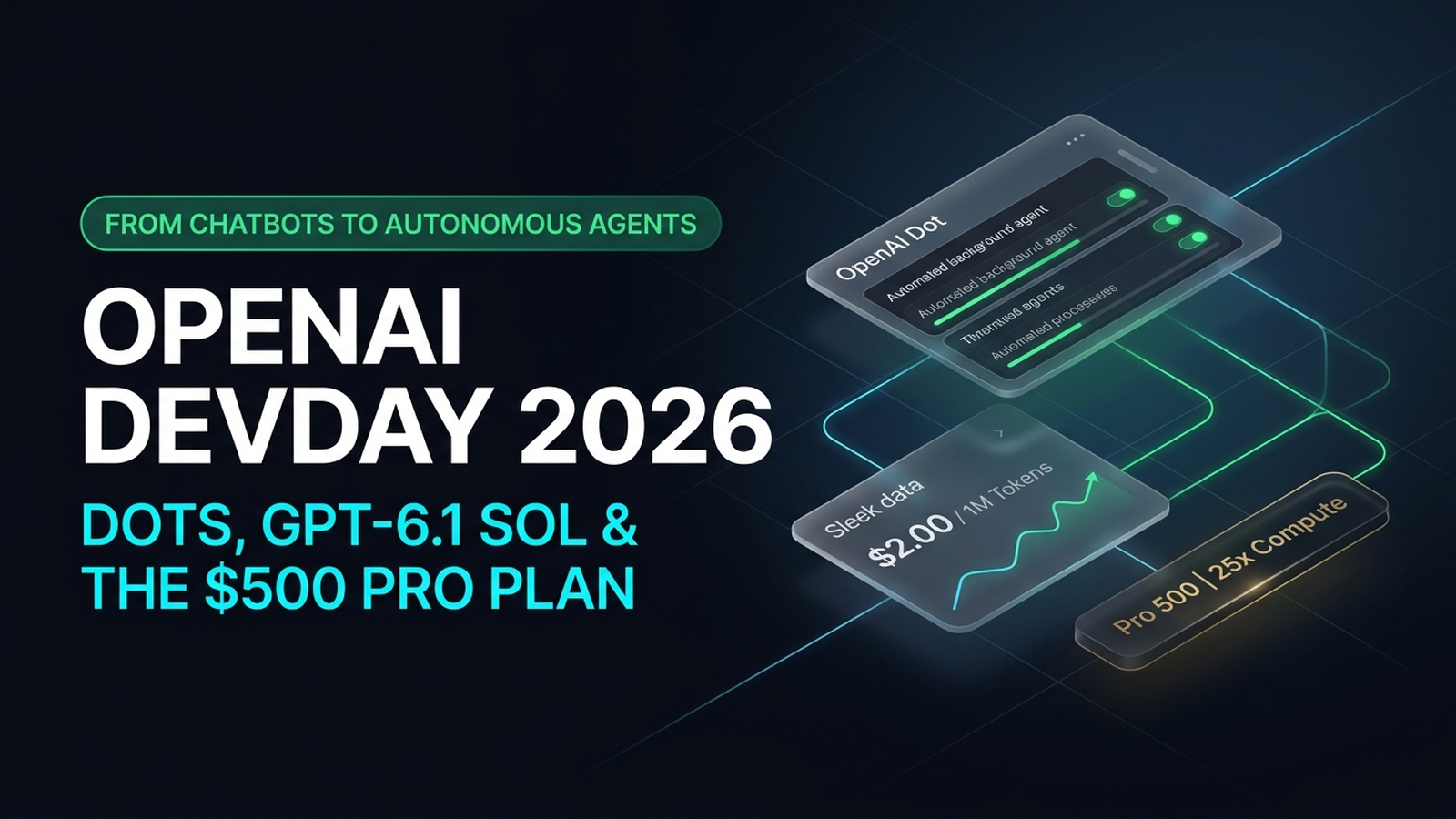
At OpenAI DevDay 2026 on September 29 in San Francisco, OpenAI officially shifted its product ecosystem from turn-based conversational chatbots to persistent, autonomous background agents. The headline OpenAI DevDay 2026 announcements center on OpenAI Dots (always-on cloud-hosted AI agents capable of operating across 4,000+ business applications), GPT-6.1 Sol (a high-speed reasoning model priced at $2.00 per million input tokens and $10.00 output), a new ChatGPT Pro 500 plan ($500 per month for extreme compute users), and major developer platform additions including the Agents API with native Computer Use and the ultra-low-latency Decisions API powered by Luna.
What if the single biggest threat to your operating margins this year is not the cost of software licenses, but autonomous agents executing thousands of recursive background API calls while your team sleeps? For business operators, agency owners, and startup founders, the transition from reactive chat interfaces to autonomous agency represents a fundamental shift in how work gets budgeted, monitored, and delivered.
You already know that generative AI has rewritten the draft phase of knowledge work. The promise of this new wave is that software will finally execute end-to-end operational workflows rather than simply offering suggestions. In this comprehensive analysis of the OpenAI DevDay 2026 announcements, we cut through keynote hyperbole to examine model specifications, benchmark figures, real token economics, and the loaded labor costs required to deploy persistent agents without eroding your company's profitability.
Key Takeaways
The Shift to Persistent Agency: The major OpenAI DevDay 2026 announcements mark the structural transition from chat sessions to persistent background agents (Dots) running in dedicated cloud sandboxes.
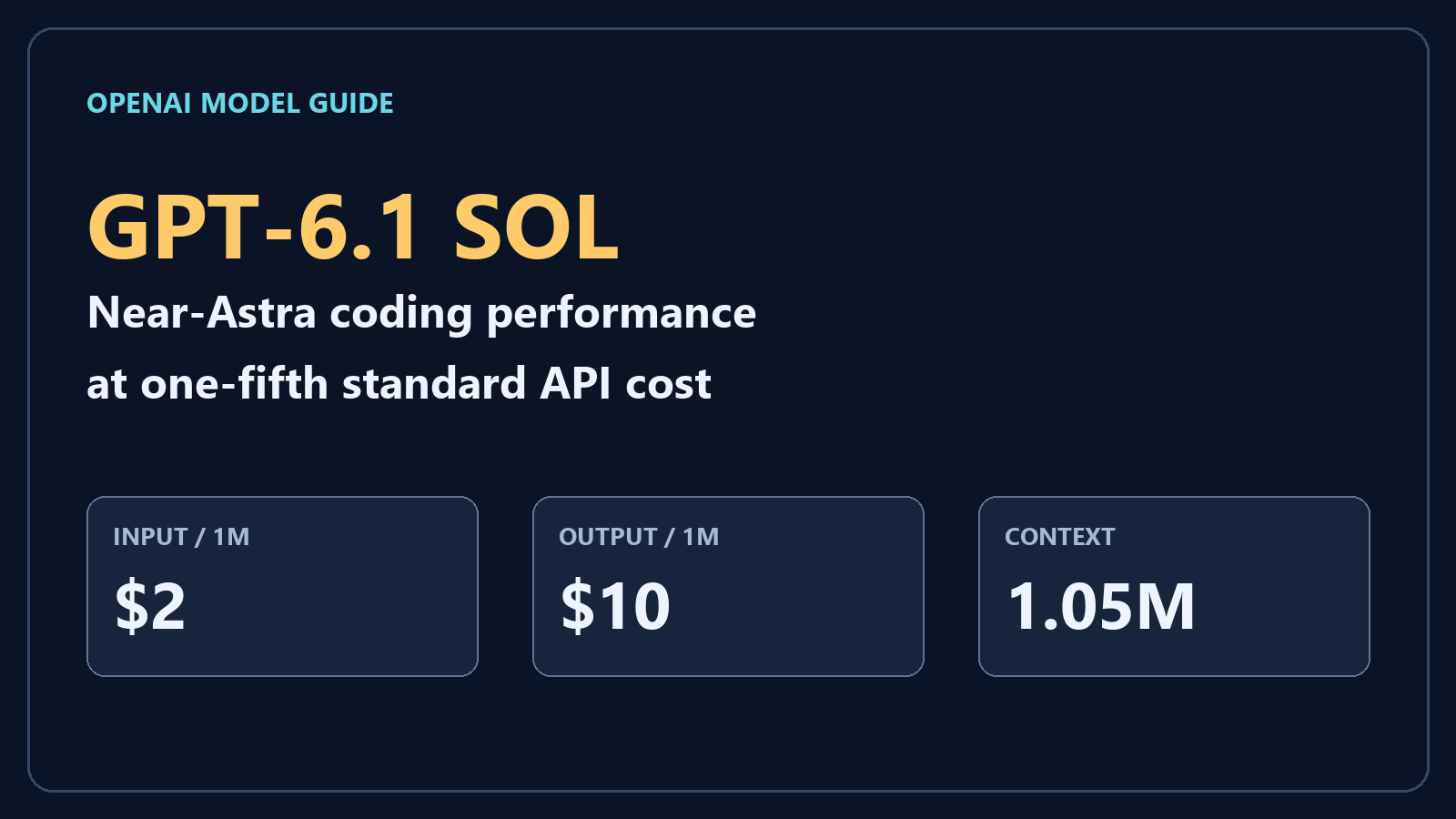
Disruptive Model Economics: GPT-6.1 Sol delivers near-Astra intelligence at an 80% price reduction ($2.00/M input, $10.00/M output, and $0.10/M cached input tokens) while cutting factual hallucinations by 32%.
The $500/Month Pro 500 Tier: Introduces a high-tier subscription with a 25x usage cap multiplier and dedicated Astra Ultrafast allocations for development shops and enterprise builders.
Developer Execution Primitives: The new Agents API enables native Computer Use (operating desktop and browser GUIs), while the Decisions API (Luna) provides rock-bottom deterministic routing.
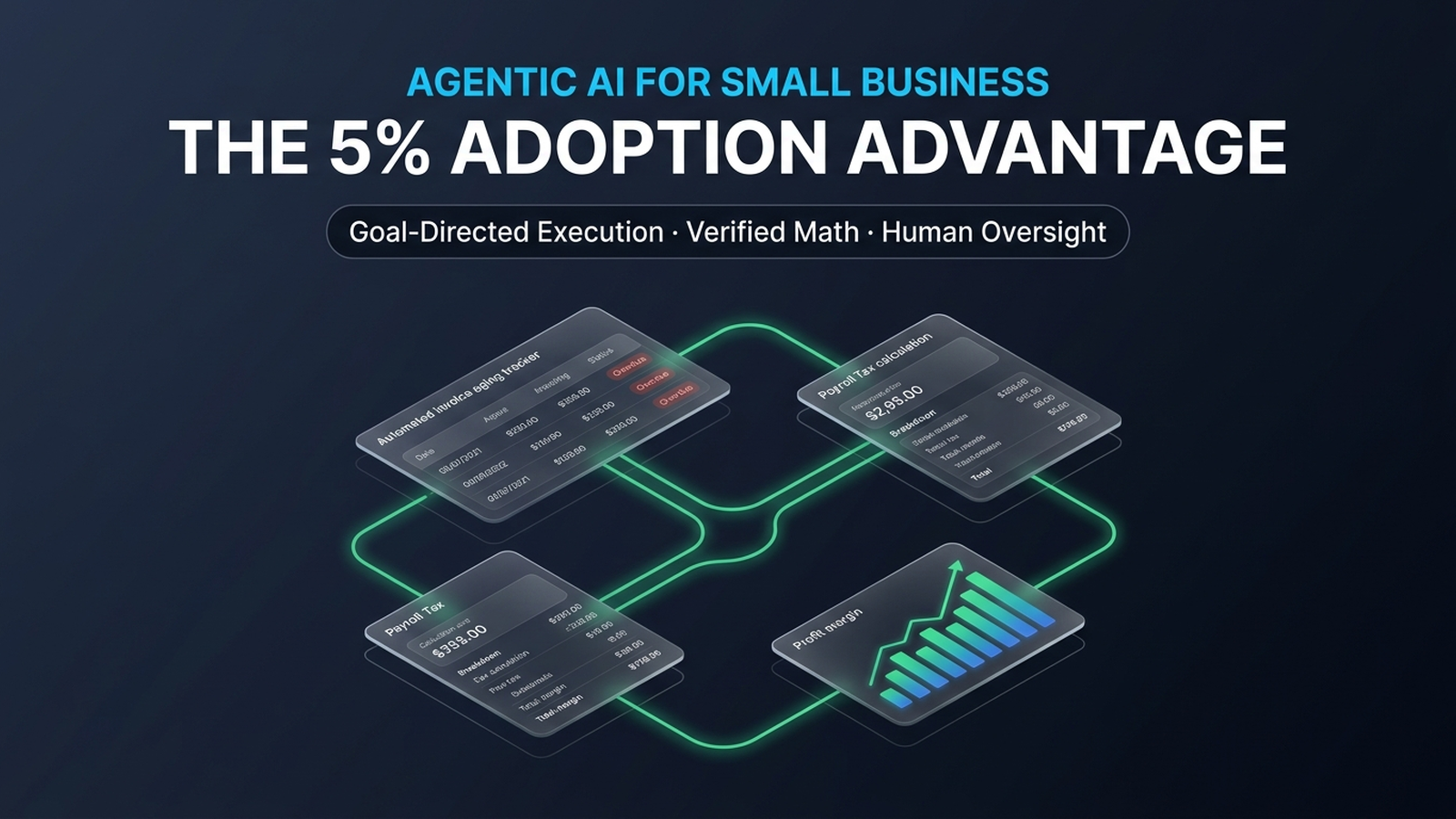
Operator Math Matters: Running recursive agentic loops introduces variable API expenses that can quickly eliminate service margins unless protected by strict unit economics and cost modeling.
OpenAI DevDay 2026 Announcements: Complete Pricing & Feature Breakdown
Product / Feature | Primary Use Case | Target Audience | Availability | Pricing / Token Cost |
|---|---|---|---|---|
OpenAI Dots | Always-on background autonomous task execution | Operators, freelancers, knowledge teams | Pro, Business, Enterprise beta | Included in tier limits; API metered |
GPT-6.1 Sol | Production reasoning, multi-file code refactoring | Developers, software engineering teams | Public API & ChatGPT Pro tiers | $2.00/M input, $10.00/M output ($0.10/M cached) |
ChatGPT Pro 500 | Unrestricted agent usage and dedicated compute | Heavy developers, boutique agencies, power users | General Availability | $500 / month ($6,000 / year) |
Agents API (Computer Use) | GUI automation, screen reading, multi-step actions | System integrators, enterprise developers | Developer Beta | Standard token rates + $0.005 per visual action |
Decisions API (Luna) | Sub-50ms deterministic classification & intent routing | High-throughput backend microservices | Public API | $0.15/M input, $0.60/M output |
Codex Cloud | Asynchronous repository refactoring and automated QA | Engineering leads, DevOps teams | Integrated in ChatGPT Workspace | Included in Pro 500 / Enterprise; API billing |
1. What Are OpenAI Dots? Persistent, Always-On Autonomous Agents
OpenAI Dots are persistent, cloud-hosted autonomous AI agents designed to execute complex, multi-day workflows across web browsers, code repositories, and third-party software applications independently without requiring an active browser tab or user prompt session.
+-----------------------------------------------------------------------------------+
|                            OPENAI DOTS ARCHITECTURE                               |
+-----------------------------------------------------------------------------------+
| [ User Instruction / Webhook ]                                                    |
|        |                                                                          |
|        v                                                                          |
| +-----------------------------------------------------------------------------+   |
| | Persistent Cloud Sandbox Container                                          |   |
| |   +---------------------+  +---------------------+  +-------------------+   |   |
| |   | State Machine Engine|  | Headless Browser GUI|  | Terminal / Python |   |   |
| |   +---------------------+  +---------------------+  +-------------------+   |   |
| +-----------------------------------------------------------------------------+   |
|        |                                              |                           |
|        v                                              v                           |
| [ 4,000+ App Integrations ]              [ Human Escalation Trigger ]             |
| (Salesforce, GitHub, Slack, Gmail)       (Budget Caps, Destructive Actions)       |
+-----------------------------------------------------------------------------------+
For the past four years, interaction with large language models has followed a rigid transactional cadence: submit a prompt, wait for tokens to stream, review the output, and copy-paste the result into an external system. Of all the headline OpenAI DevDay 2026 announcements, the introduction of OpenAI Dots AI agents fundamentally inverts this workflow. Rather than waiting for prompt turns, a Dot is assigned a persistent objective—such as reconciling monthly client accounts receivable, running automated regression suites, or monitoring vendor contract renewals—and works continuously inside a cloud sandbox until the task is complete.
How Dots Differ from Traditional Chatbots and Custom GPTs
Unlike Custom GPTs, which remain passive instructions triggered only when a user types a prompt into a chat window, Dots run inside isolated containerized cloud environments equipped with persistent storage, memory scratchpads, and integrated execution runtimes as detailed in the OpenAI Dots product announcement:
Independent Compute and State Persistence: Dots possess their own headless browser instances, sandboxed Python interpreters, and terminal environments. If a task requires scraping data from forty vendor portals, validating the figures against an internal database, and generating an audit report, the Dot maintains its state over several days, pausing and resuming execution as external jobs complete.
Native Third-Party Application Footprint: At launch, Dots integrate natively with more than 4,000 business applications through OAuth connections and Model Context Protocol (MCP) endpoints. A Dot can read an email in Gmail, extract an attached statement, cross-reference line items against a CRM record in HubSpot, and update a Jira ticket without human copy-pasting.
Event-Driven Execution Triggers: Rather than waiting for manual prompts, Dots can be configured to wake up on specific webhooks, calendar milestones, database alerts, or external API signals.
According to OpenAI CEO Sam Altman during the Fort Mason keynote:
"Astra is our most aligned model yet, built so you can finally hand off ongoing responsibility to an agent without wondering what happened while your laptop was closed."
The Human-in-the-Loop Escalation Model
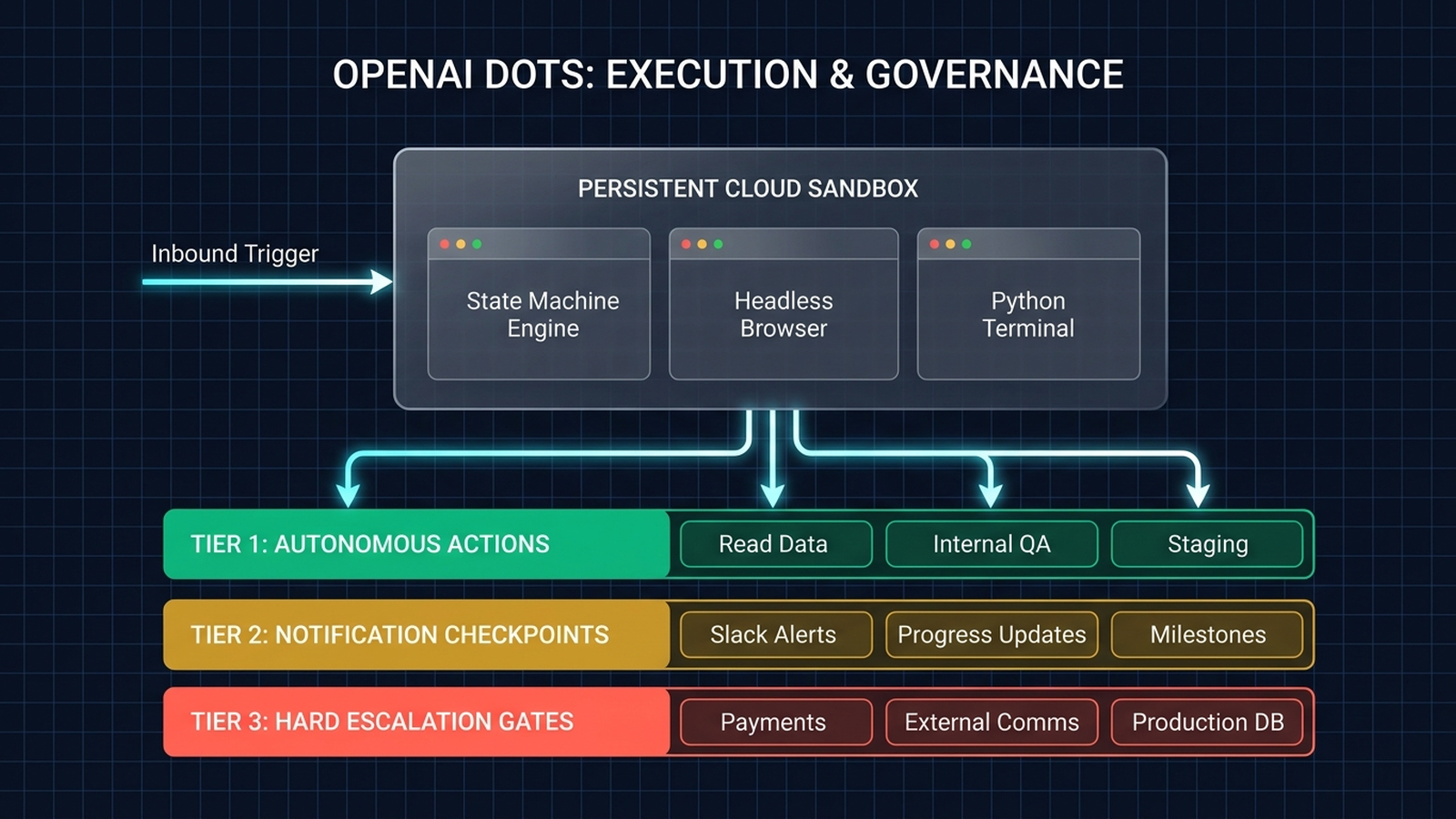
Autonomous execution introduces operational liability. To prevent unauthorized data changes or unintended expenditures, Dots operate on a structured permission ladder. The system classifies actions into three tiers:
Autonomous Actions: Read-only operations, internal data aggregation, drafting communications, running local tests, and staging records.
Notification Checkpoints: Non-destructive external actions (such as sending internal Slack notifications or logging client milestones) that notify the user upon completion.
Hard Escalation Gates: Financial transfers, outbound communications to clients, permanent database deletions, or changing production settings pause the agent and trigger an interactive approval modal across the user's mobile device or desktop.
When deploying automated workflows inside your firm, establishing clear guardrails is essential. Before giving an agentic system unmonitored access to external tools, review how your organization defines billable capacity and oversight using professional services capacity planning.
Mini-Story: The Boutique Agency and the Automated Reconciliation Dot
Last month, Elena, managing partner of a 12-person digital growth agency in Austin, participated in the early beta for OpenAI Dots. She set up a Dot tasked with auditing weekly billable hours across 18 retainer clients, comparing logged contractor timesheets against scope caps in Asana, and generating draft client summaries.
During the first test run, the Dot processed 450 time entries across three systems in 14 minutes, a workflow that previously absorbed 6 hours of an operations associate's Monday morning. However, because the agent ran into an ambiguous client discount rule, it looped through 22 variations of the invoice math, consuming $42 in API tokens before hitting a timeout. Elena realized that while the agent saved 5.5 hours of human administrative labor, her team needed rigid scope boundaries and deterministic rule checks before granting the Dot unmonitored production clearance.
Calculate Your Automation ROI
Want to see if automated agency tools pay off? Calculate your payback period and operational savings before investing in expensive software seats.
Explore our ROI Calculators ->
2. GPT-6.1 Sol: Benchmark Performance and Model Economics from DevDay 2026
Alongside autonomous agents, OpenAI introduced GPT-6.1 Sol, representing the production workhorse tier of the GPT-6 architecture. While frontier models like GPT-6 Astra establish new reasoning milestones for scientific research, Sol is engineered specifically for commercial reliability, high inference throughput, and low token costs. For teams analyzing the full scope of OpenAI DevDay 2026 announcements, GPT-6.1 Sol provides the economic foundation that makes high-volume multi-agent workflows viable.
+-----------------------------------------------------------------------------------+
|                        API TOKEN COST PER 1M TOKENS (USD)                         |
+-----------------------------------------------------------------------------------+
| Model                  | Input Tokens | Output Tokens | Cached Input Tokens       |
| ---------------------- |:-----------: |:------------: |:-------------------------:|
| GPT-6 Astra (Standard) | $10.00       | $50.00        | $2.50                     |
| GPT-6.1 Sol            | $2.00        | $10.00        | $0.10                     |
| Percent Savings        | -80%         | -80%          | -96%                      |
+-----------------------------------------------------------------------------------+
Near-Astra Intelligence at a Fraction of the API Cost
GPT-6.1 Sol bridges the historical performance gap between lightweight "mini" models and expensive flagship engines. In benchmark evaluations published during the OpenAI GPT-6.1 Sol Technical Release:
32% Reduction in Factual Hallucinations: On multi-document comprehension and enterprise legal queries, Sol displayed a 32% lower error rate compared to standard GPT-6 Sol.
Software Engineering Benchmark (SWE-bench Verified): Sol resolved 68.4% of real-world GitHub issues, approaching Astra's 74.2% mark at one-fifth the execution cost.
Complex Instruction Following: Sol achieved an 89.1% score on multi-turn constraint validation, ensuring it adheres strictly to JSON schemas and programmatic outputs.
GPT-6.1 Sol Pricing and Token Economics Breakdown
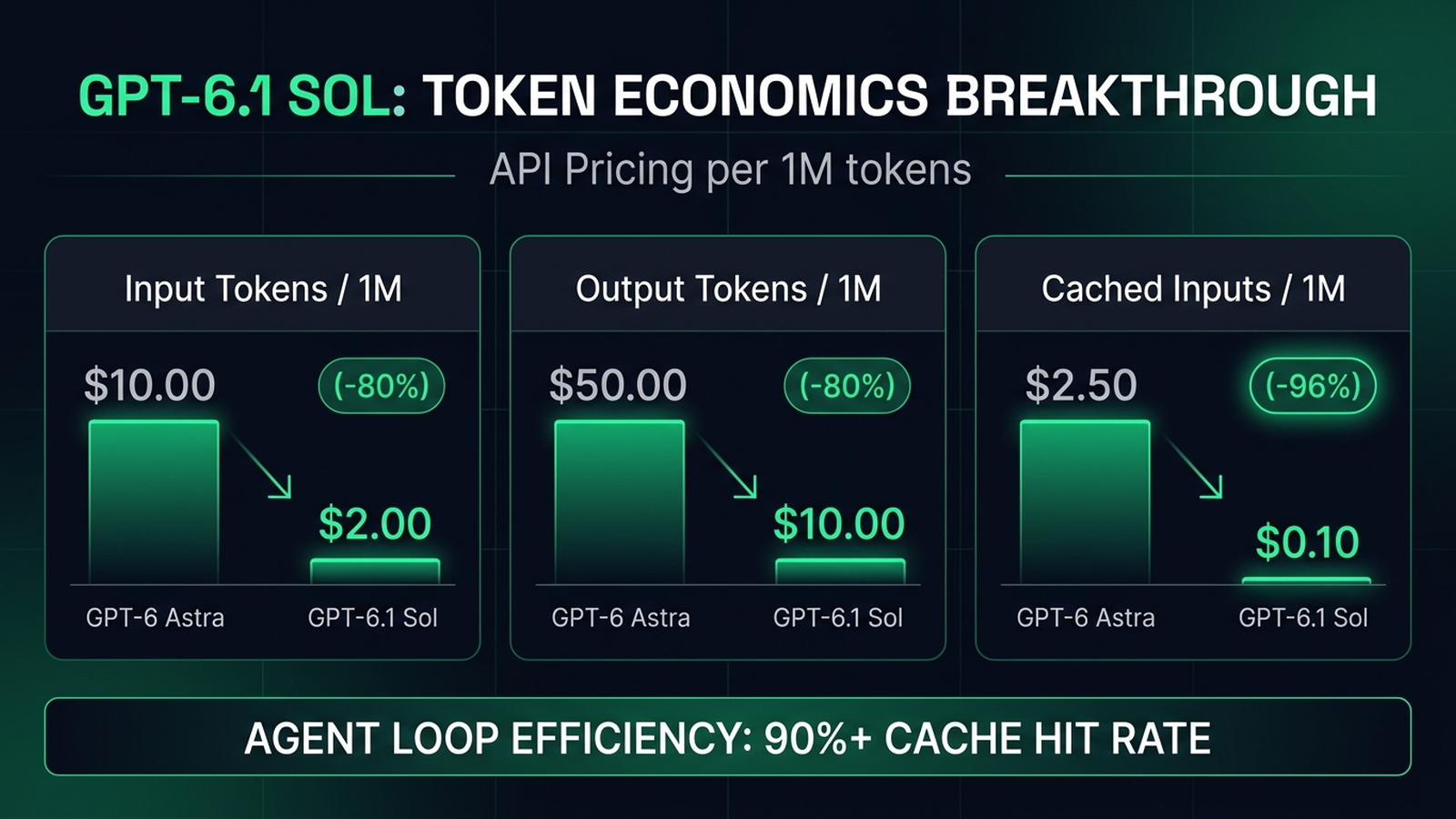
The primary barrier to running multi-agent workflows has historically been token compounding across a large context window. When an agent executes an autonomous loop, it passes the entire history of its environment—browser DOM structures, previous tool responses, and terminal logs—back into the context window with every iterative step.
Under older pricing models, an agent taking 50 sequential steps to complete a research task could consume millions of tokens, generating surprise invoices of $15 to $30 for a single job.
GPT-6.1 Sol addresses this bottleneck through aggressive pricing and advanced prompt caching:
Base Input Tokens: $2.00 per 1,000,000 tokens (an 80% reduction from Astra).
Base Output Tokens: $10.00 per 1,000,000 tokens (an 80% reduction from Astra).
Prompt Caching Advantage: $0.10 per 1,000,000 cached tokens.
The 95% discount on cached input tokens is the critical economic breakthrough for agent developers. Because a persistent agent's system prompt, tool definitions, and baseline environment state remain constant across sequential execution steps, up to 90% of the input payload hits the cache. A continuous agent loop that formerly cost $12.00 to process can now run for less than $0.85.
Codex Ultrafast Inference Tier
In addition to base token discounts, OpenAI introduced the Ultrafast inference tier for GPT-6.1 Sol within Codex and the developer API. Ultrafast delivers 8x higher token generation speeds compared to baseline GPT-6 models. For autonomous coding agents, this drops the round-trip latency of code editing and linting from 18 seconds to sub-2-second bursts, enabling near-instantaneous continuous integration feedback loops.
3. ChatGPT Pro 500 Plan Review: Who Is the $500/Month Tier Actually For?
One of the most debated announcements of DevDay 2026 was the introduction of the ChatGPT Pro 500 subscription plan, priced at $500 per user, per month ($6,000 per user annually).
+-----------------------------------------------------------------------------------+
|                         CHATGPT SUBSCRIPTION TIERS COMPARED                       |
+-----------------------------------------------------------------------------------+
| Tier             | Price / Month | Usage Limits    | Dedicated Compute Access     |
| ---------------- |:------------: |:--------------: |:---------------------------: |
| ChatGPT Plus     | $20           | 1x Baseline     | Standard shared queue        |
| ChatGPT Pro      | $200          | 5x Standard     | Priority Astra reasoning     |
| ChatGPT Pro 500  | $500          | 25x Multiplier  | Dedicated Astra Ultrafast    |
+-----------------------------------------------------------------------------------+
Quota Multipliers and Dedicated Infrastructure
To understand why OpenAI introduced a $500/month tier alongside its existing $20 Plus and $200 Pro plans, operators must examine how agent compute is consumed. Running a fleet of background Dots, continuous Codex Cloud runners, and unrestricted visual Computer Use tasks exhausts standard rate limits within hours.
The Pro 500 tier provides:
25x Usage Cap Multiplier: Enables continuous daily agent execution across multiple active Dots without encountering hourly throttling.
Dedicated Astra Ultrafast Compute Allocation: Guarantees zero-queue access to OpenAI's flagship reasoning infrastructure, even during global peak demand windows.
Priority Computer Use Sandboxes: Allocates dedicated remote virtual machine instances for visual GUI navigation with zero spin-up latency.
Expanded Context Persistence: Retains working memory and sandbox filesystem states across 30-day rolling execution windows.
Cost-Benefit Analysis: Solopreneurs, Agencies, and Startups
Is spending $6,000 annually per seat economically rational for a small business or boutique consultancy? The answer depends entirely on whether the seat substitutes for variable labor or merely subsidizes unfocused experimentation.
 BREAK-EVEN ANALYSIS: PRO 500 SEAT

 Monthly Subscription Cost: $500
 Loaded Cost of Junior Knowledge Worker / Subcontractor: $35 - $65 / hour

 Break-Even Labor Threshold:
 $500 / $45/hr average loaded cost = 11.1 hours of saved labor per month

 +-----------------------------------------------------------------------------+
 | IF the seat saves > 12 hours/month of billable or operational labor:        |
 |  12 hours/month of billable or operational labor:        |
 | --> Net Positive ROI (Proceed with subscription)                            |
 +-----------------------------------------------------------------------------+
 | IF the team uses it primarily for general research and chat inquiries:      |
 |  Net Positive ROI (Proceed with subscription)                            |
 +-----------------------------------------------------------------------------+
 | IF the team uses it primarily for general research and chat inquiries:      |
 | --> Negative ROI (Remain on $20 Plus or switch to direct API billing)       |
 +-----------------------------------------------------------------------------+
For a solo software engineer or an agency technical director, saving 15 to 20 hours of manual boilerplate coding, dependency upgrading, and documentation refactoring per month generates an immediate 300% to 500% return on the $500 fee.
Conversely, for marketing agencies or general service businesses where staff use the interface primarily for copywriting and brainstorming, the Pro 500 seat is excessive capital allocation. Such firms achieve higher gross margins by utilizing purpose-built, deterministic tools or paying for metered API access with GPT-6.1 Sol.
Before committing capital to expensive annual software seats, evaluate your company's investment criteria with our guide on capital budgeting framework for technology.
4. Next-Generation Developer Infrastructure: Agents API, Decisions API, and Codex Cloud
For software engineers and platform builders, DevDay 2026 introduced foundational backend primitives that standardize how applications construct, orchestrate, and govern autonomous agents.
+-----------------------------------------------------------------------------------+
|                         ENTERPRISE AGENT ROUTING PIPELINE                         |
+-----------------------------------------------------------------------------------+
| [ Inbound Client Request / User Trigger ]                                         |
|        |                                                                          |
|        v                                                                          |
| +-----------------------------------------------------------------------------+   |
| | OpenAI Decisions API (Luna - <50ms Routing Engine)                         |   |
| +-----------------------------------------------------------------------------+   |
|   |                           |                               |                   |
|   v                           v                               v                   |
| [ Deterministic Task ]     [ Complex Reasoning ]     [ Visual Desktop UI]         |
| (Fixed Math / Schema)      (GPT-6.1 Sol Engine)      (Agents API Action)          |
|   |                           |                               |                   |
|   v                           v                               v                   |
| +-----------------------------------------------------------------------------+   |
| | Codex Cloud Runner                                                          |   |
| | (Asynchronous Multi-Repo Verification & Testing)                            |   |
| +-----------------------------------------------------------------------------+   |
|        |                                                                          |
|        v                                                                          |
| [ Verified Output Staged to ChatGPT Space / Production Database ]                 |
+-----------------------------------------------------------------------------------+
OpenAI Agents API: Native Computer Use & GUI Navigation
Prior to DevDay 2026, building an agent that could interact with legacy software required complex, brittle third-party browser automation frameworks and visual scraping pipelines. Independent evaluation in the InfoQ DevDay 2026 architecture analysis highlighted how the new Agents API provides native Computer Use capabilities directly through model endpoints:
Visual Desktop Navigation: The model receives screen captures, analyzes UI element hierarchies, calculates screen coordinates, and outputs structured mouse clicks, keyboard keystrokes, and scroll actions.
Context Compaction Engine: The API automatically prunes repetitive visual frames and compresses historical action logs, preventing visual tasks from overflowing token limits.
Built-in Error Recovery: If a button click fails to trigger an expected modal, the Agents API recognizes the interface anomaly, re-reads the screen buffer, and attempts alternative navigation paths without crashing the broader workflow.
As software architect Simon Willison observed in his DevDay 2026 Live Analysis:
"The shift from building conversational interfaces to managing background workers changes the developer contract entirely. You aren't crafting prompt-response turns anymore; you are defining state machines and safety bounds."
The Decisions API Powered by Luna
High-performing enterprise architectures rarely route every user interaction to an expensive multi-billion-parameter reasoning model. Doing so introduces unacceptable latency and inflates operating costs.
To solve this, OpenAI announced the Decisions API, driven by a lightweight, ultra-specialized model named Luna:
Sub-50ms Latency: Designed for instantaneous intent detection, query categorization, and guardrail enforcement.
Constrained Deterministic Outputs: Returns structured classifications (such as selecting one of five workflow routes or evaluating content policy compliance) with zero syntactic variation.
Ultra-Low Cost: Priced at $0.15 per 1M input tokens and $0.60 per 1M output tokens, Luna enables developers to evaluate high-volume inbound events before deciding whether to invoke GPT-6.1 Sol or escalate to human review.
Codex Cloud and Persistent Workspaces
Developer workflows received an infrastructural upgrade through Codex Cloud. Rather than binding code agents to a local machine's terminal, Codex Cloud provisions remote developer containers:
Asynchronous Test and Refactor: An engineer can instruct Codex Cloud to upgrade 30 microservices to a new Node.js LTS release, execute full test suites, and open verified pull requests while the developer's laptop is powered down.
ChatGPT Space: A shared real-time canvas where human team members and active agents collaborate over code diffs, architecture diagrams, and application runtimes using live Model Context Protocol (MCP) data streams.
Mini-Story: The Overnight Multi-Repo Migration
David leads a team of seven backend engineers at a healthcare technology company in Denver. During an internal hackathon following the DevDay announcements, David's team tested Codex Cloud with the Agents API to migrate 34 internal microservices from a legacy authentication protocol to OAuth 2.1.
David initialized the job on Friday at 6:00 PM, assigning an automated Dot with repository access, local build permissions, and an instruction prompt specifying security schemas. Working inside isolated Codex Cloud containers, the agent systematically pulled each repository, updated dependencies, modified endpoint middleware, and executed Docker-based integration tests.
By Saturday morning, the agent had successfully generated 31 clean pull requests with green CI/CD builds. For the remaining 3 repositories where legacy tests failed, the Dot halted, isolated the breaking error log, and tagged David in a dedicated ChatGPT Space thread. The migration, which had been estimated at 120 senior engineering hours ($11,000 in loaded team salary), was completed for $84 in API tokens and 4 hours of human review time.
Protect Your Retainers from Runaway API Costs
Running client projects with heavy agentic API usage? Protect your retainers by tracking direct costs and preserving healthy service delivery margins.
Check your project profit margins ->
5. The Business & Financial Impact: Modeling the True Cost of Agentic AI
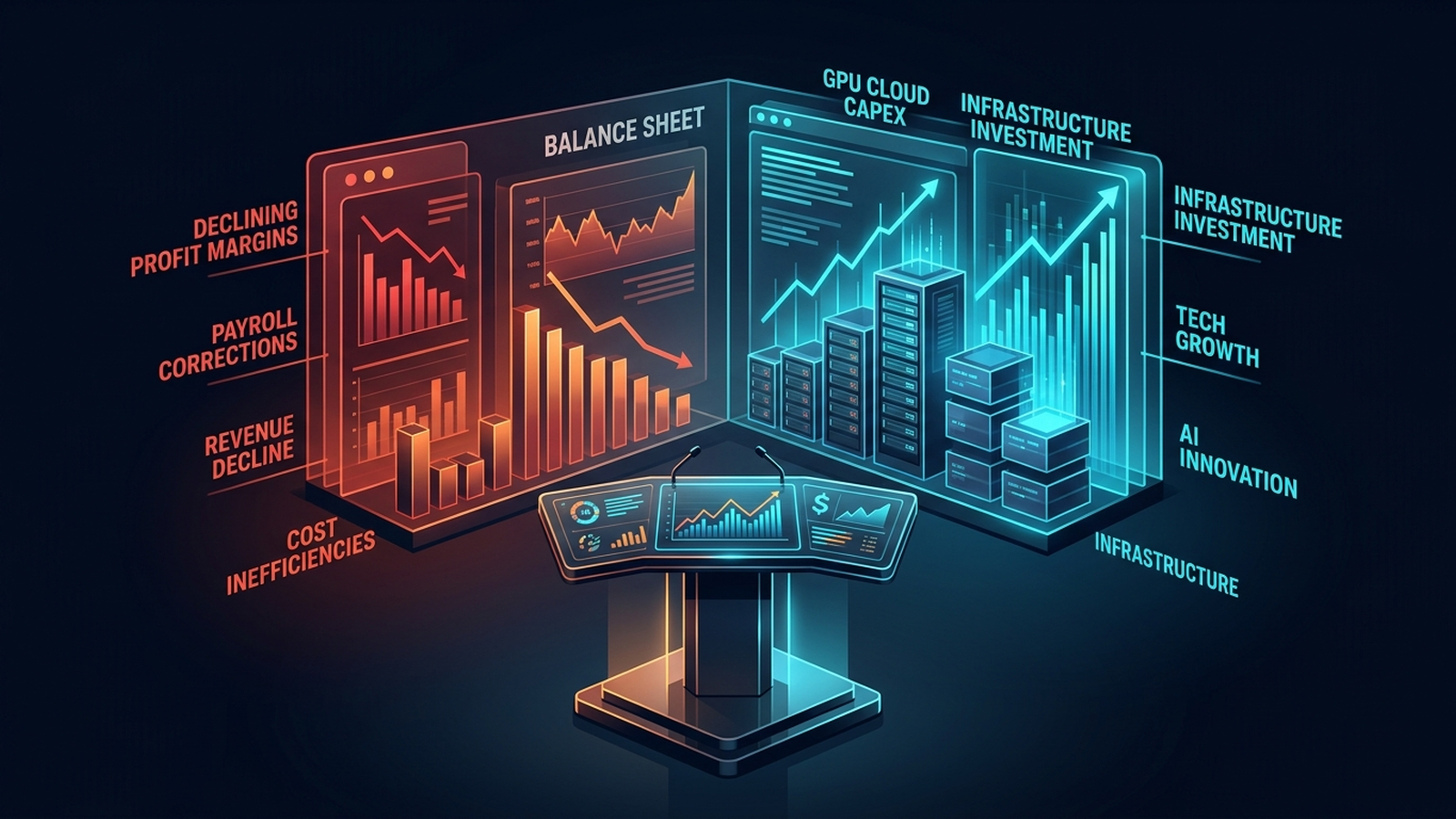
The technical achievements unveiled at DevDay 2026 are impressive, but business leaders must evaluate these capabilities through the lens of unit economics, delivery risk, and profit protection.
+-----------------------------------------------------------------------------------+
|                         THE LOADED COST OF AGENTIC WORKFLOWS                      |
+-----------------------------------------------------------------------------------+
|                                                                                   |
| +-------------------------------------------------------------------------+       |
| | Direct API Token Consumption (Base Input + Output + Visual Actions)     |       |
| +-------------------------------------------------------------------------+       |
|                                    +                                              |
| +-------------------------------------------------------------------------+       |
| | Tool & Infrastructure Overhead (Cloud Containers, Proxies, Vector DBs)  |       |
| +-------------------------------------------------------------------------+       |
|                                    +                                              |
| +-------------------------------------------------------------------------+       |
| | Human Verification Drag (Senior Operator Review, QA, Error Correction)  |       |
| +-------------------------------------------------------------------------+       |
|                                    +                                              |
| +-------------------------------------------------------------------------+       |
| | Error Budget / Remediation (Cost to fix corrupted records or bad code)  |       |
| +-------------------------------------------------------------------------+       |
|                                    =                                              |
| +-------------------------------------------------------------------------+       |
| | TRUE LOADED OPERATIONAL COST                                            |       |
| +-------------------------------------------------------------------------+       |
+-----------------------------------------------------------------------------------+
Calculating the Loaded Operating Cost of Autonomous Workflows
Many teams assume that replacing human tasks with AI agents immediately cuts operational costs by 90%. In practice, calculating the true loaded cost of an agentic workflow requires modeling four distinct expense layers:
Direct API Token Consumption: The baseline cost of prompt tokens, generated tokens, cached inputs, and GUI visual snapshots processed during the task.
Infrastructure and Environment Overhead: Cloud sandbox hosting fees, dedicated IP proxies for web scraping, and database persistence layers required to support persistent Dots.
Human Verification Drag: The time required for a qualified professional to inspect, validate, and approve the agent's work. If an agent drafts a legal brief in 3 minutes but requires 45 minutes of partner review to check for subtle hallucinations, the labor savings are significantly smaller than headlines suggest.
Error Remediation Budget: The financial reserves required to audit and repair systems when an agent acts on incorrect assumptions or executes an erroneous action across third-party software.
Unit Economics and Margin Considerations for Service Firms
For service businesses, digital agencies, and IT consultancies, the rise of agentic tools like Dots fundamentally disrupts traditional billing models. If an agency bills clients on time-and-materials, completing tasks 8x faster using GPT-6.1 Sol directly reduces billable revenue unless contracts transition to value-based or fixed-fee pricing.
Furthermore, agencies must decide how to handle client-specific API token consumption. If your team manages marketing campaigns across 25 client accounts using autonomous Dots, a sudden surge in recursive agent tool calls can unexpectedly erode client profitability.
To maintain healthy operations:
Separate Variable API Fees from Service Retainers: Pass third-party token and compute costs directly through to clients, or build an explicit software allowance into monthly service agreements.
Audit Contribution Margins Quarterly: Continuously monitor the gross profit remaining on each client account after deducting direct labor and API usage expenses.
Establish Hard Budget Controls: Use OpenAI's organizational spend caps and Decisions API routing to prevent runaway background loops from running up unmonitored bills.
To structure your pricing model effectively and prevent cost misunderstandings, consult our guide on gross margin vs markup for pricing.
Mini-Story: Managing the "Infinite Loop" Cash Drain
Marcus operates an e-commerce automation consultancy that builds inventory forecasting models for Shopify merchants. Excited by the announcement of the Agents API and Computer Use, his team deployed an experimental agent designed to log into supplier portals, extract weekly freight rates, and adjust retail pricing rules.
On the third day of deployment, a supplier portal introduced an unannounced CAPTCHA check. Unable to resolve the challenge, the agent entered an unconstrained retry loop, taking visual screen captures and querying GPT-6.1 Sol every 12 seconds. By the time Marcus reviewed his billing dashboard on Monday morning, the single runaway agent had processed over 24,000 visual inference steps, racking up $680 in API charges on a client contract that generated only $1,500 in monthly retainer revenue.
Marcus immediately implemented strict operational safeguards: a maximum execution budget of $15 per agent session, hard timeout limits, and a Decisions API pre-check that alerted a human supervisor whenever an unexpected UI barrier appeared.
6. Watch the OpenAI DevDay 2026 Announcements: Keynote Stream
To see the live demonstrations of OpenAI Dots, Codex Cloud, and the Agents API in action, watch the OpenAI DevDay 2026 Keynote Live broadcast from Fort Mason in San Francisco, showcasing persistent background agents and developer infrastructure updates.
7. Frequently Asked Questions About OpenAI DevDay 2026 Announcements
How much does OpenAI's Pro 500 plan cost, and what is included?
The ChatGPT Pro 500 plan costs $500 per month ($6,000 per year per user). It includes a 25x usage cap multiplier over standard ChatGPT Plus limits, dedicated queue-free access to Astra Ultrafast compute cycles, continuous execution allowances for persistent OpenAI Dots, priority sandboxes for Computer Use, and extended 30-day workspace state retention.
What is the primary difference between OpenAI Dots and Custom GPTs?
Custom GPTs are static, prompt-driven instructions that execute only when a user interacts with them inside an active chat session. OpenAI Dots are autonomous, cloud-hosted agent instances that operate independently in persistent sandbox containers. Dots can run continuously across days, interact with 4,000+ third-party tools via API and GUI automation, execute code, and pause for human approval without an active browser tab.
How does GPT-6.1 Sol compare to GPT-6 Astra in speed and pricing?
GPT-6.1 Sol is designed for high-throughput production workloads, priced at $2.00 per 1M input tokens and $10.00 per 1M output tokens (an 80% discount compared to Astra's $10/$50 rates). In addition, Sol offers prompt caching at $0.10 per 1M tokens (a 95% discount) and features an Ultrafast inference mode within Codex that generates tokens up to 8x faster than standard frontier models.
Can OpenAI Dots execute tasks while my computer is turned off?
Yes. Because Dots run inside OpenAI's isolated cloud infrastructure rather than on your local machine, they continue executing background tasks, monitoring webhooks, running code suites, and orchestrating workflows even when your computer is shut down or offline. Critical decisions or destructive actions can be set to pause and notify your mobile device for confirmation.
How does the Decisions API improve application reliability?
The Decisions API uses a specialized, lightweight model called Luna to deliver sub-50ms deterministic classifications at $0.15 per 1M input tokens. It enforces rigid schema conformity without output variation, enabling developers to route inbound user requests, enforce security policies, and evaluate workflow logic reliably before invoking heavier, more expensive reasoning models like GPT-6.1 Sol.
Conclusion: Turning DevDay Announcements into Practical Operating Strategy
The OpenAI DevDay 2026 announcements confirm that the era of simple conversational chatbots has evolved into the era of persistent autonomous background agency. For ambitious operators, the arrival of OpenAI Dots, GPT-6.1 Sol, and the Agents API unlocks unprecedented leverage, enabling small, agile teams to deliver the operational output of organizations three times their size.
However, technical capability must always be balanced against commercial discipline. Subscribing to high-ticket $500 monthly plans or granting autonomous agents unrestricted access to third-party APIs without governance introduces real financial risk. Sustainable growth requires modeling unit economics, establishing clear verification workflows, and treating AI agents as operational investments that must demonstrate measurable payback.
Before committing capital or restructuring client agreements around autonomous systems, outline your assumptions, labor projections, and technology costs using our AI business plan generator and test your break-even horizon with our financial calculation methodology.