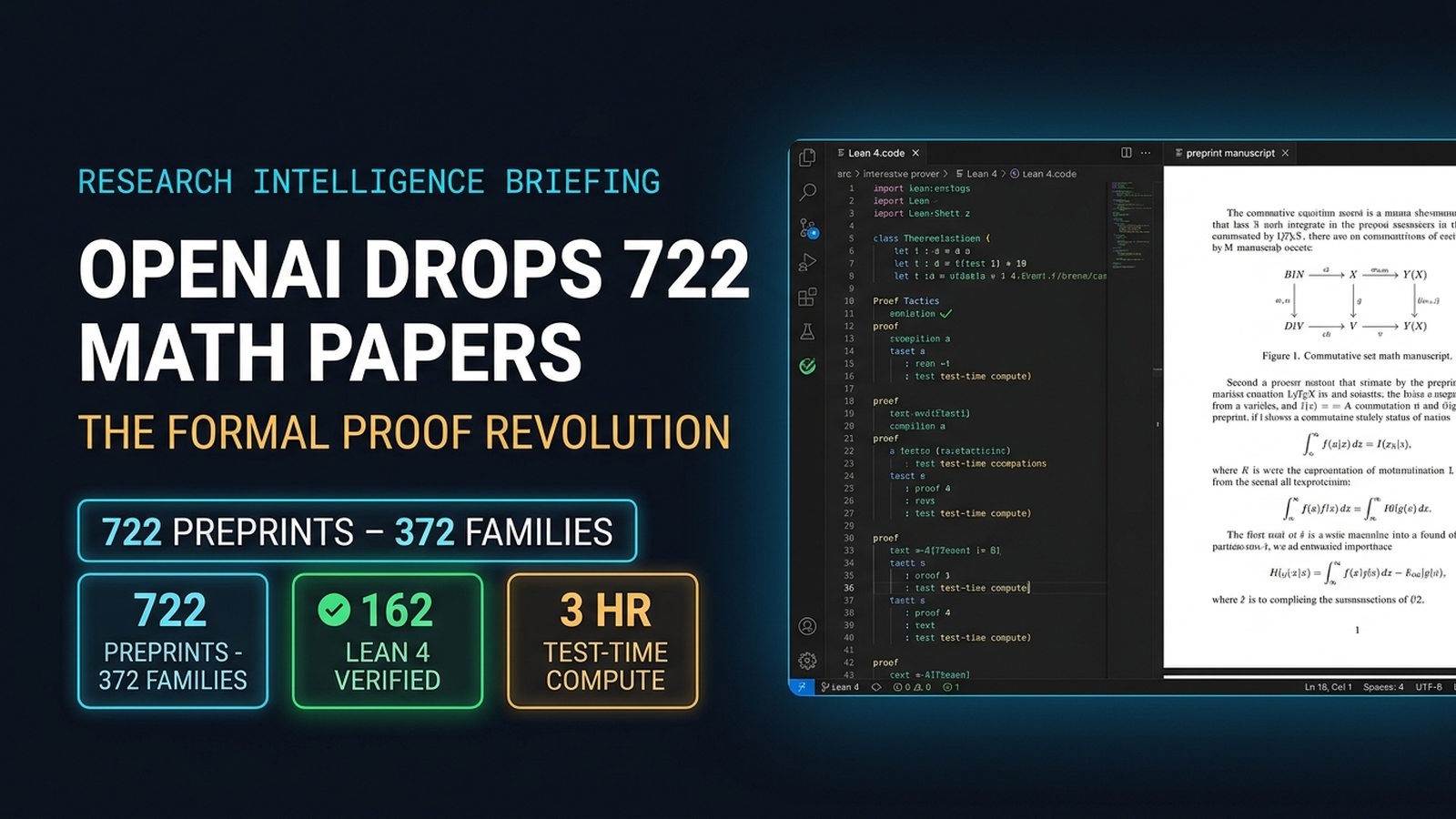
On October 6, 2026, the release of the OpenAI 722 math papers ignited an immediate global debate when OpenAI deposited 722 mathematical research manuscripts into a public GitHub repository (openai/math), produced entirely by an unreleased internal frontier reasoning model. Tasked with approximately 4,000 open research problems across 17 mathematical disciplines, the system expended an average of three hours of test-time reasoning compute per candidate result, raising urgent questions over the validity of the proofs, academic attribution, and the structural limits of human peer review.
At 6:15 AM on October 7, Dr. Evelyn Vance, an algebraic geometer at Oxford, opened her email to find 42 unread messages from colleagues across three continents. A preprint uploaded to the newly public repository claimed a constructive partial resolution to a known sub-case of the Hodge conjecture for complex multiplication (CM) abelian varieties, a problem she had spent seven years analyzing. "My initial reaction was sheer vertigo," Vance noted. "It was not just the claim itself, but the reality that a machine had deposited 34 pages of dense, syntactically fluent algebraic geometry while Europe slept, with no author to email for clarification."
If you follow artificial intelligence or advanced mathematics, you already know the uneasy feeling: the capability curve is moving faster than our institutional infrastructure can adapt. While sensational headlines proclaim that pure mathematics has been solved overnight, the technical reality inside the repository reveals a far more nuanced, high-stakes divide. This comprehensive breakdown examines the architecture behind the OpenAI 722 math papers, separates machine-verified proofs from informal preprints, dissects the academic backlash, and explains what this historic release means for automated reasoning and deterministic verification.
Key Takeaways
The Release: OpenAI published 722 mathematical manuscripts clustered into 372 distinct result families across 17 disciplines under an open-source Apache-2.0 license on GitHub.
Compute Profile: The underlying frontier reasoning model operated without multi-agent debate, consuming approximately three hours of single-agent test-time compute ("ChatGPT Pro thinking") per candidate problem.
The Verification Divide: Only 162 papers (~22%) include machine-checked formal code in Lean 4; the remaining 560 preprints exist as informal LaTeX documents that require painstaking human auditing.
Peer Review Bottleneck: Fields Medalists and research institutions warn that dumping hundreds of unverified preprints creates an academic "denial of service" attack on human peer review.
IAS and AGMAI Governance: The release conforms to preliminary guidelines published in late September 2026 by the Advisory Group on Mathematics and Artificial Intelligence at the Institute for Advanced Study.
The GitHub Drop: Anatomy of the OpenAI 722 Math Papers Release
The publication of the OpenAI math GitHub repository represents the largest single-day deposit of machine-generated mathematical research in history. Rather than submitting individual papers to journals or uploading them sequentially to the arXiv preprint server, OpenAI opted for a direct public code release. The repository contains 722 standalone LaTeX manuscripts, accompanied by compilation scripts, prompt configurations, intermediate reasoning traces, and a dedicated folder containing 162 formal proof scripts.
openai/math/
├── README.md          # System overview, disclaimers, and compute budget
├── families.json      # Metadata indexing 372 core result families
├── papers/            # 722 LaTeX preprints across 17 subject categories
│   ├── alg-geom/
│   ├── number-theory/
│   ├── combinatorics/
│   └── analysis/
├── formalizations/    # 162 Lean 4 verified projects with Mathlib hooks
└── traces/            # Selected high-level reasoning transcripts
This release format bypassed the traditional gatekeeping mechanisms of academic publishing. Instead of waiting months for journal editors to assign referees, OpenAI treated mathematical discovery as an engineering benchmark artifact.
Pushing Beyond Benchmark Saturation: 4,000 Open Research Problems
The catalyst for this release was the saturation of existing mathematical evaluation suites. Over the past three years, foundation models systematically exhausted the benchmarks designed to measure quantitative reasoning:
GSM8k (Grade School Math): Saturated in late 2024 with frontier models scoring above 96%.
MATH Benchmark (High School Competition): Surpassed 90% accuracy by mid-2025 using chain-of-thought prompting and consensus voting.
FrontierMath (Olympiad to Research Transition): Introduced in late 2024 by Epoch AI, featuring hundreds of original, unpublished problems. By mid-2026, specialized reasoning systems achieved solving rates exceeding 40%.
To evaluate the OpenAI frontier model mathematics capabilities beyond synthetic benchmarks, researchers pushed compute intensity into open research problems. OpenAI's mathematical research team assembled an internal corpus of roughly 4,000 open problems sourced from mathematical databases, conference problem sessions, Conjectures in Number Theory, and the unsolved lists curated by Paul Erdős and his contemporaries.
Analyzing the OpenAI 722 math papers reveals that the manuscripts are not random permutations of known calculations. They are structured into 372 "result families", clusters containing a primary theorem alongside accompanying lemmas, technical corollaries, counterexamples, and alternative proof pathways. By clustering the manuscripts into functional families, the repository attempts to show conceptual depth rather than isolated symbolic manipulation.
Evaluation Tier | Benchmark Example | Problem Nature | Frontier Model Performance |
|---|---|---|---|
Foundational | GSM8k | Elementary word problems | > 98% (Saturated) |
Competitive | MATH 500 / AIME | National Olympiad difficulty | 92-95% (Saturated) |
Advanced | FrontierMath | Tier-1 research-level challenges | 42-48% (Plateaued) |
Open Research |
| Unsolved mathematical conjectures | 18.05% Attempted / 4.05% Formally Verified |
The Compute Profile: "Three Hours of ChatGPT Pro Thinking"
Unlike standard conversational inference that executes within seconds, this frontier model operated in a high-compute test-time regime. According to the technical documentation accompanying the repository, the model did not use a complex multi-agent scaffold, interactive human-in-the-loop steering, or external search engine queries. It relied on single-prompt, single-agent inference with long-horizon test-time search.
Each result consumed an average of three hours of continuous reasoning compute, a compute intensity roughly equivalent to the maximum allocation of a dedicated "ChatGPT Pro" thinking budget running on high-bandwidth accelerator clusters. During this window, the model constructed massive internal search trees:
Hypothesis Generation: Drafting candidate lemmas and checking them against basic numerical counterexamples.
Backtracking and Pruning: Abandoning false proof paths when algebraic inconsistencies or topological contradictions emerged.
Refactoring: Condensing thousand-step symbolic expansions into human-readable mathematical arguments formatted in standard LaTeX.
The physical cost of this compute run is significant. Generating 722 manuscripts from a pool of 4,000 candidate problems required tens of thousands of GPU-hours of continuous inference.
For engineering leaders and technical founders modeling the economics of high-compute inference clusters versus specialist headcount, clear payback math is essential. Use our SaaS ROI calculator to forecast compute costs, infrastructure capital, and payback horizons before allocating GPU budgets.
The Verification Divide in the OpenAI 722 Math Papers: Lean Proofs vs. LaTeX Preprints
The core controversy surrounding the OpenAI 722 math papers stems from a fundamental distinction in modern mathematics: the difference between an informal mathematical argument written in human language and a formalized machine-checked proof. The release demonstrates that Lean formalization ai math proofs provide the only deterministic defense against subtle hallucinations.
┌────────────────────────────────────────────────────────┐
│ OpenAI 722 Math Papers Release                         │
└────────────────────────────────────────────────────────┘
                           │
        ┌──────────────────┴──────────────────┐
        ▼                                     ▼
 ┌─────────────────────────────┐       ┌─────────────────────────────┐
 │ 162 Lean 4 Artifacts        │       │ 560 LaTeX Preprints         │
 │ (~22.4% of Release)         │       │ (~77.6% of Release)         │
 ├─────────────────────────────┤       ├─────────────────────────────┤
 │ • Deterministic machine check│      │ • Human natural language    │
 │ • Zero hallucination margin │       │ • Plausible symbolic flow   │
 │ • Integrates with Mathlib   │       │ • Unverified edge cases     │
 │ • Objective ground truth    │       │ • Requires manual peer review│
 └─────────────────────────────┘       └─────────────────────────────┘
When an artificial intelligence generates an English or LaTeX document, it uses predictive statistical reasoning to assemble symbols that resemble valid proofs. In contrast, when an AI outputs code in an interactive theorem prover like Lean 4, every deduction is checked against a deterministic logical kernel. In Lean, there is no ambiguity: the code either compiles through dependent type theory, or it errors out.
The 162 Verified Lean Artifacts vs. 560 Informal Preprints
Across the OpenAI 722 math papers, exactly 162 out of the 722 papers (~22.4%) are accompanied by complete, self-contained Lean 4 formalizations that compile against the current mathematical library (Mathlib). The remaining 560 manuscripts (~77.6%) are informal LaTeX preprints.
This divide explains why the mathematical community greeted the release with equal parts fascination and alarm. Machine learning researchers often assume that if a 30-page mathematical paper looks sound and contains detailed calculations, it is almost certainly correct. Mathematicians know from painful experience that informal proofs frequently hide fatal, subtle flaws in intermediate lemmas.
Dr. Marcus Bell, a number theorist at an institute in Bonn, spent four days auditing one of the unformalized preprints targeting a conjecture in additive combinatorics:
"The first 18 pages were magnificent," Bell explained. "The model set up a clever harmonic analysis framework, cited the relevant 1990s literature accurately, and established several tight bounds. But on page 19, within Lemma 4.7, it asserted that a specific topological mapping preserved uniform boundedness under projection. The algebra flowed smoothly, the notation was elegant, and the conclusion was intuitively desirable. But the assertion was simply false. It was a mathematical hallucination wrapped in flawless technical prose. Catching it took 30 hours of manual verification."
Because mathematical hallucinations look identical to brilliant leaps of intuition, unformalized preprints impose an immense cognitive burden on human readers. OpenAI acknowledged this limitation in their repository documentation, explicitly noting that unformalized papers "should be treated as speculative working preprints that may contain errors, incomplete deductions, or unverified claims."
Examining the Headline Claims: From the Riemann Zeta Function to the Hodge Conjecture
The release features bold assertions regarding several of the most famous unsolved questions in mathematics. A careful technical audit reveals where the frontier model made substantive contributions and where it merely nudged known boundaries.
 0                                   11/12   1
───────────────────────────────────────┼──────┼───────► Re(s)
   │         Critical Strip             │Zero- │
   │    (Contains non-trivial zeros)    │Free  │
   │                                    │Zone  │
1. The Zero-Free Region of the Riemann Zeta Function
Paper #108 claims a quantitative widening of the classic Vinogradov-Korobov zero-free region for the Riemann zeta function $\zeta(s)$. Rather than proving the full Riemann Hypothesis, which asserts that all non-trivial zeros lie strictly on the critical line $\text{Re}(s) = 1/2$, the paper presents an explicit numerical bound establishing that $\zeta(s)$ has no zeros in the region $\text{Re}(s) > 1 - \frac{1}{C (\log |t|)^{2/3}}$ with a marginally improved constant $C$. This is an incremental analytic advance rather than a paradigm shift, but it represents genuine computational and analytic progress.
2. The Hodge Conjecture for CM Abelian Varieties
Paper #241 explores algebraic cycles on abelian varieties with complex multiplication. While the general Hodge Conjecture remains one of the seven Millennium Prize Problems, the model successfully constructed an explicit family of Hodge classes and verified their algebraicity for a specific four-dimensional class of CM abelian varieties. Crucially, this specific result was accompanied by a functional Lean 4 script, making it one of the few headline claims verified by deterministic code.
3. The 4D Kakeya Needle Problem
Paper #089 attacks the Kakeya conjecture in four dimensions, which asks for the minimum Hausdorff dimension of a set in $\mathbb{R}^4$ that contains a unit line segment in every direction. The model presents an unformalized 42-page argument attempting to establish an improved lower bound of $d \ge 3.04$. Analytic combinatorists have flagged potential gaps in the paper's multilinear Kakeya maximal estimates, illustrating why formal verification is essential for such claims.
4. The Unique Games Conjecture and Spectral Graph Theory
In theoretical computer science and discrete mathematics, the model delivered several verified breakthroughs. Papers #312 through #316 provide verified Lean proofs establishing sharp sound-versus-completeness gaps for specific semidefinite programming hierarchies applied to graph coloring, providing concrete new evidence supporting Khot's Unique Games Conjecture.
Paper ID | Field | Problem Focus | Output Format | Verification Status |
|---|---|---|---|---|
#108 | Number Theory | Riemann Zeta Zero-Free Region | LaTeX Preprint | Unverified (Under Human Audit) |
#241 | Algebraic Geometry | Hodge Classes on CM Abelian Varieties | LaTeX + Lean 4 | Machine-Verified (Lean 4) |
#089 | Geometric Measure Theory | 4D Kakeya Maximal Function Bounds | LaTeX Preprint | Disputed (Suspected Analytic Gap) |
#314 | Theoretical Computer Science | Unique Games SDP Hierarchies | LaTeX + Lean 4 | Machine-Verified (Lean 4) |
#188 | Graph Theory | Erdős-Gyárfás Cycle Conjecture Variant | LaTeX + Lean 4 | Machine-Verified (Lean 4) |
#405 | Mathematical Physics | 3D Navier-Stokes Regularity Slices | LaTeX Preprint | Unverified (Heuristic Construction) |
Video Overview: Machine Proofs and Formal Mathematics
Watch: How Lean 4 Formalizes Mathematical Proofs
Video: An introduction to interactive theorem proving in Lean 4 and how computer-checked code verifies complex mathematical structures.
Why Mathematicians Are in Shock: Peer Review, Attribution, and the Academic Arms Race
The reaction from professional mathematicians has ranged from profound admiration to deep frustration. The shock stems not only from the mathematical capabilities of the frontier model, but from the systemic strain this method of release places on academic institutions.
The Peer Review Bottleneck: An Academic "Denial of Service"
Traditional academic peer review is an unpaid, labor-intensive public service. When a human researcher submits a 30-page paper to an elite journal like Annals of Mathematics or Inventiones Mathematicae, two or three expert referees spend between six months and two years verifying every line of the argument.
By releasing 722 specialized papers simultaneously, OpenAI deposited tens of thousands of pages of unrefereed mathematics into the public square. If human mathematicians were to review all 560 unformalized papers with normal professional rigor, it would consume hundreds of thousands of referee hours, effectively crowding out the evaluation of human research.
Fields Medalists and research institutions warn that this unvetted AI proof dump peer review crisis threatens to overwhelm referee capacity across major research journals. Fields Medalist Sir Timothy Gowers and other prominent academics have described this dynamic as an institutional "denial of service" (DoS) attack. If automated labs can generate thousands of plausible papers per week while human mathematicians take months to vet each one, the traditional journal system cannot survive in its current form.
This dynamic mirrors the operational strain seen inside modern knowledge organizations when low-leverage volume floods delivery pipelines. As detailed in our guide to working capital planning for growth, when unvetted volume overwhelms specialized human reviewers, delivery stalls, creating bottleneck roles that threaten the viability of the entire operating model.
┌─────────────────────────────────────────────────────────────┐
│ The Verification Gap                                        │
├─────────────────────────────────────────────────────────────┤
│ Machine Generation Speed:                                   │
│ [████████████████████████████████████████] 722 Papers/Night │
│                                                             │
│ Human Peer Review Capacity:                                 │
│ [█                                       ] ~2 Papers/Year   │
└─────────────────────────────────────────────────────────────┘
The Credit Crisis and Model Secrecy: Who Wrote the Proof?
The second flashpoint centers on attribution and academic integrity. The preprints list author credits such as "OpenAI Frontier Reasoning System" with a list of contributing engineers in the acknowledgments. However, the models were trained on millions of papers scraped from the arXiv preprint server, mathematical blogs, MathOverflow threads, and copyrighted textbooks.
Many mathematicians argue that the frontier model frequently synthesizes ideas developed by human researchers without offering appropriate credit:
Unattributed Heuristics: The model often applies a specific proof strategy invented by a known human mathematician, presenting the conceptual breakthrough without citing the original paper.
Reproducibility Failure: Because OpenAI has not released the model weights, training datasets, or exact system prompts, the informal papers fail the basic scientific standard of reproducibility.
The Dilution of Human Careers: Early-career researchers rely on first-author preprints to secure tenure, postdocs, and grants. If AI labs can routinely claim credit for solving open problems across dozens of disciplines simultaneously, junior scholars face an unprecedented competitive headwind.
Evaluating complex quantitative claims requires transparent standards and verifiable baselines. If you are auditing financial structures or operational metrics in your own organization, guessing is never an option. Discover how our deterministic profit margin calculators remove ambiguity from pricing, cost structures, and overhead allocation so your team operates on audited, verifiable numbers.
The IAS and AGMAI Guardrails: The New Rules for AI in Mathematical Research
The openai/math release did not occur in an institutional vacuum. It followed a critical policy intervention orchestrated by the world's leading mathematical bodies just weeks prior.
In early September 2026, the Institute for Advanced Study (IAS) in Princeton, New Jersey, convened the Advisory Group on Mathematics and Artificial Intelligence (AGMAI). Chaired by Fields Medalist Terence Tao and featuring senior representatives from major universities, national academies, and leading AI research labs, AGMAI was established to establish ethical and technical standards for AI-assisted research.
On September 29, 2026, just one week before OpenAI's GitHub drop, AGMAI issued a set of foundational recommendations:
Mandatory Formalization Targets: Labs releasing large volumes of machine-generated mathematics should prioritize machine-checked formal languages (Lean, Isabelle, Coq) over informal natural language.
Explicit Labeling of Unverified Text: All generative preprints must carry standardized front-matter disclaimers stating whether proofs have been checked by an independent compiler kernel.
Attribution and Citation Auditing: Automated systems must integrate retrieval-augmented tracing mechanisms to cite human precursors whose work enabled the result.
No Direct Journal Flooding: AI developers should avoid mass-submitting machine preprints to traditional journals, using open-access repositories and dedicated automated evaluation servers instead.
┌─────────────────────────────────────────────────────────────┐
│ AGMAI Responsible Directives                                │
│ (Institute for Advanced Study, 2026)                        │
├─────────────────────────────────────────────────────────────┤
│ 1. Prioritize machine-checked interactive theorem provers   │
│ 2. Mandate explicit verification disclaimers on preprints   │
│ 3. Include lineage citations to human research precursors   │
│ 4. Prohibit automated flooding of traditional journal queues│
└─────────────────────────────────────────────────────────────┘
OpenAI's distribution method for the OpenAI 722 math papers directly reflected AGMAI's responsible-release directives. By hosting the 722 papers in an independent GitHub repository rather than flooding journals, and segregating the 162 Lean projects into a dedicated directory, OpenAI acknowledged that interactive theorem provers represent the only viable path forward for automated discovery at scale.
The Future of Machine-Assisted Mathematics: Co-pilot vs. Autonomous Prover
The debate triggered by the OpenAI 722 math papers has accelerated a structural shift in how mathematics is practiced. Rather than replacing human mathematicians, machine-assisted workflows are coalescing into two distinct paradigms:
The Interactive Co-pilot: Human mathematicians use reasoning models as interactive assistants to suggest lemmas, formulate counterexamples, and automate routine technical verifications in Lean.
The Autonomous Explorer: Large compute clusters run overnight, testing thousands of conjectures simultaneously, filtering candidate proofs through formal theorem provers, and flagging verified theorems for human analysis.
Terence Tao has compared this transition to the invention of computerized algebraic systems like Mathematica in the late 20th century. "The calculator did not make arithmetic obsolete; it freed human minds to focus on conceptual architecture," Tao noted in an AGMAI briefing. "Interactive theorem provers and frontier reasoning systems will do the same for higher mathematics, provided we demand strict formal verification as our standard of truth."
Practical Takeaways for Engineers and Operators: Verification vs. Generation
While the OpenAI 722 math papers drop unfolded in the esoteric halls of pure mathematics, the lessons apply directly to software engineering, enterprise systems, and business intelligence.
Whether you run an engineering department, a financial services practice, or a high-growth startup, the core structural lesson is clear: Generative reasoning is an accelerator for initial drafts, but deterministic systems must own verification.
Deterministic Verification vs. Generative Drafting
Consider the parallel between pure mathematics and applied quantitative systems:
┌───────────────────────────────┬───────────────────────────────┐
│ Pure Mathematics              │ Applied Operations            │
├───────────────────────────────┼───────────────────────────────┤
│ • Generative AI:              │ • Generative AI:              │
│   Drafts 30-page LaTeX        │   Drafts code, plans,         │
│   informal preprints          │   contracts, strategies       │
│                               │                               │
│ • Deterministic Kernel:       │ • Deterministic Kernel:       │
│   Lean 4 compiler checks      │   Audited calculators,        │
│   logical axioms              │   unit tests, P&L models      │
└───────────────────────────────┴───────────────────────────────┘
When building automated workflows, organizations frequently make the mistake of trusting unstructured language model outputs for high-stakes operational numbers. Just as an unverified LaTeX manuscript can hide an algebraic flaw behind persuasive mathematical prose, an AI-generated spreadsheet, business plan, or codebase can hide catastrophic arithmetic and logical errors behind confident text.
Elena Rostova, VP of Quantitative Infrastructure at a systematic asset manager in London, saw this dynamic firsthand during their Q2 infrastructure review:
"Our quantitative analysts began using reasoning models to generate algorithmic trading strategies," Rostova explained. "The models produced elegant backtesting reports with fantastic Sharpe ratios and plausible risk controls. But when our quantitative audit team ran the underlying logic against our deterministic execution engine, they uncovered a subtle look-ahead bias in the data filtering step. The AI didn't make a math error out of malice; it simply generated what looked like a working quantitative strategy. If we had deployed without our deterministic checking pipeline, we would have suffered significant drawdown on day one."
Building Verifiable Workflows in Applied Intelligence
For technical leaders evaluating the OpenAI 722 math papers, the core operational takeaway is clear. To use frontier reasoning systems without falling victim to structural hallucinations, operators should implement three foundational principles:
Decouple the Generator from the Verifier: Never let the system that generates an asset act as the sole auditor of that asset. In mathematics, this means pairing an LLM with Lean 4. In software engineering, it means pairing an AI coder with static analysis, type checkers, and comprehensive unit tests. In business planning, it means using generative tools to rapidly scaffold narrative sections, while strictly requiring deterministic financial models and break-even analysis for service businesses to audit cash flows and unit economics before submitting documents to lenders or investors.
Demand Ground-Truth Auditing: When evaluating capital investments, revenue projections, or payroll runs, use deterministic mathematical tools built on audited formulas. Grounding decisions in audited calculations ensures operational resilience under scrutiny.
Plan for Verification Bottlenecks: Generative tools reduce the marginal cost of creating drafts to near zero, but the cost of verifying those drafts remains fixed. Before accelerating generative output in your organization, ensure your review and verification pipeline has the capacity to handle the incoming volume without creating an administrative bottleneck.
If your team is currently modeling capital expenditures, technological infrastructure investments, or large equipment purchases, avoid relying on generative text estimates. Consult our guide to capital budgeting for small-business equipment to ground your long-term expansion plans in verifiable financial frameworks.
Frequently Asked Questions About the OpenAI 722 Math Papers
What are the OpenAI 722 math papers?
The OpenAI 722 math papers are a collection of research preprints published on October 6, 2026, in the public openai/math GitHub repository. Generated autonomously by an unreleased internal frontier reasoning model, the manuscripts address open research problems across 17 mathematical disciplines using approximately three hours of test-time reasoning compute per result.
Are the proofs in the OpenAI 722 math papers correct?
Only 162 of the 722 papers (~22.4%) contain machine-checked formal proofs written in Lean 4 that have been verified against Mathlib. The remaining 560 papers are informal LaTeX preprints that require human peer review; initial audits have already identified subtle logical hallucinations in some unformalized manuscripts.
What is the difference between Lean 4 proofs and LaTeX preprints?
Lean 4 proofs are interactive code scripts checked deterministically by an automated logical kernel where every deduction must be mathematically valid. In contrast, LaTeX preprints are written in natural human language, meaning an artificial intelligence can generate plausible-sounding symbolic deductions that conceal invalid lemmas or algebraic gaps.
Why are mathematicians concerned about the OpenAI math release?
Mathematicians have raised alarms over peer review capacity, calling the simultaneous release of hundreds of unverified preprints an academic "denial of service" attack. Evaluating 560 dense preprints would require hundreds of thousands of unpaid referee hours, crowding out human research while raising unresolved attribution questions for early-career scholars.
What did the OpenAI math model achieve on the Riemann Hypothesis and Hodge Conjecture?
The model did not prove the full Riemann Hypothesis or the general Hodge Conjecture. For the Riemann zeta function, it established an improved numerical constant for the zero-free region. For the Hodge Conjecture, it constructed an explicit family of verified Hodge classes for a specific four-dimensional CM abelian variety, accompanied by a Lean 4 formalization.
Conclusion: Navigating the New Era of Mathematical Discovery
The publication of the OpenAI 722 math papers will be remembered as a pivotal milestone in the history of artificial intelligence. By demonstrating that an unreleased frontier reasoning model can sustain autonomous deduction for hours to produce hundreds of research manuscripts, OpenAI has shown that long-horizon test-time search can unlock complex symbolic problem-solving.
Yet the release has simultaneously exposed the fragility of an academic infrastructure reliant on informal, human-dependent verification. The true frontier of automated discovery is not the ability to generate plausible manuscripts; it is the capacity to verify claims deterministically. As the 162 Lean-formalized papers demonstrate, machine-checked code provides an objective standard of truth that protects researchers from the subtle traps of mathematical hallucination.
For researchers, engineers, and operators alike, the directive is unmistakable: embrace artificial intelligence to accelerate discovery, explore creative hypotheses, and draft complex solutions, but never compromise on the rigor of the verification pipeline.
Explore the ToolsToFind Directory to access deterministic calculators, audited financial modeling tools, and structured business planning workflows designed to give you numbers you can trust.