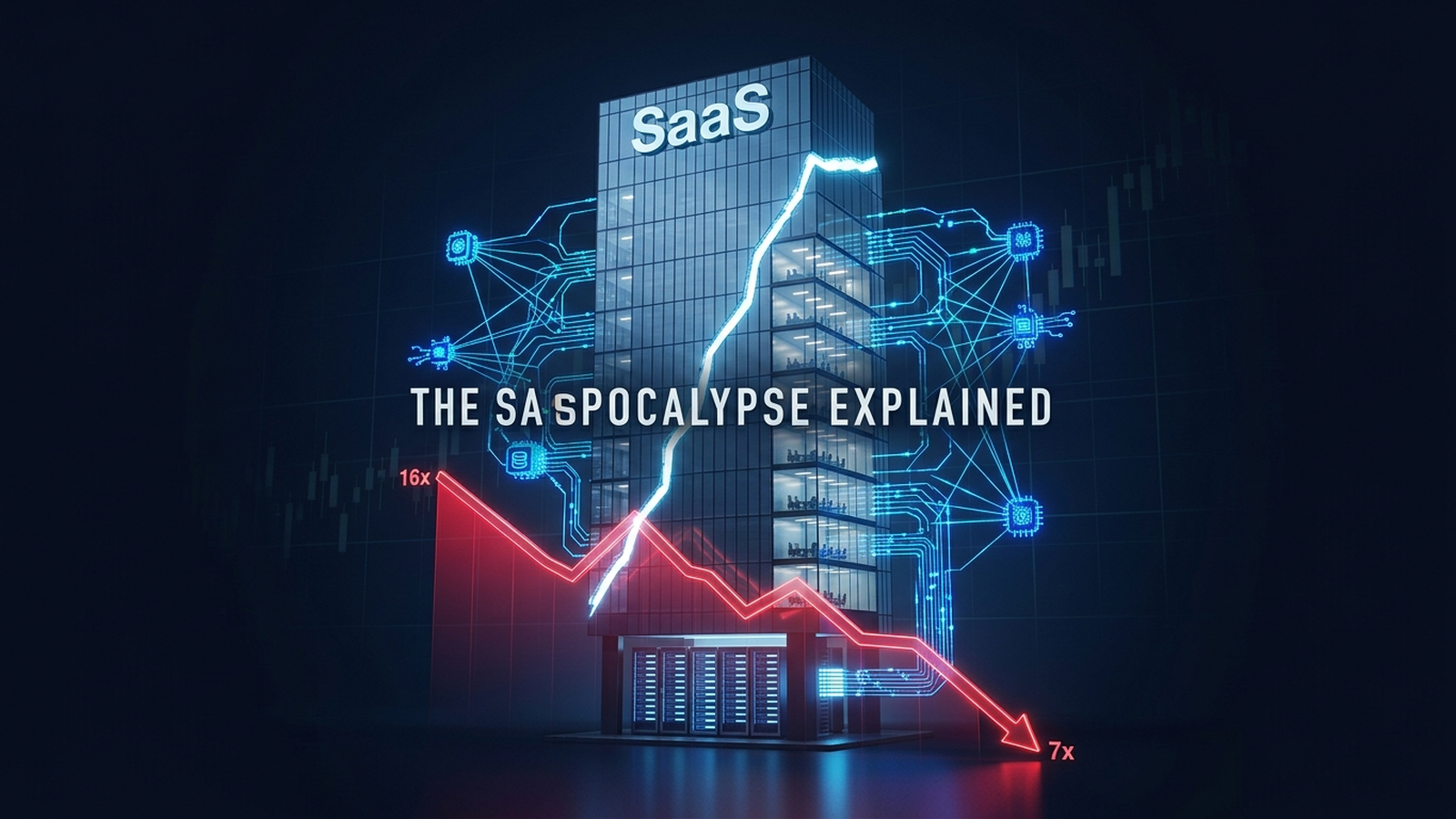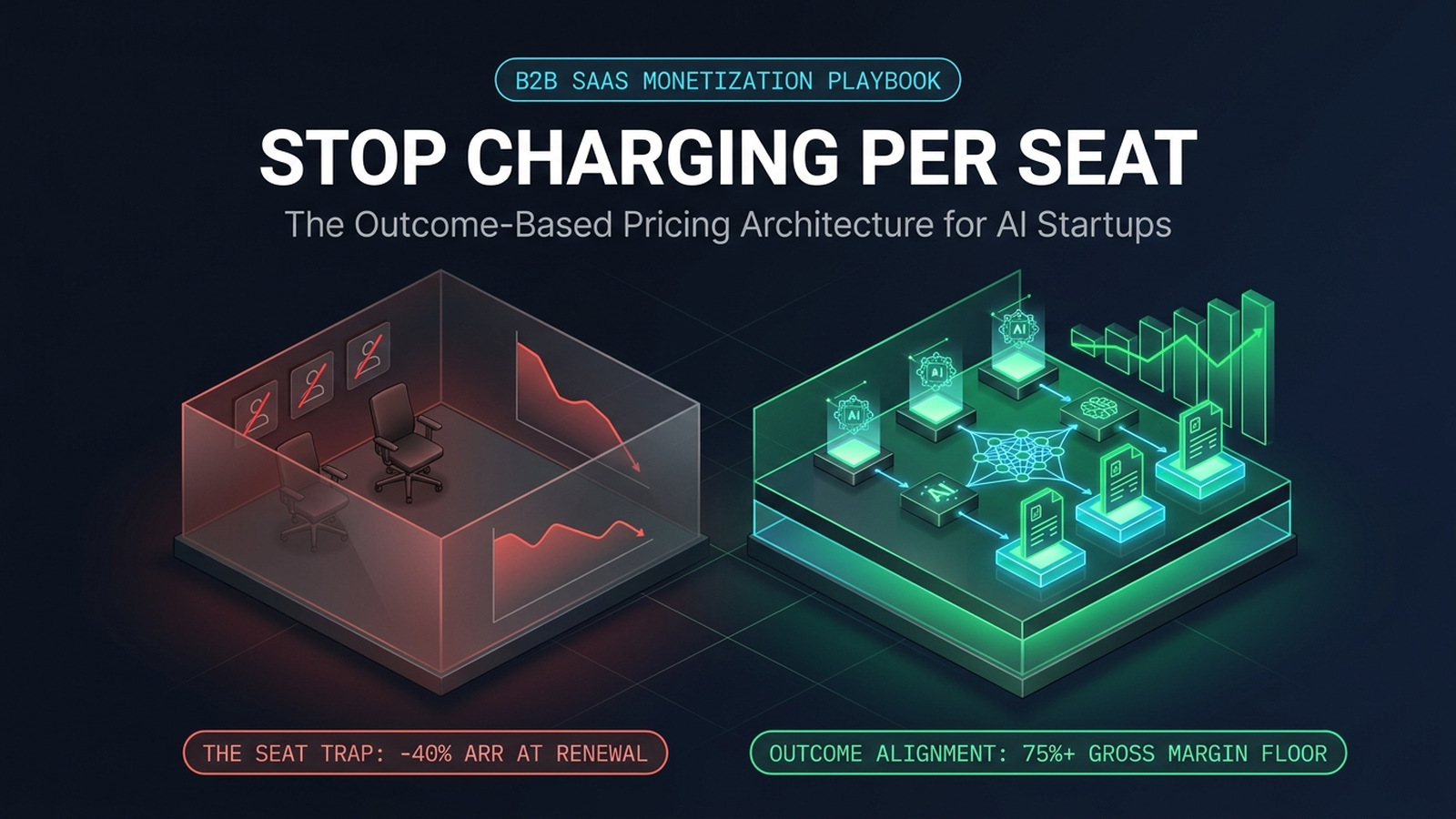
Outcome-based pricing for AI startups is a software monetization model where customers pay exclusively for verified, quantifiable business results, such as resolved support tickets, qualified meetings booked, or reconciliations cleared, rather than seat licenses or raw compute tokens. By tying revenue directly to autonomous work completed rather than human headcount, early-stage AI companies avoid cannibalizing their own revenue as their software eliminates manual labor.
What if the pricing model you copied from Salesforce is actively killing your valuation?
If you run an AI company in 2026, you already know the tension: your software is designed to automate tasks, eliminate manual workflows, and make teams leaner. Yet if you charge $40 per user per month, every productivity breakthrough you deliver reduces the number of seats your customer needs. You work for months to make your agent 50% more autonomous, and your reward at renewal is a 40% contraction in annual recurring revenue (ARR).
The legacy per-seat model was designed for passive software, tools that sat on a desktop waiting for a human to type. Generative AI agents are active digital workers that execute end-to-end jobs. Charging per seat for autonomous work is not just an outdated convention; it is an economic trap that turns your best technical wins into revenue destruction.
This playbook gives founders, product leaders, and finance operators the operational blueprint to transition to outcome-based pricing for AI startups. You will learn how to identify your atomic unit of value, calculate an airtight compute cost-of-goods-sold (COGS) floor, structure hybrid contracts that eliminate revenue volatility, settle attribution disputes with enterprise buyers, and manage the working-capital lag that comes with performance-based billing.
Key Takeaways
The Seat Inversion: Selling per-seat software when your product reduces team headcount creates an inverse relationship between product efficiency and revenue retention.
The Atomic Unit Rule: A defensible outcome metric must be binary, customer-verifiable in an independent audit log, causally attributable to your agent, and price-insulated against multi-step LLM retry costs.
Gross Margin Floor Equation: Never price an outcome without accounting for token failure rates:
Minimum Price = [(Expected Inference COGS) x (1 + Retry Rate)] / (1 - Target Gross Margin).The 3-Tiered Hybrid Model: Transitioning straight from seats to 100% pure outcome pricing causes dangerous cash-flow whiplash; the optimal enterprise structure pairs an upfront Platform Access Base with performance-tiered outcome drawdowns.
Working Capital & ASC 606: Outcome billing in arrears stretches the Cash Conversion Cycle by 45 to 75 days, requiring structured contractual deposits and explicit milestone definitions under FASB ASC 606 rules.
1. Why Per-Seat Pricing Is Dead for AI Startups: The SaaS Metrics Inversion
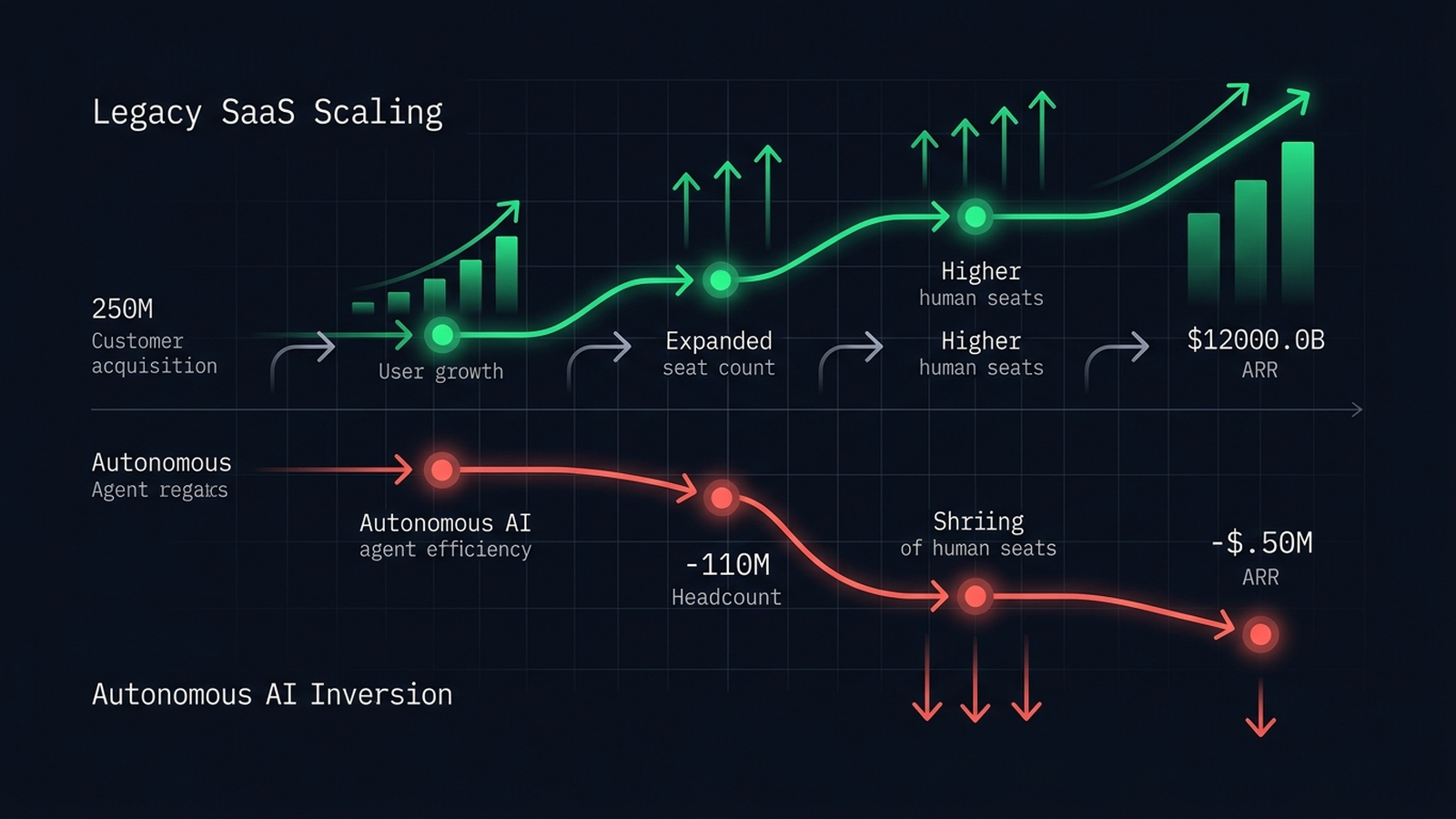
For two decades, B2B SaaS operated on a simple value exchange: vendors charged for access, and customers extracted value through manual labor. If an enterprise wanted to scale its customer support, sales development, or data entry, it hired more representatives and purchased more seats of Zendesk, Salesforce, or Workday. The software vendor's revenue grew in lockstep with the customer's headcount.
Generative AI breaks that correlation completely. Industry consensus among venture operators is clear: per seat pricing is dead for AI agents whose explicit goal is labor replacement.
When software stops acting like a digital typewriter and starts acting like an autonomous employee, the customer's economic objective is to reduce headcount, not expand it. If your AI agent handles 70% of tier-1 customer inquiries without human intervention, your customer does not need 50 support seats anymore, they need 15. If your revenue is tied to seat licenses, your best product deployment just destroyed two-thirds of your contract value.
+-------------------------------------------------------------------------+
|                    THE PER-SEAT AI REVENUE INVERSION                    |
+-------------------------------------------------------------------------+
| Legacy SaaS:                                                            |
| Customer Growth -> More Human Staff -> More Seats Purchased -> ARR Rises|
+-------------------------------------------------------------------------+
| Autonomous AI:                                                          |
| Agent Efficiency -> Fewer Humans Needed -> Seats Canceled -> ARR Drops  |
+-------------------------------------------------------------------------+
The Buyer's Dilemma and the Procurement Revolt
Enterprise chief financial officers (CFOs) and procurement teams have caught on. When an enterprise software buyer evaluates an AI agent that promises to automate contract reviews, they refuse to pay $120 per user per month for a 10-person legal team. Why? Because the software is doing the work of three senior paralegals, yet the vendor is asking for software-seat pocket change.
Conversely, when a vendor attempts to charge an exorbitant $2,000-per-seat fee to capture that value, procurement balks: "Why are we paying $24,000 a year for software that only two administrators log into once a week to review logs?"
Access-based metrics fail to reflect value when the software itself performs the labor.
The Token Trap: Why Raw Consumption Pricing Is Not the Answer
Terrified of the per-seat trap, many early AI startups swung to the opposite extreme: pass-through consumption pricing based on API tokens, compute seconds, or credits.
When comparing token pricing vs outcome pricing, raw compute metering shifts the risk of architectural efficiency onto the vendor, whereas outcome billing captures delivered business value. Pure consumption models introduce three critical flaws:
It passes commodity deflation to your top line: As foundation model providers cut token costs by 60% to 80% year-over-year (documented in Bessemer Venture Partners' AI pricing research), your revenue falls unless customer volume grows fast enough to offset the price drop.
It penalizes your architectural efficiency: If your engineering team optimizes a prompt chain or switches to a distilled model that uses 40% fewer tokens, a token-metered model punishes you with a 40% drop in billable revenue.
Enterprise buyers despise unpredictable invoices: No corporate controller approves a vendor contract where monthly spend fluctuates wildly based on token volume, recursive agent loops, or prompt context lengths.
The solution is neither the user seat nor the raw compute token. The winning path for vertical and horizontal AI companies is outcome-based pricing for AI startups, pricing anchored directly to the completed business deliverable.
Mini-Story: Elena's Customer Support Cannibalization
In October 2024, Elena founded ResolvIQ, an AI customer support agent for mid-market e-commerce brands. Taking cues from standard B2B playbooks, she priced ResolvIQ at $65 per seat per month.
Her first enterprise customer, a direct-to-consumer apparel brand with 40 full-time support agents, signed a $2,600/month contract. Within ninety days, ResolvIQ was autonomously resolving 72% of inbound shipping, return, and order-tracking tickets on the first touch. The customer was ecstatic: they reallocated 25 support reps to other initiatives and eliminated contractor positions.
Then came the renewal meeting.
The client's director of operations delivered the news: "ResolvIQ is incredible. We only have 15 human reps now who handle escalated edge cases. We need to downgrade our account from 40 seats to 15."
Elena's monthly recurring revenue on her best account plunged from $2,600 to $975. Worse, because the AI was now fielding thousands of autonomous conversations every week, Elena's underlying OpenAI inference bill had doubled. She had delivered massive, demonstrable ROI, saved the client over $90,000 in annualized staffing costs, and received an 80% margin squeeze in return. That was the day ResolvIQ dismantled its seat-based tiers and shifted to charging per verified ticket resolution under an outcome-based pricing for AI startups model.
2. Anatomy of an Outcome: Defining the Atomic Unit in AI Pricing Models
When evaluating emerging AI pricing models, the single most common mistake in drafting an outcome based pricing SaaS playbook is choosing a metric that is too broad, subjective, or divorced from your software's direct execution.
An "outcome" cannot be an abstract business result like "a 10% lift in marketing revenue" or "improved employee retention." Those macro metrics depend on dozens of variables your code cannot control, such as the customer's product-market fit, sales team competence, or macroeconomic shifts. If their revenue drops for reasons unrelated to your bot, they will refuse to pay your invoice.
Instead, an outcome must be an atomic unit of work: a discrete, verified task that previously required human labor and can be independently confirmed through code.
+-----------------------------------------------------------------------+
|                  THE 4 PILLARS OF A DEFENSIBLE OUTCOME                |
+-----------------------------------------------------------------------+
| 1. Independently Auditable | Customer can verify success in logs      |
| 2. Causally Attributable   | Directly generated by code, not humans   |
| 3. Margin-Protected        | Contract price > variable inference COGS |
| 4. Friction-Free           | Client does not limit usage to cut bills |
+-----------------------------------------------------------------------+
The Four Criteria of a Defensible Outcome Metric
To prevent billing disputes and maintain predictable revenue in outcome-based pricing for AI startups, test your candidate metric against these four operational criteria:
Independently Auditable: Can the customer verify that the outcome occurred without having to trust your internal database blindly? There must be an immutable log, export, or external event (e.g., an email sent, a database entry updated, an API payload returned).
Causally Attributable: Can the result be definitively credited to your AI agent rather than a human employee stepping in? If your software assists a human who then finishes the job, you have an assisted workflow, not an autonomous outcome.
Margin-Protected: Does the revenue captured from this outcome comfortably exceed the worst-case inference, tool-calling, and retrieval-augmented generation (RAG) cost required to generate it?
Friction-Free (Incentive-Aligned): Does paying for this outcome make the customer want to use the product more? If a customer hesitates to deploy your agent because they fear a surprise bill, your unit is calibrated incorrectly.
Atomic Value Units Across Industry Verticals
Different software categories require different atomic metrics. Notice in the table below how each metric replaces a human time block rather than a seat license:
AI Vertical | Bad Metric (Seat / Token) | Dangerous Metric (Macro Outcome) | Winning Atomic Outcome Metric |
|---|---|---|---|
Customer Service | $49 / agent seat / month | % increase in customer CSAT | $0.85 per verified autonomous resolution (no human touch within 72 hrs) |
Sales Development | $120 / SDR seat / month | $ARR of closed deals | $250 per completed executive discovery meeting held |
Legal / Compliance | $250 / attorney seat / month | Total corporate legal spend reduction | $18 per third-party vendor contract fully redlined & classified |
DevOps / Engineering | $50 / developer seat / month | Velocity points shipped | $15 per autonomous vulnerability patch merged to main |
Accounts Payable | $35 / accountant seat / month | Total cash discount captured | $2.50 per invoice fully extracted, 3-way matched, and synced to ERP |
Want to see how your current pricing covers variable compute? Use our SaaS profit margin calculator to model your inference COGS against gross margin benchmarks.
3. The Unit Economics Math: Protecting Your 75% Gross Margin Floor
In legacy software, the cost of goods sold (COGS) for delivering an extra software license was effectively zero. Hosting a user record in a PostgreSQL database costs fractions of a cent. As a result, SaaS companies enjoyed 80% to 85% gross margins.
In AI applications, inference is a real, variable manufacturing cost—a fundamental shift detailed in a16z's analysis of AI gross margins. Protecting your SaaS gross margin against AI inference variability requires setting rigorous pricing floors before launching autonomous agent tiers.
In outcome-based pricing for AI startups, every autonomous outcome involves an unpredictable web of LLM prompt tokens, output completion tokens, vector database queries, multi-agent evaluation loops, and third-party tool API calls. If an autonomous coding agent attempts to fix a bug, it might resolve the issue on its first attempt using 4,000 tokens ($0.02). Or it might enter a 12-step recursive reasoning loop, execute six unit test suites, read twelve code repositories, fail twice, retry, and burn 300,000 tokens ($1.80).
If you price that outcome at a flat rate of $2.00 without mathematical safeguards, your gross margin on the complex case collapses to 10%. Factor in platform infrastructure, customer success, and cloud hosting, and you are literally paying money for your customer to use your software.
+--------------------------------------------------------------------------+
|                 THE MULTI-AGENT INFERENCE EXPENSE STACK                  |
+--------------------------------------------------------------------------+
| Level 1: System Prompts & Context Retrieval (Input Tokens / Embeddings)  |
| Level 2: Reasoning & Planning Loops (Chain-of-Thought Scratchpads)       |
| Level 3: Tool-Calling Actions (API Integrations, Scraping, Execution)    |
| Level 4: Verification & Reflection Agent (Secondary Guardrail LLM Call)  |
| Level 5: Fallback & Retry Allowance (Edge Cases, Formatting Errors)      |
+--------------------------------------------------------------------------+
The Gross Margin Floor Equation
To guarantee that your AI startup preserves the 75%+ gross margin standard required for venture-scale valuations, you must calculate your pricing floor using this formula:
$$\text{Minimum Outcome Price} = \frac{\left(\text{Base Unit Tokens} \times \text{Cost per Token}\right) + \text{Tool Costs}}{\left(1 - \text{Retry Rate}\right) \times \left(1 - \text{Target Gross Margin}\right)}$$
Where:
Base Unit Tokens: The median input and output tokens consumed in a successful single-pass execution.
Cost per Token: Blended cost based on your model mix (e.g., GPT-4o, Claude 3.5 Sonnet, or fine-tuned Llama instances).
Tool Costs: Third-party API charges (web scrapers, search indices, data enrichment, sandbox runners).
Retry Rate: The empirical percentage of runs that hallucinate, fail validation, or require multi-turn self-correction before completion.
Target Gross Margin: The target financial return (typically 0.75 to 0.80 for high-performing SaaS).
Worked Numeric Example: An AI Compliance Contract Reviewer
Let's walk through the numbers for an enterprise compliance agent that parses vendor Data Protection Agreements (DPAs):
Expected Base Compute:
Context Input: 45,000 tokens @ $3.00 per million tokens = $0.135
Output Analysis: 3,500 tokens @ $15.00 per million tokens = $0.0525
Vector DB Embeddings & RAG Retrieval: $0.015
Document OCR Extraction API: $0.12
Subtotal Direct Base Cost: $0.3225
Failure & Multi-Turn Verification Overhead:
Complex enterprise contracts require a secondary verification agent pass 20% of the time, plus a 10% prompt retry rate when formatting validations fail.
Empirical Retry Rate ($R$): 25% (0.25)
Fully Loaded Expected COGS: $$\text{Expected COGS} = \frac{$0.3225}{1 - 0.25} = \frac{$0.3225}{0.75} = $0.43$$
Pricing for an 80% Gross Margin:
Target Margin: 80% (0.80)
Gross Margin Divisor: $1 - 0.80 = 0.20$ $$\text{Minimum Defensible Price} = \frac{$0.43}{0.20} = $2.15$$
If this compliance startup charges anything less than $2.15 per contract processed, its gross margin will drop below venture thresholds. If human legal contractors charge $35 to review the same DPA manually, the startup can comfortably price the service at $9.50 per contract.
At $9.50, the customer saves 73% compared to human labor, while the AI startup secures an astonishing 95% gross margin on standard runs and maintains an 82% margin even on complex, retry-heavy documents.
For a deeper exploration of avoiding markup mistakes and establishing defensible pricing tiers, read our operational guide on gross margin versus markup.
Mini-Story: David's OCR & Retry Nightmare
David was the CTO of an AI-driven invoice parsing and reconciliation tool called LedgerPulse. When pitching early enterprise customers, David priced his product aggressively at $0.50 per processed invoice.
"Our simple OpenAI API call costs us less than four cents," David told his board. "At fifty cents, our gross margin will exceed 90%."
He was wrong.
When LedgerPulse landed its first Fortune 500 logistics client, the incoming invoices were not clean, digital PDFs. They were crumpled mobile photos of receipts, multi-page international bills of lading with nested tables, and handwritten carbon copies.
To process these documents without errors, LedgerPulse's pipeline had to execute an expensive visual model pass, call an OCR microservice, trigger an LLM-based structured data extraction, validate the line items with code, and rerun the extraction whenever table columns misaligned. On difficult multi-page documents, the system executed up to five retry loops.
Instead of costing $0.04, the average invoice processing cost skyrocketed to $0.41. On 15% of foreign-language manifests, compute costs hit $0.85 per invoice. LedgerPulse was losing 35 cents every time its client uploaded a complex manifest.
David's monthly gross margin dropped to 18%. The company was burning through cash despite "rapid customer acquisition." David had to pause sales, rewrite the pricing model to include a multi-page complexity surcharge, and establish a minimum base price of $1.75 per invoice to restore his company's unit economics.
4. The Hybrid Pricing Model Playbook: How AI Startups Transition Without Revenue Whiplash
One of the most dangerous myths circulating in tech incubators is that AI startups should launch with a 100% pure outcome-based pricing model on day one.
Going "100% pure outcome" too early creates severe operational vulnerabilities:
Revenue Whiplash: If your enterprise client enters a seasonal lull (e.g., e-commerce in late January), your software revenue falls off a cliff even though your fixed engineering salaries remain unchanged.
Enterprise Budgeting Gridlock: Corporate procurement departments are legally bound by purchase orders with fixed dollar caps. If you tell a Fortune 500 buyer, "Just connect your API and we'll see what the bill is at the end of the quarter," their procurement software will reject the vendor application.
Underwriting Risk: You take on all the operational risk. If the customer's data pipeline breaks and your agent sits idle for three weeks, you collect zero revenue.
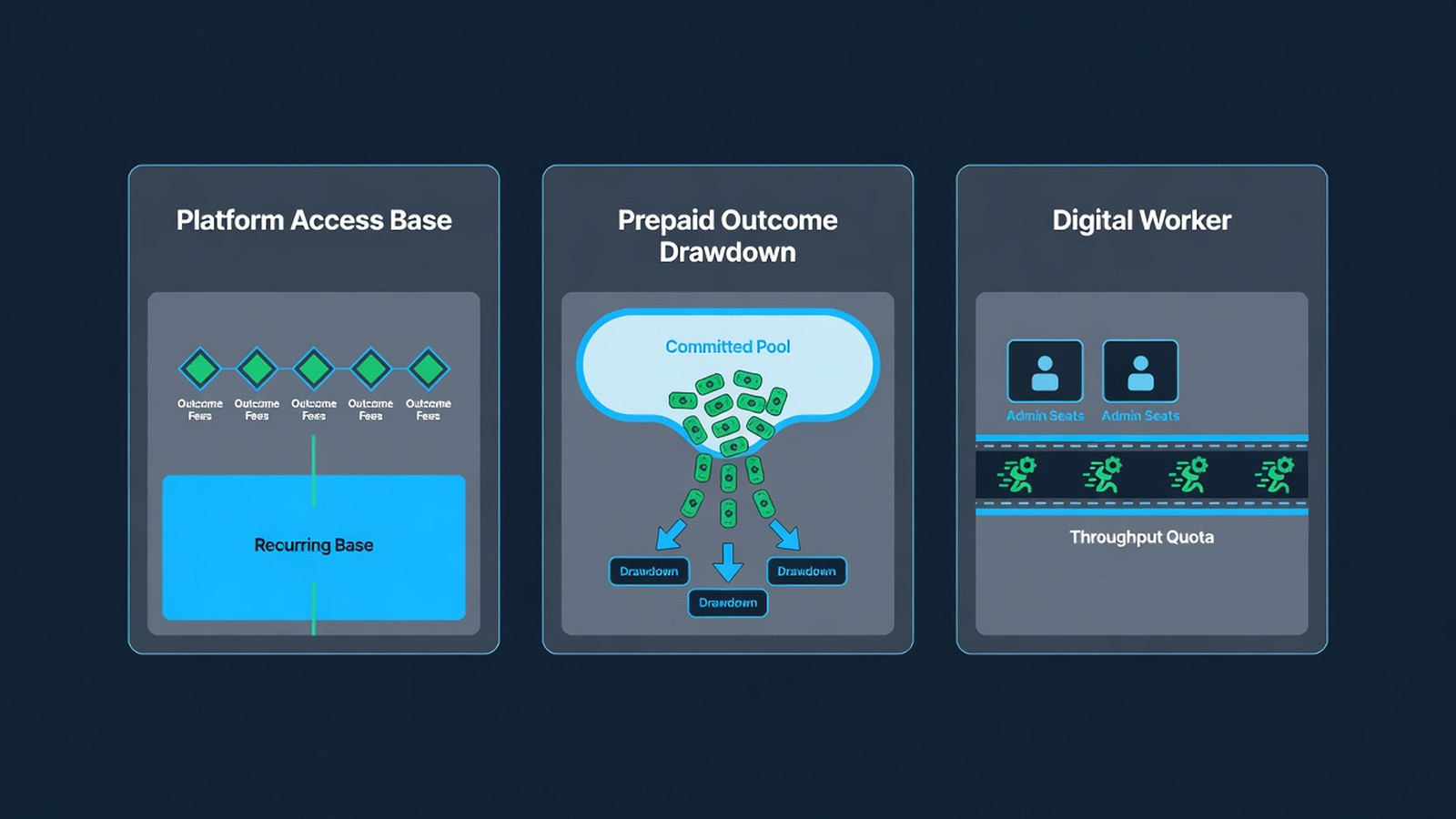
The proven strategy is to implement a hybrid pricing model for B2B SaaS. This model combines recurring base revenue with performance-aligned outcome tiers, providing a stable bridge to full outcome-based pricing for AI startups.
+--------------------------------------------------------------------------+
|                    THE 3 HYBRID PRICING ARCHITECTURES                    |
+--------------------------------------------------------------------------+
| Model A: Platform Base + Discounted Usage (Intercom Style)               |
| [Fixed Monthly Platform Fee] + [Per-Outcome Fee Above Baseline]          |
|                                                                          |
| Model B: Prepaid Outcome Drawdown (Snowflake Style)                      |
| [Annual Committed Contract Value] -> [Drawn Down via Monthly Outcomes]   |
|                                                                          |
| Model C: The "Digital Worker" Seat License                              |
| [Base Seat for Human Admins] + [Outcome Capacity Blocks per Bot]         |
+--------------------------------------------------------------------------+
Model A: Platform Access Base + Variable Outcome Surcharges (The Intercom Architecture)
In this framework (pioneered in Intercom's Fin architecture), the customer pays a non-negotiable monthly or annual platform fee to access the system, integrations, analytics dashboard, and security compliance infrastructure. Every successful outcome generated by the AI agent is billed on top as a metered performance charge.
Platform Base: $1,500 / month (includes infrastructure, SOC2 compliance, CRM integrations, and 500 included outcomes).
Variable Outcome Tier:
Outcomes 501 - 2,500: $1.20 per outcome
Outcomes 2,501 - 10,000: $0.95 per outcome
Outcomes 10,001+: $0.75 per outcome
This structure provides your startup with an ARR revenue floor to cover core operating overhead while preserving uncapped expansion upside as the customer scales usage.
Model B: The Prepaid Outcome Credit Drawdown (The Enterprise Contract Architecture)
For mid-market and enterprise deals with 6- to 12-month sales cycles, procurement requires a fixed budget line item. You cannot bill their corporate credit card in arrears.
Instead, package outcomes into a Prepaid Annual Drawdown:
The enterprise commits to an annual contract of $60,000.
That capital is converted into 60,000 "Outcome Credits" banked in their account.
As the AI agent resolves tickets, redlines contracts, or processes invoices, credits are deducted from the balance based on task complexity.
The "Use It or Lose It" Anchor: Unused credits expire at month 12 unless renewed into a larger tier. If the customer burns through their credit pool in month 8, an automatic overage refill kicks in at a higher per-unit price.
This structure allows the buyer's procurement team to approve a fixed, predictable Purchase Order, while your finance team books cash upfront to protect liquidity.
Model C: Human Management Seats + "Digital Worker" Quotas
If an enterprise customer refuses to abandon the per-seat concept entirely, meet them where they are by introducing the concept of the Digital Worker License:
Human administrator seats remain priced at a modest rate ($30/user/month) for monitoring, auditing, and configuring rules.
The AI agent itself is billed as an FTE equivalent: e.g., $1,200 per month for an "Autonomous AP Agent" that carries a contractual throughput quota of 1,000 processed invoices per month.
Excess outcomes beyond the quota are metered at a premium overage fee.
Before rolling out an outcome metric to enterprise buyers, model the payback period and cash impact with our SaaS ROI calculator to see how a hybrid platform fee stabilizes gross margin across different customer utilization tiers.
5. Overcoming Attribution Disputes in Outcome-Based Pricing for AI Startups
The moment an AI startup issues an invoice for 5,000 "resolved tickets" or 40 "qualified sales meetings," the customer's immediate instinct is skepticism: "Did your AI actually resolve that ticket, or did the customer just get frustrated and hang up? Did that meeting show up, or was it a spam lead?"
Attribution friction is the primary reason enterprise deals stall in outcome-based pricing for AI startups. If you do not build contractual and technical dispute mechanisms directly into your application, your billing team will spend every month-end locked in forensic accounting battles with customer success leads.
+--------------------------------------------------------------------------+
|                 THE 14-DAY ATTRIBUTION AUDIT LIFECYCLE                   |
+--------------------------------------------------------------------------+
| Day 0: Outcome Executed -> Timestamped Event Logged in Customer Portal   |
| Day 1 - 14: Verification Window -> Client Flags False Positives / Errors |
| Day 15: Automated Settlement -> Outcome Becomes Immutable Invoice Item   |
| Day 30: Monthly Billing Clears -> Payment Processed via Net-Terms / ACH  |
+--------------------------------------------------------------------------+
The 14-Day Audit and Mutual Verification Protocol
Never bill an outcome on the day it occurs. You must establish a standard Contractual Verification Window (typically 7 to 14 days):
The Event Log: When the AI completes an outcome, it records an immutable event log accessible via the customer dashboard. The log contains the conversation transcript, the specific action taken, the API response from the external system, and the confidence score.
The Passive Challenge Window: The customer has 14 days to flag an outcome as invalid (e.g., an inquiry marked "resolved" where the human customer emailed back within 48 hours saying "This didn't fix my problem").
Automated De-Duplication: If an issue reopens within your designated cooldown window, the billing system automatically voids the initial charge without requiring manual human negotiation.
The Settlement Gate: Once day 14 passes without a dispute flag, the event becomes an immutable, billable item.
The "Exception Cost" SLA
What happens when your AI fails and a human customer support representative or engineer has to intervene?
Your master services agreement (MSA) must explicitly define what constitutes a billable outcome versus an unbillable escalation. If your AI handles 80% of a task but requires human intervention to click "confirm," you cannot bill it as a fully autonomous outcome. Doing so breaks customer trust.
Sample Contract Language: Defining a Successful Outcome
Incorporate precise definitions into your Order Forms to avoid enterprise legal stalls:
Section 4.2: Definition of Billable Outcome (Autonomous Resolution). "A 'Billable Resolution' shall be deemed to have occurred if and only if: (a) Provider's AI software delivers an end-to-end response to an end-user communication via an approved communication channel; (b) the software executes all necessary back-end workflow operations without human intervention; and (c) the end-user does not submit an additional communication regarding the same ticket reference ID within seventy-two (72) hours of delivery. Any communication requiring manual re-routing or intervention by Customer's human personnel prior to terminal status shall be classified as an 'Assisted Event' and shall not be subject to outcome billing."
Mini-Story: Marcus and the $9,000 Lead Dispute
Marcus was the founder of RevAgent, an autonomous AI sales development representative that booked sales meetings for cybersecurity firms. RevAgent's pricing was simple: $500 per completed discovery meeting.
In November 2025, RevAgent had a banner month for an enterprise client, scheduling 18 executive meetings. On December 1, Marcus sent an invoice for $9,000 with net-30 terms.
On January 5, thirty-five days later, the client's VP of Sales refused to approve the invoice:
"Four of these prospects were junior security analysts with no purchasing budget."
"Two of them never showed up to the Zoom call."
"One was an existing vendor testing our form."
The client offered to pay for only 11 meetings ($5,500) and demanded that Marcus credit the rest. Because Marcus had already paid thousands of dollars in LinkedIn scraping fees, email verification tool costs, and Anthropic API inference bills to generate those leads, the dispute wiped out his entire cash profit for the quarter.
Marcus had to wait 82 days from the time the work was performed to collect a compromised check. That painful lesson forced him to rewrite his terms: RevAgent introduced a strict definition of a "Qualified Meeting" (director-level title verified on LinkedIn, attendee presence logged in Zoom for >15 minutes), instituted a real-time 5-day dispute dashboard, and required all clients to maintain an upfront $5,000 credit deposit.
6. Financial Operations: Cash Flow, Working Capital, and ASC 606
Shifting to an outcome based pricing SaaS playbook transforms your finance function from standard software subscription mechanics into something closer to financial operations and transaction clearing.
In traditional SaaS, billing is simple: the customer pays you $12,000 on January 1st for the year ahead. You collect the cash immediately on day zero. Your Cash Conversion Cycle is negative, providing you with customer-funded working capital to hire engineers and scale infrastructure.
In pure outcome-based pricing for AI startups, you deliver the work first, verify it second, and bill in arrears third.
+--------------------------------------------------------------------------+
|                   THE OUTCOME-BASED WORKING CAPITAL LAG                  |
+--------------------------------------------------------------------------+
| Day 1 - 30: AI executes tasks (You pay OpenAI / AWS hosting daily)       |
| Day 31: Billing cycle closes; usage logs compiled                        |
| Day 31 - 45: 14-day client dispute / audit window                        |
| Day 45: Invoice issued with Net-30 enterprise payment terms              |
| Day 75: Customer accounts payable clears invoice                         |
+--------------------------------------------------------------------------+
| RESULT: A 75-day cash deficit where you fund variable compute upfront!   |
+--------------------------------------------------------------------------+
If you do not model this working capital gap, a sudden 300% surge in customer usage can drain your startup's bank account simply from floating the underlying model inference bills.
Bridging the Cash Conversion Gap
To prevent an operational cash squeeze, execute these three liquidity guardrails:
Pre-Funded Wallets (The Prepaid Float): Require all accounts on performance billing to link an automated payment method and deposit an initial float (e.g., equivalent to their anticipated 30-day volume). When their balance dips below 25%, an automatic credit card reload triggers.
Weekly True-Up Thresholds: Do not wait for month-end to invoice fast-growing accounts. Establish a contractual threshold (e.g., $2,500). The moment an account accumulates $2,500 in unbilled outcomes, an intermediate invoice generates immediately.
Structured Working Capital Models: Treat your variable compute costs as direct accounts receivable financing. Review your liquidity requirements using our guide to working-capital planning.
Revenue Recognition Under ASC 606
Under US GAAP and International Financial Reporting Standards (FASB ASC 606 / IFRS 15), you cannot recognize revenue simply because you charged a customer's credit card or sent an invoice. Modern metering architectures (such as Stripe's billing architecture) address this by aligning billing events with completed performance obligations.
Revenue recognition requires a structured five-step framework:
Identify the contract with the customer.
Identify the performance obligations in the contract.
Determine the transaction price.
Allocate the transaction price to the performance obligations.
Recognize revenue when (or as) the entity satisfies a performance obligation.
Under outcome-based contracts, every discrete outcome represents a distinct performance obligation.
If a customer purchases a $24,000 annual bucket of outcome credits, that $24,000 sits on your balance sheet as deferred revenue (a liability). You can only move capital from deferred revenue into recognized subscription revenue as the individual outcomes are verified and pass through their audit reconciliation windows.
If your contract includes a "use-it-or-lose-it" expiration clause, work closely with a CPA to model "breakage revenue", the statistical percentage of prepaid credits that customers never consume, which must be recognized proportionally over the contract term rather than dumped into your P&L on the final day.
When managing variable invoice terms, calculate baseline operational viability using our profit margin calculator.
7. How to Implement Outcome-Based Pricing for AI Startups: The 5-Step Framework
Transitioning your live product from seat-based pricing to outcome-based pricing for AI startups does not require an overnight rewrite of your existing contracts. Follow this step-by-step rollout framework to migrate accounts smoothly while minimizing churn.
+-----------------------------------------------------------------------+
|                   THE 5-STEP IMPLEMENTATION ROADMAP                   |
+-----------------------------------------------------------------------+
| Step 1: Shadow-Meter Current Accounts (Track compute vs. outcomes)    |
| Step 2: Calculate the Breakeven Threshold (Model the COGS floor)      |
| Step 3: Launch the "Grandfathered Hybrid" to 5 Alpha Customers        |
| Step 4: Build the Self-Service Dispute Dashboard                      |
| Step 5: Update the Public Pricing Page and Deprecate Pure Seats       |
+-----------------------------------------------------------------------+
Step 1: Shadow-Meter Your Existing User Base
Before altering a single public pricing tier, deploy internal telemetry to measure your unit economics. For every active customer account, track:
How many human seats log in each week.
Total input, output, and tool-call tokens consumed.
The exact number of atomic tasks (resolutions, extractions, meetings) completed.
The effective price-per-outcome they are currently paying under their seat plan.
You will likely discover that 20% of your customer base consumes 80% of your inference costs while paying standard seat rates, while another 30% of accounts barely use the product but pay you full price. Shadow-metering reveals who you are under-charging and who you are over-charging.
Step 2: Establish Your Break-Even Pricing Threshold
Using the Gross Margin Floor Equation from Section 3, establish the absolute minimum price per outcome for each customer tier. Check your models against realistic industry utilization metrics. For service-oriented or human-in-the-loop software models, compare your economics with our benchmark guide to break-even analysis.
Step 3: Run a Closed Alpha with 5 Churn-Risk Customers
Never test a radical pricing overhaul on your happiest, most profitable enterprise accounts.
Instead, identify five accounts that are threatening to churn because "they don't have enough users logging in" or "the seat license feels too expensive for their small team." Approach their leadership with a custom proposition:
"We are testing a new partnership tier. We will waive your seat license entirely. You only pay us a $500 monthly platform fee plus $1.50 per verified resolution. If our software doesn't resolve issues, your bill drops to almost nothing. If it does, you only pay for direct work."
This framing transforms a churn conversation into an aligned partnership. It also allows you to field-test your audit logs, verification windows, and invoicing mechanics on real-world edge cases before a company-wide rollout.
Step 4: Build Customer-Facing Audit Dashboards
Outcome pricing requires transparency. Before billing performance metrics, build a dedicated customer dashboard that displays:
Real-time tally of completed outcomes this billing cycle.
A live feed of recent task executions with one-click transcript reviews.
A prominent button to challenge an outcome within the 14-day window.
Projected invoice totals for the current period to eliminate end-of-month bill shock.
Step 5: Update Master Services Agreements and Deprecate Seats
Once your alpha accounts demonstrate healthy gross margins (>75%) and positive net revenue retention, formalize the structure across your sales organization:
Train account executives to sell outcomes rather than seats. Emphasize that your software eliminates the need to budget for new full-time employee headcount.
Implement Model A (Platform Base + Outcomes) or Model B (Prepaid Outcome Drawdown) across all standard contract templates.
Grandfather existing seat-based clients on their legacy plans for 12 months, but establish clear usage caps that require migrating to the outcome model once their deployment volume expands.
For a visual breakdown of real-world monetization pivots, watch Outcome-Based Pricing Models in B2B SaaS and AI.
8. Outcome-Based Pricing for AI Startups: Frequently Asked Questions (FAQ)
What is outcome-based pricing in AI?
Outcome-based pricing is a software monetization model where customers pay for verified, delivered business results, such as a resolved customer support ticket, a qualified sales meeting, or an audited financial record, rather than paying for user seat licenses or raw compute infrastructure (tokens). It aligns the vendor's software revenue directly with the business value delivered to the client.
How does outcome-based pricing differ from usage-based pricing?
Usage-based pricing charges for input consumption or activity, such as API calls, compute hours, data storage, or raw LLM tokens, regardless of whether that activity produced a valuable result for the customer. Outcome-based pricing charges exclusively for terminal business achievements. If an AI agent attempts to debug code and fails, usage-based pricing still charges for the tokens burned, whereas outcome-based pricing charges zero.
What happens if an AI agent hallucinates or makes a mistake during an outcome?
Under professional outcome-based contracts, failed outcomes are governed by a contractual verification window (typically 7 to 14 days). If an agent hallucinates, returns malformed data, or fails to complete the task autonomously, the customer flags the event in their audit dashboard, and the charge is automatically credited or removed from the billing run.
Why shouldn't early-stage AI startups use 100% pure outcome pricing?
Pure outcome pricing without a base platform fee introduces extreme revenue volatility, creates cash-flow deficits when customers enter seasonal slowdowns, and complicates sales cycles with enterprise procurement teams who require predictable, capped purchase orders. Early-stage startups should deploy a hybrid model combining a recurring platform access fee with outcome-based tiers.
How do you track outcomes without violating enterprise data privacy?
Outcome tracking does not require storing sensitive customer payload data indefinitely. The platform records cryptographic event hashes, task metadata (timestamps, token volume, status codes), and anonymized execution IDs. Customers can verify transactions using zero-knowledge proofs or local telemetry integrations connected directly to their own data warehouse or CRM.
How do I maintain an 80% SaaS gross margin with fluctuating LLM token costs?
You maintain gross margins by establishing a mathematical pricing floor that accounts for median prompt lengths, model token pricing, external tool API fees, and an empirical failure/retry multiplier. Never set an outcome price based solely on a single "happy path" LLM prompt pass.
Conclusion: Stop Selling Software, Start Selling Autonomous Work
The era of charging $50 a month for passive software interfaces is ending. As artificial intelligence evolves from supportive autocomplete features into fully autonomous agents, the value of your startup is no longer determined by how many humans stare at your user interface. It is determined by the volume, quality, and reliability of the work your software executes.
Sticking with the per-seat model puts your startup on a collision course with its own customers: every technical optimization you ship will reduce your contract sizes, every efficiency breakthrough will spark seat downgrades, and every enterprise renewal will feel like an uphill battle.
By embracing outcome-based pricing for AI startups, you unlock the true economics of the AI era:
You align your revenue directly with the measurable value you create.
You participate in the unlimited upside of your customers' operational scale.
You build a defensible, margin-protected business model that enterprise buyers understand and champion.
Audit your current product telemetry today. Identify your atomic unit of value, calculate your true compute COGS floor, and stop penalizing your business for building software that actually works.
Build Your SaaS Financial Model with ToolsToFind Run multi-variable scenarios, benchmark your gross margins against high-performing software companies, and model your pricing transition with our dedicated suite of founder-built tools, completely free to start.